Form 1120 is the annual C corporation income tax return. It reports income, deductions, credits and tax. It isn't a payment slip, and the retired Form 1120-W estimated-tax worksheet isn't one either. This guide covers what to do instead: confirm your form, calculate the balance, pick a payment method, meet the deadline and keep proof.
Key Takeaways
- Form 1120 files the return; Forms 2220, 7004 and the historical 1120-W each do something different.
- No current Form 1120-V appears in the IRS's Form 1120 materials, so don't build your process around one.
- Business Direct Pay accepts Form 1120 balance-due payments online, free of charge.
- Form 7004 extends the time to file, never the time to pay.
- Check live IRS pages for the tax period, payment type and address before paying.
What Is IRS Form 1120-V and Who Uses It?
Where the voucher fits today
A payment voucher exists to tell the IRS which taxpayer and period a paper check belongs to. That is the only job a voucher would do. The return itself reports the tax, and the payment settles it.
The IRS's current Form 1120 page identifies no corporate voucher. Whether a form-specific Form 1120-V instruction exists (optional or mandatory, with checks or without) is unclear, so treat any template you find online with suspicion and confirm details on IRS.gov. If you still want to pay by paper, the IRS's general pay by check guidance applies instead.
Form 1120 versus related forms
| Form | What it does |
|---|---|
| 1120 | Annual U.S. corporation income tax return |
| 1120-W | Estimated-tax worksheet for corporations, now historical, last revised 2022 |
| 2220 | Works out whether an estimated-tax underpayment penalty applies |
| 7004 | Requests an automatic extension, generally six months, to file |
Track estimated payments made during the year separately from the final balance due with the return. They land on different lines of Schedule J.
When a different return applies
Don't assume Form 1120 covers you. S corporations file Form 1120-S, foreign corporations file Form 1120-F, and partnerships file Form 1065. Confirm your tax classification, tax year and filing obligation against the current Form 1120 instructions, or ask a qualified tax professional.
How to Complete the Payment Details for Form 1120
When you pay Form 1120 tax, the priority is getting your identifying details right wherever the payment is made.
Gather the information first
- Exact legal name as registered with the IRS
- Employer Identification Number (EIN)
- Mailing address on file
- Tax period (year-end date)
- Balance due from the finished Form 1120
- A copy of the completed return
Get the name and EIN exactly right
The IRS matches payments and returns on name and EIN. For e-filed corporate returns, a mismatch between the EIN and name control in the return header causes a rejection. Business Direct Pay also verifies the name and EIN on file.
A typo or outdated address can leave a payment unapplied and trigger avoidable notices. If a payment goes missing, the IRS traces it using bank evidence such as cancelled-check images, statements and EFTPS confirmation numbers.
Verify the amount
Reconcile before paying. Total tax comes from Schedule J. Subtract estimated payments, any tax deposited with Form 7004 and credits. The remainder is the amount owed on page 1 of the return.

Line numbers in the 2026 draft form aren't final, so confirm them on the final form before you pay.
If you pay by check
- Make it payable to "U.S. Treasury" and state dollars and cents
- Write your name, address, phone number, EIN, form (1120) and tax year on it
- Don't staple or paper-clip it to the return
- Never mail cash
Corporate federal tax deposits must go by electronic funds transfer, so a check isn't an option for those.
Final checklist
- Legal name and EIN match IRS records
- Tax period is correct
- Amount equals the finalised balance due
- Payment method suits the payment type
- Mailing address matches current IRS records
How to File Form 1120 and Pay the Balance Due
Filing and paying are separate acts. Corporations filing 10 or more returns of any type in a calendar year must e-file Form 1120, subject to relief. Payment follows its own channels.
Choose a payment method
| Method | Notes |
|---|---|
| Business Direct Pay | Free, no sign-in, covers Form 1120 balance due |
| EFTPS | Enrolment required; schedule by 8 p.m. ET the day before the due date |
| Electronic funds withdrawal | Available while e-filing the return |
| Same-day wire | Ask your bank about cut-off times |
| Card | Confirm Form 1120 eligibility and any card fees on the IRS payment pages |
| Paper check | Follow general IRS check rules; confirm the address first |
EFTPS enrolment can take up to 5 business days, with a mailed PIN taking 5 to 7. Enrol well before a deadline.
Pay online
The IRS confirms Direct Pay for Business accepts Form 1120 payments, including balance due, estimated tax and extension payments. In practice:
- Choose the business payment option
- Select the Form 1120 payment type matching your reason (balance due versus estimate)
- Enter the tax period, normally the year-end, after checking it against the return
- Enter the amount and settlement date
- Save the confirmation

Screen labels change, so follow the live prompts.
If you pay by mail
Don't reuse the return-filing address without checking. The IRS publishes Form 1120 return addresses, which vary by state, asset size and Schedule M-3. Those are return addresses, not verified payment addresses. Use the address on your notice or the current instructions.
Under IRC section 7502, a qualifying U.S. postmark can establish timely payment. Use a mailing method with proof of date, or an IRS-designated private delivery service, and keep copies of everything.
If you can't pay in full
File on time and pay what you can. Late filing costs more than late paying. For payment arrangements, businesses call the number on the notice, 800-829-4933, or visit a Taxpayer Assistance Center.
The IRS says businesses owing $50,000 or less may qualify for a Simple Payment Plan, and Form 433-B may be requested. Interest and some penalties keep running until the balance is paid.
Where VJM Global fits
Many Australian-owned businesses with a U.S. corporation find the paperwork unfamiliar. VJM Global helps international businesses coordinate corporate tax preparation, payment documentation, bookkeeping records and compliance deadlines, with cross-border support. It can't guarantee any IRS outcome.
Deadlines, Extensions, Penalties, and Record Keeping
Know the due date
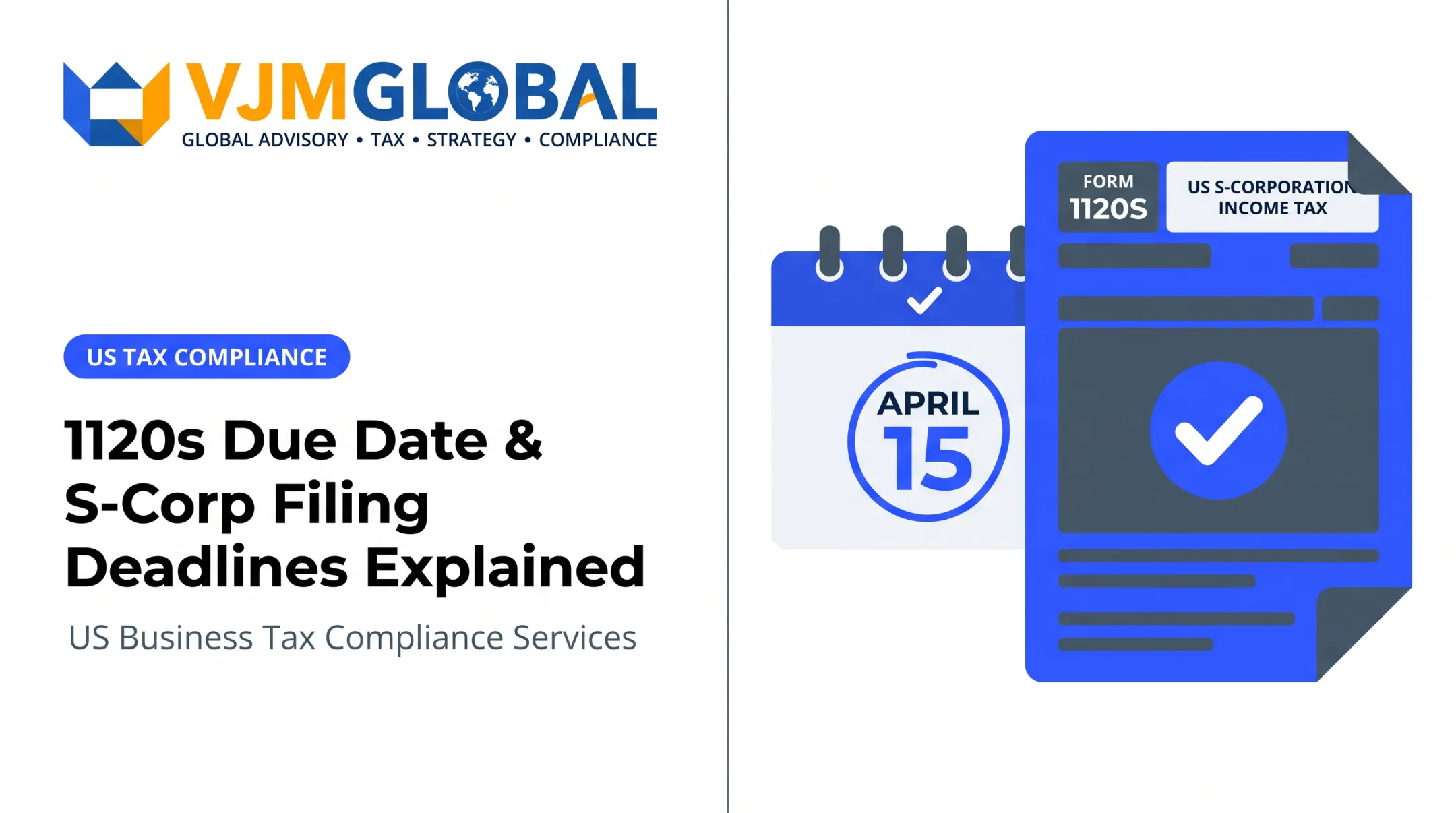
Calendar-year corporations file Form 1120 and pay by April 15 of the following year. Fiscal-year corporations generally use the 15th day of the fourth month after year-end.
If the date lands on a weekend or legal holiday, it moves to the next business day. June 30 year-ends have special transition rules, so confirm with the current IRS tax calendar.
Form 7004 gives time to file, not to pay
Form 7004 generally buys six extra months to file. The Form 7004 instructions are explicit: it does not extend the time to pay. Estimate your tax on line 6, subtract payments on line 7, and pay the line 8 balance by the original deadline.

Penalties to expect
- Failure to file: 5% of unpaid tax per month or partial month, capped at 25%
- Minimum late-filing penalty: for returns required in 2026, more than 60 days late, the lesser of $525 or 100% of the tax
- Failure to pay: generally 0.5% per month, capped at 25%
- Interest: compounds daily, and rates are set quarterly
- Estimated-tax underpayment: calculated on Form 2220 (no addition if tax shown is under $500)
Relief is available in limited cases:
- Reasonable cause is assessed case by case; lack of funds alone is not enough
- First-Time Abatement may apply to qualifying businesses for eligible filing and payment penalties
- Automatic penalty exemption for the Form 1120 series starts with 2025 returns, subject to eligibility
Keep a complete record
Retain these for at least three years, and six if you omitted more than 25% of gross income:
- The filed return and any extension paperwork
- Electronic confirmation or cancelled check
- Bank statements showing the payment date
- IRS correspondence
A simple ledger listing payment date, amount, tax period and confirmation number makes reconciling with your IRS account far easier.
Conclusion
The sequence is straightforward: confirm the entity and form, calculate the final balance, pay by a verified method rather than a template voucher, meet the original deadline, and file away the confirmation.
If your corporation or international business needs help with Form 1120 compliance, payment coordination or supporting accounting records, VJM Global can provide tailored support. Contact [email protected] or +91 98915 76441.
Frequently Asked Questions
What is Form 1120-V used for?
Current IRS Form 1120 materials do not list a Form 1120-V. Corporations should follow the Form 1120 instructions and IRS payment pages for how to pay any balance due.
Is Form 1120-V required if I pay electronically?
No voucher requirement applies to Direct Pay, which accepts Form 1120 balance-due payments directly. Follow the prompts of whichever system you use, such as EFTPS or Direct Pay.
Can I use Form 1120-V to pay estimated corporate taxes?
Estimated instalments are separate from the balance due, and Form 1120-W is historical. Pay estimates electronically and calculate any underpayment penalties on Form 2220.
How do I pay the balance due on Form 1120?
Use Business Direct Pay, EFTPS, electronic funds withdrawal with your e-filed return, or a same-day wire. Select the correct payment type and tax period. For checks, follow IRS check guidance.
Does Form 7004 extend the deadline to pay?
No. It extends only the time to file. Estimate your tax and pay it by the original due date to limit penalties and interest.
What should I do if my corporation cannot pay the full amount?
File on time and pay what you can. Then call 800-829-4933 or the number on your notice about payment arrangements, and get professional advice on penalties and interest.