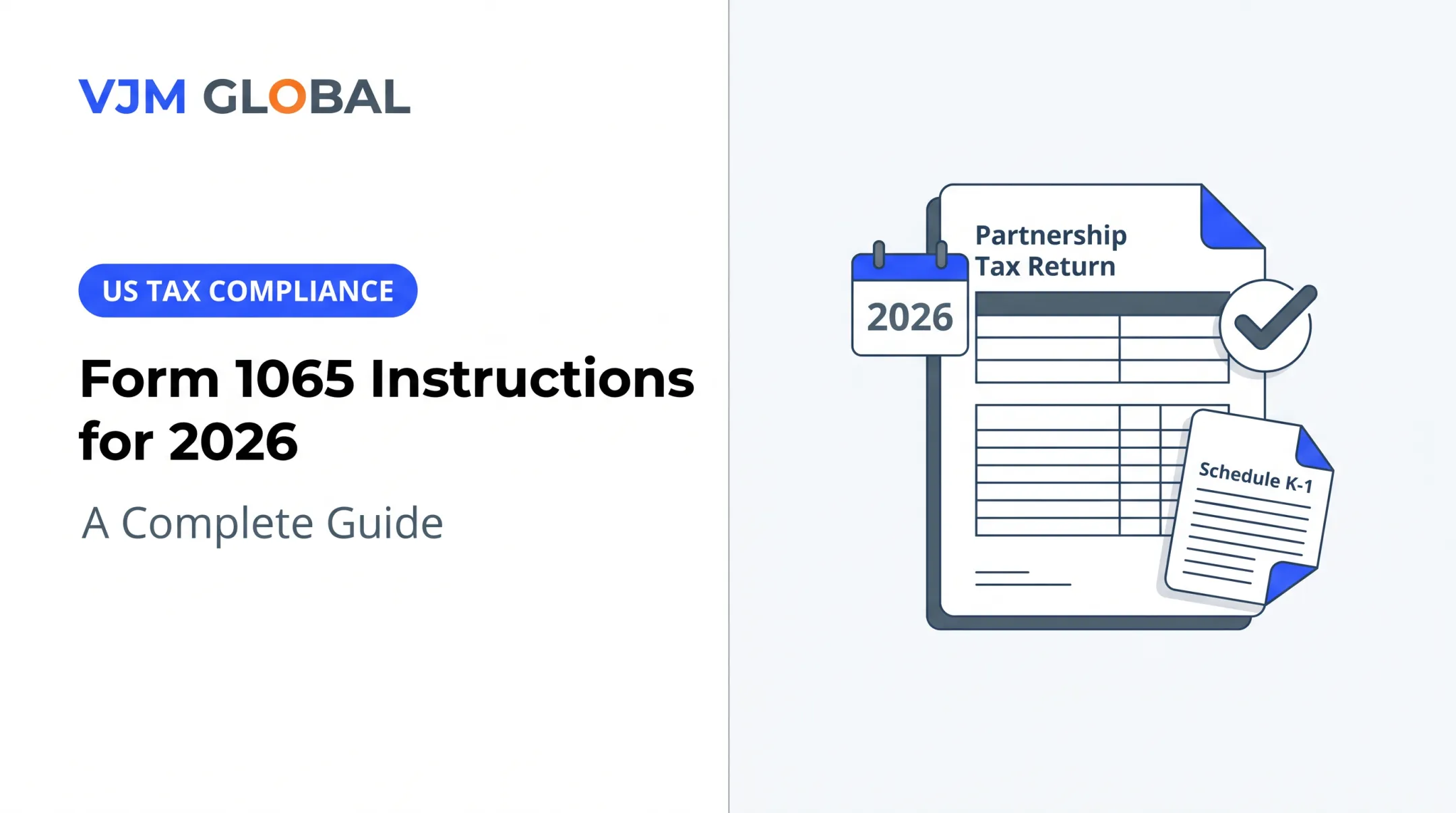
"For 2026" can mean two different things. A partnership return for the 2025 tax year is filed during 2026 on the 2025 form. A return for a year ending in 2026 depends on when the year began. The IRS has only posted a draft 2026 form, marked "DRAFT - DO NOT FILE".
This guide covers who files, what records you need, how Schedule K-1 works, deadlines, e-filing, penalties, and the extra checks Australian-based owners should run.
Key Takeaways
- Partnerships and multi-member LLCs taxed as partnerships generally file Form 1065.
- Confirm the tax year, due dates and penalty amounts against current IRS instructions.
- Page 1, Schedule K, capital accounts and every K-1 must reconcile.
- Australian owners need separate checks on US classification, treaty position and withholding.
What Is Form 1065 and Who Must File It?
Purpose and pass-through treatment
Form 1065 is the U.S. Return of Partnership Income. It is an information return, not a tax payment vehicle. Ordinary income, separately stated items, deductions, gains, losses and credits flow to partners according to the partnership agreement.
Partners owe tax on allocated income whether or not cash was distributed. A partner can face a tax bill with no cash in hand.
Entities commonly required to file
- Domestic general partnerships, limited partnerships and limited liability partnerships
- Domestic multi-member LLCs, which default to partnership treatment unless they elect otherwise
- Foreign partnerships with effectively connected income or US-source income, subject to exceptions
One exception for foreign partnerships applies where US-source income is $20,000 or less, there is no effectively connected income, and less than 1% of each item is allocable to direct US partners. Test each exception separately. Australian ownership alone does not decide the classification.
Situations that may use another return
The legal name of an entity does not set its federal return. Check the tax classification:
- Disregarded single-member LLC: the owner's Schedule C
- S corporation election: Form 1120-S
- C corporation: Form 1120
A domestic partnership with no income and no deductions or credits may have no filing requirement. Don't assume inactivity or no profit removes the obligation. The IRS instructions make clear that no profit is not the same as no filing duty.
How to Complete Form 1065 for 2026
Gather records before starting
- Prior-year return, EIN and entity details
- Accounting method and trial balance
- Income and expense records
- Fixed-asset and depreciation schedules
- Debt records and the partnership agreement
- Contributions, distributions and guaranteed payments
- Ownership changes during the year
For each partner, collect legal name, address, tax ID, partner status, ownership allocations, capital activity, and whether the partner is domestic or foreign. Missing tax IDs are a common source of K-1 delays.
Page 1: income and deductions
Page 1 reports trade or business income on lines 1a to 8 and deductions on lines 9 to 21. Rental and portfolio items are generally reported separately. Rental real estate also uses Form 8825.
Classification must match the books and the agreement. Guaranteed payments are set without regard to partnership income and are generally deducted on line 10 when they are deductible business expenses.
The IRS example in Publication 541 shows why: a partner with a 30% share and an $8,000 minimum, on $20,000 of income, has a $6,000 ordinary share. Only $2,000 is the guaranteed payment.

Schedules B, K, L, M-1 and M-2
- Schedule B asks entity, ownership and compliance questions, including foreign accounts and digital assets.
- Schedule K summarises all partners' items and must equal the combined K-1 amounts.
- Schedule L is the balance sheet per books.
- Schedule M-1 reconciles book income to return income.
- Schedule M-2 analyses partners' tax-basis capital accounts.
A small partnership can skip Schedules L, M-1 and M-2 only if all four Schedule B question 4 conditions are met:
- Total receipts under $250,000
- Year-end assets under $1 million
- K-1s filed with the return and furnished by the due date, including extensions
- No Schedule M-3 filed or required
This is schedule relief, not an exemption from filing.
International schedules and recent law changes
Schedules K-2 and K-3 apply where partnership items matter to partners' international tax.
Exceptions exist, including a domestic filing exception for partnerships with no foreign activity (or limited passive foreign income with no more than $300 of creditable foreign tax) and only listed US direct partners. Partners must be notified and can request a K-3.
Enacted changes from P.L. 119-21 (OBBBA) that matter for partnerships:
- Section 179 limit of $2.5 million for tax years beginning in 2025, phasing out from $4 million
- 100% bonus depreciation for qualifying property acquired and placed in service after 19 January 2025
- Current deduction of domestic research costs under section 174A
- Depreciation and amortisation added back for the section 163(j) interest limit
- Information-return threshold under section 6041 rising from $600 to $2,000 for payments after 31 December 2025
Quality control before submission
Before you file, reconcile and check:
- Page 1, Schedule K, Schedule L and capital accounts
- Allocations and every K-1
- Signatures, attachments and tax IDs
- Ownership percentages
- Initial, amended or final-return boxes
Schedule K-1 and Reporting Income From a Partnership
How partnership income reaches each partner
The partnership files one Form 1065 and issues one K-1 per partner. Each partner then reports their share on their own return.
Ordinary business income is reported separately from items such as:
- Interest and dividends
- Rental income and capital gains
- Charitable contributions and Section 179 items
- Credits, foreign items and guaranteed payments
K-1 timing, basis and distributions
K-1s are due to partners by the Form 1065 due date, including a valid extension. A late K-1 can derail a partner's own return, estimated payments and extension decisions.
Item L on the K-1 shows tax-basis capital. It is not outside basis, which generally includes the partner's share of partnership liabilities.
Losses are tested in this order:
- Basis under section 704(d)
- At-risk rules under section 465
- Passive-activity rules under section 469
A simple hypothetical
This example is illustrative only and not tax advice. A two-partner firm earns $40,000 of interest income. It records the income in its books and shows it as a separately stated item on Schedule K.
Each 50% partner then receives a K-1 showing $20,000 of interest. Each partner reports $20,000 on their own return, whether or not any cash was paid out.
2026 Form 1065 Deadlines, Extensions, E-Filing, and Penalties
Determine the correct deadline
The general deadline is the 15th day of the third month after year-end, adjusted for weekends and holidays.
| Return | Original due date | Extended due date |
|---|---|---|
| 2025 calendar year, filed in 2026 | 16 March 2026 | 15 September 2026 |
| 2026 calendar year (draft IRS calendar) | 15 March 2027 | 15 September 2027 |

Short years, final returns, foreign partnerships and disaster relief may need separate analysis. For example, IRS relief for Washington State moved certain deadlines to 5 August 2026.
Requesting an extension with Form 7004
File Form 7004 by the original due date. A proper filing gives an automatic six-month extension, and the IRS generally contacts you only if it is disallowed. Keep the acceptance confirmation.
The extension covers time to file, not time to pay. Partnerships keeping books outside the US and Puerto Rico have a separate extension mechanism, so don't assume the domestic calendar applies.
The extended date also governs K-1 and K-3 delivery. Partners' own returns, estimated taxes and state filings still need planning around it.
Can IRS Form 1065 be filed electronically?
Yes. Since 2024, a partnership filing 10 or more returns in aggregate (including information, income, employment and excise returns) generally must e-file. A separate rule covers partnerships with more than 100 partners. Hardship waivers require a written request, and a religious exemption exists.
E-filing gives you a transmission acknowledgement, which you should retain. The IRS processing-status page doesn't publish a Form 1065-specific benchmark, so don't promise clients a processing time.
Late filing and incorrect information penalties
For returns due in 2026, the Form 1065 instructions set these penalties:
- $255 per partner, per month or part-month, up to 12 months, for a late return
- $340 per K-1 or K-3 not furnished timely or correctly
- Annual caps of $4,098,500, or $1,366,000 for entities with gross receipts of $5 million or less
- Intentional disregard: $680 or 10% of the reportable amount, whichever is greater, with no cap
Reasonable-cause relief is available. Three relief routes apply:
- First Time Abate requires a clean recent compliance history (generally the previous three years)
- Rev. Proc. 84-35 generally covers partnerships with 10 or fewer partners who are US natural persons, not non-resident aliens
- Small-partnership schedule relief only removes certain schedules
What to do after missing the deadline
- Check whether the return or extension was accepted.
- Finish the books.
- File the return and partner statements promptly.
- Review state obligations and partner-level impacts.
- Request penalty abatement with a reasonable-cause or First Time Abate argument.
Final Form 1065 Checklist, Common Mistakes, and Professional Help
Final document and review checklist
Keep supporting records generally for three years from the later of the due or filing date. Retain:
- Partnership agreement and financial statements
- General ledger and bank reconciliations
- Fixed-asset and debt records
- Ownership records and prior returns
- Extension acceptance and filed forms
- Evidence of K-1 delivery
Common errors to avoid
- Missed deadlines or no Form 7004
- Wrong tax classification or accounting method
- Misclassified guaranteed payments
- Unsupported allocations
- K-1 and Schedule K mismatches
- Incorrect tax-basis capital accounts
- Missing K-2/K-3 or other international forms
- Stale partner information
To fix a K-1 error, request a corrected K-1 rather than editing your copy.
Australian owners: separate questions
A K-1 does not settle three separate issues:
- US classification: whether the entity is a partnership at all
- Treaty position: the US-Australia treaty uses a permanent-establishment test; Treasury's technical explanation says ownership alone creates a PE only if activities rise to that level
- Australian treatment: residents declare worldwide income; a US LLC may or may not be a foreign hybrid; a foreign income tax offset needs tax actually paid, converted to Australian dollars
Foreign partners can also face section 1446 withholding on effectively connected income: 37% (non-corporate) or 21% (corporate). Report it on Forms 8804, 8805 and 8813. Withholding is not the same as final tax.

When professional preparation may be appropriate
Consider specialist support when you have:
- Foreign or Australian-based partners
- Filings across several US states
- Changing ownership or complex allocations
- Related-party transactions or digital assets
- International reporting, amended returns or IRS notices
VJM Global prepares Form 1065 and other US federal and state filings, follows IRS protocols, and helps with IRS notices and audit readiness. It serves 250+ Australian businesses and holds ISO 27001 certification. Outcomes depend on your facts. Start with a review of your records and timeline at [email protected].
Frequently Asked Questions
Can IRS Form 1065 be filed electronically?
Yes. Partnerships filing 10 or more returns in aggregate, or with more than 100 partners, generally must e-file. Confirm current thresholds, approved software and waiver rules before filing.
How do you report income from a partnership?
The partnership reports on Form 1065 and Schedule K, then issues each partner a K-1. Partners carry those amounts to their own returns, and allocated income is taxable even without a cash distribution.
What is the partnership tax deadline for 2026?
A 2025 calendar-year return was due 16 March 2026, or 15 September 2026 with a timely Form 7004. A 2026 calendar-year return is due 15 March 2027 under the draft IRS calendar.
Who needs to file Form 1065 for 2026?
Domestic partnerships, multi-member LLCs taxed as partnerships, and foreign partnerships with relevant US income generally file. Exceptions exist, so confirm the entity's federal tax classification first.
What is the difference between Form 1065 and Schedule K-1?
Form 1065 reports the partnership's overall activity to the IRS. Each Schedule K-1 reports one partner's allocated share for use on that partner's return.