Introduction
A partner register can show someone at 30% while the Schedule B-1 answer comes out very differently. Family attribution and indirect ownership through other entities can push a person to the 50% mark that the partner list never reveals.
This article explains U.S. Form 1065 Schedule B-1, the 50% ownership test, and the difference between direct, indirect, and attributed ownership. It is written for Australian and other non-U.S. businesses and advisers who work with U.S. partnerships.
One caution. The current IRS form and instructions control. Schedule B-1 is still the Rev. August 2019 version, while the Form 1065 and its instructions are updated each tax year, so confirm question numbers and wording before you file.
Key Takeaways
- Schedule B-1 discloses owners holding 50% or more of profit, loss, or capital, directly or indirectly.
- Family attribution applies only to listed relatives who hold their own qualifying interest.
- Test profit, loss, and capital separately, and measure at year-end.
- Keep a workpaper that reconciles to Schedule B, Schedule K-1, and the partnership agreement.
What Is Schedule B-1 on Form 1065 and When Does It Apply?
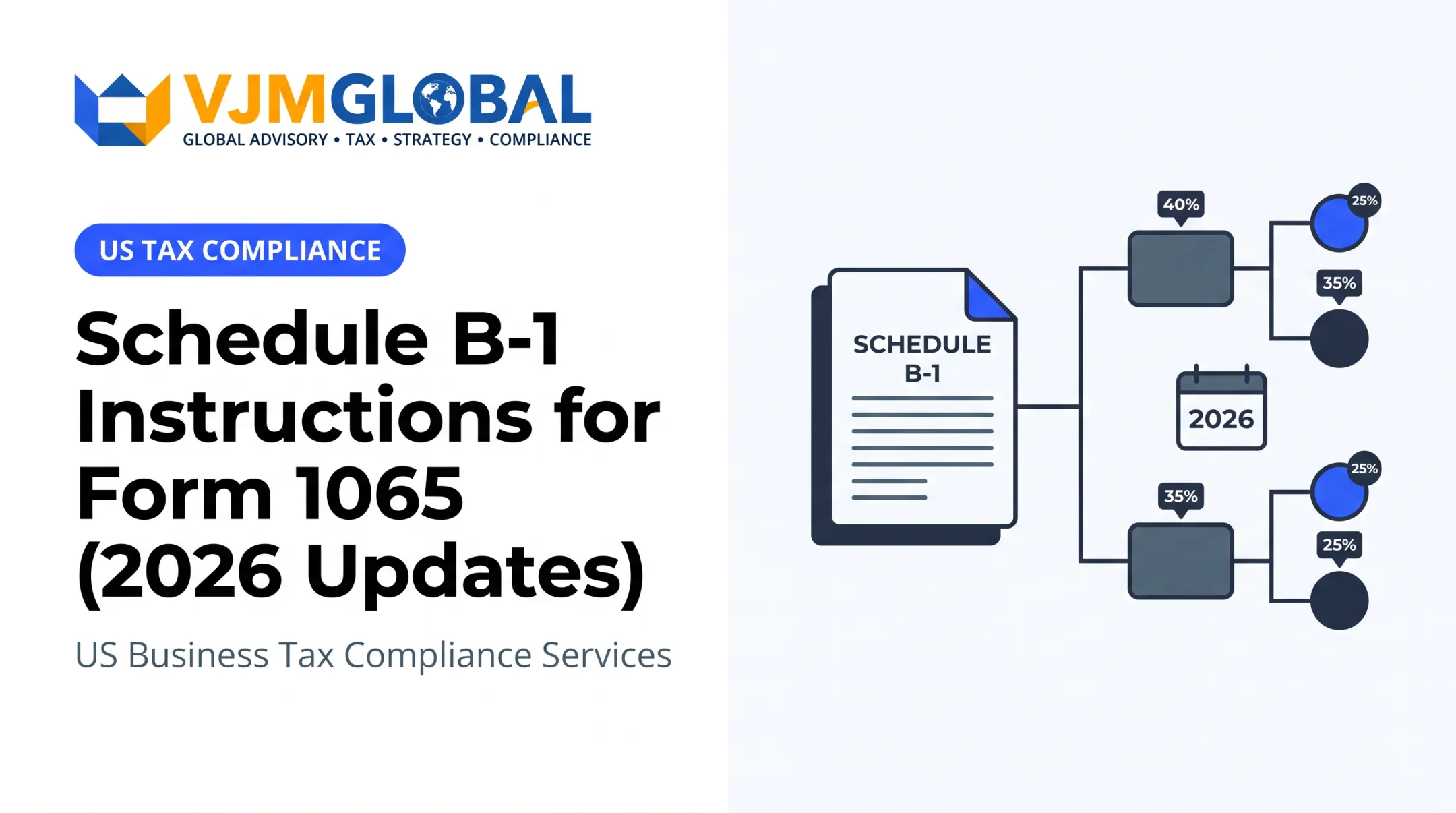
Schedule B-1 is titled "Information on Partners Owning 50% or More of the Partnership." You attach it to Form 1065 when Schedule B question 2a or 2b is answered "Yes." Older guidance may cite questions 3a/3b, which apply to tax years 2009 to 2017. The 2025 form uses 2a/2b.
The threshold is inclusive: exactly 50% qualifies. Profit, loss, and capital are alternative measures, and the test applies at the end of the tax year.

Part I and Part II
- Part I (question 2a): corporations, partnerships (including entities treated as partnerships), trusts, tax-exempt organisations, and foreign governments.
- Part II (question 2b): individuals and estates.
For each qualifying owner, report:
- Name and identifying number, if any
- Entity type (Part I only; enter "tax-exempt organization" where relevant)
- Country of organisation (Part I) or citizenship (Part II; for an estate, the decedent's citizenship)
- Maximum percentage owned in profit, loss, or capital
Country of organisation and country of citizenship are different fields. Schedule B-1 travels with Form 1065 and is not a standalone return.
How the Family Attribution Rules Work for Schedule B-1
Attribution means the IRS treats you as owning an interest that someone else holds. For question 2, the Form 1065 instructions apply section 267(c), excluding section 267(c)(3), to partnership interests as well as stock.
Who counts as family
The instructions say the family of an individual "includes only that individual's spouse, brothers, sisters, ancestors, and lineal descendants." In practice:
- Spouses, siblings (whole or half blood), parents, grandparents, children, and grandchildren
- Legal adoptees (adoption is given full effect under the regulation)
- In-laws and cousins (outside the exhaustive list)
The key limitation
An interest is attributed from an individual only if the person receiving it owns a direct interest in the partnership, or an indirect interest under section 267(c)(1) or (5). A family tie alone is not enough.
The IRS example shows this. A owns 50% of Partnership X directly. A's daughter B has no direct interest and no indirect interest through any entity. A's interest is not attributed to B, so X lists A in Part II and does not list B.
Direction and double counting
Attribution runs from the individual owner to a qualifying family recipient. Family-attributed ownership cannot be passed on again to another relative. Ownership attributed through an entity under section 267(c)(1), however, can be treated as actual ownership for family attribution.

The instructions tell you to add direct and indirect percentages. They provide no double-counting worksheet, so build your own and count each underlying interest once.
Do not borrow rules from other forms
Similar family lists appear elsewhere, but the regimes differ:
- Form 8865: also uses section 267(c) excluding (c)(3), but limits attribution from nonresident alien individuals with different wording
- Section 318: covers constructive stock ownership for spouse, children, grandchildren, and parents only (not siblings)
Use the Schedule B-1 wording, not either comparison.
Which Ownership Interests Can Be Combined for the Schedule B-1 Test?
Direct and indirect interests
Direct ownership comes from the partnership agreement, capital records, and year-end partner information. Indirect ownership is traced through entities. An interest held by a corporation, partnership, estate, trust, or tax-exempt organisation is treated as owned proportionately by its shareholders, partners, or beneficiaries.
Add an owner's direct and indirect percentages to see whether the total reaches 50%.
Disregarded entities
Do not list a disregarded entity. List its tax owner instead. If that owner is an individual, the individual goes in Part II.
IRS example: direct plus indirect
Corporation A owns 50% of Partnership B and 15% of Partnership C. B owns 70% of C.
- A's indirect share of C: 50% × 70% = 35%
- Add A's direct 15%: total 50%
- Part I of C's Schedule B-1 lists A at 50% and B at 70%
This example has no family component. The IRS publishes no positive family-only or family-plus-indirect example, so any such scenario you build is your own analysis. Label it that way in your workpapers.
Profit, loss, and capital
Review each measure on its own. If any one reaches 50%, the owner is reportable, and the form asks for the maximum percentage owned in profit, loss, or capital. The instructions do not define "maximum" beyond that, and the owner-identification date is year-end. If the percentages differ across measures or shifted during the year, document your reading.

How to Calculate and Document Family-Attributed Ownership
Work in this order:
- Inventory every interest. List direct partner interests, holdings through other entities, mid-year changes, and profit, loss, and capital percentages.
- Map each tier. Record the legal and tax classification of every owner: corporation, partnership, trust, estate, or disregarded entity.
- Apply family attribution last. Document the relationship, the relative's qualifying direct or indirect interest, and the rule relied on.
- Compare to the threshold. Test each measure against 50% and note why each person is included or excluded.
- Preserve records. Keep the agreement, ownership ledgers, entity charts, attribution analysis, identification and country details, and reviewer sign-off.
The IRS prescribes no attribution worksheet or family declaration. Form 1065 instructions set general recordkeeping duties: keep records as long as needed to administer the Code, and usually for three years from the later of the return's due or filing date. Keep copies of filed returns too.
VJM Global supports Australian and international businesses with accounting records, U.S. tax compliance workflows, and review of complex partnership ownership disclosures.
Common Schedule B-1 Family Attribution Errors and Final Review Checklist
Common errors
These are instruction-based checks rather than measured error rates:
- Importing the Form 8865 or section 318 standard
- Assuming every relative's ownership is attributed automatically
- Listing a disregarded entity instead of its tax owner
- Placing an owner in the wrong part
- Omitting country or identifying information
- Creating duplicate owner records
Incomplete returns carry exposure. The 2025 instructions state $255 per partner per month or part-month, up to 12 months, for filing late or filing a return that fails to show all required information, unless there is reasonable cause. It is not a separate Schedule B-1 penalty.
Pre-filing checklist
- Confirm the current IRS instructions and question numbers.
- Reconcile Schedule B answers 2a/2b with Schedule B-1.
- Test profit, loss, and capital separately at year-end.
- Verify family and indirect ownership workpapers.
- Attach the completed schedule to Form 1065.
Frequently Asked Questions
What are the family attribution rules for Schedule B-1 on Form 1065?
Section 267(c), excluding (c)(3), treats a spouse's, sibling's, ancestor's, or lineal descendant's interest as owned by a relative. The relative must hold a direct or qualifying indirect interest. Confirm against the current instructions.
What is Schedule B-1 on Form 1065 and what must be reported on it?
It discloses owners of 50% or more of profit, loss, or capital. Part I covers entities and Part II covers individuals and estates. Report name, identifying number, type, country, and maximum percentage owned.
How does direct ownership differ from family-attributed ownership?
Direct ownership is held in the person's own name. Attributed ownership is treated as theirs through the family rules, and both count toward the same threshold.
Do siblings count under the Schedule B-1 family attribution rules?
Yes, whole- and half-blood siblings are on the list, subject to the recipient-interest condition. Do not substitute section 318, which omits siblings.
Does a spouse's partnership interest count toward the Schedule B-1 test?
Spouses are covered, but marriage alone is not enough. The spouse receiving the attribution needs a direct or qualifying indirect interest.
How should a partnership document family attribution calculations?
Use an ownership chart, entity records, a relationship analysis, separate profit, loss, and capital calculations, rule citations, and reviewer approval.