Confusion often starts with the form number itself. Form 1120 is the return C corporations file, while Form 1120-S is the return S corporations use. Partnerships file a different form entirely, Form 1065. This guide focuses specifically on Schedule L as it applies to Form 1120-S.
Here's what we'll cover: who actually has to file Schedule L, what belongs on each line, how to reconcile it with Schedules M-1 and M-2, and the mistakes that invite IRS correspondence. Get this schedule wrong, and you risk flagging an otherwise clean return over what should be a simple bookkeeping exercise.
Key Takeaways
- Book-basis assets, liabilities, and equity go on Schedule L, not a business valuation
- Corporations meeting both the $250,000 receipts and assets tests can skip Schedule L and M-1
- Shareholder loans need correct placement: an asset on line 7, a liability on line 19
- Total assets must equal total liabilities plus equity, with no exceptions
- Shareholder stock or debt basis is never calculated on Schedule L
What Is Form 1120-S Schedule L?
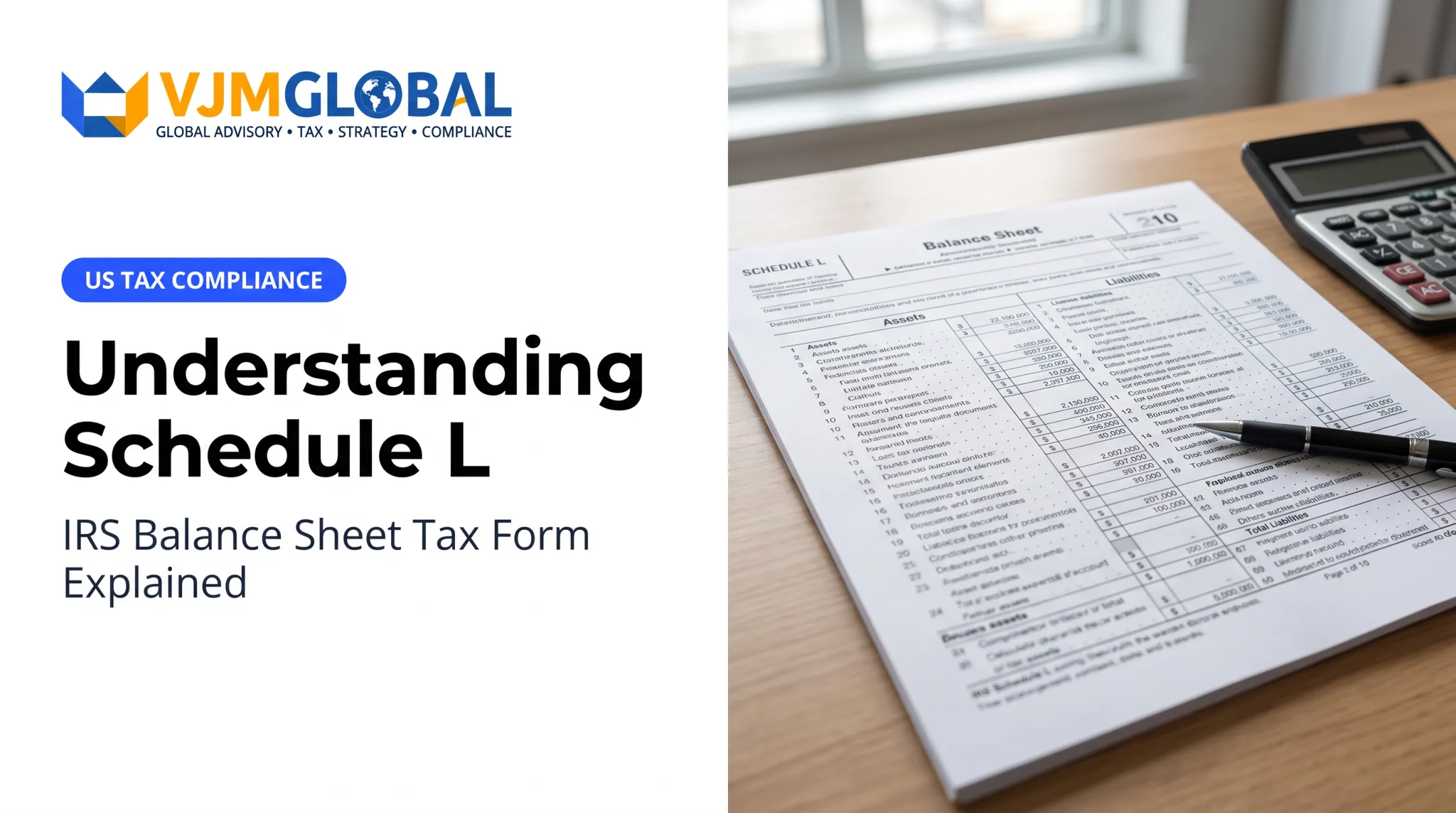
Schedule L is officially titled "Balance Sheets per Books," and that name tells you exactly what it does. It reports the corporation's assets, liabilities, and shareholders' equity at the start and end of the tax year, pulled directly from the company's accounting records.
The form uses four columns: two for the beginning of the tax year and two for the end, per the 2025 Form 1120-S. In most cases, last year's ending balances simply carry forward as this year's beginning balances, assuming nothing changed between filing the prior return and opening the new books.
Book Value, Not Market Value
Schedule L isn't an appraisal. It doesn't show what the business would sell for, what a buyer might pay, or management's internal estimate of worth. It shows book value, following the corporation's regular accounting method.
That distinction matters. A company with fully depreciated equipment still generating revenue might show almost nothing for that asset on Schedule L, even though it carries real operational value. That's expected; Schedule L isn't trying to tell that story.
How Schedule L Differs From Schedule K and K-1
Schedule K and Schedule K-1 report the pass-through items (income, deductions, and credits) that flow to each shareholder's personal return. Schedule L does something different: it presents the corporation's own balance sheet, separate from what gets allocated to owners.
The IRS uses Schedule L to cross-check the rest of the return. Large swings in retained earnings, unexplained loan balances, or distributions that don't match recorded cash movement can draw attention. Those figures need to line up with income, credits, and shareholder activity reported elsewhere.
Schedule L does not calculate a shareholder's stock or debt basis. Basis tracking happens separately, typically on Form 7203, and requires its own records and analysis.
Who Must File Schedule L With Form 1120-S?
Not every S corporation completes Schedule L. The requirement hinges on how the corporation answers Schedule B, question 11 on Form 1120-S.
The Small-Corporation Exception
According to the IRS Form 1120-S instructions, a corporation can skip Schedules L and M-1 if it meets both conditions for the tax year:
- Total receipts were less than $250,000
- Total assets at year-end were less than $250,000
Both tests must pass. A corporation with $200,000 in receipts but $300,000 in year-end assets still has to complete Schedule L.
There's no partial exception. Failing either condition means Schedule L is required, and "less than $250,000" means strictly below that figure. A corporation at exactly $250,000 does not qualify.

What Counts as "Total Receipts"
Total receipts is broader than gross sales. It adds together:
- Gross receipts or sales reported on page 1
- All other income reported on page 1
- Several categories of income and gain reported on Schedule K
- Certain rental income and gains from Form 8825
Businesses with modest sales but meaningful investment or rental income can cross the threshold faster than they expect.
When Schedule L Is Likely Required Anyway
Schedule L is often required in these situations:
- First-year returns, where opening balances need to be established
- Corporations holding significant fixed assets, inventory, or investments
- Returns that must reconcile through Schedule M-1 or M-2
- Years with major changes in accounting records, ownership, or debt structure
Even when the exception applies and Schedule L isn't filed, keep the underlying balance-sheet records anyway. Lenders, investors, and future tax preparers will want them.
What Goes on Schedule L: Assets, Liabilities, and Shareholders' Equity
Schedule L follows a standard balance-sheet structure: assets at the top, liabilities and equity below, and a total that has to match on both sides.
Reporting Assets
Common asset lines include:
- Cash
- Trade receivables, reported net of the allowance for bad debts
- Inventories
- Loans to shareholders
- Investments, including U.S. government obligations and tax-exempt securities
- Buildings and depreciable assets, shown at cost with accumulated depreciation subtracted
- Land and amortizable intangible assets, net of accumulated amortization
- Other assets, which require an attached statement explaining what they are
Property and equipment figures should tie back to a fixed-asset register, using the corporation's book accounting treatment rather than the tax depreciation method used elsewhere on the return. Those two numbers often differ, and that's normal.
Reporting Liabilities
On the liabilities side, typical lines cover:
- Accounts payable
- Short-term debt and the current portion of long-term obligations
- Other current liabilities (with a supporting statement)
- Loans from shareholders
- Long-term debt and other long-term liabilities (also requiring statements)
Loans from shareholders deserve special attention. They're debt, not equity, so they belong on the liability side, never mixed into capital stock or paid-in capital.
Keep the loan agreement, track repayment and interest, and record it the same way every time. A shareholder advancing cash to cover payroll shouldn't show up as a loan one quarter and a capital contribution the next, depending on who's doing the bookkeeping.
Shareholders' Equity
Equity typically includes:
- Capital stock
- Additional paid-in capital
- Retained earnings
- Adjustments to shareholders' equity, such as unrealized gains or currency translation items
- Treasury stock, shown as a reduction where applicable
The Balance Sheet Must Actually Balance
This is non-negotiable: total assets must equal total liabilities plus shareholders' equity. If the two sides don't match, something was misclassified, omitted, or recorded twice.
Don't force a difference into "other assets" or an equity adjustment just to make the numbers line up. Track down the real discrepancy — it's usually a timing issue, a missed journal entry, or a loan coded to the wrong side of the ledger.

How to Complete and Reconcile Form 1120-S Schedule L
Good Schedule L preparation starts before anyone opens the tax form. It starts with clean books.
Start With the Trial Balance
Pull the final trial balance and year-end balance sheet from the accounting system. Confirm the accounting method matches what's been used consistently, and that the book balances reflect reality rather than software defaults.
From there, map each general-ledger account to the correct Schedule L line. Debt often needs splitting between current and long-term portions using the loan's amortisation schedule, not a guess.
Beginning-of-Year Checks
Before carrying anything forward:
- Compare this year's beginning balances against last year's ending Schedule L
- Investigate any differences, since they shouldn't exist if the prior return was accurate
- Document the explanation if a difference is legitimate, such as a prior-period adjustment
End-of-Year Reconciliation
Each major account needs its own tie-out:
- Cash to bank statements
- Receivables and payables to subsidiary ledgers
- Inventory to physical counts or inventory records
- Fixed assets to the depreciation schedule
- Debt to lender statements and amortisation tables
Connecting Schedule L to Schedule M-1 and M-2
Schedule L doesn't operate in isolation. Schedule M-1 reconciles book income to the income reported on the return, accounting for items like tax-exempt interest that appear in the books but not on Schedule K. Schedule M-2 tracks four separate equity-related accounts, including the Accumulated Adjustments Account, rather than simply mirroring Schedule L's retained earnings line.
Distributions, current-year income, and prior-year retained earnings should move together across all three schedules. If retained earnings jumps in a way M-2 can't explain, something was likely recorded incorrectly somewhere in the chain.

Final review checklist before filing:
- Total assets equal total liabilities plus equity
- Shareholder loans are classified correctly and consistently
- Distributions and contributions are recorded separately, not netted
- Retained earnings ties to Schedule M-2
- Schedule M-1 explains every book-to-tax income difference
- Supporting statements are attached for every line requiring one
Common Schedule L Errors, Corrections, and Recordkeeping
Most Schedule L problems trace back to a handful of recurring mistakes:
- Reporting a market-value estimate instead of book value
- Omitting shareholder loans entirely from the balance sheet
- Misclassifying short-term versus long-term debt
- Duplicating depreciation adjustments between book and tax records
- Mixing personal transactions into corporate accounts
- Using figures that don't match the underlying books
Unexplained year-over-year swings deserve attention before filing, not after the IRS asks about them. The same goes for negative or unusual equity balances, and any gap between Schedule L and Schedule M-2 that can't be traced to a specific transaction.
Correcting an Error
If a mistake surfaces after filing, check the current IRS instructions to determine whether an amended Form 1120-S and corrected schedules are necessary. Requirements shift year to year, so don't rely on last year's process.
Records Worth Keeping
Keep these source documents with the return file:
- Trial balance and general ledger
- Bank reconciliations and financial statements
- Fixed-asset register and loan statements
- Shareholder contribution and distribution records
Per IRS recordkeeping guidance, retention periods vary by situation. Some records need to be kept far longer than the standard filing window, especially those tied to bad-debt deductions or unreported income.
Clean books take deliberate process, not luck. VJM Global's accounting and tax-compliance team works with businesses filing Form 1120-S to reconcile balance-sheet accounts, untangle shareholder-loan activity, and prepare accurate U.S. corporate tax filings from records that hold up under review.
Conclusion: Use Schedule L as a Financial Accuracy Check
Schedule L is a book-based balance sheet. It is not a valuation of the business, and it is not a substitute for calculating shareholder stock or debt basis. Those remain separate exercises with their own records and rules.
The workflow, in short:
- Determine whether the small-corporation exception applies
- Work from reliable, reconciled books
- Classify each balance to the correct line, especially shareholder loans
- Confirm total assets equal total liabilities plus equity
- Reconcile the result against Schedule M-1 and M-2
Corporations preparing their own returns should verify the current-year IRS instructions before filing, since thresholds and requirements can change annually.
When the books don't reconcile, or shareholder, debt, and ownership activity has gotten complicated, bringing in outside help usually saves more time than it costs.
VJM Global's trial balance and reconciliation support confirms that figures tie to supporting entries and resolves discrepancies before they become filing problems. The team also prepares federal and state returns in line with IRS protocols for businesses operating in the United States.
Frequently Asked Questions
Is a balance sheet (Schedule L) required on Form 1120?
Yes, unless the corporation meets the small-corporation exception. On Form 1120, that test sits at Schedule K, question 13. Check current IRS instructions for the exact thresholds before treating Schedule L as optional.
Who is exempt from filing Schedule L on Form 1120?
Corporations meeting all conditions of the small-corporation exception, both the receipts test and the total-assets test, can skip Schedule L. Review the current Form 1120 instructions, since dollar thresholds are confirmed annually.
Is Schedule L required for an S corporation?
It depends on how the corporation answers Schedule B, question 11 on Form 1120-S. Meeting both thresholds waives Schedule L and M-1, but the corporation still needs accurate books regardless of whether the form itself is filed.
What is Form 1120 Schedule L?
It's the "Balance Sheets per Books" schedule, reporting a corporation's assets, liabilities, and shareholders' equity at the beginning and end of the tax year, drawn directly from its accounting records.
What is IRS Form 1120 used for?
C corporations generally use Form 1120 to report income, deductions, taxable income, and tax liability. S corporations file Form 1120-S instead, reflecting their pass-through tax treatment.