For U.S. citizens, green card holders and other U.S. persons living in Australia, the confusion usually starts with an inheritance from a relative, a family trust distribution or an Australian trust connection. This article explains how Form 3520, Form 3520-A and Form 1040 relate, what each covers, and where the traps are. Rules change yearly, so confirm details against the current IRS instructions before filing.
Key Takeaways
- Form 3520 does not replace Form 1040, and filing it doesn't automatically mean tax is due.
- Taxable trust income still belongs on Form 1040 and its schedules.
- Foreign trust events and foreign gifts follow different rules and thresholds.
- Due dates, signature rules and filing methods change, so check the current instructions.
What Is Form 3520 and Who Must File?
What the form covers
The IRS titles it "Annual Return To Report Transactions With Foreign Trusts and Receipt of Certain Foreign Gifts." The current instructions (revised December 2025) are used with the December 2023 form. The IRS does not label the form an "information return" on its About page. Treat it as an annual reporting return.
Filing depends on whether you are a U.S. person under IRC section 7701: a U.S. citizen or resident, domestic partnership, domestic corporation, non-foreign estate, or a qualifying domestic trust. Living in Australia doesn't change that. Citizenship, tax residency and the specific transaction decide whether you must file.
Foreign trust events
These can trigger Form 3520:
- Creating a foreign trust or transferring property to one (Part I)
- Being treated as owner of a foreign trust's assets (Part II)
- Receiving a distribution, or certain loans and uncompensated use of trust property (Part III)
Some trust reporting applies regardless of the amount involved. Gifts follow separate thresholds.
Foreign gifts and inheritances
Part IV covers gifts and bequests from foreign persons. Current IRS thresholds:
- Nonresident alien individuals or foreign estates: aggregate over $100,000 in the tax year, including related parties
- Foreign corporations or partnerships: aggregate over $20,116 for 2025, or $20,573 for 2026
A gift or inheritance can be non-taxable and still reportable. Qualified tuition or medical payments made on your behalf are excluded, and trust distributions belong in Part III, not Part IV.

Is your Australian arrangement a foreign trust?
The Australian label doesn't settle it. U.S. rules look at legal structure, court supervision and who controls substantial decisions. Superannuation, private foundations and similar vehicles need a facts-and-circumstances review.
Rev. Proc. 2020-17 offers an exemption from section 6048 reporting for qualifying tax-favoured foreign retirement and savings trusts. It applies only to eligible individuals and trusts that meet its conditions. The U.S.-Australia treaty's pension article doesn't itself create a Form 3520 exemption.
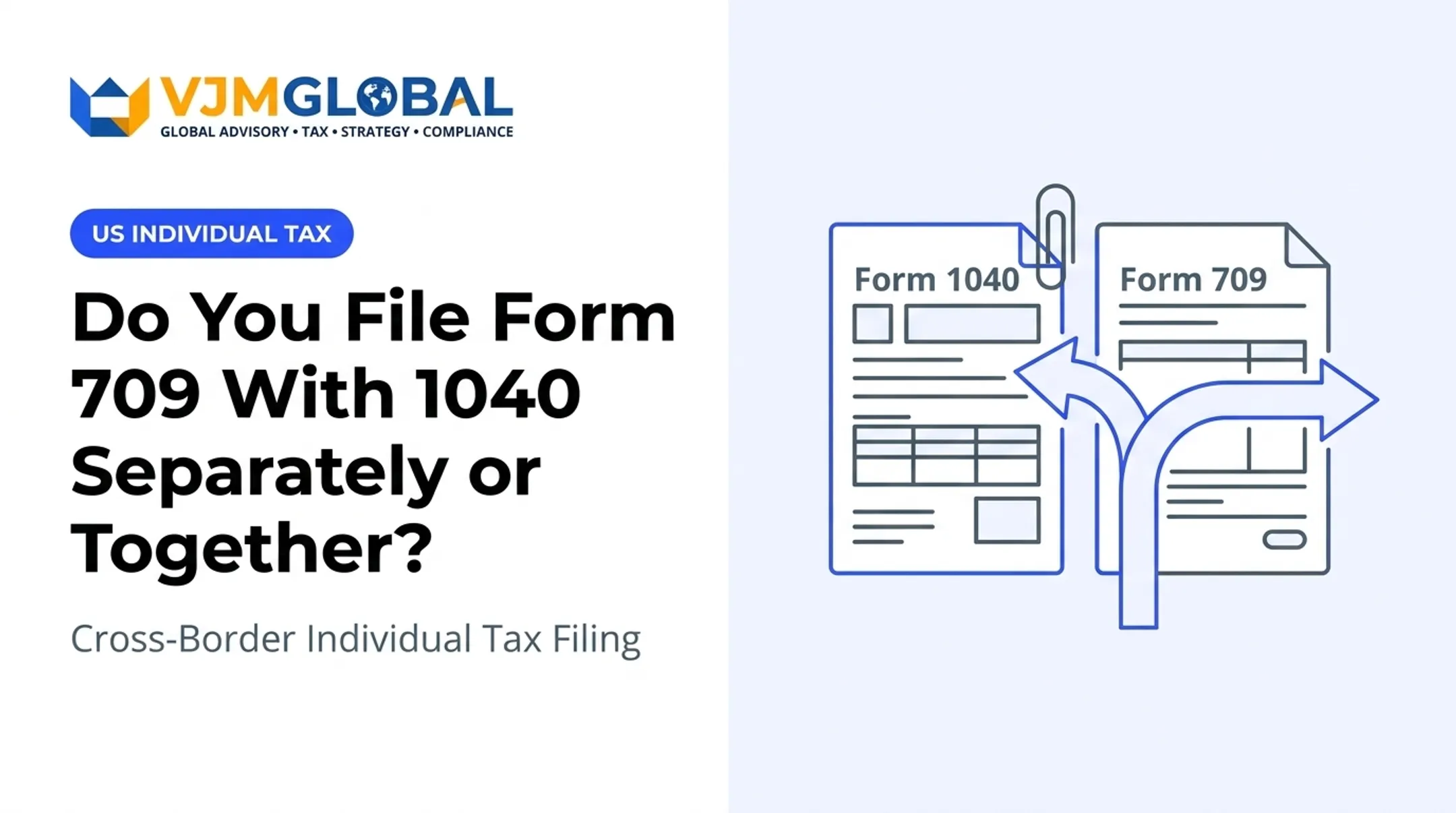
Is Form 3520 Filed Separately From Form 1040?
The direct relationship
Yes. Form 3520 is prepared, signed and submitted separately. Its instructions give it its own mailing address, require a separate form for each foreign trust, and note that its due date may differ from the income tax return due date and is not tied to it.
One nuance: the instructions don't state a blanket rule that it is "not filed with Form 1040." Where a Form 3520 line 53 amount applies, you report it as additional tax on your income tax return. You don't attach the whole form.
"Filed separately" also differs from "reported separately." Form 1040 reports income, deductions, credits and tax. Form 3520 reports the underlying trust transaction, gift or bequest.
Even so, keep both filings consistent on:
- Names and taxpayer identification numbers
- Tax year and transaction dates
- Currency conversions and income figures
For example, say you receive a distribution from a foreign trust. You report the receipt and trust details in Part III of Form 3520. Separately, you work out whether any portion is taxable income on Form 1040 and its schedules.
Due dates and extensions
For a calendar-year individual, Form 3520 is generally due on the Form 1040 due date. Key rules from the 2025 instructions:
- With an income tax return extension, Form 3520 is due by the 15th day of the tenth month after year-end.
- A qualifying U.S. person living and working outside the United States may use the automatic two-month extension to the 15th day of the sixth month, with a statement showing eligibility.
- If you file Form 4868, check the extension box on Form 3520 and enter "1040" on the applicable line.

Don't assume every overseas taxpayer gets the same extension. Confirm your eligibility.
Filing method, signatures and proof
The IRS states Form 3520 isn't eligible for e-filing. For calendar year 2026, paper filings go to IRS, P.O. Box 409101, Ogden, UT 84409. Electronic signatures are accepted under the 2025 instructions, but that is distinct from e-filing.
Keep a signed copy and mailing evidence apart from your Form 1040 records. Under IRC section 7502, the registration date of U.S. registered mail counts as the postmark date. For certified mail, the sender's receipt must be postmarked by the postal employee.
What Goes on Form 3520 and What Goes on Form 1040?
The parts of Form 3520
- Part I: transfers to foreign trusts
- Part II: U.S. ownership of foreign trusts
- Part III: distributions from foreign trusts
- Part IV: certain foreign gifts and bequests
Complete only the parts that apply, using the current-year form and instructions.
When both forms are needed
A foreign trust distribution creates two tasks. Form 3520 reports the receipt and trust information. Form 1040 and its schedules report any taxable income. Form 3520 is a reporting return and doesn't itself calculate ordinary income tax.
Gifts versus income
A qualifying foreign gift or inheritance isn't automatically taxable income. But interest, dividends, rent or gains the property later generates may be taxable on Form 1040. Don't assume tax-free treatment. Gifts, bequests, trust distributions, wages and investment income each follow different rules.
Form 3520-A and related forms
Form 3520-A is the foreign trust's annual return when the trust has a U.S. owner. The owner must ensure it is filed. If the trustee doesn't file, the owner prepares a substitute Form 3520-A and attaches it to the owner's timely Form 3520, not Form 1040.
Other forms report different things:
| Form | Scope |
|---|---|
| FBAR (FinCEN 114) | Foreign financial accounts, filed with FinCEN |
| Form 8938 | Specified foreign financial assets, filed with the return |
| Form 8621 | Passive foreign investment company holdings |
| Form 5471 | Interests in certain foreign corporations |
The IRS expressly says Form 8938 doesn't replace the FBAR. Don't assume any one filing replaces another, and Australian tax filings are separate again.
Records and currency conversion
Gather:
- Trust deed, statements and trustee correspondence
- Distribution records and bank statements
- Gift or inheritance documents and valuations
- Donor details and prior-year filings
- Exchange-rate evidence
Part III values property at fair market value when received. The Part IV instructions don't specify a valuation date, so confirm the approach with a professional.
Amounts must be in U.S. dollars, generally at the rate when received, paid or accrued. The IRS has no official rate and generally accepts any posted rate used consistently. The IRS yearly average for 2025 is 1.551 Australian dollars per U.S. dollar.

Deadlines, Filing Method, and Records
Form 3520-A runs on a different track. It is generally due the 15th day of the third month after the trust's year-end (15 March for a calendar-year trust).
File Form 7004 to request an automatic six-month extension of Form 3520-A. A Form 1040 extension does not extend it.
- Identify the trigger event.
- Select the correct parts.
- Gather supporting records.
- Reconcile figures with Form 1040.
- Sign correctly.
- Mail by the approved method.
- Keep proof of timely filing.
Penalties, Corrections, and When Professional Help Makes Sense
Penalty framework
| Failure | Penalty |
|---|---|
| Part I transfers | Greater of $10,000 or 35% of gross amount |
| Part II ownership | Greater of $10,000 or 5% of trust assets treated as owned |
| Part III distributions | Greater of $10,000 or 35% of distributions |
| Part IV gifts | 5% per month, capped at 25% of gift value |
Further $10,000 penalties per 30-day period can apply after IRS notice. Reasonable-cause exceptions exist under IRC section 6677 and section 6039F.

The Taxpayer Advocate Service reported that during 2018-2021 the IRS abated 67% of penalties by count. Those are historical figures, not a forecast.
If you missed a filing
- Identify the affected years and forms.
- Check whether Form 1040 also needs amending.
- File delinquent Forms 3520 or 3520-A under their own instructions, not attached to an amended return, with a reasonable-cause statement if applicable.
- Don't treat Streamlined Foreign Offshore Procedures as automatic Form 3520 penalty relief. They require a non-willful certification.
No single correction path fits everyone.
When to get help
VJM Global is a firm of Chartered Accountants with a dedicated team of CPAs and U.S.-compliant professionals. The firm supports U.S. individual return preparation and cross-border tax work for clients in Australia, and maintains offices in India and the United States. Confirm directly whether the team can assist with your specific Form 3520 situation.
Frequently Asked Questions
Do I need to file Form 3520 with my tax return (Form 1040)?
Form 3520 is generally filed separately, by mail, to its own address. Related taxable income may still need to appear on Form 1040.
What is IRS Form 3520?
It is an annual reporting return for certain foreign trust transactions and receipts of certain foreign gifts or bequests.
Who must file IRS Form 3520?
U.S. persons who transfer property to, own, or receive distributions from certain foreign trusts, or who receive reportable foreign gifts or bequests. Executors of U.S. decedents may also file.
Do I need to file Form 3520 if I receive a gift from a foreign person?
It depends on the donor, the aggregate amount and the current thresholds. Reporting doesn't mean the gift is taxable.
When is Form 3520 due and how do I file it?
Generally on your Form 1040 due date, with extension rules as above. It must be mailed, with a valid signature. Check the current instructions for your tax year.
What are the penalties for failing to file Form 3520?
Penalties vary by event type and can be substantial, from 5% per month on gifts to 35% on transfers or distributions. Reasonable-cause relief may be available.