Introduction
No. An employer doesn't hand you a Form 1040. If you're a US employee, your employer issues Form W-2. Form 1040 is your own annual US federal income tax return, and you or a tax professional complete it.
If you're in Australia, it gets trickier. Your obligations depend on whether you worked for a US employer, performed services in the US, earned US-source income, or are a US citizen or resident for tax purposes.
This guide explains how Forms W-2, W-4, 1099, 1040 and 1040-NR fit together, and what to check from an Australian standpoint.
Key Takeaways
- You file Form 1040 yourself or through a tax professional; no employer issues it.
- W-2 Box 1 feeds line 1a and Box 2 feeds line 25a of the 2025 return.
- W-4 sets payroll withholding, while 1099-NEC covers contractor payments.
- Confirm your US tax status and Australian obligations before assuming Form 1040 applies.
Does Your Employer Give You Form 1040? Understand the Main Tax Forms
The four forms that matter
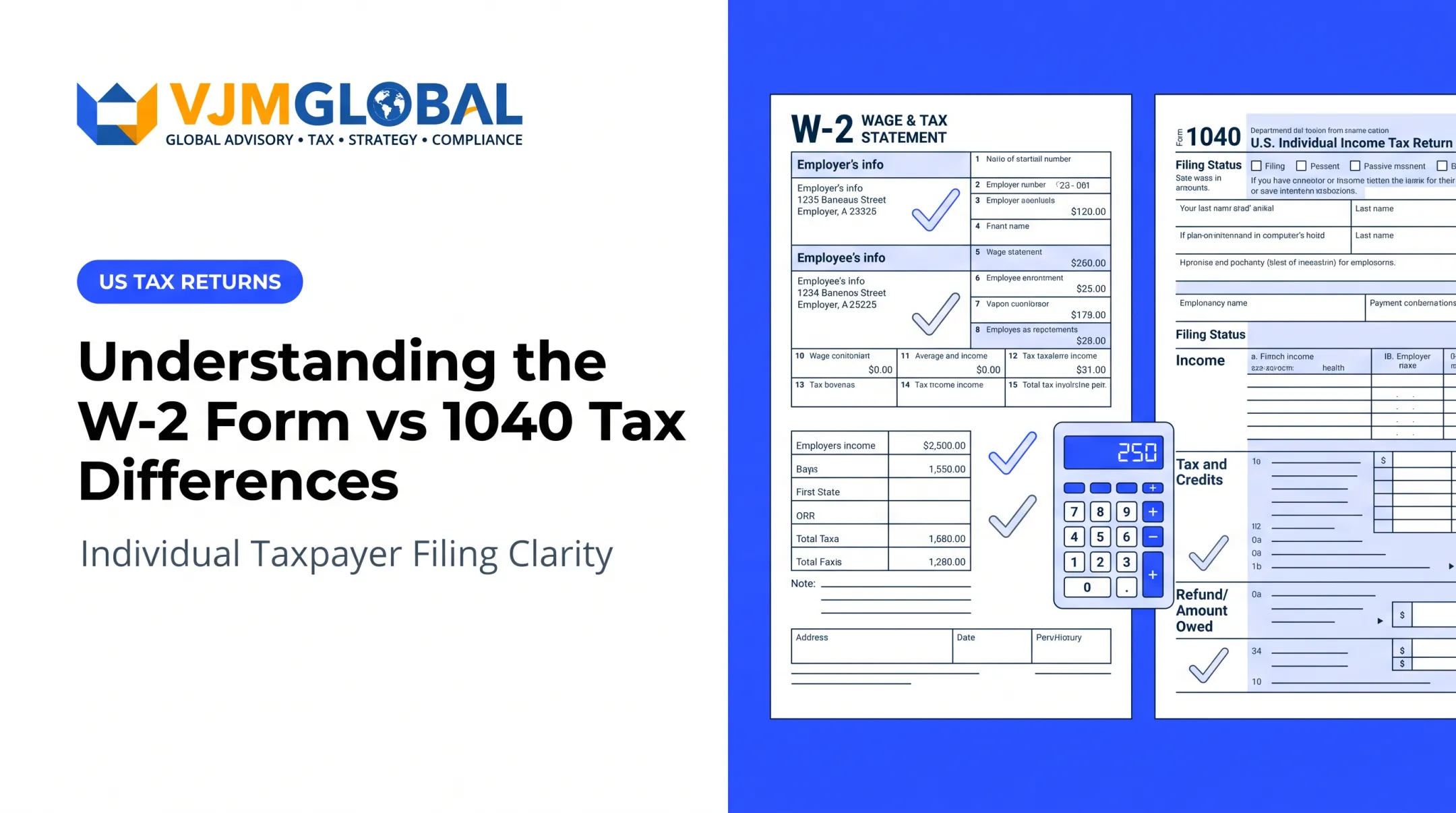
- Form 1040: the IRS Form 1040 is the individual return reporting income, deductions, credits, tax withheld, payments, and refund or balance due.
- Form W-2: the employer's annual wage and tax statement showing wages, federal withholding, Social Security and Medicare figures, and any state or local data. For 2026 wages, employers must furnish copies by 1 February 2027.
- Form W-4: completed when you start a job or your circumstances change. It tells the employer how much federal income tax to withhold, and you give it to the employer, not the IRS.
- Form 1099-NEC: reports payments for non-employee (contractor) services. Receiving one instead of a W-2 means different tax treatment, often with business-income reporting. The threshold rises from US$600 (2025) to US$2,000 (2026).
How the paperwork chain works
You give your employer a W-4. The employer withholds tax and reports your annual pay on a W-2. You then use the W-2 and other records to prepare Form 1040, or Form 1040-NR if you're a non-resident.
Picture two people earning US$80,000 from the same US company. Sam is an employee: W-4 on day one, W-2 in January, wages on line 1a. Priya is a contractor: no withholding, a 1099-NEC, and a business-income calculation that includes self-employment tax.

How W-2 Information Is Used on Form 1040
Box 1 and Box 2
Box 1 (wages, tips and other compensation) goes on line 1a of the 2025 Form 1040. Box 2 (federal income tax withheld) goes on line 25a as a payment credit. It doesn't reduce your wages. Always check the official instructions for the year you're filing, since line numbers can change.
Boxes 3 to 6 cover Social Security and Medicare wages and tax. They serve a separate purpose, so don't enter them as federal income tax withheld.
Multiple employers and other income
Include every W-2. If you worked for two employers, add both Box 1 amounts. For example, US$30,000 from one employer and US$25,000 from another means US$55,000 on line 1a, and both Box 2 amounts added together on line 25a.
Contractor income is different. A 1099-NEC amount generally goes through Schedule C, with self-employment tax on Schedule SE. Under IRS Publication 334, the rate is 15.3% (12.4% Social Security plus 2.9% Medicare), triggered by US$400 in net self-employment earnings. Freelance, investment and rental income need separate treatment and should not be reported as W-2 wages.

Check the W-2 before filing
Don't rely on a final pay slip once the W-2 is available. Verify:
- Your name and Social Security number or taxpayer ID
- Box 1 and Box 2 amounts
- Employer details
- State or local information
Reconcile everything before you file.
What Australian Residents With US Employment Income Need to Check
US status and where you worked
Living in Australia doesn't settle which return you file. US citizens and resident aliens are taxed on worldwide income. Green card holders meet the residence test.
Others may meet the substantial presence test:
- 31 days in the current year
- 183 weighted days over three years (all current-year days, one-third of the prior year, one-sixth of the year before)
Nonresidents may need Form 1040-NR if they have US trade or business activity, or US-source income not fully taxed through withholding.
The employer's address isn't the only factor. Services performed in the US generally produce US-source pay. Work done from Australia is treated differently. Track your US workdays and ask how your employer handled payroll.
The US-Australia treaty
Under Article 15, employment pay is generally taxable only in your residence country, unless the work is done in the other country. The exemption needs all three conditions:
- Presence in the work country doesn't exceed 183 days in its tax year.
- An employer not resident in that country pays the remuneration.
- The pay isn't deductible against a permanent establishment's profits there.

Don't rely on the 183-day figure alone. The treaty text also has a saving clause that lets each country tax its own residents and citizens, subject to exceptions.
Australian obligations are separate
Check the ATO's residency tests (resides, domicile, 183-day, Commonwealth superannuation). Foreign employment income may need to be reported in your Australian return, and a foreign income tax offset may apply for foreign tax actually paid.
On the US side, a US citizen abroad may use the foreign earned income exclusion (Form 2555) or the foreign tax credit (Form 1116). Excluded wages can't also generate a credit.
Practical complications
- Convert income and tax paid into Australian dollars for the ATO, and into US dollars for the IRS
- Australia's year runs 1 July to 30 June; the US year is the calendar year
- US withholding may not cover obligations in both countries
- Keep records of work locations, income, withholding and foreign tax paid
Your filing path depends on residency status and treaty facts, so map those before you choose forms.
VJM Global offers Form 1040 and 1040-NR preparation, along with tax compliance and advisory support for people and businesses managing US-related income. Confirm the firm's scope for your individual cross-border situation before engaging.
What to Do If Your W-2 Is Missing or Incorrect
Missing W-2
- Check your employer's payroll portal for a downloadable copy.
- Confirm the mailing address on file is current and complete.
- Contact the employer or payroll department to request a duplicate W-2.
- If it's still missing after the end of February, contact the IRS. The IRS can follow up with your employer, and you can file Form 4852 as a substitute.

A missing form doesn't remove your duty to file on time. The standard failure-to-file penalty is 5% of unpaid tax per month, up to 25%.
Form 4852
Form 4852 substitutes for a missing or incorrect W-2. Try to get the original first. Estimate wages and withholding carefully using your final pay records. If the real W-2 arrives later and differs, file Form 1040-X.
Incorrect W-2
Ask your employer for a Form W-2c. Don't change figures without documentation. Then check whether a federal, state, Australian or amended filing is affected, and get professional help for cross-border discrepancies.
A Practical Form 1040 Filing Checklist
Gather records
- Every W-2 and 1099
- Final pay records and prior returns
- Identity and residency details
- US work-location dates
- Proof of foreign tax paid and exchange-rate support
- Records for deductions or credits
Filing workflow
- Confirm your tax status and the correct return.
- Enter all W-2 wages and withholding.
- Add other income.
- Claim eligible deductions and credits.
- Reconcile payments.
- Compare against IRS and ATO records before submitting.
Deadlines and filing method
The 2025 Form 1040 deadline is 15 April 2026. US citizens and resident aliens living outside the US get an automatic extension to 15 June 2026, though interest runs on tax unpaid after 15 April.
Form 1040-NR is due 15 June 2026 for filers without wages subject to withholding.
E-filing submits the return electronically. Paper returns need W-2 copies attached. Keep full copies of your return for at least three years.
Frequently Asked Questions
Does my employer give me a Form 1040?
No. Employers generally provide Form W-2 for US employee wages. You or a tax professional prepare and file Form 1040.
What form does my employer give me for taxes?
Employees receive Form W-2; many contractors receive Form 1099-NEC. Form W-4, which you complete, determines how much federal tax is withheld from pay.
Is Form 1040 the same as a W-2?
No. A W-2 reports annual employer-paid wages and withholding. Form 1040 is your complete federal income tax return.
Can I file Form 1040 if I live in Australia?
It depends on your US tax status, income source, work location and treaty position. Some people need Form 1040-NR or only Australian reporting.
What should I do if I do not receive my W-2?
Contact your employer and check payroll systems. If that fails, contact the IRS after February, which may lead to Form 4852.
Do I need Form 1040 if I am an independent contractor?
Contractor income is reported differently from wages, usually via Schedule C and Schedule SE with self-employment tax. The correct return depends on your US tax status.