If you live in Australia, one W-2 doesn't settle much. You may have U.S. filing duties, Australian ones, or both, and the return may not be as simple as the single form suggests. This guide covers what to do with the W-2 you have, what else to check, and when to get help.
Key Takeaways
- Your employer sends the W-2; you prepare the 1040.
- Use the W-2 for wages and withholding, then complete the rest of the return.
- Check other income, credits, foreign reporting forms and Australian obligations.
- Never file the W-2 alone.
W-2 and Form 1040: What's the Difference?
What the W-2 does
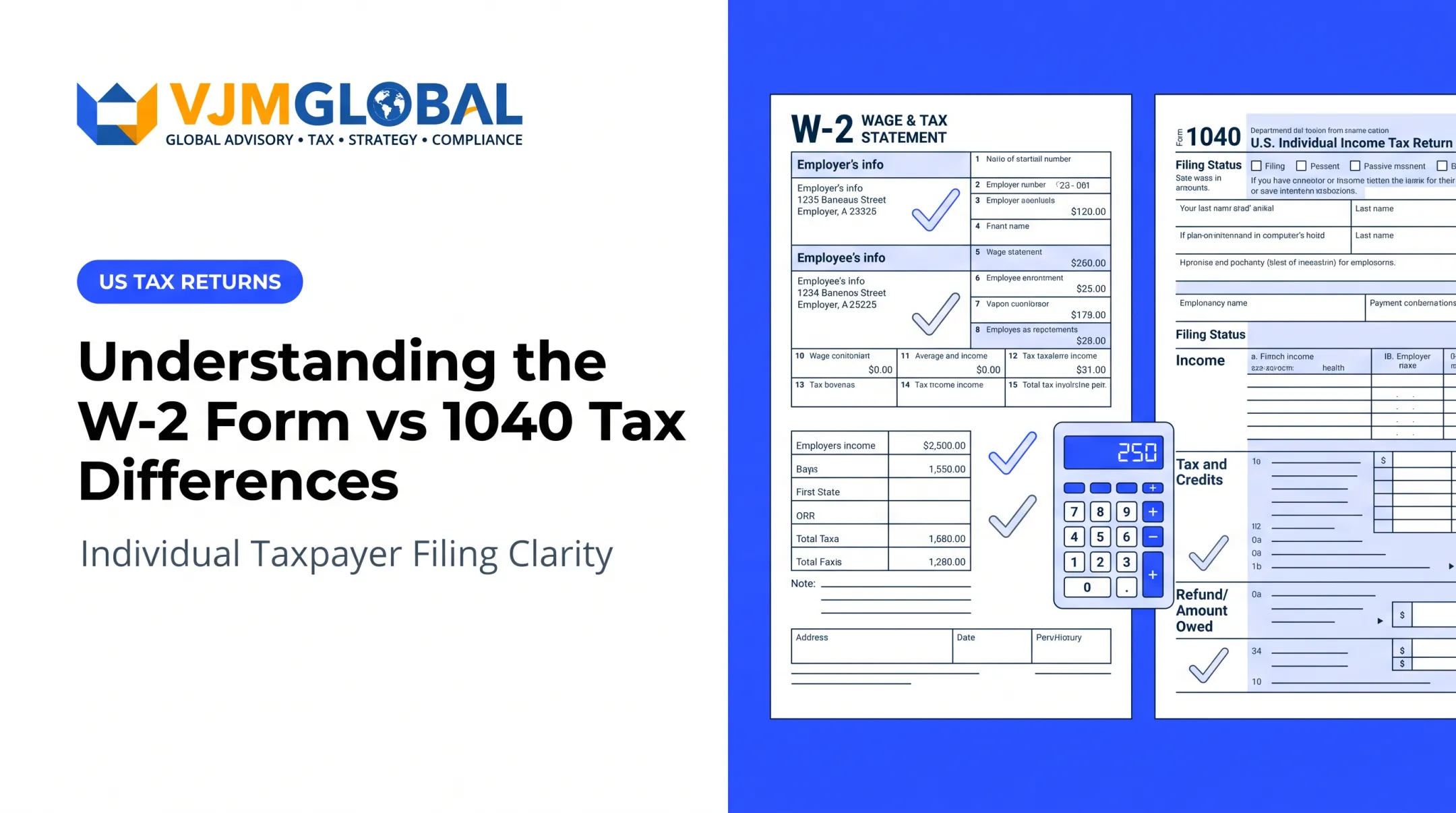
Form W-2 is the Wage and Tax Statement. It reports your wages, federal income tax withheld, Social Security and Medicare tax, and state details. Your employer reports the same figures to the IRS.
Box numbers can shift between years, so check the current-year W-2 and Form 1040 instructions before entering anything.
What Form 1040 does
Form 1040 is the annual individual income tax return. It combines your W-2 wages with other income, adjustments, deductions, credits and tax payments to produce a refund or a balance due.
Nobody mails you a completed 1040. You prepare it through tax software, a tax professional or another IRS-approved filing route.
Do you automatically need to file?
Not necessarily. Having a W-2 doesn't answer that question. Filing requirements depend on your filing status, age, gross income and dependency status. For 2025, the general threshold for a single filer under 65 is $15,750, per the IRS 2025 instructions and Publication 17. Other statuses differ.

You might not need to file and still want to. The 2025 Form W-2 instructions note that someone below the threshold may still get a refund if tax was withheld or a credit applies.
Status matters too:
- U.S. citizens and green card holders generally file Form 1040, even abroad.
- Nonresident aliens may need Form 1040-NR instead.
What to Do If You Only Have a W-2
Gather and review the W-2
- Collect every W-2 for the tax year.
- Check your name and Social Security number against your card.
- Compare the wage and withholding figures with your final pay records.
If something is wrong, ask the employer for a corrected W-2 before filing. Contact the IRS if the issue is still unresolved by the end of February.
If the form never arrives, file using Form 4852 (a substitute W-2) with a final pay stub as your guide. Amend with Form 1040-X if the real form later differs.
Start the 1040 with the W-2
Enter the W-2 into current tax software or hand it to your preparer. For 2025, box 1 wages go on Form 1040 line 1a, and box 2 withholding goes to line 25a. Confirm the lines for your tax year.
The W-2 feeds the return; it doesn't replace it.
Complete the rest of the return
Even if the W-2 is all you hold, you still need:
- Filing status and any dependents
- Bank details for a refund
- Deductions and credits that apply
- Any other income or tax documents
A W-2-only return can be fairly straightforward, but no outcome is guaranteed, including a refund.
Choose the filing method
E-filing is usually quicker. You use the W-2 information but don't mail the form to the IRS unless asked. On paper:
- Attach Copy B of the W-2 to your federal return
- Keep the other copies for your records
- Never send originals you need to retain
Keep records after filing
Keep the W-2, the filed return, supporting records and proof of acceptance or mailing. The IRS generally suggests holding income-tax records for 3 years, with longer periods for cases like substantial omitted income. You may need them for an IRS notice, an amendment, proof of income or a foreign tax calculation.
Check Whether You Have Other Filing Obligations
Look beyond the W-2
A W-2 rarely captures everything. Income may also arrive as:
- Bank interest (1099-INT)
- Dividends (1099-DIV)
- Contractor or gig income (1099-NEC)
- Investment sales, retirement distributions, unemployment or rental income (often 1099-B, 1099-R, 1099-G or Schedule E)
Income counts even when a payer sent no form.
Deductions, credits and household details
Other details can change your return, including:
- Dependents, education and childcare
- Health coverage and retirement contributions
- Charitable giving and mortgage interest
Some items need extra schedules and records. A W-2 alone can't produce your final tax figure.
Foreign and financial-account reporting
From Australia, extra U.S. forms may apply:
- FBAR (FinCEN Form 114): required when foreign accounts together exceed $10,000 at any point in the year. It's filed separately from your return.
- Form 8938: attached to your return when foreign assets exceed $200,000 at year-end or $300,000 at any time (single filers abroad). It doesn't replace the FBAR.

Foreign tax relief is not automatic. Two common options are:
- Foreign Tax Credit (Form 1116): offsets U.S. tax with foreign tax paid
- Foreign Earned Income Exclusion (Form 2555): excludes qualifying earnings if you meet residence or presence tests
You can't claim a credit for foreign tax on income you've excluded.
State and local obligations
A federal return doesn't settle state tax. If you moved abroad, worked in several states or kept U.S. ties, check each state authority's rules separately.
Employee or contractor?
W-2 wages are treated differently from self-employment income. Freelance or side work generally goes on Schedule C, with Schedule SE for self-employment tax. That shift also changes which deductions you can claim and how you report the income.
If You Live in Australia
Confirm your U.S. status
U.S. citizens and green card holders stay subject to U.S. tax on worldwide income while living in Australia. For non-U.S. persons, the right form depends on residency, source of income and other facts. Use IRS guidance to decide between Form 1040 and Form 1040-NR, and seek advice if you're unsure.
Treat Australian and U.S. filings separately
A 1040 isn't an Australian tax return. Australian tax residents generally declare Australian and overseas income, even where foreign tax was paid. A foreign income tax offset may be available. Check the ATO's residency tests for your position.
The U.S.-Australia treaty helps avoid double taxation, but its saving clause generally preserves U.S. taxation of citizens. It isn't a blanket exemption.
Organise records for cross-border reporting
Keep:
- The W-2 and pay records
- Australian tax documents
- Exchange-rate support
- Evidence of foreign taxes paid
- Overseas account details

When both returns cover the same income, a cross-border professional can help assess relief and reporting forms.
Common Mistakes and When to Get Help
Avoid the usual errors
- Waiting for your employer to send a completed 1040
- Filing the W-2 by itself
- Entering wages as contractor income
- Leaving out other income
- Using a prior-year form
- Choosing the wrong filing status, mistyping your SSN or forgetting to sign
Compare the final return with your W-2 to confirm wages and withholding match.
Know when self-filing is unsuitable
Get a professional review if any of these apply:
- Multiple W-2s
- Foreign residency or dual-country obligations
- Self-employment income or investments
- Amended returns or missing records
- Uncertainty about your tax or immigration status
Always verify deadlines, extensions and payment rules for the relevant tax year.
Where VJM Global fits
VJM Global's CPAs and Chartered Accountants prepare Form 1040 and 1040-NR returns and handle cross-border matters including tax treaties and FATCA/Form 8938 reporting. Clients get a single point of contact for U.S. tax queries.
This article is general education and doesn't replace personalised tax advice.
Frequently Asked Questions
Do I need a 1040 if I have a W-2?
The W-2 reports wages and withholding. Form 1040 is the return that reports them and calculates your result, when a federal return is required.
Is a W-2 the same as a 1040?
No. The W-2 is an employer-issued wage statement. The 1040 is the income tax return you prepare.
Can I file taxes with only a W-2?
Some returns rest mainly on one W-2. You still need to check for other income, deductions, credits and filing requirements.
Where do I enter my W-2 on Form 1040?
Use current tax software or the current 1040 instructions. Line references can change by tax year.
Do I need to attach my W-2 to my tax return?
On paper, attach Copy B. When e-filing, you generally don't mail it. Follow current IRS or software instructions.
What if I live in Australia and only have a U.S. W-2?
You may need to assess U.S. and Australian obligations, including tax status, foreign tax relief, exchange rates and extra reporting forms.