That group is bigger than most people expect: freelancers, investors, landlords, retirees, W-2 employees with thin withholding, and Australian-based U.S. citizens and green card holders who still file in the U.S. Living in Sydney or Melbourne doesn't switch off your U.S. obligations.
This guide covers how to use Form 1040-ES, test whether you must pay, estimate the amount, follow the schedule, pick a payment method, and avoid underpayment penalties. One caveat up front: the IRS had not published a final 2027 Form 1040-ES when this was written, so figures below come from 2026 and draft 2027 material. Confirm everything against the 2027 form before you pay.
Key Takeaways
- Form 1040-ES estimates and pays current-year tax; Form 1040 is the annual return.
- Check the final 2027 form, Publication 505 and deadlines before paying.
- Recalculate when income, deductions, credits or foreign tax change.
- Keep confirmations and bank records to reconcile payments on your return.
What Is Form 1040-ES and Who Needs It?
What Form 1040-ES does
Form 1040-ES, Estimated Tax for Individuals, contains a worksheet, instructions and payment vouchers. You use it to calculate and send in payments, not to report your full year of income, deductions and credits.
Form 1040-ES versus Form 1040
Form 1040 is the annual return. It reports your completed tax year and reconciles everything you've already paid. Estimated payments made during 2027 are credited against your final 2027 liability when you file.
| Feature | Form 1040-ES | Form 1040 |
|---|---|---|
| Purpose | Estimate and pay current-year tax | Report the finished tax year |
| Timing | During the year | After year-end |
| Content | Worksheet and vouchers | Full income, deductions, credits |
Who may need to make estimated payments
The latest published test is for 2026. Treat it as a guide to the 2027 rules, not as 2027 figures. Under the 2026 Form 1040-ES, both conditions generally apply:
- You expect to owe at least $1,000 after withholding and refundable credits.
- Your withholding and credits will be less than the smaller of 90% of current-year tax or 100% of prior-year tax (the prior year must cover 12 months).
If prior-year AGI exceeded $150,000 ($75,000 if married filing separately), the prior-year figure becomes 110%. Farmers and fishers with at least two-thirds of gross income from those activities follow a different rule.
Common triggers include:
- Self-employment, freelance or gig income
- Pass-through business income
- Interest, dividends and capital gains
- Rental income
- Taxable retirement income, prizes and alimony
W-2 employees aren't exempt. If withholding falls short, you can submit a new Form W-4 to raise it, or make estimated payments instead.
Form 1040-ES covers individuals only. Corporations (Form 1120), partnerships (Form 1065), estates and trusts follow separate rules.
How to Calculate 2027 Estimated Tax Using Form 1040-ES
Gather the information
Collect these before starting:
- Your prior-year federal return
- Expected 2027 income, deductions and credits
- Expected withholding
- Self-employment income details
- Estimated payments already made and any overpayment carried forward
If you live in Australia, separate out foreign wages, business income, investment income, rental income and foreign taxes paid. Per the IRS yearly rates table, U.S. returns must be in U.S. dollars. The IRS 2025 annual-average rate for the Australian dollar is 1.551 (divide the AUD amount by it). You may use another rate if you apply it consistently throughout the return.
Work through the worksheet
The worksheet follows a set order:
- Project adjusted gross income and subtract deductions to get taxable income.
- Calculate regular tax using the current tax rate schedules.
- Add AMT, self-employment tax and other taxes; subtract credits.
- Subtract expected withholding.
- Compare the result against the safe-harbor tests to find your required annual payment.
- Divide into installments.
Illustrative example only (not official figures): Suppose a freelancer projects a required annual payment of $12,000 and has $1,500 withheld from other income. Using the regular method, the remaining $10,500 is split into four installments of $2,625.

Self-employment and other taxes
For 2026, self-employment tax is 15.3% (12.4% Social Security, 2.9% Medicare), applied to 92.35% of net earnings, with a $184,500 Social Security wage base. Half is deductible when figuring AGI. Verify 2027 amounts on the new form.
Foreign income doesn't automatically remove your obligation. Per Publication 54, taxpayers abroad have the same estimated-tax requirements, though you may exclude income that will be exempt from U.S. tax. The Foreign Earned Income Exclusion, housing deduction, Foreign Tax Credit and treaty positions depend on your facts, and the exclusion is claimed on the annual return.
Determine the installment amount
Equal installments suit steady income. If income is seasonal or lumpy, such as a large late-year capital gain, the annualized income method (Form 2210, Schedule AI) may produce smaller early payments. If you use it for one payment date, use it for all.
Subtract payments already made, apply any prior-year overpayment correctly, and recompute later installments whenever your projection moves.
2027 Form 1040-ES Due Dates and Payment Schedule
Calendar-year schedule
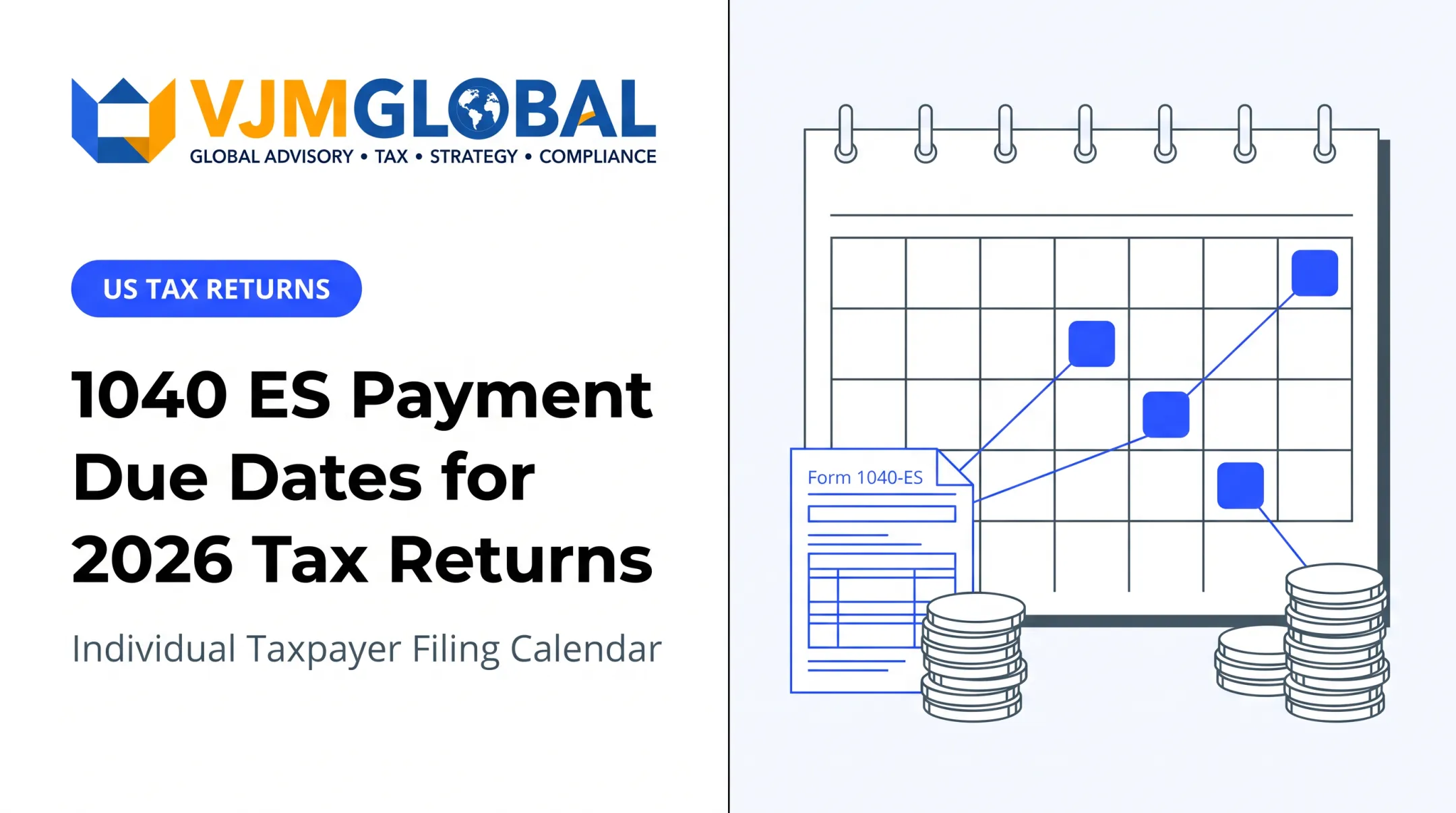
Calendar-year taxpayers generally use these estimated tax due dates:
| Period | Due date |
|---|---|
| 1 | April 15, 2027 |
| 2 | June 15, 2027 |
| 3 | September 15, 2027 |
| 4 | January 2028 (15th day of the first month after year-end) |

Until the IRS publishes the final 2027 Form 1040-ES, treat these dates as provisional. The schedule governs when you pay, not when Form 1040 is filed. Don't reuse the 2026 dates (April 15, June 15, September 15, 2026 and January 15, 2027).
Australian residents get an automatic two-month extension to file the annual return (June 15 for calendar-year filers), but that does not move the estimated-payment dates. April 15 is still the first one.
Weekend, holiday and disaster adjustments
A due date on a Saturday, Sunday or legal holiday moves to the next business day. IRS disaster relief can postpone deadlines too, but only for taxpayers in a qualifying area, so check IRS announcements for your situation.
Fiscal-year and late-income situations
Fiscal-year taxpayers pay on the 15th day of the 4th, 6th and 9th months and the first month after year-end. Income arriving late in the year may call for a revised estimate or annualized calculation.
How to Pay, Track, and Adjust Estimated Tax Payments
IRS payment methods
Availability changes, so confirm each option on IRS.gov for 2027.
- IRS Direct Pay: free, but requires a U.S. checking or savings account. A foreign bank without a U.S. affiliate won't work.
- IRS Online Account: same-day or scheduled bank payments up to 365 days ahead, plus five years of payment history.
- EFTPS: individuals can no longer use it as of 12 November 2026.
- Card or digital wallet: IRS card providers charge fees. As of October 2026, Pay1040 lists $2.15 for debit and 1.75% for consumer credit (minimum $2.50).
- IRS mobile app: replaced IRS2Go and supports payments.
- International wire: payable in U.S. dollars from a foreign bank with a relationship to a U.S. bank. You'll need the Same-Day Taxpayer Payment Worksheet and tax type code 10406. Your bank may charge a wire fee.

For most Australian-based taxpayers without a U.S. account, the wire or a card payment is the practical route. Compare the wire fee against card fees.
Paper vouchers and records
Mail the correct-year voucher with a check or money order payable to "United States Treasury." Never send cash.
Confirm your name, taxpayer ID, payment year and period, then use the mailing address on the IRS page for your situation. For foreign-address payments, the 2026 form lists P.O. Box 1303, Charlotte, NC 28201-1303.
Keep a record file:
- Electronic confirmations
- Cancelled checks and bank statements
- Voucher copies and mailing evidence
- IRS online account records
- A running total of amounts to claim on your return
Adjust during the year
Rerun the worksheet after a big change in income, business profit, investment gains, deductions, credits, withholding, foreign tax or filing status.
An overpayment so far lowers later installments. A shortfall means catching up in the next one.
Penalties, Exceptions, and Special Situations
Missed or insufficient payments
Use Form 2210 to calculate the underpayment penalty. The amount depends on how much was unpaid and for how long, and each installment is tested separately. The IRS publishes interest rates quarterly; for October to December 2026 the individual underpayment rate is 7%. That rate changes, so check the current quarter.
Exceptions and possible relief
These exceptions follow the 2026 Form 2210 rules and 2025 instructions; confirm they still apply for 2027:
- No prior-year liability: no estimate is required if you were a U.S. citizen or resident for all of the prior year and owed no tax.
- Farmers and fishers: a 66 2/3% test and a single due date apply.
- Waivers: the IRS may waive a penalty if you retired after 62 or became disabled and the shortfall was reasonable cause, or where a casualty or disaster makes the penalty inequitable.
Paying the full balance with your return doesn't necessarily erase penalties for earlier short installments.
Cross-border review and practical checklist
A U.S. payment doesn't satisfy Australian obligations. The ATO's PAYG instalments are a separate system, and many U.S. states have their own estimated-tax rules (California's differ from federal, for example). Check each authority.
Your 2027 checklist:
- Download the correct IRS form.
- Decide whether estimated tax applies.
- Calculate the amount.
- Calendar every deadline.
- Choose a payment method.
- Save proof of payment.
- Revisit the estimate when circumstances change.
With foreign income, several income sources, business activity or unclear credits and exclusions, VJM Global's U.S. tax compliance and accounting team can review your estimates, track payments and coordinate cross-border information.
Frequently Asked Questions
Who must pay quarterly estimated taxes and when are payments required?
You generally must pay if you expect to owe at least $1,000 after withholding and credits and fall short of the safe-harbor thresholds. Self-employment, investment, and rental income are common triggers. Use the 2027 payment schedule.
What are the due dates for 2026 estimated tax payments (Form 1040-ES)?
For calendar-year taxpayers: April 15, June 15 and September 15, 2026, and January 15, 2027. These differ from the 2027 schedule above, so use the form for the correct year.
How do I pay estimated tax payments to the IRS (best methods)?
Options include Direct Pay (U.S. bank only), an IRS online account, approved card providers (fees apply), international wire, and check with voucher. Confirm current availability and fees.
What form do I use to make quarterly estimated tax payments?
Individuals use Form 1040-ES. Corporations, estates and trusts use different forms or procedures.
What are the rules for making estimated tax payments?
Compare expected liability to withholding and the safe harbors, pay across four periods, and adjust when income changes. Falling short can trigger underpayment penalties.
What is Form 1040-ES and how is it different from Form 1040?
Form 1040-ES estimates and pays current-year tax during the year. Form 1040 reports the completed year and reconciles payments, refunds or balances due.