Introduction
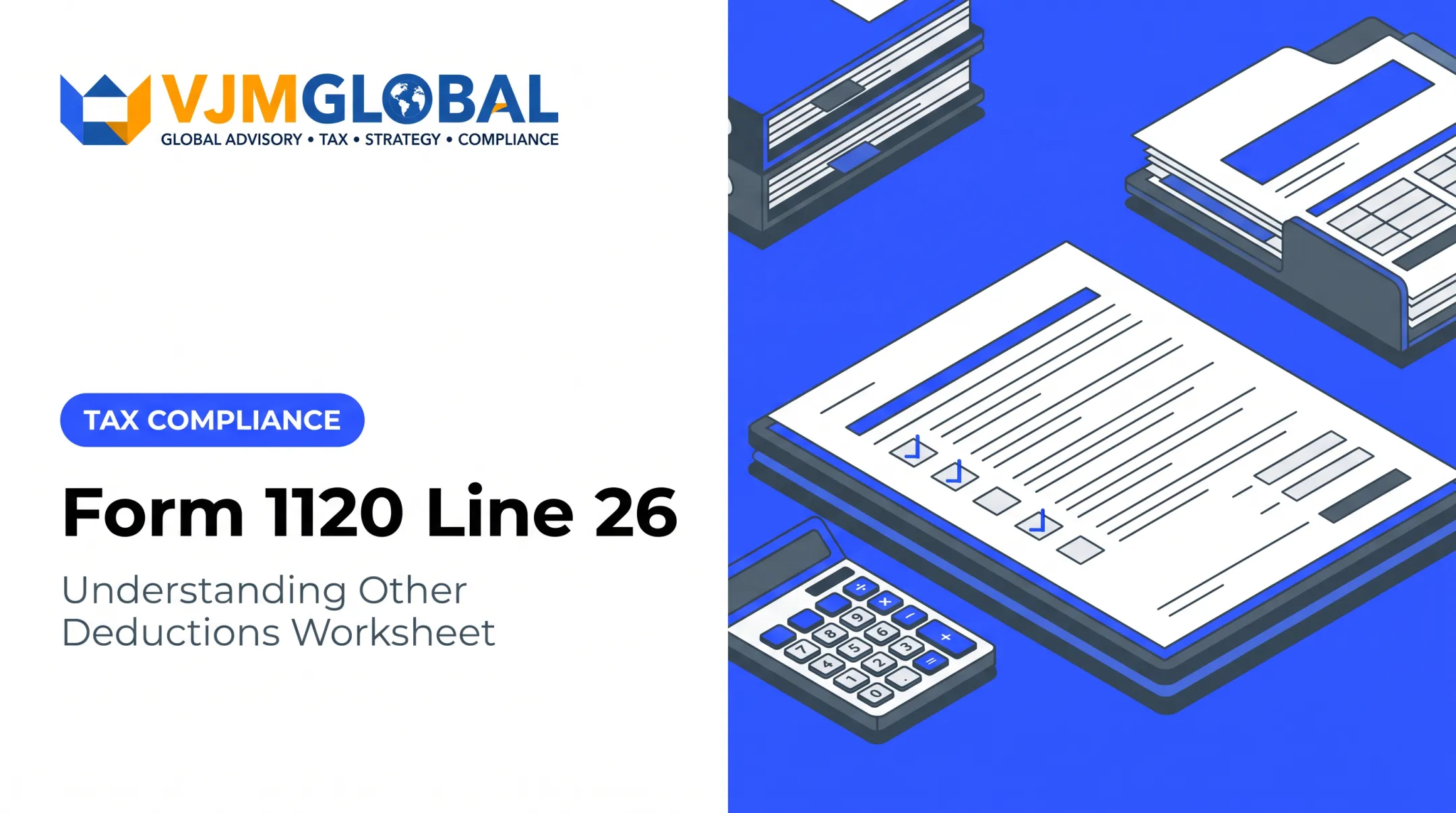
Line 26 on Form 1120 is labelled "Other deductions." That label leaves many corporations unsure whether amortization belongs there or on a different line.
The confusion runs deeper than the label. Amortization, depreciation, interest and loan principal often sit side by side in the same ledger, yet each follows different tax rules. Treatment depends on the type of cost and the IRS instructions for the tax year.
This guide covers U.S. corporations filing Form 1120. It explains when amortization belongs on Line 26, how it differs from related deductions, and what detail the IRS expects.
It does not cover Form 1120-S, Form 1065 or individual returns. It is educational, not individualised tax advice.
Key Takeaways
- Allowable amortization not claimed on another line generally goes on Line 26, with a supporting statement.
- Book amortization and deductible tax amortization often differ.
- Loan principal repayments are never amortization deductions.
- Reconcile Line 26 with Form 4562, your tax schedule and source documents before filing.
What Is IRS Form 1120 Line 26?
Line 26's role on the corporate tax return
Line 26 captures allowable deductions that don't belong on Lines 12 through 25. Its amount feeds Line 27 (total deductions, the sum of Lines 12 to 26). Line 28 then subtracts Line 27 from Line 11 to give taxable income before net operating loss (NOL) and special deductions, according to the 2025 Form 1120.
Capitalisation rules and expense limits still apply. Landing on Line 26 doesn't make a cost deductible.
What does "other deductions" include?
The 2025 instructions list examples such as:
- Amortization (referencing Form 4562, Part VI)
- Certain startup and organizational costs
- Legal and professional fees
- Insurance premiums, utilities and supplies used and consumed
- Qualifying section 181 production costs and reforestation costs
Each item must be separately supportable. Line 26 is not a catch-all for costs that belong on another line, that must be capitalised, or that aren't deductible at all.
Required statement and supporting detail
Corporations attach a statement listing the type and amount of each Line 26 deduction. For amortization, name the specific category and the current-year amount. Confirm the exact attachment requirements in the current-year Form 1120 instructions.
What Does Amortization Mean for Line 26?
A plain-English definition
Amortization spreads the tax cost of an eligible intangible asset or deferred cost over a fixed period, rather than deducting it all at once. The Form 4562 instructions describe it as similar to straight-line depreciation.
Hypothetical example (illustration only): A corporation acquires a customer list as part of a business purchase with an amortizable basis of $150,000 and a 15-year period. That is $10,000 a year.
| Year | Opening balance | Deduction | Closing balance |
|---|---|---|---|
| 1 | $150,000 | $10,000 | $140,000 |
| 2 | $140,000 | $10,000 | $130,000 |

First-year amounts can differ because recovery starts in the month of acquisition.
Amortization versus depreciation
Amortization commonly applies to intangibles and certain deferred costs. Depreciation generally applies to tangible property. Line 20 covers depreciation from Form 4562 not claimed elsewhere.
Both may involve Form 4562, but that doesn't let you shift a deduction between Line 20 and Line 26. The tax category controls placement. Off-the-shelf software is a common trap: section 167(f) allows 36-month depreciation, which belongs on Line 20, not Line 26.
Amortization versus interest and loan principal
A lender's amortization schedule splits payments into principal, interest and fees. Those pieces don't share one tax treatment.
- Principal repayment reduces debt. It is not an expense.
- Interest generally falls under IRC 163 and Line 18, subject to limits such as section 163(j).
- Loan fees need separate analysis.
Book amortization versus tax amortization
Financial statements may use different periods or methods than tax law. Schedule M-1 and, for larger corporations, Schedule M-3 reconcile those differences. M-3 is generally required at $10 million or more in year-end assets.
Never copy an accounting software expense into Line 26. First confirm tax basis, recovery period and eligibility.
Why classification matters
Misclassification can lead to:
- Duplicate or omitted deductions
- Unsupported Line 26 amounts
- Mismatches across Form 1120, Form 4562, the general ledger and the attached statement
What Types of Amortization May Be Reported on Line 26?
Acquired intangible assets
Section 197 allows 15-year ratable amortization starting in the acquisition month. Covered items include:
- Goodwill and going-concern value
- Workforce, customer and supplier relationships
- Trademarks, trade names and franchises
- Acquisition-related noncompetes
See IRC 197.
Exclusions matter. Most self-created intangibles, interests in land and qualifying off-the-shelf software fall outside it. Anti-churning rules also restrict certain legacy intangibles.
Startup and organizational costs
These are separate regimes with similar mechanics:
- Startup (IRC 195): deduct the lesser of eligible costs or $5,000, reduced by costs above $50,000. Amortize the rest over 180 months from when the business begins.
- Organizational (IRC 248): the same $5,000/$50,000 structure, then 180 months. Stock-issuance and selling costs are excluded.
Elections are deemed made in the start year. A timely return can elect capitalization instead, and elections are irrevocable.
Loan fees and debt issuance costs
No single code section covers every loan fee. Treatment depends on the cost type:
- Borrower issuance costs (Reg. 1.446-5): recover over the debt term as original issue discount using a constant-yield method, not straight-line
- Points and prepaid interest: cash-method taxpayers follow IRC 461(g)
Software, leases and other deferred costs
- Acquired software outside section 197: 36 months, straight line
- Business lease acquisition costs: spread over the lease term (Reg. 1.162-11)
- Domestic research and software development: section 174A, generally for years beginning after December 31, 2024
- Foreign research: 15 years under section 174
Establish ownership, acquisition date, business use, basis and recovery period before entering an amount.

Items that don't belong on Line 26 as amortization
- Loan principal
- Personal expenses
- Unsupported book entries
- Ordinary repairs
- Costs required to be capitalized
Also check whether an item belongs on another Form 1120 line, Form 1125-A (cost of goods sold) or a separate schedule.
How to Calculate, Document, and Report Amortization
Step 1: Identify the asset or cost
Record each of the following before you calculate anything:
- What was bought or incurred
- Who incurred it and the business purpose
- Acquisition or service date
- Tax basis
- Related contract or invoice
Classify the item under the correct tax provision next.
Step 2: Confirm the period and method
Recovery period and method depend on the category, facts and elections. Start dates differ by provision:
- Section 197: acquisition date
- Sections 195 and 248: business start date
- Software: placed-in-service date
Verify against current IRS instructions, the Code and regulations, not the book schedule.
Step 3: Calculate the current-year deduction
- Determine the amortizable tax basis.
- Apply the required method.
- Account for the start date.
- Pro-rate for the corporation's tax year.
Adjust for additions, prior-year deductions, disposals, changes in use and remaining basis.
Step 4: Reconcile supporting forms
Form 4562 Part VI has columns for cost description, start date, amount, code section, period and current-year amortization. Line 42 covers amortization beginning this year, Line 43 earlier costs, and Line 44 is the total.
Form 4562 is generally required for new amortization. Form 4562 instructions allow an exception for non-research amortization that began in earlier years: report it directly on Line 26 with a statement. Check that nothing is also claimed on Line 20.
Step 5: Enter Line 26 and prepare the statement
Enter only the allowable current-year amount not reported elsewhere. The statement should:
- List each category, description and amount
- Reference the amortization schedule
- Explain any book-to-tax difference
Step 6: Retain documentation
Keep:
- Purchase agreements and loan documents
- Invoices and payment records
- Tax elections and basis calculations
- Amortization schedules and prior-year returns
- Form 4562 support and the Line 26 statement
A reviewer should be able to trace each amount from transaction to ledger, workpapers, Form 4562 and Line 26. IRS guidance generally says to keep records for 3 years, or 6 years if you omit income exceeding 25% of reported gross income.

Common Mistakes and When to Get Professional Help
Common Line 26 errors
- Reporting a full loan payment as amortization
- Confusing principal, interest and fees
- Relying on a lender's schedule without splitting those amounts
- Copying book amortization into the return
- Omitting the Line 26 statement
- Using an outdated Form 1120
- Reporting the same amount on Lines 20 and 26
Errors can trigger a 20% accuracy-related penalty under IRC 6662, though reasonable cause may be a defence.
Tax issues requiring additional review
Seek professional review for:
- Acquired goodwill or other intangibles
- Related-party transactions
- Startup or organizational costs
- Debt refinancing
- Accounting method changes (Form 3115)
- Asset disposals
- Foreign ownership
- Large book-to-tax differences
Foreign ownership brings a separate filing requirement. Corporations with at least 25% foreign ownership may need Form 5472, and failure to file properly can draw a US$25,000 penalty.
Confirm the entity's tax classification before applying Form 1120 guidance to any other entity type.
Professional support
Australian businesses and other cross-border companies can get US tax compliance, accounting and Form 1120 support from VJM Global, working with professionals who handle international operations.
Frequently Asked Questions
Is amortization reported on line 26 of IRS Form 1120?
Generally yes, when it is allowable and not deductible on another line. Attach the required statement and follow the current-year instructions.
What is the IRS code section for amortization of loan fees?
No single section covers every loan fee. Borrower issuance costs generally fall under Reg. 1.446-5, with OID under IRC 163(e). Prepaid interest and points are analysed separately.
What is the difference between amortization and depreciation on Form 1120?
Amortization recovers qualifying intangible or deferred costs, while depreciation recovers tangible property. Depreciation generally goes on Line 20, amortization on Line 26.
Do I need to attach Form 4562 for amortization on line 26?
Generally for amortization beginning this year. Qualifying earlier-year non-research amortization can be reported directly with a statement. Reconcile Form 4562, Line 26 and the statement.
Can I deduct loan principal payments as amortization on Form 1120?
No. Principal repayment reduces the loan balance and isn't an amortization expense. Interest and eligible fees need separate analysis.