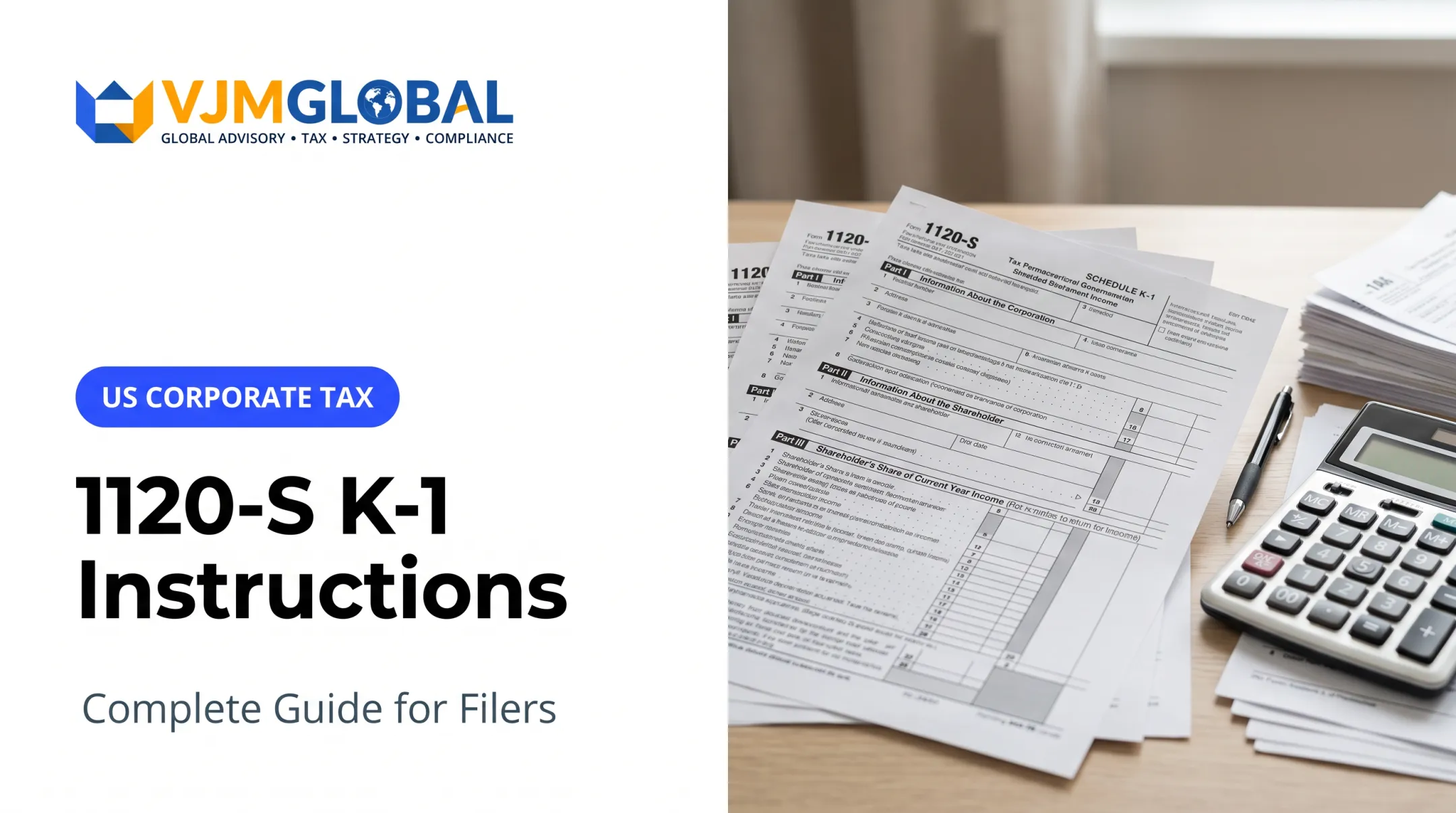
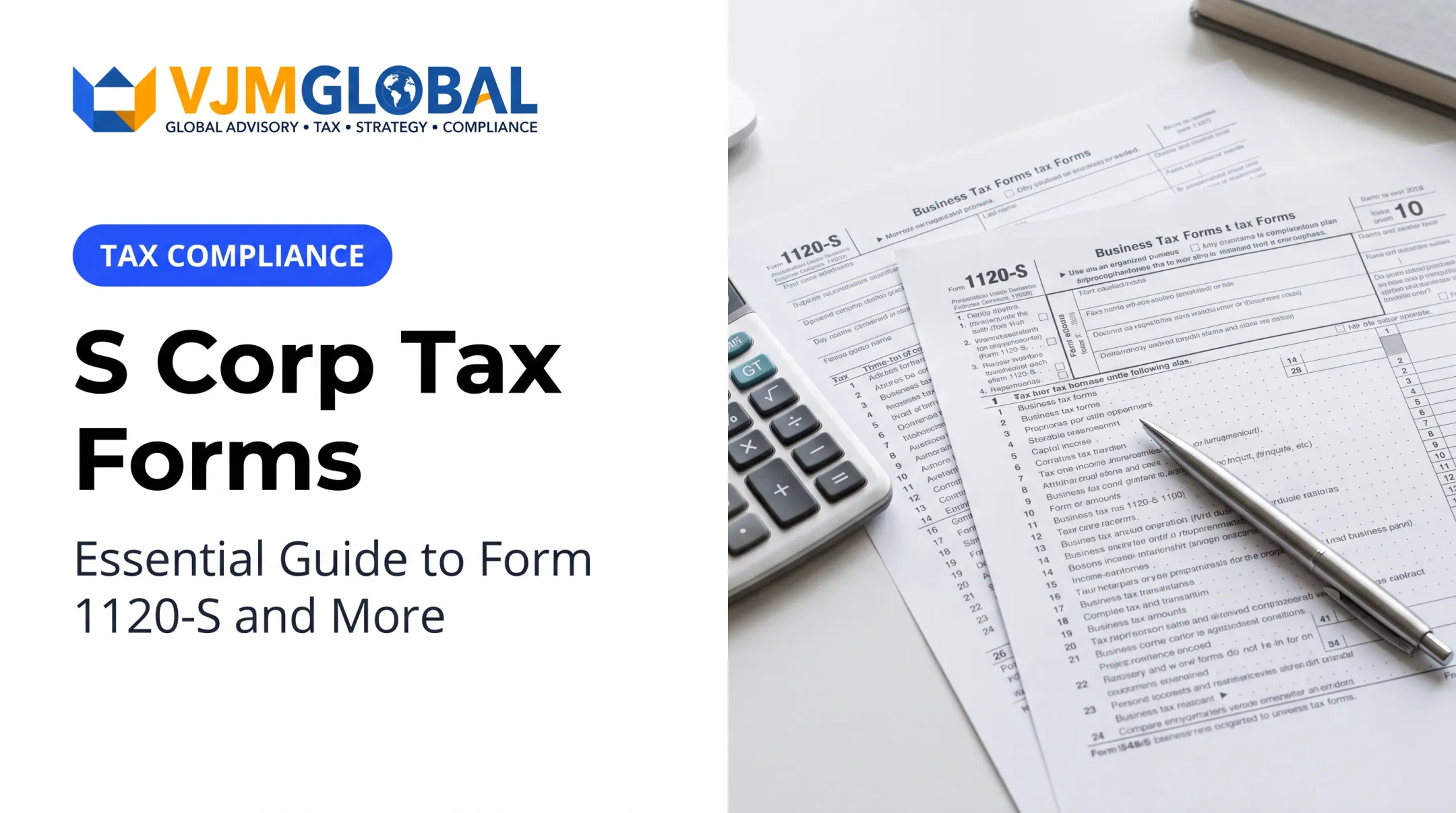
The distinction matters because the business and its owners are taxed differently. The corporation files Form 1120-S, but shareholders generally pick up their share of income, deductions, and credits on their personal returns using a Schedule K-1.
For Australian business owners and investors with a stake in a US company, this difference between status and paperwork gets confusing fast. This article covers S corporation eligibility, what Form 1120-S actually contains, filing deadlines, how shareholders report their share, and the compliance traps that catch people out. Everything here reflects US federal rules; state-level and cross-border obligations need separate checking.
Key Takeaways
- Form 1120-S is an annual information return, not the name of a business entity.
- S corporations use pass-through taxation, with items allocated to shareholders via Schedule K-1.
- A corporation or eligible LLC must make a valid S election and keep meeting eligibility rules.
- Shareholders can owe tax on allocated income even without receiving any cash.
- Wages, distributions, and pass-through income each follow different tax treatment.
What Is Form 1120-S, and Is It the Same as an S Corporation?
Form 1120-S is officially titled "U.S. Income Tax Return for an S Corporation." It reports the business's income, losses, deductions, credits, shareholder information, and other tax items to the IRS for the year.
Three separate ideas get muddled here, and it helps to pull them apart:
- A corporation is a legal business entity, formed under state law.
- An S corporation is a federal tax status, created through a valid Subchapter S election.
- Form 1120-S is the annual return used to report that S corporation's activity to the IRS.
Not every filer of Form 1120-S started life as a corporation, either. An eligible LLC can elect S corporation tax treatment without converting its legal structure, which is a common path for smaller US operations.
How Form 1120-S Compares to Other Business Returns
| Return | Who typically files it | How income reaches owners |
|---|---|---|
| Form 1120 | C corporations | Corporation pays tax on its income; distributed dividends can be taxed again to shareholders |
| Form 1065 | Partnerships | Information return; profit and loss flow through to partners |
| Form 1120-S | Entities with an effective S election | Tax items generally pass through, though some entity-level taxes can still apply |
Filing Form 1120-S doesn't mean the business is free of other obligations. Payroll taxes, certain corporate-level taxes, state filings, and other liabilities may still apply depending on the specifics of the business.
How S Corporation Income Reaches Shareholders
The pass-through mechanism runs through a short chain of documents:
- Form 1120-S reports the S corporation's annual results
- Schedule K summarises items allocated across all shareholders
- Schedule K-1 breaks that total into each shareholder's share
The shareholder then transfers the relevant K-1 figures onto Form 1040.
Here's the part that trips up a lot of first-time shareholders: allocated income and cash distributions are not the same thing. Taxable income can pass through to a shareholder even if the money stays in the business and no cash ever moves. A distribution, by contrast, is an actual transfer of cash or property, and it's taxed under its own set of rules.

Three Categories Every Shareholder Should Track
- Wages paid to a shareholder-employee, reported through payroll and Form W-2
- Pass-through income or loss reported through Schedule K-1
- Distributions, which generally reduce stock basis and can trigger tax when basis limitations or other rules kick in
Shareholder-employees who perform real services for the business generally need to be paid reasonable wages before any remaining profit is treated as a distribution.
The IRS weighs duties, training, time commitment, and what comparable businesses pay for similar work, per the IRS compensation guidance. Labelling a payment "distribution" does not settle the question on its own; the IRS can and does reclassify underpaid wages.
Basis tracking matters too. Losses can only be deducted up to a shareholder's basis, and non-dividend distributions are generally tax-free only to the extent of stock basis. Anyone claiming an S corporation loss, receiving a non-dividend distribution, or disposing of stock should check whether Form 7203 is required for the year.
Eligibility, Elections, and Who Must File
Before a business can file as an S corporation, it needs a valid and effective election in place, typically made on Form 2553. Filing Form 1120-S without that election first isn't an option.
Core federal eligibility requirements worth confirming against current IRS guidance include:
- Domestic status (a domestic corporation or eligible domestic entity)
- Permitted shareholders, generally individuals, estates, certain trusts, and specified exempt organisations
- A cap of 100 shareholders, with special counting rules for spouses and family members
- One class of stock, disregarding differences in voting rights
- No nonresident alien shareholders holding shares directly, per the Form 2553 instructions
An S corporation generally files Form 1120-S every year the election stays in effect, even if the business had minimal or no activity. There's no blanket exemption for a quiet year.
Electing S status doesn't change an LLC's legal structure. The LLC remains an LLC under state law; the election only changes its federal tax classification, while adding payroll and compliance responsibilities that didn't exist before.
A Note for Australian Owners and Investors
A nonresident alien can't directly hold shares in a US S corporation, which rules out some straightforward ownership structures for Australian individuals.
Beyond eligibility, withholding rules, state tax obligations, and treaty considerations under the US-Australia tax convention affect how income is taxed on both sides of the Pacific. None of this can be worked out from Form 1120-S alone; it depends on the ownership structure and needs advice tailored to the facts.

What Form 1120-S Reports and How to File It
Preparing an accurate return starts well before anyone opens the form. Useful records to pull together include:
- Income statement and balance sheet
- Trial balance and general ledger
- Fixed-asset and depreciation records
- Payroll reports
- Shareholder ownership details
- Prior-year return and records of estimated tax payments
Once the records are in hand, the return itself breaks down into a few main parts:
- The main income and deduction section reports gross receipts, cost of goods sold, compensation, rent, interest, depreciation, taxes, and other deductible expenses.
- Schedule B captures required business and shareholder details.
- Schedule K summarises pass-through income, deductions, credits, and other separately stated items.
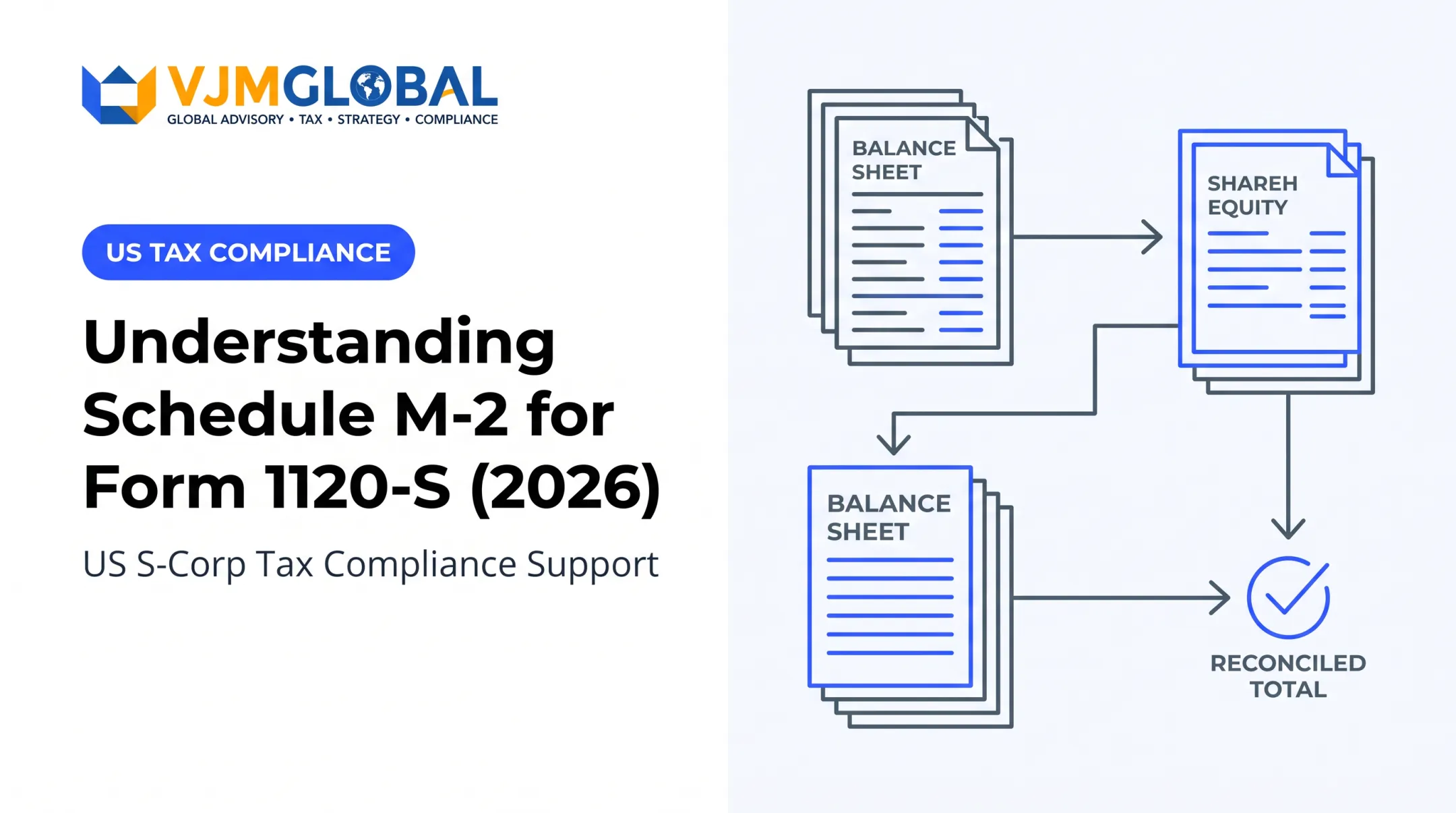
- Schedules L, M-1, and M-2 cover balance-sheet information, book-to-tax reconciliation, and accumulated adjustments where required.
The return also feeds a separate Schedule K-1 for each shareholder. If ownership changed hands during the year, those allocation calculations get more involved.
Deadline: Form 1120-S is generally due on the 15th day of the third month after the tax year ends, moving to the next business day if that date falls on a weekend or legal holiday. Always confirm the exact date for the relevant tax year against current IRS instructions.
Need more time? Filing Form 7004 generally buys a six-month extension. But an extension to file is not an extension to pay. Any tax owed still needs to be estimated and paid by the original deadline, and shareholder payment obligations don't move either.

For businesses juggling this alongside Australian reporting requirements, VJM Global helps assemble the underlying records, prepares Form 1120-S, and coordinates the shareholder K-1 information needed on both sides of the filing.
Common Compliance Issues and Preparation Checklist
A handful of errors show up repeatedly in S corporation filings:
- Filing Form 1120 by mistake instead of Form 1120-S
- Missing or late Schedule K-1s
- Inconsistent ownership percentages across schedules
- Unsupported deductions
- Incorrect shareholder basis calculations
- Incomplete balance-sheet schedules
- Failure to reconcile book and tax figures
Payroll deserves particular attention. Shareholder-employees need their wages separated clearly from distributions, with payroll tax compliance maintained throughout the year rather than patched together at tax time.
Year-End Checklist
- Reconcile bank accounts, revenue, expenses, loans, shareholder contributions, and distributions
- Update fixed-asset and depreciation records
- Confirm shareholder names, tax ID details, ownership changes, and beginning/ending basis
- Gather payroll filings, Forms W-2 and 1099, prior-year adjustments, and state tax information
Penalties for late filing are charged per month (or part-month) the return is overdue, multiplied by the number of shareholders during the year. The per-shareholder rate changes annually, so confirm the figure for the specific tax year rather than relying on a prior-year amount.
Professional review matters most when a filing involves any of the following:
- Late elections or amended returns
- Multiple shareholders or ownership changes
- International owners or foreign transactions
- Large losses
- Distributions with unclear tax treatment
Frequently Asked Questions
What is US tax form 1120?
Form 1120 is generally the federal income tax return for a C corporation, separate from Form 1120-S used by S corporations. Which one applies depends entirely on the entity's underlying tax classification.
What does it mean to be taxed as an S corp?
It means pass-through taxation: business items get reported on Schedule K-1 and taxed at the shareholder level rather than the corporate level. Shareholder-employees still need reasonable wages through payroll, and the corporation may have other tax obligations beyond income tax.
Where does income from S corp go on 1040?
Shareholders use Schedule K-1 to move different income, deduction, credit, and loss items to the matching Form 1040 schedules. The exact landing spot depends on the type of item, with ordinary business income commonly flowing to Schedule E.
Do S Corp distributions count as earned income?
No. Distributions are generally not wages or earned income for payroll purposes, unlike shareholder-employee wages or self-employment income. Their actual tax treatment still depends on stock basis, reasonable compensation already paid, and the shareholder's broader situation.