Introduction
A Form 1099-R does not mean a Roth IRA paid you. The form reports distributions from traditional IRAs, Roth IRAs, employer plans, pensions, annuities, and conversions. Guess wrong and you can misreport income or trigger an avoidable penalty.
For a US taxpayer in Australia, the stakes are higher. US citizens and resident aliens generally owe US tax on worldwide income, wherever they live. Australian treatment is a separate question.
This guide walks through the review: Box 7, the IRA checkbox, Box 2 details, your account statement, Form 5498, and transaction history.
Key Takeaways
- Box 7 codes J, Q, and T mark a Roth IRA or Roth SIMPLE IRA; Code B marks an employer-plan Roth.
- The IRA/SEP/SIMPLE checkbox cannot separate Roth from traditional.
- A blank Box 2a does not mean the payout is tax-free.
- Match the form to statements and Form 5498 before filing.
- Never edit the form; request a corrected one.
What You Need to Check on Form 1099-R
No single box answers the question. Read several fields together.
Form fields and documents to gather
Gather a complete copy of the form and look at:
- Payer name
- Box 1 (gross distribution) and Box 2a (taxable amount)
- Box 2b indicators
- Box 4 (federal tax withheld)
- Box 7a distribution code
- Box 7b, the IRA/SEP/SIMPLE checkbox
The 2026 form labels the code box 7a and the checkbox 7b. Older forms show a single Box 7 and the checkbox beside it.
Then collect your account statement, distribution confirmation, Form 5498, and records of Roth contributions, conversions, rollovers, and recharacterisations.
Before you start
- Confirm the tax year and that the form is yours. Compare the payer name and account reference with your statement.
- Download the current IRS Instructions for Forms 1099-R and 5498. Code meanings change.
- Protect documents that carry your Social Security number and account numbers. Use encrypted or password-protected files when sharing them with a preparer, and never send them by plain email.
Methods to Identify Whether Your 1099-R Is From a Roth IRA
Use all three methods together. When the form is ambiguous, account records win.
Method 1: Read the Box 7 Distribution Code
Box 7 names the transaction type. The Roth IRA codes are:
| Code | IRS definition |
|---|---|
| J | Early distribution from a Roth IRA, no known exception |
| Q | Qualified distribution from a Roth IRA |
| T | Roth IRA distribution, exception applies |
Q means the payer knows the five-year period is met. T means the payer does not know, but age 59½, death, or disability applies. J can pair with 8, P, or S. Q and T cannot be combined with any other code.
Steps:
- Copy the exact code, number and letter, from the form.
- Compare it with the current IRS description and check whether it names a Roth IRA or Roth SIMPLE IRA.
- Confirm it fits your statement and what actually happened.

Pros: It is the fastest route to a likely answer.
Cons: It won't settle a conversion, a Roth 401(k) payout, or a payer coding error.
Method 2: Review the IRA Indicator and Payer Records
Box 7b tells you the form relates to an IRA-type account. It does not tell you which kind. The IRS says to check it for a traditional IRA or a Roth SIMPLE IRA, but not for an ordinary Roth IRA. So a checked box doesn't exclude Roth, and an unchecked box doesn't exclude it either.
Steps:
- Note whether 7b is checked and record the payer's account description.
- Look on the statement or distribution notice for wording such as "Roth IRA," "Traditional IRA," "Roth SIMPLE IRA," "Roth 401(k)," or "designated Roth account."
- Contact the payer if the form says only "IRA" or the description conflicts with the code.
Pros: Payer records confirm account type more reliably than the form.
Cons: The payer may not know your full Roth history and may need to issue a corrected form.
Method 3: Cross-Check Form 5498 and Transaction History
Form 5498 shows what went into your IRAs. Its relevant boxes:
- Box 10: Roth IRA contributions (excludes Roth SEP and Roth SIMPLE contributions)
- Box 2: rollover contributions
- Box 3: traditional-to-Roth conversion amounts
- Box 4: recharacterised contributions
- Box 7: IRA type
Steps:
- Check whether Form 5498 shows Roth contributions, conversions, rollovers, or recharacterisations for the year.
- Match the 1099-R amount and date to an account transaction. Decide whether money left a Roth IRA, a traditional IRA, or an employer plan.
- If records disagree, ask the custodian to explain and request a corrected form.

One timing note: contribution information on Form 5498 is due by May 31 of the following year, so it often arrives after 1099-R.
Pros: Best for conversions, rollovers, multiple IRAs, and inherited accounts.
Cons: It needs more records and may involve basis calculations the 1099-R doesn't show.
How to Interpret the Results
Identifying the account is separate from deciding what's taxable. A confirmed Roth IRA distribution can be qualified, nonqualified, partly taxable, or subject to additional tax.
Reading the Signals
- Strong Roth indicator: J, Q, or T in the code box, with payer records naming a Roth IRA or Roth SIMPLE IRA.
- Ambiguous: Blank Box 2a, "taxable amount not determined," or a generic IRA label. Blank is not zero for Roth IRAs; compare Form 5498 and account history.
- Not an ordinary Roth IRA withdrawal: Code B marks a designated Roth account in an employer plan. Code H marks a direct rollover from that account into a Roth IRA.
- Possibly traditional or a conversion: Codes 2 or 7 with the IRA box checked. The IRS says not to use code 7 for a Roth IRA; the conversion 1099-R comes from the traditional account.
What Happens Next
Nonqualified Roth distributions come out in this order:
- Regular contributions
- Conversions and rollovers
- Earnings

A 10% additional tax generally applies to the taxable part unless an exception applies.
US tax reporting uses these forms:
- Form 1040: IRA distributions on line 4a, taxable amount on 4b
- Form 8606: nonqualified Roth distributions and conversions
- Form 5329: additional tax on early distributions
If you live in Australia, get separate advice on local consequences. The ATO says most foreign pensions and annuities are taxable in Australia, but its guidance doesn't expressly address Roth IRAs.
Common Errors in Checking a 1099-R and Safety and Best Practices
Common Errors
- Treating the IRA checkbox as proof of Roth, or Box 1 as the taxable amount. Box 1 is gross, before withholding.
- Confusing a Roth IRA with a Roth 401(k) or 403(b). The IRS treats a designated Roth account as a separate account inside an employer plan.
- Assuming Q, J, T, a blank Box 2a, or a zero taxable amount ends the review. Five-year rules, contribution basis, and conversion records still matter.
- Mixing up the two five-year rules. Qualified-distribution timing differs from conversion recapture, where each conversion has its own five-year clock.
Safety and Best Practices
- Never alter Box 7, Box 2a, or any other field. Ask the issuer for an explanation or corrected form, and keep the originals.
- Redact unnecessary personal details when seeking general guidance, and use secure channels for document review.
- If no corrected form arrives in time, IRS Topic 154 explains the Form 4852 substitute.
Get professional review for multiple IRAs, Roth conversions, inherited accounts, missing basis records, corrected forms, or cross-border filing.
VJM Global's tax professionals are trained in US tax law, IRS regulations, and Form 1040, and the firm prepares US individual returns. This service does not cover Australian tax advice, so keep those questions with your local adviser.
Conclusion
Box 7 gives the strongest first clue, but check it alongside the IRA checkbox, account statement, Form 5498, and transaction records.
Distribution codes to watch:
- J, Q, and T generally point to Roth IRA distributions
- Code B usually means a Roth employer-plan account
- Codes 2 or 7 call for more digging
Where details conflict, ask the issuer. If the account type or tax treatment is still unclear, get professional help before you file.
Frequently Asked Questions
What does a 1099-R look like?
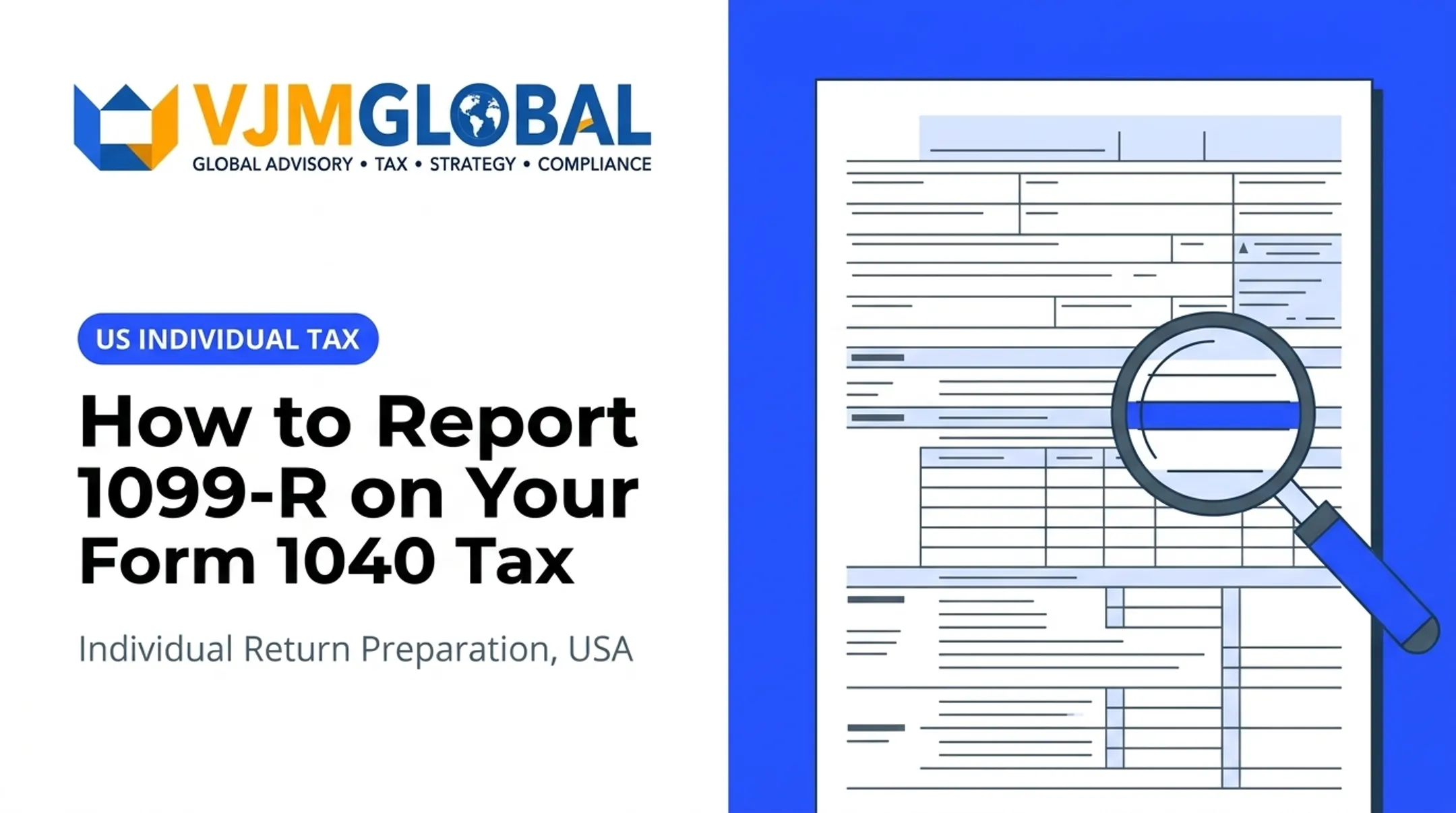
It lists payer and recipient details, then numbered boxes: Box 1 gross distribution, Box 2a taxable amount, Box 4 withholding, the distribution code, and the IRA/SEP/SIMPLE checkbox. Layout varies by issuer.
How do I tell if my IRA is Roth or not?
Codes J, Q, and T strongly suggest a Roth IRA. Confirm with your account statement, Form 5498, and payer records.
Is my 401(k) considered a Roth IRA?
No. A Roth 401(k) is a designated Roth account within an employer plan. It can later be rolled over to a Roth IRA under the applicable rules.
Which 1099-R Box 7 codes usually indicate a Roth IRA distribution?
Codes J, Q, and T. Code B generally identifies a designated Roth account in an employer plan, not a Roth IRA.
Does the IRA/SEP/SIMPLE box prove my 1099-R is from a Roth IRA?
No. It shows an IRA-related transaction but doesn't separate Roth from traditional. Confirm through the payer's records and Form 5498.
What should I do if the 1099-R code does not match my account records?
Compare the form with your statements, then ask the payer for clarification or a corrected form. Keep all documents, and get tax advice before filing if it stays unresolved.