Introduction
"Nonpassive loss allowed" on Schedule E does not mean every loss on the form reduces your wages or business income. The column label sounds like a green light. It isn't one.
Confusion usually comes from mixing up five things: Schedule E reporting, passive activity classification, material participation, active participation, and separate deduction limits. Each answers a different question.
This article sets out when a loss is nonpassive, when a passive loss gets limited relief, what records you need, and how Australian taxpayers with US income should approach it. Dollar amounts are US dollars unless marked A$.
Key Takeaways
- Schedule E reports results; the underlying activity decides passive or nonpassive.
- Nonpassive status still faces basis, at-risk and excess business loss limits.
- Active participation can unlock a limited deduction without making a rental nonpassive.
- US filing and Australian reporting are separate analyses.
What "Nonpassive Loss Allowed" Means on Schedule E
Schedule E is a reporting form, not a classification decision
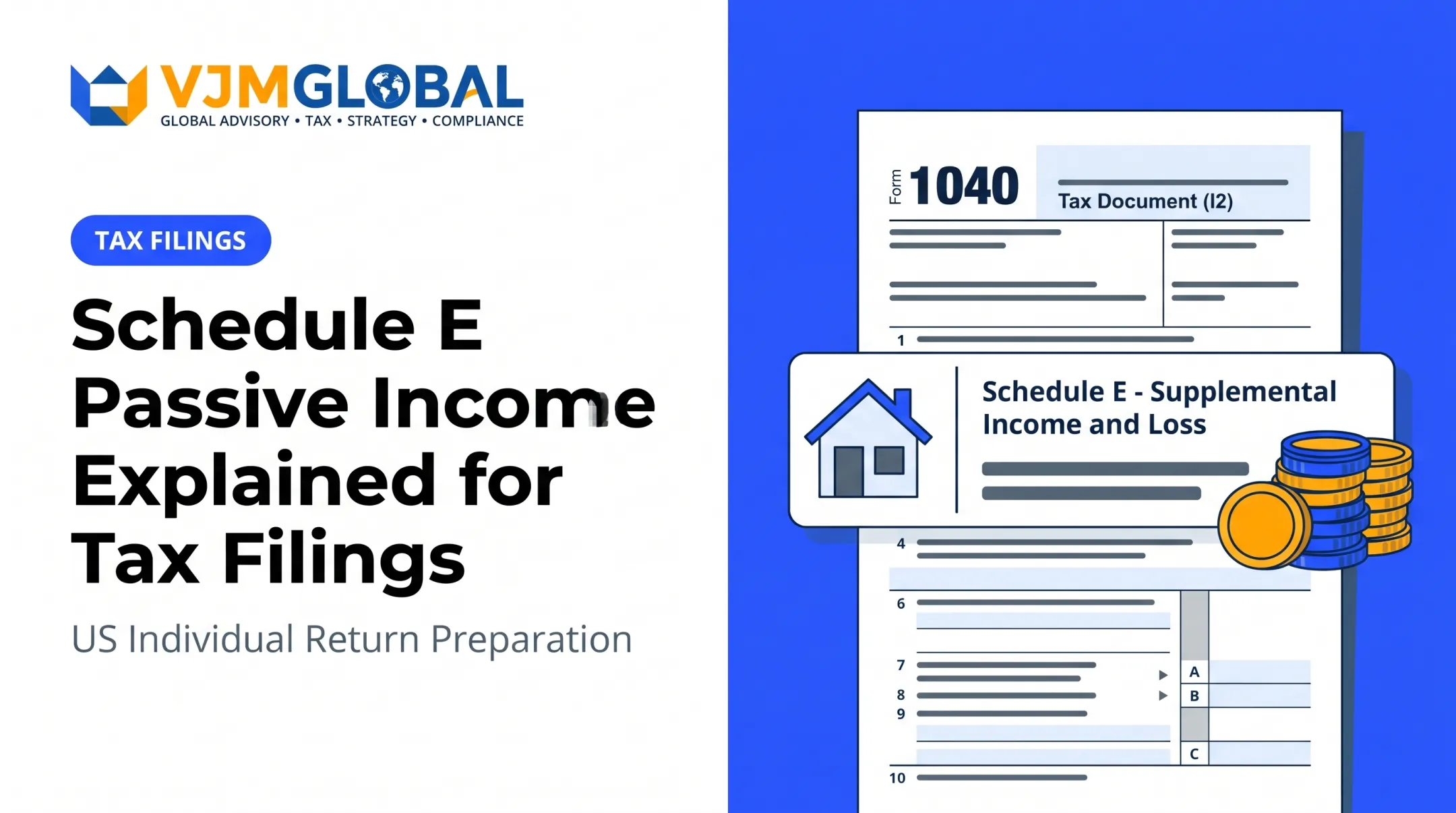
Schedule E has three main parts: Part I covers rental real estate and royalties, Part II covers partnerships and S corporations, and Part III covers estates and trusts. Line 28, column (i), in Part II is labelled "Nonpassive loss allowed" (see Schedule K-1).
The form records your share of results. Whether that share is passive depends on the facts, the rental rules and your participation level.
Nonpassive is not the same as deductible
A nonpassive loss comes from an activity that is not passive for you. It can still be cut back by:
- Basis limits (partnership or S corporation)
- At-risk rules (Form 6198)
- Passive rules (Form 8582)
- The excess business loss limit (Form 461)
For 2026, the excess business loss threshold is $256,000, or $512,000 on a joint return. So keep three words apart: "nonpassive" is a classification, "allowed" is a label on the form, and "deductible" is the final result.
How passive losses are handled
Passive losses generally offset only passive income. The excess is suspended and carried forward, not lost.
Suspended losses can be used against future passive income or released when you dispose of your entire interest in a fully taxable transaction to an unrelated person. Selling only part of an activity does not qualify.
A simple comparison
Picture one taxpayer with three Schedule E results:
- A rental loss, no special allowance: stays passive and is suspended.
- A K-1 loss from a business where they work full time: nonpassive, but only deductible up to basis and at-risk amounts.
- A rental loss with active participation and modest income: passive, yet partly deductible under the special allowance.

Same form, three different outcomes.
How a Schedule E Activity Becomes Nonpassive and When Losses Are Allowed
Rentals start as passive
Rental activities are generally passive, even where you do some management. Ownership or occasional oversight doesn't change that. You have to meet specific rules.
The material participation tests
The seven tests in Treasury Regulation 1.469-5T are alternatives. Meeting one is enough:
- More than 500 hours in the year.
- Your participation is substantially all participation by anyone.
- More than 100 hours, and no one else participates more.
- Significant participation activities that together exceed 500 hours.
- Material participation in any five of the previous ten years.
- Material participation in any three prior years (personal service activity).
- Regular, continuous and substantial participation on the facts (not available at 100 hours or less).
Meeting a test does not by itself override a rental's default passive treatment.
Real estate professional status
You need both:
- More than 750 hours in real property trades or businesses.
- More than half your personal services in those businesses.
On a joint return, one spouse must meet both on their own. Status alone isn't enough: you must also materially participate in each rental, unless you make the election to treat all rental interests as one activity.
Short-term rentals
Under the temporary regulations, an activity isn't a "rental activity" if average customer use is 7 days or less, or 30 days or less with significant personal services. That only removes the automatic passive label. You still need material participation.
Schedule C is a separate question. Substantial services mainly for occupants' convenience, such as regular cleaning or linen changes, can push reporting to Schedule C and bring self-employment tax.
The special $25,000 allowance
Active participation needs at least a 10% ownership interest and genuine management decisions, such as approving tenants or setting rents. The allowance:
- Is up to $25,000, reduced by 50% of modified adjusted gross income (MAGI) above $100,000, and gone at $150,000.
- Is $12,500 for separate filers who lived apart all year, phasing out from $50,000.
- Is unavailable to separate filers who lived together at any point.

IRS example: an unmarried landlord with $120,000 MAGI and $31,000 of rental losses deducts $15,000. The other $16,000 carries forward. The loss never became nonpassive.
Partnerships and S corporations
A K-1 loss is passive or nonpassive depending on your participation in the underlying business. Limited partners generally qualify only under tests 1, 5 or 6. Check grouping elections and ownership records. Test basis first, then at-risk, before treating any K-1 loss as allowed.
How to Report and Document a Nonpassive Schedule E Loss
Schedule E, Form 8582 and supporting schedules
Form 8582 applies when you have passive deductions, including prior-year suspended losses. A nonpassive loss alone doesn't trigger it. You typically do not need it when all of the following apply:
- Your only passive activities are actively managed rentals
- You have no prior suspended losses
- Your rental loss is $25,000 or less and MAGI is $100,000 or less (with the separate-filer variants)
Final deductibility can also turn on basis schedules, Form 6198, K-1 data, depreciation records and Form 461. A partnership K-1 supplies your share of items; it doesn't decide deductibility.
Build a participation file
Daily logs aren't compulsory. The regulation accepts any reasonable means, including calendars, appointment books and narrative summaries. Keep:
- Time logs kept through the year
- Task descriptions and property identification
- Emails and tenant communications
- Booking records and invoices
- Travel records
- Hours worked by managers and contractors
Credibility matters more than format. In Hailstock, detailed testimony succeeded without daily logs, though the court warned about future record keeping. In Manalo, reconstructed logs with vague entries and excessive hours failed.
A filing review workflow
- Reconcile books, K-1s, depreciation schedules and ownership records.
- Tie suspended-loss carryforwards to prior returns.
- Confirm each activity is classified consistently year to year.
- Allocate personal-use expenses.
- Run basis, at-risk, passive and excess business loss in that order.

Common Mistakes That Can Prevent a Schedule E Loss From Being Allowed
Confusing active and material participation
Approving tenants can support the special allowance for active participation. That step alone does not meet a material participation test or make the loss non-passive.
Treating Schedule E and Schedule C as interchangeable
Short stays don't settle everything. The services you provide drive Schedule E versus Schedule C, and self-employment tax follows.
Assuming a form or depreciation creates a deduction
A 1099 or K-1 reports information; it doesn't override loss limits on its own.
Residential rentals generally depreciate over 27.5 years, land is never depreciable, and depreciation stays subject to those limits.
Personal use matters too. A dwelling counts as a home if personal use exceeds the greater of 14 days or 10% of fair rental days. Rent a home for fewer than 15 days and the income isn't reported.
Escalate to a tax professional if any of these apply:
- Short-term rentals with guest services
- Any personal use of the property
- A K-1 with unclear basis
- Suspended losses that don't match prior returns
- A real estate professional claim
Australian Taxpayers With US Schedule E Income
Keep US and Australian obligations separate
Schedule E belongs to the US system. It may apply to Australians with US rental, partnership or S corporation income. Filing it doesn't determine what goes on your Australian return.
Residency, foreign income and offsets
Australian tax residents generally declare worldwide income, including foreign rent. Amounts convert to Australian dollars.
Foreign income tax offset (FITO) points:
- Foreign tax must be actually paid or deemed paid.
- Claims of A$1,000 or less skip the full limit calculation.
- Larger claims need an offset-limit calculation.
- The offset is non-refundable with no carry-forward.
US tax is not automatically creditable. Entity labels do not control Australian treatment. A US LLC, partnership or S corporation is classified under Australian rules separately.
Under the Australia-US treaty, property income may be taxed where the property sits, and Australian relief is subject to treaty conditions.
For Australians who are non-residents of the US, rents not connected to a US business face 30% tax on gross rents by default. A section 871(d) election allows net-basis taxation, filed with Form 1040-NR.

Where cross-border support helps
Coordinated bookkeeping, Schedule E and K-1 review, and documentation help most when two systems apply at once. VJM Global supports Australian and US-connected businesses with tax compliance and accounting coordination through its cross-border team, subject to engagement scope and your facts.
Frequently Asked Questions
When are losses allowed on Schedule E, and how do passive and nonpassive losses differ?
Passive losses generally offset only passive income. Nonpassive losses can offset nonpassive income, subject to basis, at-risk and other limits.
How do you tell whether Schedule E income is passive or nonpassive?
It depends on the underlying activity, rental rules, material participation, real estate professional status where relevant, and your ownership and involvement.
Can a passive rental loss offset wages or active business income?
Generally no. The special rental allowance of up to $25,000 may allow limited relief, but not every taxpayer qualifies.
Does active participation make a Schedule E loss nonpassive?
No. Active participation may provide limited relief while the activity stays passive. Material participation is a higher standard.
What records support a nonpassive claim?
Time logs, calendars, emails, management records and invoices, plus evidence of your hours relative to others involved.
Do Australian residents need to report US Schedule E income in Australia?
Often yes, but it depends on residency, income character, entity structure and current ATO rules. Coordinate US filing with Australian advice.