Introduction
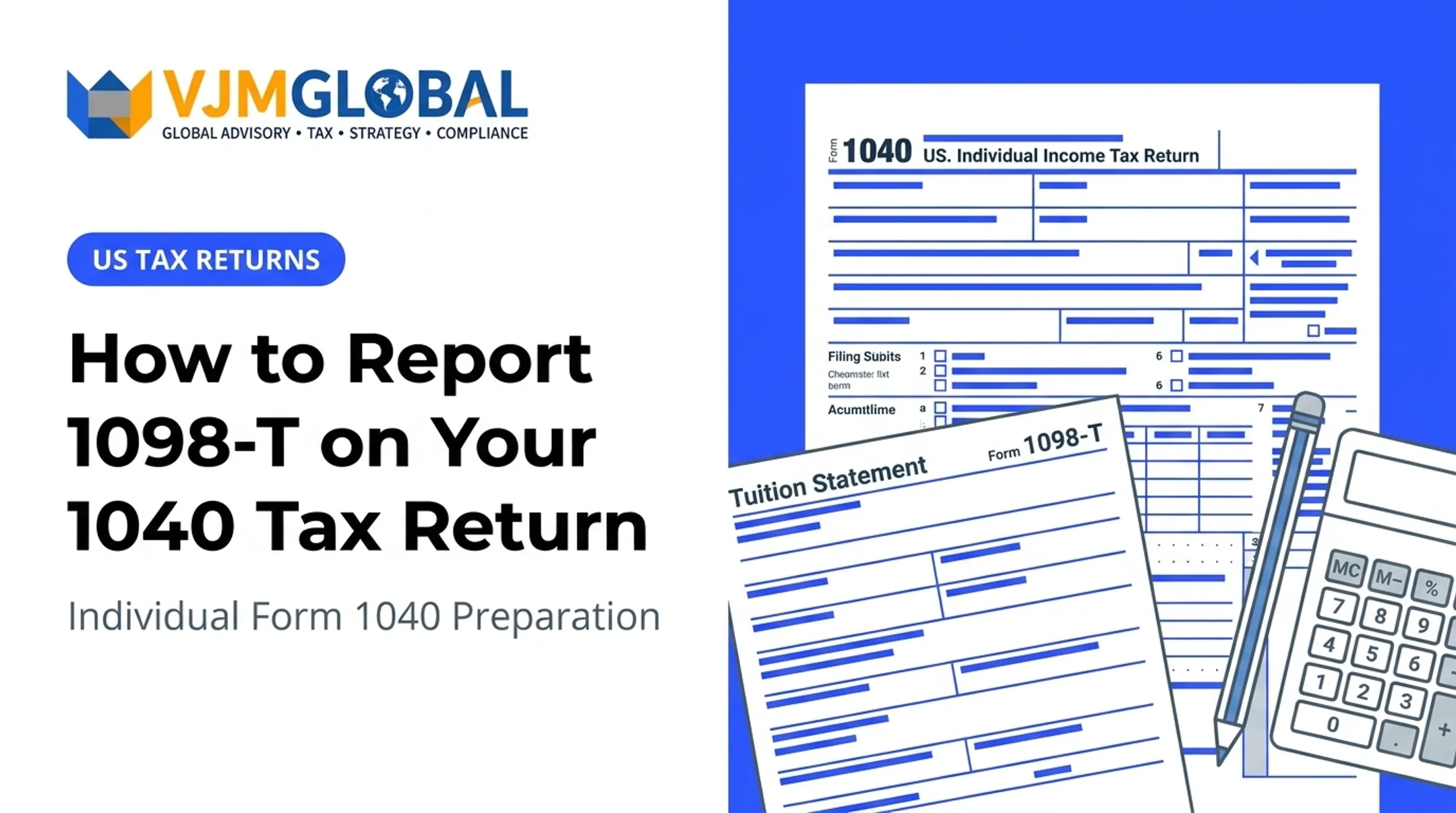
Form 1098-T has no line of its own on Form 1040 for tax year 2026. It is supporting information that helps you decide whether another form or schedule is needed.
Students, parents and Australian-based taxpayers filing a U.S. return often copy Box 1 or Box 5 straight onto the return. That is usually wrong.
The form leads to one of three outcomes:
- It supports an education credit on Form 8863
- It helps you identify taxable scholarship income
- It stays in your records and nothing is entered
One caveat: the 2026 Form 1040, Schedule 1, Schedule 3 and Form 8863 instructions were still marked draft in the latest IRS release. Line numbers below are provisional.
Key Takeaways
- Never enter Box 1 or Box 5 directly as wages, income or a deduction.
- Pair the 1098-T with payment records to test AOTC or LLC eligibility.
- Taxable scholarships follow a separate income route; some people have no entry at all.
- Check final 2026 IRS instructions for line numbers before filing.
What Form 1098-T Reports and Why It Matters
What is Form 1098-T?
A school issues Form 1098-T to report qualified tuition payments, scholarships and grants, and certain adjustments. It is an information statement. It does not calculate your credit, your taxable scholarship or your tax.
The boxes most relevant to a 2026 return
According to the 2026 IRS instructions, the key boxes are:
- Box 1: payments received in 2026 for qualified tuition and related expenses, less refunds made in 2026
- Box 4: 2026 refunds or charge reductions tied to amounts reported in a prior year
- Box 5: scholarships or grants administered and processed in 2026
- Box 6: reductions to scholarships or grants reported in a prior year
- Box 7: checked if a payment relates to a term beginning January to March 2027
- Boxes 8-10: half-time status, graduate programme status, and insurer reimbursements
Box 1 is not reduced by Box 5. Don't subtract one from the other yourself.
Why the 1098-T amount may not match your eligible expenses
Box 1 measures payments received in a calendar year. Timing, refunds, past-due balances, scholarships and early-2027 payments can all push it away from the expenses you can actually use.
Reconcile the form against:
- Student-account statements and tuition bills
- Receipts and payment confirmations
- Scholarship records
- Refund notices
Where Does Form 1098-T Go on Form 1040?
Does Form 1098-T have a dedicated line?
No. Don't treat it like a W-2 or 1099. You use it, with your records, to complete the education-credit form or the income-reporting schedule that applies.
If you claim an education credit
Use Form 8863 for the American Opportunity Tax Credit (AOTC) or Lifetime Learning Credit (LLC). Based on the draft 2026 forms:
- The nonrefundable credit goes from Form 8863 to Schedule 3, line 3.
- Schedule 3's credit total flows to Form 1040, line 20.
- The refundable AOTC goes to Form 1040, line 29.

These are draft line numbers. Confirm them against the final 2026 forms.
If a scholarship or grant is taxable
Box 5 is not automatically taxable. Amounts used for qualified tuition, fees and required course materials can be tax-free. Amounts applied to room, board or travel generally are taxable.
Per Publication 970, taxable scholarship or fellowship amounts not already reported as wages go on Schedule 1, line 8r. The draft 2026 Schedule 1 keeps line 8r and sends its total to Form 1040, line 8. The student reports this on their own return.
If neither applies
Receiving a 1098-T doesn't by itself require a Form 1040 entry. If you claim no credit and have no taxable assistance, nothing goes on the return. Keep the form and supporting records anyway, as the IRS may ask for them.
Australian note: Form 1098-T supports your U.S. federal return. Don't copy it onto an Australian return. Australian treatment needs separate advice.
How to Decide What to Report: Credit, Taxable Scholarship, or Neither
Identify who claims the student
If the student is claimed as a dependent, the person claiming them claims the credit. If a parent could claim the student but doesn't, the student may claim it. If nobody can claim the student, only the student can.
Parent and student must not both use the same expenses. Agree on the position before filing.
Check which expenses qualify
For AOTC, qualified expenses include tuition, required enrolment fees and course materials needed for the course. Room and board never qualify. Tax-free assistance and refunds reduce the amount available for a credit, and your records may support amounts that Box 1 doesn't show exactly.
Compare the AOTC and LLC
The table shows 2025 final figures, the latest complete set published.
| Feature | AOTC | LLC |
|---|---|---|
| Maximum | $2,500 per student | $2,000 per return |
| Refundable | 40% may be refundable | Nonrefundable |
| Duration | 4 tax years per student | All years of postsecondary study, plus job-skills courses |
| MAGI phase-out | $80,000-$90,000 single; $160,000-$180,000 joint | Same |
| Married filing separately | Cannot claim | Cannot claim |
The draft 2026 Form 8863 instructions show the same maximums and a $90,000 single / $180,000 joint upper limit. Treat these as draft until final guidance is out.

Consider taxable scholarships
Assistance used for required tuition, fees, books and supplies is treated differently from amounts used for room, board or travel. The taxable portion generally belongs to the student, even when a parent claims them as a dependent.
Check special circumstances
- Boxes 4 and 6: prior-year refunds can reduce expenses for the earlier year or require repaying a credit already claimed.
- Box 10: insurer reimbursements to the student.
- Calendar-year timing: payments in 2026 for terms starting in early 2027 may count.
- Australian-based filers: U.S. citizens and resident aliens living abroad generally follow the same filing rules as those in the U.S. (Publication 54). Form 1040-NR filers cannot claim education credits; confirm your form and status allow the credit.

Filing Checklist and Common 1098-T Mistakes
Documents to gather
- Current and prior-year Forms 1098-T
- Tuition bills and student-account statements
- Proof of payment and refund notices
- Scholarship, grant and employer-assistance records
- Enrolment information and dependency details
Check the student's name and taxpayer identification number. Form 8863 requires a valid SSN. If the form is wrong, ask the school for a corrected one. Don't edit it yourself.
Mistakes to avoid
- Entering Box 1 as wages
- Subtracting Box 5 from Box 1 mechanically
- Treating every scholarship as taxable
- Letting parent and student claim the same expense
- Assuming the form must be attached
Form 8863 is what you attach when claiming a credit. The 1098-T stays in your records.
When professional review is worthwhile
Consider a tax professional if you have:
- Missing or corrected forms
- Prior-year adjustments
- Taxable scholarships
- Complex dependency questions
- Uncertainty over Form 1040 versus 1040-NR
VJM Global's U.S.-compliant tax professionals support Form 1040 and 1040-NR preparation and review, including cross-border filing situations. Outcomes depend on your facts and circumstances.
Frequently Asked Questions
Where does Form 1098-T go on Form 1040?
It generally doesn't go on Form 1040 directly. It supports Form 8863 for an education credit, or Schedule 1 for taxable scholarship amounts.
Do I have to attach Form 1098-T to my tax return?
No. Keep it with your records. You attach Form 8863 when claiming a credit.
Who claims the 1098-T, the parent or the student?
Whoever properly claims the student as a dependent claims the credit. If nobody does, the student claims it, subject to eligibility rules.
Is it worth claiming 1098-T?
The form is not a benefit itself. An education credit may be worthwhile if you qualify and have eligible expenses. The result depends on income, filing status, dependency and tax liability.
Why didn't I get a 1098-T from my school?
Schools needn't issue one for non-credit courses, nonresident alien students who don't request it, or students whose costs were fully waived or covered by scholarships. Check the student portal and contact the school.
What happens if Box 5 is greater than Box 1?
The difference isn't automatically taxable. Work out how the aid was used, whether qualified expenses exist elsewhere, and whether any taxable part belongs on the student's return.