This guide covers U.S. federal reporting and is written for Australian founders, investors and businesses with U.S. operations. Being incorporated or resident in Australia doesn't by itself decide which form applies.
Below: who files each form, how income reaches owners, how Schedule K-1 works, the compliance workload, and when to get professional review.
Key Takeaways
- Schedule C reports sole-proprietor or disregarded single-member LLC activity on the owner's Form 1040.
- Form 1065 is a partnership information return; Schedule K-1 passes each partner's share through.
- Ownership, classification and elections control the form, not which looks simpler.
- Australian owners may face extra US state tax, withholding and international reporting.
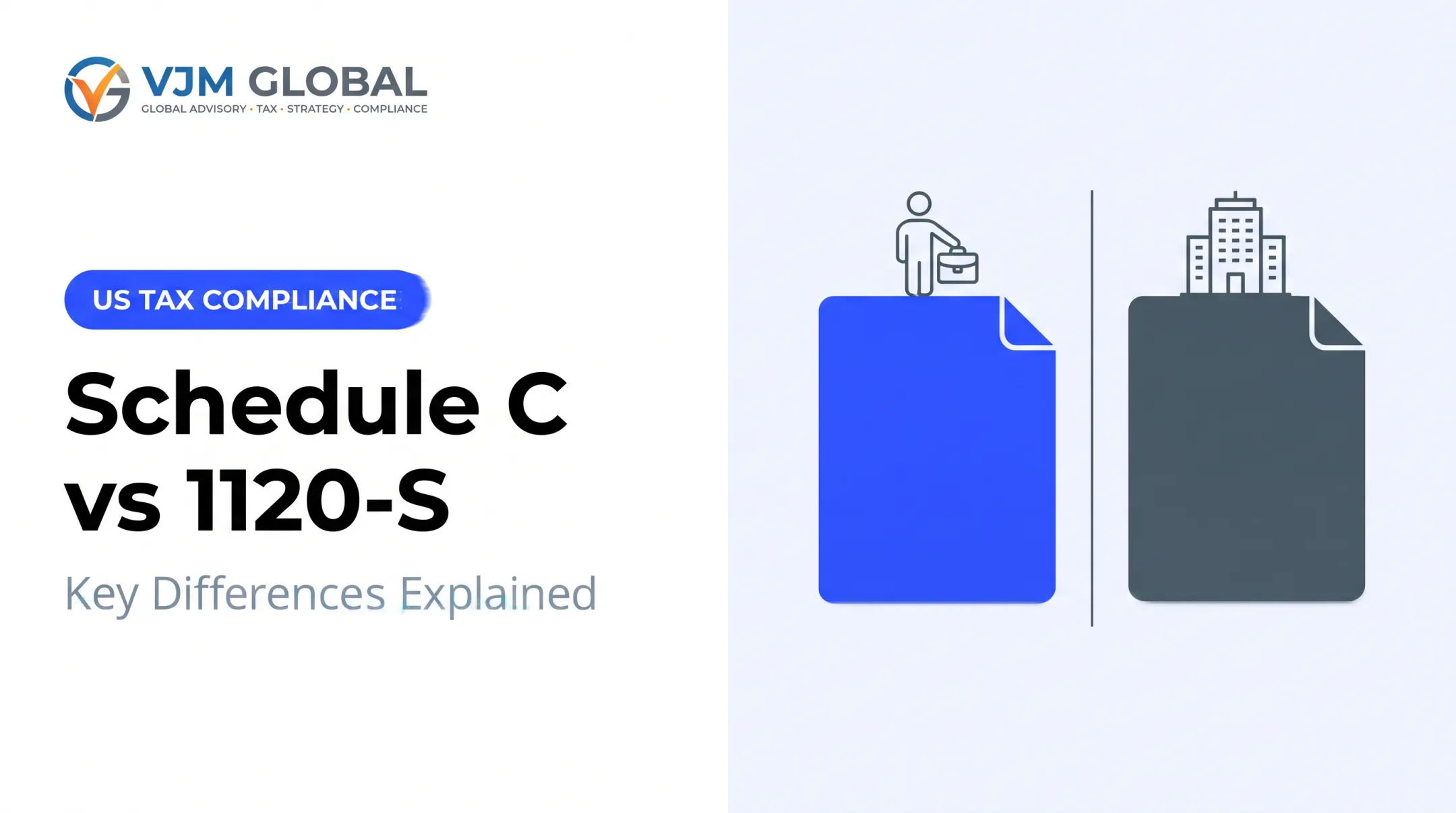
Schedule C vs Form 1065: Quick Comparison
| Item | Schedule C | Form 1065 |
|---|---|---|
| Typical filer | Sole proprietor or disregarded single-member LLC | General partnership, LLP, multi-member LLC taxed as a partnership |
| Where filed | Attached to the owner's Form 1040 | Separate return filed by the partnership |
| Income flow | Net profit or loss goes straight to the owner's return | Allocated to each partner via Schedule K-1 |
| Workload | Direct, though records are still needed | Partner data, capital accounts, allocations, extra schedules |
Structure and number of owners
A U.S. domestic single-member LLC defaults to disregarded status, and its owner reports the activity on Schedule C. A U.S. domestic LLC with two or more members defaults to partnership treatment and files Form 1065. Either can elect corporate treatment, which replaces these filings with corporate returns.
Where filing happens and how income reaches owners
Schedule C is never filed alone. Net profit may also feed self-employment tax.
The general rate is 15.3% (12.4% Social Security plus 2.9% Medicare), with $176,100 as the 2025 Social Security wage base. Australia has a social security agreement with the U.S., so that headline rate is not automatically owed by every Australian owner.
A partnership reports total activity, then allocates shares per the partnership agreement. Partners owe tax on their share whether or not cash was distributed.
Complexity, deadlines and cost
For tax year 2025, Form 1040 is due 15 April 2026 and Form 1065 16 March 2026. Form 4868 extends the individual filing by six months (not payment), and Form 7004 gives partnerships an automatic six-month extension.
Late Form 1065 penalties run $255 per partner per month (up to 12 months) for 2025 returns. Preparation cost rises with complexity: a partnership with several K-1s costs more to prepare than a simple Schedule C.

State and cross-border obligations
Disregarded status for federal tax doesn't remove state duties. California charges LLCs an $800 annual tax, and New York imposes a $25 filing fee on disregarded LLCs with New York-source income. Partnerships may also face foreign-partner withholding and international reporting.
Schedule C and Form 1065: What Each One Reports
Schedule C: Profit or Loss From Business
Schedule C reports gross receipts and deductible expenses for a sole proprietorship or disregarded single-member LLC. The result is net profit or loss, which moves to Form 1040 and, where applicable, Schedule SE.
Don't confuse it with Schedule C (Form 1065), a different schedule tied to Schedule M-3 reporting for certain large partnerships.
Typical records:
- Income documentation and expense receipts
- Asset and depreciation records
- Inventory or cost-of-goods-sold figures
- Vehicle logs with dates, destinations and business purpose
- Home-office details, generally requiring regular and exclusive use
Form 1065: U.S. Return of Partnership Income
Form 1065 reports the partnership's income, deductions, gains, losses and credits. The partnership generally pays no federal income tax itself. Schedule K totals the items, and each partner's Schedule K-1 shows their share to use on their own return.
Partnership returns carry more moving parts:
- Ownership percentages, contributions and distributions
- Liabilities and capital accounts (Schedules L, M-1, M-2)
- Guaranteed payments, which are deductible by the partnership and ordinary income to the partner
- Special allocations and partner basis tracking
- Schedules K-2 and K-3 for international items
A small-partnership exception can remove some schedules where receipts are under $250,000 and assets under $1 million, but it isn't a filing exemption.
Cross-border triggers
A foreign partnership generally files Form 1065 if it has U.S.-source gross income or income effectively connected with a U.S. trade or business. That requirement can apply even when every partner is outside the United States.
Related filings include:
- Forms 8804, 8805 and 8813 when there are foreign partners
- Form 5472 for a foreign-owned disregarded LLC, with a $25,000 penalty for failure to file

Which Filing Method Applies to Your Business?
Start with ownership, then check classification.
Ownership and default classification
- One owner, domestic LLC: disregarded unless it elects corporate treatment
- Two or more members, domestic LLC: partnership unless it elects corporate treatment
- Foreign entities follow different defaults, and some, such as an Australian public company, are automatically corporations
State-law status and federal tax status differ. An LLC can exist under state law while its income appears on the owner's Schedule C.
Situational guidance
- Expect Schedule C if you have one owner, no corporate election and a straightforward operation.
- Expect Form 1065 if you have two or more owners, default partnership treatment, or an agreement requiring partner-level allocations.
- Get a review first if you have appreciated assets, significant debt, foreign owners, complex allocations or plans to add an owner.
Future plans matter. Under Revenue Ruling 99-5, when a new member buys into a disregarded LLC, the owner is treated as selling part of each asset. Contributing capital is treated differently, so the structure of the deal changes the tax result.

Decision checklist
- How many owners does the business have, now and soon?
- Has a Form 8832 election been filed?
- What does the operating agreement say about allocations?
- What is the business activity, and is it U.S.-source?
- Where are the owners resident?
- Which state fees and filings apply?
- Do you need separate K-1 reporting?
Real-World Scenarios and Compliance Considerations
These are illustrative examples, not client results or guaranteed outcomes.
Scenario 1: One-owner LLC. An individual owns a domestic single-member LLC with no election. The LLC is disregarded, so the owner reports it on Schedule C.
Records include receipts, mileage logs and depreciation schedules. The owner may owe self-employment tax. Compliance risk: overlooking state fees, such as California's $800 annual tax.
Scenario 2: Two-owner LLC. Two members run an LLC that defaults to partnership treatment. It files Form 1065 and issues two K-1s.
The IRS gives an example in Publication 541: a partner guaranteed at least $8,000 from a partnership with $20,000 of income receives a $6,000 allocation plus a $2,000 guaranteed payment.
Compliance risk: late filing, which at $255 per partner per month adds up fast, or incomplete K-1 data.
VJM Global's U.S.-compliant CPAs and accountants support Australian businesses with bookkeeping, tax accounting and return preparation, including working out which filing applies and keeping records ready for it.
Conclusion
Schedule C generally suits one-owner or disregarded-entity reporting. Form 1065 suits partnerships and K-1 allocations. Neither form is universally better; ownership and entity structure decide which applies.
Australian owners should confirm these points before filing or changing methods:
- Entity classification and ownership
- Elections and state filing requirements
- Cross-border reporting obligations
- Future ownership plans
Review the current IRS instructions or speak with a qualified U.S. tax professional.
Frequently Asked Questions
What is the difference between Schedule C and Form 1065?
Schedule C reports a sole proprietorship or disregarded single-member LLC on the owner's individual return. Form 1065 is a separate partnership information return that produces Schedule K-1s.
Who should file Schedule C?
Sole proprietors and owners of single-member LLCs treated as disregarded entities. A corporate election or special circumstances can change the required filing.
Who must file Form 1065?
Generally domestic partnerships and multi-member LLCs taxed as partnerships, plus certain foreign partnerships with U.S. income. Check the current IRS exceptions.
Can a single-member LLC file Form 1065?
Not by default, since it's disregarded. Reporting changes if it elects corporate treatment or gains another member.
Does a partnership pay tax when it files Form 1065?
Generally no. Income passes through on Schedule K-1, and partners pay tax on their shares even if no cash was distributed.
Which is easier or cheaper to file?
Schedule C is usually more direct for a simple one-owner business. Form 1065 needs more records and K-1 preparation, so compare total compliance needs rather than just preparation cost.