Introduction
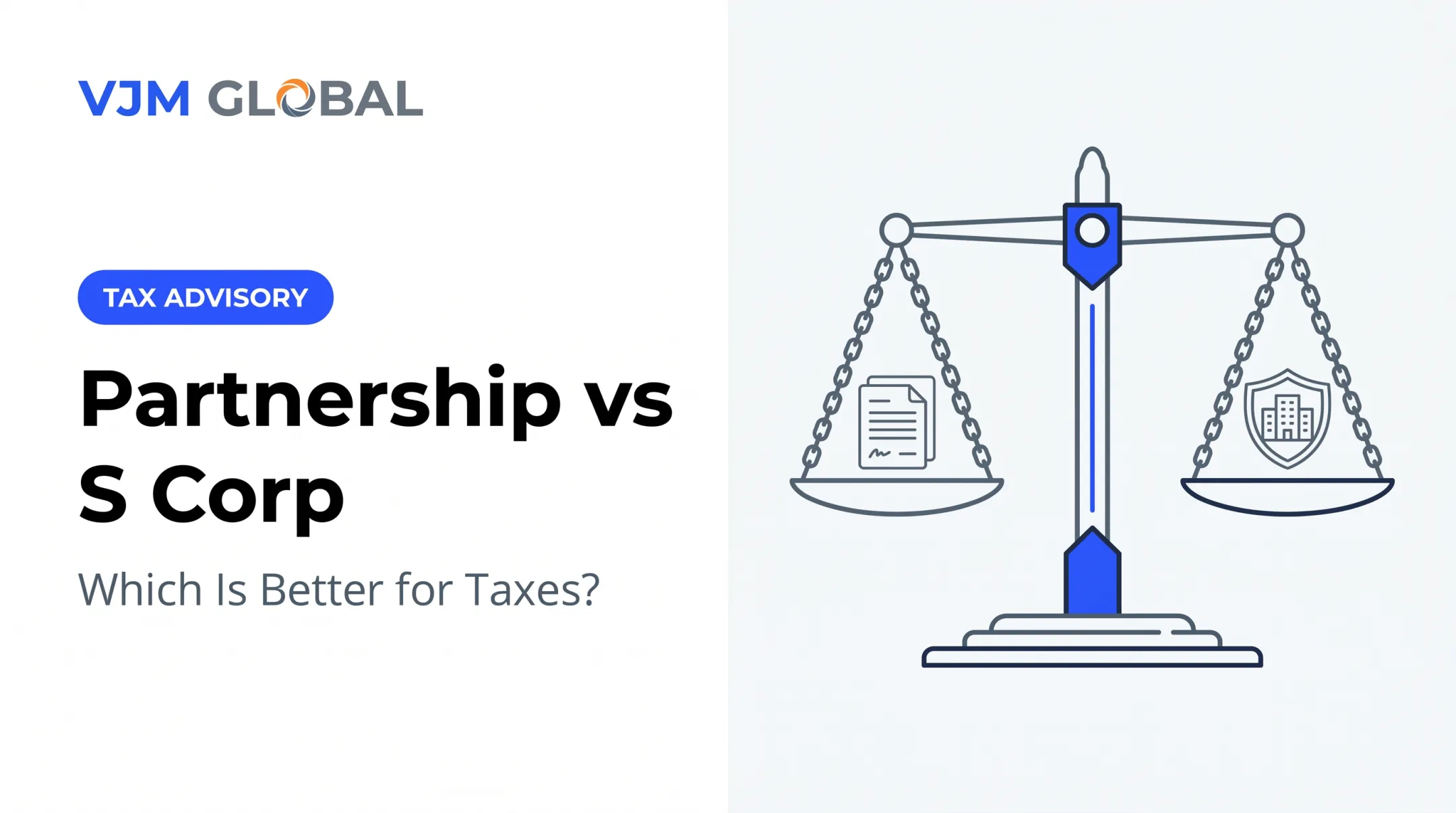
Many Australian founders running a US-facing consulting practice, online store, or services business eventually hit the same fork in the road: report income on a personal Schedule C, or elect S corporation treatment for the business.
These aren't two labels for the same thing. Schedule C is a reporting schedule attached to a US individual return. An S corporation is a federal tax election made by an eligible entity.
The distinction matters well beyond paperwork. Self-employment tax runs at 15.3% on net profit, according to IRS self-employment tax guidance, and that figure alone can swing the decision for a profitable US operation.
Choose the wrong structure and you risk paying more tax, more compliance fees, or both.
This article covers US federal treatment only. Australian owners still need separate advice on tax residency, foreign income, entity classification, and ATO reporting before acting on any of it.
Key Takeaways
- Schedule C reports sole-proprietor or disregarded-entity income on a personal return and is not a legal entity.
- S corp status is a federal election via Form 2553; the entity files Form 1120-S and issues Schedule K-1.
- S corp treatment can reduce employment-tax exposure only after reasonable owner wages are paid.
- Direct nonresident alien shareholders aren't permitted; US tax residency decides eligibility.
- Choose based on profit stability, payroll capacity, and how the US outcome interacts with Australian tax rules.
Schedule C vs S Corporation: Quick Comparison
| Factor | Schedule C | S Corporation |
|---|---|---|
| Legal status | Not a separate entity; filed with Form 1040 | Tax election on an eligible corporation or LLC |
| Core filings | Schedule C + Schedule SE | Form 1120-S + Schedule K-1 per shareholder |
| Tax treatment | Net profit generally hits income tax and self-employment tax | Wages run through payroll; qualifying distributions may skip self-employment tax |
| Administration | Lighter bookkeeping, individual filing | Payroll, corporate records, basis tracking, annual entity return |
| Ownership | Sole owner or single-member disregarded LLC | Up to 100 eligible shareholders, one class of stock |
| Best fit | Smaller or uncertain profit, simplicity matters | Steady profit with room to pay reasonable wages |
Neither option is automatically cheaper. Schedule C wins on simplicity when profit is modest or unpredictable. S corporation treatment only pays off once profit is high enough, and steady enough, to absorb payroll and compliance costs while still leaving a meaningful distribution on the table.
What Is Schedule C?
Schedule C, "Profit or Loss From Business," reports income and deductible expenses from a sole proprietorship or an eligible single-member LLC that hasn't elected corporate treatment. Filing it doesn't create a company. It provides no liability protection and involves no corporate governance. It's simply how a sole trader reports results on their individual return.
How the Numbers Flow
The mechanics follow a straightforward sequence:
- Calculate gross receipts from the business for the year
- Subtract ordinary and necessary expenses allowed under current IRS rules
- Report net profit or loss, which flows to the owner's Form 1040
- Check Schedule SE eligibility: net earnings of $400 or more generally trigger the self-employment tax calculation

Net profit touches more than one line on the return. It can shift income tax, self-employment tax, estimated payments, and deduction eligibility, so figures should be checked against current IRS thresholds each year rather than assumed from the prior year.
When Schedule C Makes Sense
Schedule C tends to suit:
- Early-stage businesses still testing a US market
- Independent contractors and consultants
- Freelancers billing US clients directly
- Businesses with modest or unpredictable profit where simplicity outweighs potential tax savings
Picture an Australian marketing consultant invoicing US clients through a single-member LLC, earning somewhere between $40,000 and $60,000 a year. Schedule C keeps things simple here: no payroll, no separate corporate return.
If that profit climbs past $100,000 and holds steady, it's worth running the S corporation numbers. This is an illustration, not a recommendation for any specific business.
When to Revisit the Decision
Review Schedule C treatment once any of these shows up:
- Profit becomes sustained rather than sporadic
- The business starts hiring employees
- Additional owners join
- Outside investment is on the table
- Cross-border operations expand
An Australian owner also needs to confirm the underlying US activity genuinely qualifies for Schedule C treatment, and separately work out how the ATO treats the same income back home.
What Is an S Corporation?
An S corporation isn't a separate type of legal entity. It's a federal tax status. An eligible corporation or LLC elects it by filing Form 2553, with every shareholder providing consent.
Once accepted, the entity generally files Form 1120-S each year and issues Schedule K-1 to each shareholder, who reports their share of income on their personal return whether or not any cash was actually distributed.
The Wage-Versus-Distribution Mechanic
The headline appeal is this: shareholder-employees take reasonable compensation through payroll, and properly structured distributions beyond that wage may avoid self-employment tax. That's not an automatic saving.
The IRS expects reasonable compensation reflecting duties performed, time committed, experience, and comparable industry pay before any distribution goes out.
Running payroll adds real work: withholding, employer filings, bookkeeping discipline, accountable expense reimbursements, shareholder basis tracking, and the Form 1120-S return itself, on top of normal record-keeping.

Who Actually Qualifies
Per the IRS's Form 2553 instructions, an eligible entity must meet several tests:
- Be a domestic corporation or eligible domestic entity
- Have no more than 100 shareholders
- Limit shareholders to individuals, certain trusts, and qualifying estates (nonresident aliens cannot hold shares directly)
- Maintain one class of stock, ignoring differences in voting rights
For Australian owners, citizenship isn't the deciding factor. US tax residency is. An Australian who's a nonresident alien for US purposes can't hold S corp shares directly. Someone who meets the green card or substantial presence test, and so qualifies as a US resident alien, generally can.
When It's Worth Considering (and When It Isn't)
S corporation treatment may be worth analysing when:
- Profit is stable and meaningful, not a one-off good year
- The owner works actively in the business
- Cash flow covers a reasonable wage comfortably
- Expected savings clearly exceed payroll and professional fees
It's usually the wrong fit when the business has losses or highly variable income, needs foreign or institutional investors, wants multiple economic classes of ownership, or the owner simply can't maintain payroll and compliance processes.
One more thing worth flagging: forming an LLC or corporation is a legal step. Electing S status is a separate tax choice layered on top. One doesn't replace the other, and an S election alone doesn't create liability protection where none existed before.
Schedule C vs S Corporation: What Is Better for Tax Planning?
No single structure wins for every owner. Use a clear framework instead. Compare projected profit, a reasonable owner salary, expected distributions, added payroll and accounting costs, state obligations, S corp eligibility, and long-term business plans before deciding.
Run the Numbers, Not Just the Headline Saving
Estimate the potential employment-tax difference, then subtract:
- Payroll processing costs
- Additional tax-return preparation fees
- Extra bookkeeping
- State or local taxes and insurance
- Ongoing compliance costs
Model more than one profit scenario, including a strong year and a soft year, rather than just the best-case outcome.
A Cautionary Example
The David E. Watson, P.C. case shows what happens when wages are set too low. According to Journal of Accountancy's coverage of the ruling, the Eighth Circuit found Watson's $24,000 salary unreasonable when he also took distributions of $203,651 and $175,470 across two years. The court upheld a government-backed $91,044 reasonable-salary figure instead, pulling an extra $67,044 into FICA tax. Underpaying wages to dodge employment tax doesn't save money. It invites reclassification and back taxes.

Timing and Compliance Guardrails
- Form 2553 is generally due 2 months and 15 days after the tax year begins (March 15 for a calendar-year business)
- Late-election relief exists under current IRS procedures, but it has conditions and isn't automatic
- Once elected, maintain documented reasonable compensation, separate bank accounts, an accountable reimbursement plan, accurate payroll, and shareholder basis records
Growth, Ownership, and Cross-Border Factors
Several future events can make S status unavailable or simply less attractive:
- Raising capital from foreign or institutional investors
- Introducing multiple stock classes
- Reinvesting most profit rather than distributing it
- Planning for succession or an eventual sale
Before electing, coordinate US advice with Australian advice. Residency status, controlled foreign company attribution rules, and foreign tax credit mechanics can all change the net outcome, regardless of what the US return alone shows.
VJM Global's US tax team works alongside Australian business owners on exactly this comparison. That includes preparing US entity and individual returns (including Form 1040-NR), running payroll where S corp status applies, and coordinating with Australian-side advisers.
Having supported 250+ Australian businesses with cross-border compliance, the team can map eligibility questions and compliance costs before you file an election, without promising a specific tax outcome in advance.
Conclusion
Schedule C offers simplicity for an eligible, smaller or less predictable US business. S corporation treatment merits real analysis once profit is stable and the owner can support payroll plus the added compliance load.
Neither is automatically better. The right call rests on current IRS eligibility rules, a documented cost-benefit model, your business goals, and how the result lands on your Australian tax return.
Before filing an election or changing how business income is reported, get a coordinated review from qualified US and Australian tax professionals — the US form is only half the picture.
Frequently Asked Questions
Which is better: C corporation or S corporation?
Neither is universally better — a C corporation offers broader ownership and fundraising flexibility, while an eligible S corporation offers pass-through tax treatment. Note this compares two corporation types, not Schedule C reporting.
How do I know if my business is an S corporation or a C corporation?
Check your formation and IRS election records, including whether Form 2553 was filed and accepted. Confirm current status with your tax adviser or directly against IRS correspondence.
Is Schedule C the same as a C corporation, and is it used for S corporations?
No. Schedule C is a tax reporting schedule, not a corporation type. S corporations generally file Form 1120-S and issue Schedule K-1 to shareholders instead of using Schedule C.
Can an LLC elect to be taxed as an S corporation?
Yes, an eligible LLC can generally elect S corporation tax treatment by meeting IRS requirements. The election doesn't remove the LLC's underlying legal and state compliance obligations.
When should a sole proprietor consider an S corporation election?
Consider it once profit is stable, you're actively working in the business, and cash flow supports a reasonable wage. Run the numbers to confirm projected savings exceed payroll and added filing costs.
Do Australian business owners need to consider Australian tax rules when choosing Schedule C or S corporation treatment?
Yes. US federal treatment is only part of the picture — Australian residency, foreign income rules, entity classification, controlled foreign company attribution, and foreign tax credits can all affect the overall result.