This guide covers Form 1120 filers specifically. It does not automatically apply to Forms 1120-S or 1065, which have their own M-3 rules. What follows: who must file, what Parts I through III actually ask for, the common book-to-tax differences that trip up preparers, and a final review process before you submit.
Key Takeaways
- Schedule M-3 is a book-to-tax reconciliation for Form 1120 filers meeting IRS asset thresholds
- Parts I–III cover financial statement data, income reconciliation, and expense/deduction differences
- Temporary differences reverse in a later period; permanent differences never do
- Confirm current-year thresholds and line references in the latest IRS instructions before filing
Who Must File Schedule M-3 With Form 1120?
The core filing test centres on total assets reported at year-end. Under the Schedule M-3 instructions, a corporation filing Form 1120 on a separate or nonconsolidated basis must file M-3 if Schedule L shows total assets of at least $10 million. Consolidated groups apply the same $10 million test to their year-end consolidated Schedule L assets, net of intercompany eliminations.
| Situation | M-3 requirement |
|---|---|
| Separate return, assets under $10 million | Not required (voluntary option available) |
| Separate or consolidated return, $10 million–$50 million | Full M-3, or Part I plus Schedule M-1 for Parts II–III |
| Assets $50 million or more | Full M-3 required; no M-1 alternative |

Consolidated Groups and Related Entities
Financial-statement consolidation alone doesn't aggregate the asset test across related corporations. In an IRS example, a parent with $12 million in consolidated financial-statement assets has two subsidiaries filing separate returns with $7 million and $6 million respectively. Neither meets the $10 million threshold on its own, so neither must file M-3.
Foreign corporations filing Form 1120-F, consolidated groups under Form 851, and corporations with disregarded entities each need a separate look at which financial statements and entities actually feed the test.
Schedule L, and where applicable Form 8916-A, support the asset determination. Not every corporation needs Form 8916-A. Required filers under $50 million and voluntary filers are exempt from it entirely, though they may still attach it.
The Schedule M-1 Alternative and Voluntary Filing
Corporations in the $10 million to under $50 million bracket can file Schedule M-3 Part I plus Form 1120 Schedule M-1 instead of completing Parts II and III. The catch: M-1 line 1 must equal M-3 Part I, line 11. Part I is never optional for a required filer.
Corporations below the mandatory threshold may still file M-3 voluntarily. Many do, for consistency year over year, stronger internal controls, or because lenders and stakeholders expect the detail. Schedule M-3 is informational. It explains the relationship between book and tax income. It doesn't calculate the final tax liability itself.
What Information Is Included in Schedule M-3?
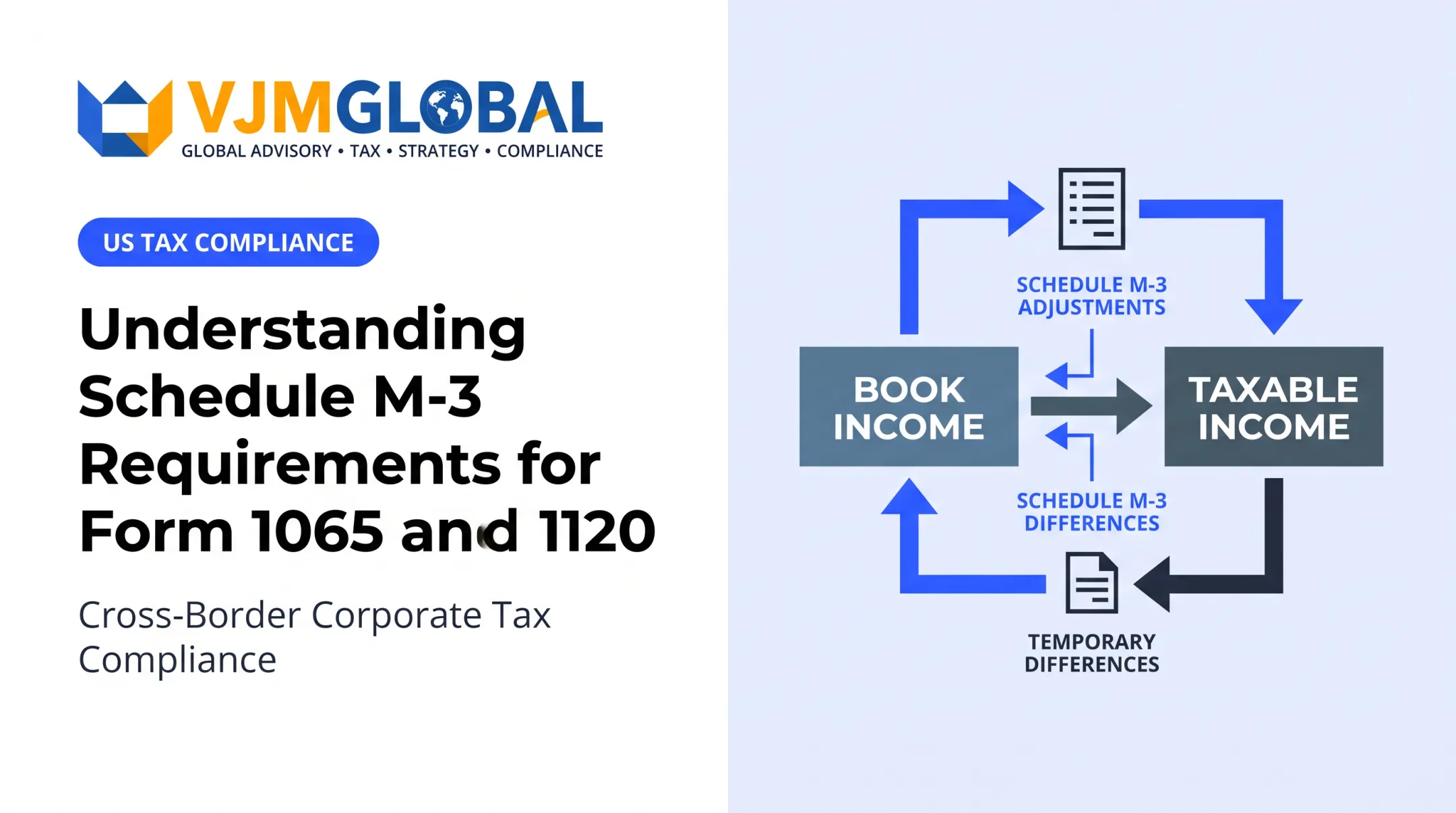
The form tracks a single thread: financial statement net income flowing through to the income reported on the tax return. Line references below follow the current form, but always verify them against the applicable tax year before filing.
Part I: Financial Information and Reconciliation
Part I establishes the starting point. It asks for:
- The financial statement type used (Form 10-K, certified statements, or books and records, in that priority order)
- The accounting standard or basis and reporting period
- Worldwide consolidated net income, adjusted by removing nonincludible entities and adding includible ones
- Consolidation eliminations, disregarded entities, foreign operations, and period adjustments
The result is the corporation's net income or loss figure that carries into Part II.
Part II: Income and Loss Reconciliation
Part II uses four columns: book amount, temporary difference, permanent difference, and tax amount. The first three must sum to the fourth. Representative line items include:
- Equity-method income, dividends, and foreign income inclusions
- Deferred or unearned revenue, long-term contracts, and accrual-to-cash adjustments
- Section 481(a) adjustments from accounting method changes
- Gains or losses on asset dispositions and reportable transactions
Part III: Expense and Deduction Reconciliation
Part III mirrors the same four-column structure for expenses. Expect to reconcile:
- Depreciation, amortisation, and bad debts
- Compensation, stock-based pay, and retirement contributions
- Meals, fines, penalties, and charitable contributions
- Goodwill amortisation and impairments, plus R&D costs
Use the current form's line descriptions rather than an outdated transcription. The IRS reshuffles specific line numbers periodically.
How to Complete Schedule M-3: A Practical Preparation Process
Preparing an accurate M-3 is less about tax theory and more about disciplined workpaper management. Here's the sequence that works:
Confirm the filing requirement and gather documents. Pull Form 1120, Schedule M-3, Schedule L, applicable Form 8916-A attachments, the current IRS instructions, prior-year returns, and any accounting-method election statements.
Establish the correct financial statement starting point. Reconcile your chosen financial statements to the general ledger, trial balance, and consolidation schedules. For cross-border groups, document precisely which entities sit in the financial statements versus the US tax return, including intercompany eliminations and foreign-entity adjustments.
Build a book-to-tax difference schedule. Map every material difference to its source account, tax treatment, the relevant M-3 part and line, and whether it's temporary or permanent. Note when each temporary item is expected to reverse.
Complete Part I first, then Parts II and III. Part I sets your book-income starting figure before you touch the reconciliation detail. Report gross, properly classified amounts in Parts II and III. don't bury distinct items into a generic "other" line when the form calls for specific disclosure.
Tie the schedule back to the return. Confirm Part I, II, and III totals agree with Form 1120, Schedule L, and Schedule K. Every adjustment needs a visible trail from the return back to the trial balance and underlying workpaper.

Skipping step 5 is the most common cause of amended returns we see. An unreconciled total usually means something was double-counted or missed entirely.
Common Book-to-Tax Differences to Review
Most M-3 errors cluster around a handful of recurring items. Work through these systematically rather than assuming last year's classification still holds.
Depreciation and amortisation: Compare book depreciation against tax depreciation, bonus depreciation, and Section 179 treatment. Bonus depreciation rules shifted again for property placed in service after January 19, 2025. Check the current rate under IRS Publication 946 rather than assuming 100% applies across the board.
Accrued liabilities: Bonuses, vacation pay, and warranty reserves need both a fixed, determinable amount and actual economic performance before they're deductible. Book accrual alone isn't enough.
Meals, fines, and nondeductible costs: Split general-ledger accounts finely enough to separate deductible, partially deductible, and nondeductible amounts. Don't assign a permanent difference without checking the current-year rule first.
Revenue recognition: Compare financial statement timing against tax recognition rules for advance payments, subscriptions, and long-term contracts. These frequently create temporary differences that reverse over several years.
Equity compensation and goodwill: Reconcile book expense against the actual tax deduction, which often differs based on vesting, exercise timing, or statutory amortisation schedules for acquired intangibles.
Interest and related-party transactions: Business interest limitations under Section 163(j) can disallow deductions depending on adjusted taxable income. Review the Form 8990 instructions for the current small-business exemption threshold before concluding an item is fully deductible. Related-party and foreign-entity transactions often need separate supporting schedules.

Avoid drawing a tax conclusion on any of these without reviewing the corporation's specific facts first.
Schedule M-3 vs. Schedule M-1: Which Reconciliation Applies?
Both schedules reconcile book income with tax-return income. The difference is depth.
| Feature | Schedule M-1 | Schedule M-3 |
|---|---|---|
| Structure | 10-line summary | Three detailed parts |
| Difference columns | None | Separate temporary and permanent columns |
| Typical filer | Smaller corporations | Corporations at or above asset thresholds |
| IRS review visibility | Lower | Significantly higher |
An eligible corporation between $10 million and $50 million in assets can use the M-1 alternative for Parts II and III while still completing M-3 Part I in full. That's a hybrid approach, not a full exemption.
One caution worth repeating: Form 1120-S and Form 1065 have their own M-1/M-3 rules, which differ from the Form 1120 version in several respects. Don't carry over assumptions from a partnership or S-corp filing without checking the correct instructions for a C-corporation.
Final Review Checklist for Form 1120 Schedule M-3
Before filing, work through this list:
- Confirm corporation name, EIN, tax year, filing status, and financial statement period match across Form 1120 and attached records
- Reconcile starting net income to the final financial statements, general ledger, and Part I totals
- Review every Part II and Part III line for correct classification, sign, and temporary/permanent treatment
- Verify required supporting statements, supplemental forms, and e-filing attachments against the current IRS instructions
- Retain the full reconciliation workbook, source schedules, and reviewer sign-off in an organised workpaper file
For Australian groups managing a US subsidiary alongside domestic operations, coordinating finance data across two jurisdictions is often the harder part of this process.
VJM Global supports businesses with accounting outsourcing and US tax compliance assistance. That includes preparing reconciliations, maintaining workpapers, and keeping finance data consistent between Australian and US entities. This support works alongside your corporation's responsible tax professional, not in place of their review.
Frequently Asked Questions
What are the instructions for filing Schedule M-3?
Confirm eligibility first, then obtain the current IRS Schedule M-3 and Form 1120 instructions. Complete Parts I–III as applicable, reconcile totals to the return, and attach any required supporting forms.
Who is required to file Schedule M-3?
Form 1120 filers with year-end total assets of at least $10 million generally must file. Always verify current-year exceptions, including the M-1 alternative for filers under $50 million.
What is Schedule M-3 on Form 1120?
It's the detailed reconciliation between a corporation's financial statement income or loss and the income or loss reported for federal tax purposes, broken into three parts.
What is the difference between Schedule M-1 and M-3?
M-1 is a short, ten-line summary reconciliation. M-3 requires granular, line-by-line reporting of temporary and permanent differences and generally applies to larger corporations.
What information is included in Schedule M-3?
Part I covers financial statement information, Part II covers income and loss reconciliation items, and Part III covers expense and deduction items, including temporary and permanent differences.