Many advisers mention Schedule M-3 in the same breath as Form 1065 and Schedule M-1, yet confuse how the three actually interact. Get the reconciliation wrong, and partner-level reporting on Schedule K-1 becomes unreliable too.
This guide covers who must file, how Parts I–III fit together, how to classify temporary versus permanent differences, what records you need, and how to tie the schedule back to the rest of the return.
Key Takeaways
- Schedule M-3 delivers a line-by-line book-to-tax reconciliation for qualifying partnerships filing Form 1065
- Filing triggers include total assets, adjusted total assets, total receipts, and Reportable Entity Partner status : check all four against current thresholds
- Parts II and III split every reconciling item into book, temporary, permanent, and tax-return columns
- Material adjustments need a paper trail tying back to Schedule L, Schedule K, and Form 1065 itself
- International reporting sits separately with Schedules K-2 and K-3, not Schedule M-3
What Schedule M-3 Reports and How It Differs From Related Schedules
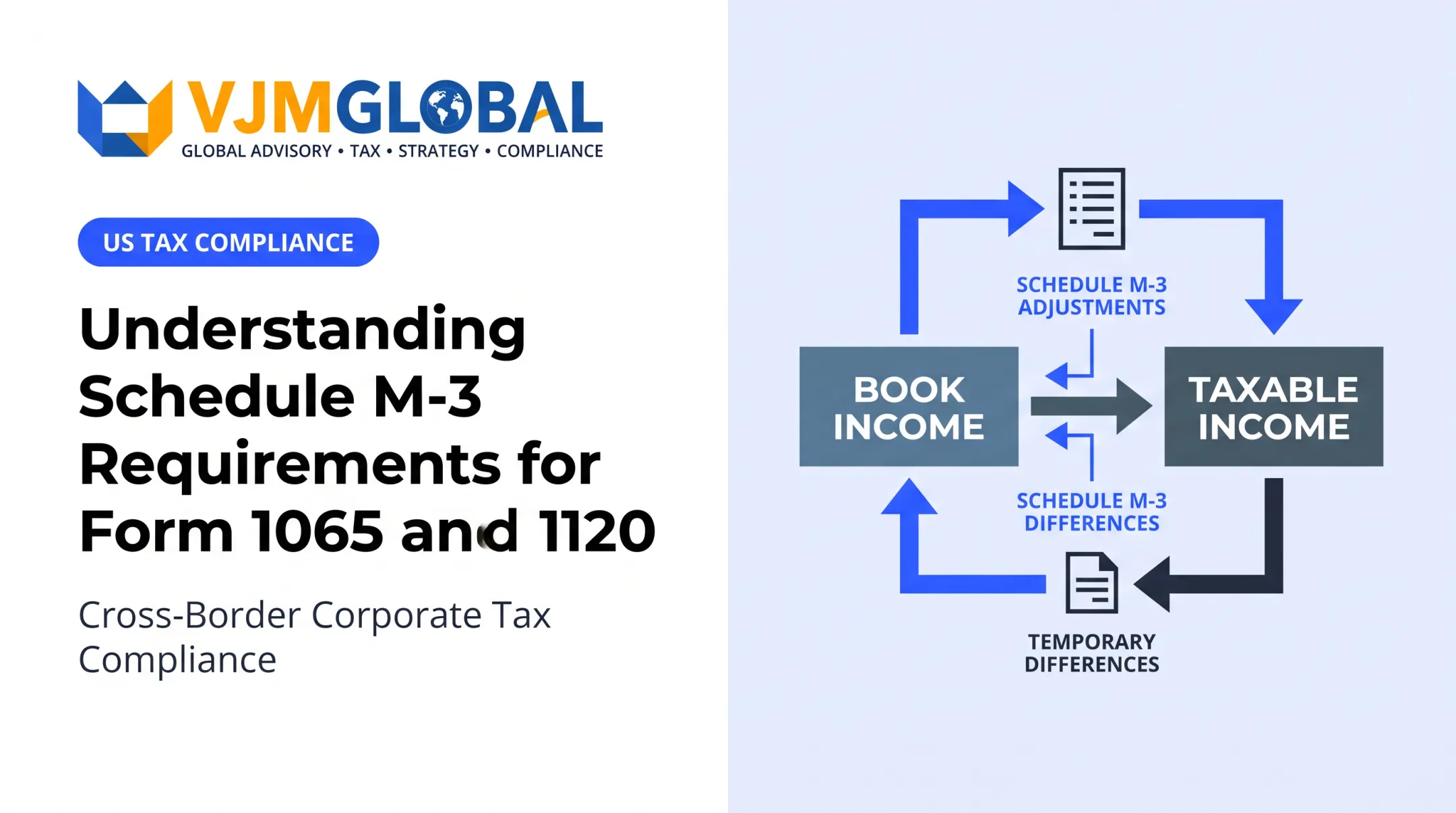
Schedule M-3 is a supplemental schedule attached to Form 1065. Its job: reconcile the partnership's financial statement net income or loss with the income or loss reported on the tax return itself.
Every partnership keeps two versions of the truth. One lives in the financial statements, built for investors, lenders, or management. The other lives in the tax return, built around US federal tax rules. Schedule M-3 is the bridge between them.
Book Income vs Tax Income
Book depreciation might run on a straight-line useful life, for example, while tax depreciation applies accelerated rates under US rules. Or a book expense (say, a client entertainment cost) might be fully recognised for accounting purposes but non-deductible for federal tax purposes.
These gaps aren't errors. They're the ordinary consequence of two different frameworks measuring the same transactions.
Temporary vs Permanent Differences
Schedule M-3 forces a classification call on every reconciling item:
- Temporary differences reverse in a later tax year — accelerated depreciation eventually evens out once an asset is fully depreciated
- Permanent differences never reverse under the applicable tax rules, such as a goodwill impairment that's never tax-deductible
- Where reversal is genuinely uncertain, the IRS's Schedule M-3 instructions direct filers to the permanent-difference column
Schedule M-3 vs Schedule M-1
Schedule M-1 is the older, simpler reconciliation: a handful of lines with no column for temporary versus permanent treatment. Schedule M-3 is far more granular, breaking income and expense items into dozens of categories across Parts II and III. Depending on current-year asset thresholds, some eligible partnerships can still complete Part I of M-3 and finish the reconciliation using M-1 rather than the full schedule.

One more point worth flagging: the Form 1065 version of Schedule M-3 is not interchangeable with the Form 1120 version used by corporations. Line numbers, labels, and some definitions differ between the two. Always confirm the exact thresholds, line references, and attachment rules against the version published for the tax year you're filing.
Who Must File Schedule M-3 and Why?
A partnership filing Form 1065 must file Schedule M-3 if it meets any one of four tests. Meeting a single trigger is enough — there's no need to satisfy all four.
| Test | Trigger |
|---|---|
| Total assets | $10 million or more at year-end (Schedule L, line 14(d)) |
| Adjusted total assets | $10 million or more for the tax year |
| Total receipts | $35 million or more for the tax year |
| Reportable Entity Partner (REP) | A partner owns, or is deemed to own, 50% or more of capital, profit, or loss on any day of the year |
Notice the phrase "on any day of the year" for the REP test. This isn't a year-end snapshot. A partnership needs to review ownership changes across the entire tax year, not just the closing balance sheet.
Working Out Adjusted Total Assets
Adjusted total assets rarely equal the figure on your balance sheet. The IRS worksheet starts with Schedule L's year-end assets, then layers in adjustments for capital distributions, losses, and partner liabilities reported across Schedule K-1s.
The final figure is the greater of two separate calculations, not simply the balance-sheet total. Partnerships using Form 8916-A for supplemental detail should check whether current-year relief applies before assuming the form is required.
What Counts as a Reportable Entity Partner
A partner only counts as an REP when both conditions are met:
- It owns, or is deemed to own (directly, indirectly, or through attribution rules), at least 50% of capital, profit, or loss on any day of the year
- It was required to file Schedule M-3 on its own most recently filed federal return, filed before that day
Ownership alone doesn't trigger REP status. Neither does voluntary M-3 filing by the partner. Both conditions must be satisfied together.
Completion Alternatives Below the Threshold
Partnerships that meet a filing trigger but hold year-end assets below the full-completion threshold may have an alternative: complete Part I of Schedule M-3, then finish the reconciliation using Schedule M-1 instead of Parts II and III.
Required filers at or above that asset threshold must complete the entire schedule. Confirm the current-year dollar threshold before relying on this shortcut. It doesn't change often, but it isn't locked in permanently.
The schedule exists for transparency. It gives the IRS visibility into material book-to-tax differences without requesting full financial statements separately, and it supports more consistent reporting across similarly sized partnerships.
How to Complete the Three Parts of Schedule M-3
Schedule M-3 is built in three stages, each reconciling a different layer of the partnership's results.
Part I: Financial Statement Foundation
Part I establishes the starting point: net income or loss per the partnership's own financial statements, adjusted for consolidation or entity-level differences, restatements, and the reporting period used. The instructions set a priority order for which statement to use:
- SEC Form 10-K income statement, if one exists
- A certified, audited non-tax-basis statement
- An unaudited non-tax-basis statement
- Books and records, where no non-tax-basis statement exists
Get this source wrong, and every downstream column is built on the wrong base.
Part II: Income and Gain Reconciliation
Part II reconciles income and gain items across dozens of specific lines, including:
- Pass-through income from other partnerships or corporations
- Dividends and interest income
- Accrual-to-cash adjustments
- Inventory and cost-of-goods-sold differences
- Deferred or unearned revenue
- Gains or losses on asset dispositions
Part III: Expense and Deduction Reconciliation
Part III mirrors that structure for expenses, covering categories such as:
- Income taxes, current and deferred, domestic and foreign
- Meals and entertainment, fines and penalties
- Guaranteed payments to partners
- Charitable contributions
- Depreciation, amortisation, and bad debts
- Interest expense and research or development costs
The Four-Column Method
Parts II and III both use the same structure:
| Column | What it captures |
|---|---|
| A | The amount per the financial statement |
| B | The temporary difference |
| C | The permanent difference |
| D | The amount per the tax return |
Each line should carry its own reconciling item rather than being netted against unrelated categories. If the instructions call for a supporting statement (common for larger or unusual adjustments), attach it.
A partnership that nets a depreciation difference against an unrelated meals-and-entertainment adjustment has made the schedule harder to audit, not easier. Keep every category on its designated line, and double-check labels and line numbers against the form version published for your filing year.
How to Prepare, Review, and Tie Out Schedule M-3
A clean Schedule M-3 starts well before anyone opens the form. Treat it as a sequence:
- Confirm filing eligibility against current-year thresholds
- Gather final financial statements and the trial balance
- Pull the prior-year M-3 or M-1 for comparison
- Review Schedule L for balance-sheet consistency
- Identify partner and ownership information, including any REP analysis
- Collect tax adjustment schedules for depreciation, inventory, and other recurring items
Build a Book-to-Tax Difference Schedule
For every material adjustment, record:
- Source account
- Book amount and tax amount
- Whether the difference is temporary or permanent
- Expected reversal treatment
- Supporting document
This working paper becomes your audit trail if the IRS, or your own reviewer, asks where a number came from.

High-Risk Areas to Review Closely
Some categories cause more reconciliation errors than others:
- Depreciation and asset disposals
- Accrued compensation and reserves
- Related-party transactions and guaranteed payments
- Inventory and revenue recognition timing
- Interest expense limitations
- Partnership investments held through tiered structures
Tie-Outs That Must Balance
Before filing, confirm these connections hold:
- Part I net income matches the financial statement starting point
- Part II's tax-return column flows into Form 1065's Analysis of Net Income (Loss)
- Part III's expense total feeds into the correct line in Part II
- Schedule L, Schedule K, and Schedule K-1 figures are consistent with what M-3 reports
Final Review Checklist
Check each of the following before you file:
- Arithmetic accuracy across all parts
- Correct signs on each adjustment
- Whole-dollar presentation where required
- Attached supplemental statements
- Correct entity names and identifying numbers
- Consistency with the rest of the federal return
- Current-year form and instructions (a prior-year line reference can throw the whole reconciliation out)
This is where good bookkeeping pays off. VJM Global supports partnerships with accounting records, reconciliation workpapers, and Form 1065 compliance coordination, including for Australian businesses managing a US partnership interest. Final tax positions and filing decisions should still be reviewed and signed off by an appropriately qualified US tax professional.
Common Issues, Misconceptions, and Limitations
Schedule M-3 doesn't calculate a partnership's tax liability. It reconciles financial and tax information so the IRS can see where the two diverge. The actual tax calculation still happens elsewhere on Form 1065 and its related schedules.
Frequent Errors Worth Avoiding
- Using Form 1120 instructions by mistake, since the partnership version has different lines and definitions
- Relying on last year's asset or receipts thresholds instead of checking current-year figures
- Confusing temporary differences with permanent ones, particularly for reserves and accruals
- Omitting supporting statements the instructions specifically require
- Skipping a proper Reportable Entity Partner analysis because an owner "doesn't look like" 50%
A partnership can owe little current tax, or even report a book loss, and still have a Schedule M-3 obligation. The filing tests are based on assets, receipts, and ownership, not profitability.
Schedule M-3 Isn't an International Reporting Substitute
Schedules K-2 and K-3 handle international tax information separately from Schedule M-3. A partnership with foreign partners or foreign-source income may need both K-2/K-3 and M-3; one doesn't replace the other. Check the IRS's K-2/K-3 instructions for current filing exceptions.

When to Bring In a Professional
Get a qualified US tax adviser involved for consolidated or multi-tier partnerships, foreign partners, complex ownership structures, material restatements, large book-to-tax differences, or genuine uncertainty about current-year instructions.
Conclusion
Schedule M-3 gives a structured, line-by-line explanation of how a partnership's financial statement results become the income or loss reported on Form 1065. It is the audit trail connecting book results to Form 1065, not a separate tax calculation.
Getting it right starts with:
- Honest eligibility analysis
- Correct classification of every reconciling item
- Complete working papers
- Reconciliation back to Schedule L, Schedule K, and Schedule K-1
For Australian businesses with a US partnership interest, the practical lesson is timing. Coordinate your accounting records and US tax reporting early in the year, verify current IRS guidance before you file, and bring in professional advice whenever the partnership structure, ownership, or transactions get complicated. The reconciliation is only as reliable as the records behind it.
Frequently Asked Questions
What are the instructions for filing Schedule M-3 on Form 1065?
Start by confirming the current-year eligibility tests: total assets, adjusted total assets, total receipts, and Reportable Entity Partner status. Then complete Parts I–III, or the permitted Part I plus Schedule M-1 alternative, attach required statements, and reconcile the totals back to Form 1065.
What is Schedule M-3 on Form 1065?
It's a detailed book-to-tax reconciliation schedule required for qualifying partnerships, breaking differences into temporary and permanent categories across four columns. It's more granular than Schedule M-1 and distinct from the Schedule M-3 version filed with Form 1120.
How do I calculate adjusted total assets for Schedule M-3?
Adjusted total assets start with Schedule L's year-end figure, then apply specified adjustments for distributions, losses, and partner liabilities per the IRS worksheet. Complex ownership or tiered structures usually warrant professional review before relying on the result.
What are the instructions for completing Schedule K-3 on Form 1065?
Schedule K-3 is a separate international tax-information schedule reporting partners' shares of foreign-relevant items. Follow its own current-year instructions and filing exceptions. It doesn't replace, and isn't replaced by, Schedule M-3.