Introduction
Does your S corporation owe money on a loan, line of credit, or related-party note? That alone doesn't answer whether you need Form 8990 in 2026.
An S corporation generally files Form 8990 when Section 163(j) applies and the business has reportable business-interest items, carryforwards, or pass-through amounts from a partnership investment.
Paying interest isn't the trigger. The real question is whether an exception removes you from the regime entirely.
A handful of factors can flip that answer:
- Small-business exception
- Tax-shelter rules
- Excepted trades or businesses
- Aggregation with related entities
- Items flowing in from a Schedule K-1
The small-business threshold alone sits at $32 million for 2026, a figure that catches plenty of S corporations off guard.
This article sets out a practical framework: what Form 8990 actually calculates, when the IRS expects you to file it, which exceptions might apply, and how the form connects to Form 1120-S. Thresholds below reflect current guidance; confirm them against the IRS instructions before filing.
Key Takeaways
- Form 8990 calculates the Section 163(j) business interest limit and reports carryforwards or pass-through amounts
- Filing may still be required even when no current-year interest deduction is disallowed
- Small-business exception: three-year gross receipts average of $32 million for 2026, plus aggregation and tax-shelter rules
- Attach Form 8990 to Form 1120-S whenever a filing is required
What Form 8990 Does for an S Corporation
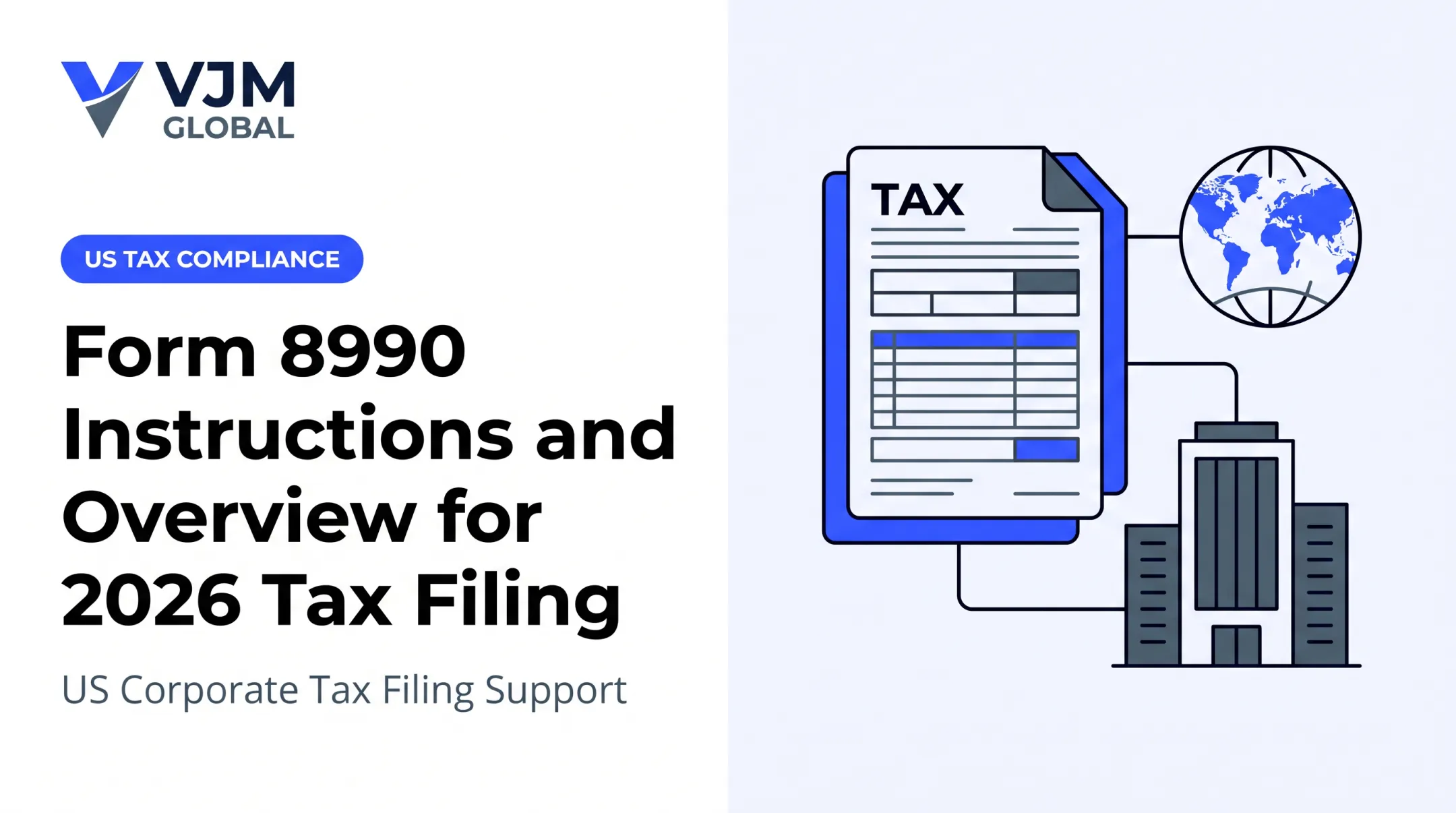
Form 8990, Limitation on Business Interest Expense Under Section 163(j), calculates how much business interest expense your S corporation can deduct this year and tracks what carries forward. The IRS revised the form and instructions in December 2025, so confirm you're working from the current version in the Form 8990 instructions.
The Core Limitation Formula
Deductible business interest expense is generally limited to the sum of:
- Business interest income for the year
- 30% of adjusted taxable income (ATI)
- Floor plan financing interest expense, where applicable
Anything above that sum typically gets disallowed and carried forward.
ATI itself runs through several additions and subtractions. Net operating losses, the Section 199A deduction, and depreciation, amortisation, and depletion all factor in, but the applicable addbacks have shifted by tax year. Check the 2026 treatment before reusing an old worksheet.

Entity-Level Carryforwards vs Shareholder Pass-Through
This is where S corporations differ from partnerships, and it trips people up constantly. When an S corporation's business interest expense is disallowed, the corporation keeps it. The disallowed amount carries forward at the entity level, unlike a partnership that pushes excess business interest expense onto its partners.
Excess taxable income and excess business interest income work differently. Those amounts do get allocated pro rata to shareholders, which is why Schedule K-1 (Form 1120-S) has dedicated codes for them.
Form 1120-S reports the S corporation's overall tax position: income, deductions, credits, shareholder allocations. Form 8990 sits underneath that, running the Section 163(j) math and feeding results back into the return. Before deciding whether filing applies, gather:
- Current-year business interest expense and income
- Adjusted taxable income inputs
- Floor plan financing interest, if relevant
- Prior-year disallowed amounts still carrying forward
- Any Section 163(j) items reported from a partnership K-1
Get those five categories organised first. The filing-trigger analysis, the exceptions, and the calculations all build from that list.
When Does an S Corporation Need to File Form 8990 in 2026?
Three things typically trigger a filing obligation:
- Current-year business interest expense or other Section 163(j) items that require a limitation computation
- Disallowed business interest expense carried forward from an earlier tax year
- Section 163(j) items that must be reported, even when the current-year deduction isn't reduced to zero
That third point catches people off guard. You can owe nothing extra in disallowed interest and still need to file, simply because the instructions require the computation to appear on the return.
Partnership K-1 Items That Trigger a Filing
If your S corporation holds a partnership interest, that partnership may pass through Section 163(j) information on Schedule K-1 (Form 1065), including:
- Business interest income
- Excess taxable income
- Excess business interest income
- Gross receipts data for the Section 448(c) test
Those items generally flow into Form 8990, Schedule A. They can require a filing even when the S corporation has no direct business interest expense of its own.

Don't confuse this with the Schedule K-1 (Form 1120-S) your own shareholders receive. The box numbers and codes differ, and mixing them up is a common source of errors.
The Tax Shelter and Aggregation Traps
Two traps still block the small-business exception. Tax shelters can't use it, regardless of how low their gross receipts run. If a meaningful share of losses is allocated to limited partners or similarly passive owners, review the syndicate definition before assuming you qualify.
Aggregation rules can also pull in related-entity receipts. Under Section 448(c)(2), businesses treated as a single employer under common-control rules get combined for the gross receipts test. Your S corporation's standalone numbers might look small, but the controlled group's combined receipts could push past the threshold.
A Quick Decision Checklist
- Is the S corporation engaged in a trade or business?
- Does it have business interest expense, relevant interest income, or Section 163(j) carryforwards?
- Does it receive Section 163(j) information from a partnership?
- Does it qualify for the 2026 small-business exception?
- Is it a tax shelter, or does it operate an excepted trade or business?
- Does the current instruction require filing for these specific items?
Two Hypothetical S Corporations
Example A: A manufacturing S corporation with $40 million in average annual gross receipts, $200,000 of business interest expense, and no excepted-business election. It exceeds the receipts threshold, so it computes the Section 163(j) limitation and files Form 8990.
Example B: A consulting S corporation with $4 million in average annual gross receipts, no partnership investments, and no tax-shelter characteristics. It qualifies for the small-business exception and generally skips Form 8990 for the year, though it should confirm no prior-year carryforward survives from before it qualified.
When the Small-Business Exception or Another Exception May Apply
The Gross Receipts Test
For tax years beginning in 2026, the Section 448(c) gross receipts threshold is $32 million, set by Revenue Procedure 2025-32. An S corporation qualifies for the small-business exception if average annual gross receipts over the preceding three tax years fall at or below that figure.
A few mechanics matter:
- Averaging: Add gross receipts for the three preceding years and divide by three. Entities with a shorter history use whatever period they've existed.
- Short tax years: Annualise by multiplying the short year's receipts by 12 and dividing by the number of months in that year.
- Predecessor rules: Receipts from a predecessor entity count toward your history.
- Aggregation: Controlled groups and commonly owned businesses combine receipts under the Section 448(c)(2) single-employer rules.
Qualifying generally means Section 163(j) doesn't apply to the S corporation for that year at all. Disallowed interest carried forward from an earlier non-exempt year, or a mid-year status change, does not disappear. Confirm how existing carryforwards are treated when the entity moves into or out of exempt status.
Excepted Trades or Businesses
Separately from the receipts test, certain trades or businesses sit outside Section 163(j) entirely:
- Performance of services as an employee
- An electing real property trade or business
- An electing farming business
- Certain regulated utility businesses, including electricity, water, sewage, and pipeline operations
These elections aren't automatic, and they come at a cost. A real property or farming election under Treasury Regulation 1.163(j)-9 generally locks the business into the alternative depreciation system for qualifying property.
That means longer recovery periods and no bonus depreciation on that property. The election is generally irrevocable once attached to a timely filed original return.

Industry labels prove nothing on their own. A real estate S corporation doesn't automatically get the real-property exception just because it owns buildings. The statutory definition, the election paperwork, and the entity's actual facts all have to line up.
A note for Australian owners: If you hold shares in a U.S. S corporation, or control one through related entities, the gross receipts threshold isn't a safe shortcut.
Related-party ownership, controlled-group aggregation, and cross-border structuring can all affect whether the small-business exception applies to your facts. Confirm the position with a U.S. tax professional rather than relying on a quick receipts check.
How to Calculate and File Form 8990
Once a filing is confirmed as required, preparation follows a fairly linear sequence.
A Practical Preparation Sequence
- Confirm the tax year and taxpayer details match the return it's attached to.
- Gather interest records, including business interest expense and business interest income.
- Identify carryforwards: prior-year disallowed amounts and current-year items from partnership K-1s.
- Calculate adjusted taxable income, applying the adjustments current instructions specify.
- Determine the allowable deduction and any amount carried forward.
- Complete the S corporation pass-through section and any required schedules.

Tentative Taxable Income and ATI Adjustments
Tentative taxable income starts from the S corporation's relevant taxable income figure, including both separately and non-separately stated items, and applies only the adjustments the current instructions require.
Depreciation, amortisation, and depletion addbacks, for instance, were removed for 2022 through 2024 and restored for tax years after 2024, including 2026, according to IRS guidance. Reusing a 2023 worksheet without checking this would overstate the deduction.
Adjustments that may affect adjusted taxable income include:
- Net operating loss deductions
- The Section 199A deduction
- Depreciation, amortisation, and depletion, restored for 2026
- Non-business income, gain, loss, or deduction items
- Pass-through items from partnership investments
Reconcile every figure back to the books before it lands on Form 8990. Interest expense recorded in an accounting system doesn't automatically match its tax classification.
Some of it might be investment interest. Some might relate to an excepted trade or business. Only the properly classified business portion belongs in the Section 163(j) calculation. Cross-check against Form 1120-S, Schedule K, Schedule K-1, and the underlying workpapers before filing.
Form 8990 attaches to the return it supports, which for an S corporation is Form 1120-S, and follows that return's due date and extension rules. S corporations that already e-file 10 or more returns of any type in a calendar year generally fall under mandatory e-filing requirements for the 1120-S itself.
For businesses juggling multi-country bookkeeping alongside U.S. compliance, this is where things get genuinely messy. VJM Global works with international business owners to coordinate bookkeeping, classify interest correctly, organise supporting records, and prepare Form 8990 alongside the broader U.S. tax return, always subject to final review by the responsible tax professional on the engagement.
Records, Deadlines, and Common Filing Mistakes
Keep a standing file for anything Section 163(j)-related:
- Loan agreements and lender statements
- Interest expense and interest income ledgers
- Prior-year Form 8990 filings and carryforward schedules
- Partnership Schedule K-1s (Form 1065) received by the S corporation
- Ownership and related-entity records for aggregation testing
- Gross receipts figures covering the required three-year lookback
- Documentation for any excepted-trade election made
The filing deadline generally tracks the due date of the federal return to which Form 8990 attaches, typically the 15th day of the third month after the tax year ends, plus any granted extension. Confirm the exact 2026 calendar, fiscal-year, and amended-return rules against current IRS instructions before relying on last year's dates.
Mistakes We See Repeatedly
- Using a stale gross receipts threshold instead of the current year's figure
- Skipping aggregation and testing only the S corporation's standalone receipts
- Treating all interest expense as business interest without classifying it first
- Losing track of prior-year carryforwards when ownership or status changes
- Overlooking Section 163(j) items buried in a partnership K-1
- Mixing up S corporation and partnership pass-through rules
- Attaching an incomplete or outdated version of the form
Controlled groups, real estate elections, tax-shelter exposure, partnership investments, international ownership, short tax years, and large carryforwards all raise the stakes for getting this wrong.
VJM Global's tax compliance and accounting teams act as a second set of eyes before filing, including audit support and IRS correspondence handling when a notice arrives.
Frequently Asked Questions
How do I know if I have to file Form 8990?
Review your S corporation's Section 163(j) status: business interest items, prior-year carryforwards, partnership K-1 pass-through amounts, and whether the small-business exception or an excepted-trade status applies. Check the current IRS instructions for the trigger matching your facts.
Who is subject to Section 163(j)?
Any taxpayer with business interest expense can be subject to Section 163(j), subject to the small-business exception, excepted-trade rules, and special provisions for partnerships, S corporations, individuals, and certain international structures.
Is there a limit on deducting business interest expense?
Yes. Deductible business interest expense is generally capped at business interest income, plus 30% of adjusted taxable income, plus floor plan financing interest where applicable. Confirm the current adjustments against 2026 guidance.
How do you calculate tentative taxable income on Form 8990?
Start with the S corporation's relevant taxable income figure, including separately and non-separately stated items, then apply only the adjustments listed in the current Form 8990 instructions. Don't reuse an outdated worksheet, as addback rules have changed across recent years.
Do S corporations qualify for QBI?
An S corporation itself doesn't claim the Section 199A deduction. Shareholders calculate their own qualified business income deduction using the information reported on Schedule K-1, box 17, code V, subject to their individual limitations.
Where does interest income go on a tax return?
It depends on the character of the income. Business interest income generally feeds into the Section 163(j) calculation on Form 8990, while investment or portfolio interest is reported separately on Schedule K and the shareholder's Schedule K-1.