Introduction
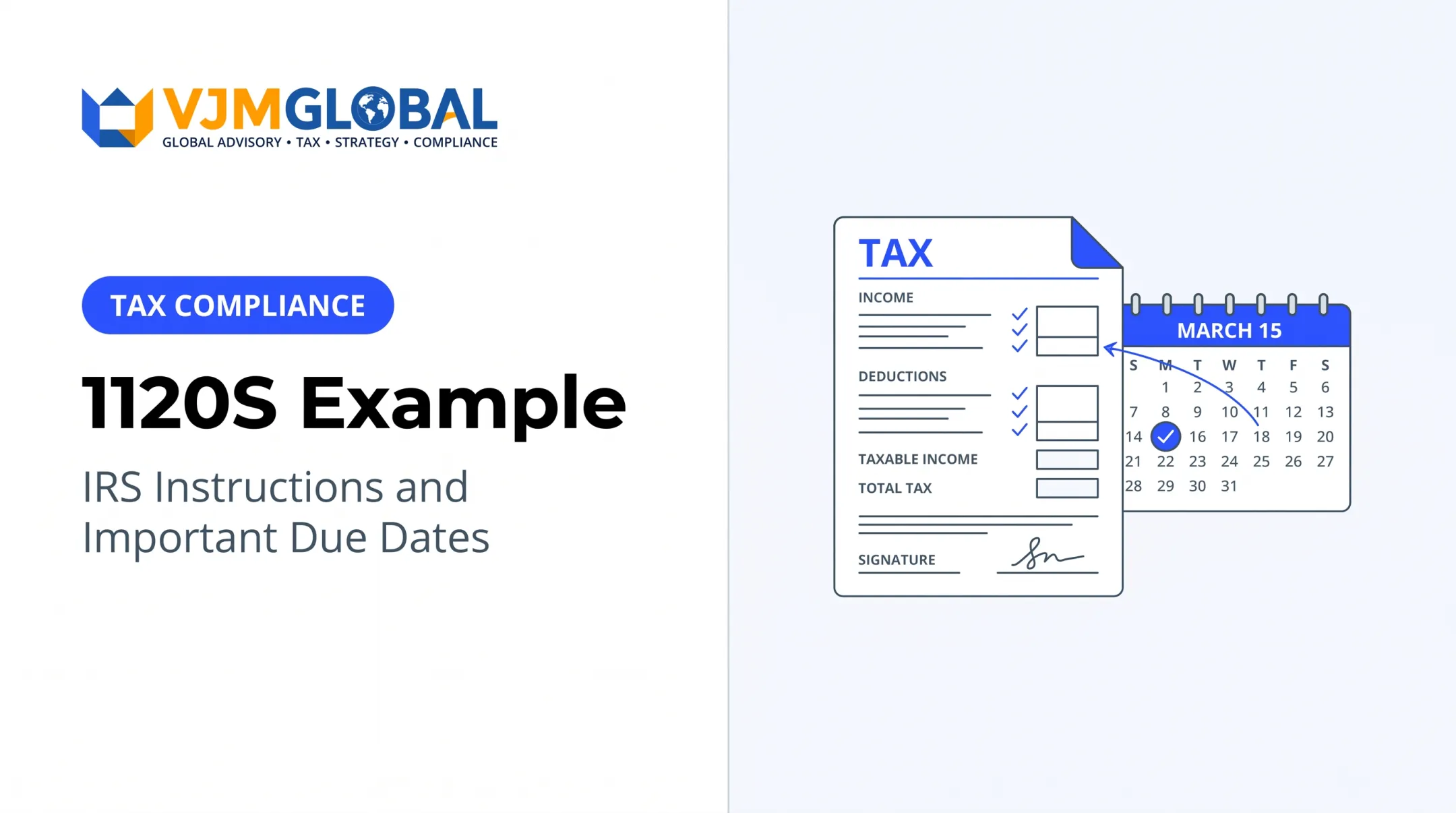
Form 1120-S is the annual federal income tax return for a US S corporation. Its deadline is generally the 15th day of the third month after the corporation's tax year ends.
That gives March 15 for calendar-year corporations. Fiscal-year, short-period, newly formed and terminated corporations can land on different dates.
Many owners assume March 15 applies to everyone, then discover a late-filing penalty that runs per shareholder, per month.
This guide covers the due-date formula, extensions, weekend adjustments, penalties and a practical preparation workflow. Dollar figures are US dollars, since the IRS sets them.
Key Takeaways
- The deadline runs from the corporation's tax year-end, not automatically from December 31.
- Calendar-year filers use March 15, moved to the next business day if it falls on a weekend or holiday.
- Form 7004 adds six months to file, but not to pay.
- A late return delays Schedule K-1s, even when the corporation has little or no income.
Why Timing Matters for Form 1120-S, and What Happens If You Miss the Due Date
What the return does
Form 1120-S reports the S corporation's income, deductions, credits and other financial information. Schedule K-1 then tells each shareholder their allocated share, which they report on their individual return.
The corporation generally pays no federal income tax on that income, yet it must still file on time. Under IRC section 6037, every S corporation files a return for each taxable year, and that requirement does not depend on having income.
Late-filing penalties
The 2025 Form 1120-S instructions set out the current rules for returns required to be filed in 2026:
- $255 per shareholder for each month or part of a month the return is late, up to 12 months.
- If tax is due, an added 5% of unpaid tax per month or part month, capped at 25%.
- A return more than 60 days late carries a minimum penalty of the smaller of the tax due or $525.
- Failing to furnish a correct Schedule K-1 on time costs $340 per failure, rising to $680 or 10% of reportable items for intentional disregard.
For example, a corporation with three shareholders that files two months late faces a base penalty of $1,530 (3 × 2 × $255). Reasonable cause can excuse the penalty. Penalty amounts are adjusted for inflation, so check the instructions for your filing year.
Downstream problems
A late or incomplete return also pushes back Schedule K-1 preparation. Shareholders then struggle to finish their personal returns or plan estimated tax payments accurately.
How this differs from Form 1120
A C corporation filing Form 1120 faces a different structure. Its penalty is 5% of unpaid tax per month or part month, capped at 25%, with no per-shareholder charge. Don't apply one form's penalty rules to the other.

Best Time to File Form 1120-S Based on Different Scenarios
The central rule is simple. Find the date the tax year closes, count to the 15th day of the third month after it, then check the result against the IRS calendar and the current instructions.
Based on a Calendar Tax Year
A tax year ending December 31 gives a due date of March 15. If that date falls on a Saturday, Sunday or legal holiday, the deadline moves to the next business day.
- Tax year 2025: March 15, 2026 was a Sunday, so the return was due March 16, 2026.
- Tax year 2026: March 15, 2027 is a Monday, so the deadline stays March 15, 2027.
Confirm each year's date in IRS Publication 509 (Tax Calendars).
Based on a Fiscal Tax Year
A fiscal-year S corporation uses the same formula from its own year-end. Two worked examples:
- Year ending June 30, 2026: due September 15, 2026.
- Year ending September 30, 2026: due December 15, 2026.
Use the corporation's approved tax year, not the shareholders' personal deadlines. Shareholders on a calendar year do not change the corporation's due date.
Based on a Short Period
A short-period return covers fewer than 12 months. It can arise from:
- A newly formed corporation (organised July 1 with a calendar year, the first period runs July 1 to December 31).
- A change in accounting period.
- An S election starting or terminating mid-year.
- A final return after dissolution (dissolved July 23, the period runs January 1 to July 23).
The due date follows the short period's end date. A final return is generally due by the 15th day of the third month after dissolution.
When an S election terminates mid-year, the S short-period return follows a distinct rule tied to the C corporation short-period return. Check whether other forms or IRS approvals apply, such as Form 2553 for the election or an accounting-period change request.
Based on an Extension Request
An S corporation requests more time with Form 7004, which must generally be filed by the original due date. Per the Form 7004 instructions, it gives an automatic six-month extension.
For a calendar-year 2025 return, the extended deadline was September 15, 2026. For tax year 2026, it is September 15, 2027.
The extension covers filing only. Any balance is still due by the original date. Late-payment penalties run at one-half of 1% of unpaid tax per month or part month.

How to Confirm It's the Right Time, and When to Avoid Filing
Validate the date
Before you set a deadline, check:
- The corporation's tax year-end and approved accounting period.
- The current Form 1120-S instructions.
- Weekend or holiday adjustments for that year.
- Whether a timely Form 7004 was accepted.
Don't mix up deadlines
March 15 is not universal. Keep these separate from Form 1120-S:
- Form 1120 for C corporations
- Form 1065 for partnerships
- Payroll returns such as Form 941
- State income tax returns
- Shareholder Form 1040 filings
When an extension beats rushing
Filing an inaccurate return can cause more trouble than extending. File Form 7004 instead if any of these remain unresolved:
- Bank and payroll records are unreconciled.
- Shareholder ownership percentages are uncertain.
- Balance-sheet figures don't tie out.
- Schedule K-1 data is incomplete.
Just remember the tax payment is still due on the original date, so estimate it and pay it.
Best Practices for Meeting the Form 1120-S Deadline
Build a reverse calendar
Work backwards from the due date and assign time to each step:
- Close the books and reconcile bank and payroll accounts.
- Review deductions and credits.
- Confirm shareholder details and ownership changes.
- Prepare the return and every Schedule K-1.
- Obtain officer approval and transmit.
Allow buffer time before the deadline. Also note the e-file rule: an S corporation filing 10 or more returns of any type in a calendar year must e-file Form 1120-S.

Gather the documents
- Prior-year return
- Income and expense records
- Balance sheet, fixed-asset register and loan details
- Payroll filings
- Shareholder changes and ownership percentages
- Support for credits and deductions
If total receipts and year-end total assets are both under $250,000, Schedules L and M-1 aren't required.
Review and keep proof
- Check the return against every Schedule K-1 for consistency.
- Confirm the officer's signature, the paid preparer's section if used, and all required schedules.
- Keep the e-file acknowledgement showing "Accepted". Rejected returns count as not filed.
- For paper filing, keep dated registered or certified mail receipts.
Where VJM Global fits
VJM Global's accounting and tax professionals work with US-focused businesses. They can organise financial records through remote bookkeeping, produce year-end financial reports used to prepare corporate returns, and help track filing deadlines. This supports your own review rather than replacing independent tax advice for your situation.
Conclusion
No single calendar date fits every S corporation. The Form 1120-S deadline depends on the tax year-end, any short period and any valid extension.
Confirm the date early, get shareholder information right, and file or extend on time. That avoids most penalties and keeps Schedule K-1s and personal returns on track.
Frequently Asked Questions
What is the late filing penalty for Form 1120?
A C corporation pays 5% of unpaid tax per month or part month, up to 25%. Form 1120-S has a separate per-shareholder penalty. Check the current instructions for the exact amounts.
What does short period return mean?
It is a return covering fewer than 12 months, caused by formation, termination, a tax-year change or an S election change. The due date runs from the short period's end date.
When is Form 1120-S due for a calendar-year corporation?
Generally the 15th day of the third month after December 31, which is March 15. Verify the year-specific date and any next-business-day shift.
Does Form 7004 extend the time to pay taxes?
No. It extends filing time only. Estimate any tax due and pay it by the original due date to avoid late-payment penalties.
Is Form 1120-S required if an S corporation had no income?
Yes, generally. IRC section 6037 requires a return for each taxable year. Confirm any exceptions in the current IRS instructions.
What happens if the due date falls on a weekend or legal holiday?
The deadline moves to the next business day. Confirm the date in the IRS tax calendar for that year.