This guide is for Australian tax residents, founders, and investors who own a U.S.-formed single-member LLC. You answer to two systems: the IRS and the ATO. Getting one right doesn't excuse mistakes in the other.
People use "single-member LLC," "disregarded entity," and "sole proprietorship taxation" as if they mean the same thing. They don't, operationally. Below: the filing flow, key forms, elections, deadlines, and cross-border traps.
Key Takeaways
- An LLC is a state-law entity; its federal tax classification decides how income is reported.
- A single-member LLC is generally disregarded by default, so activity lands on the owner's return.
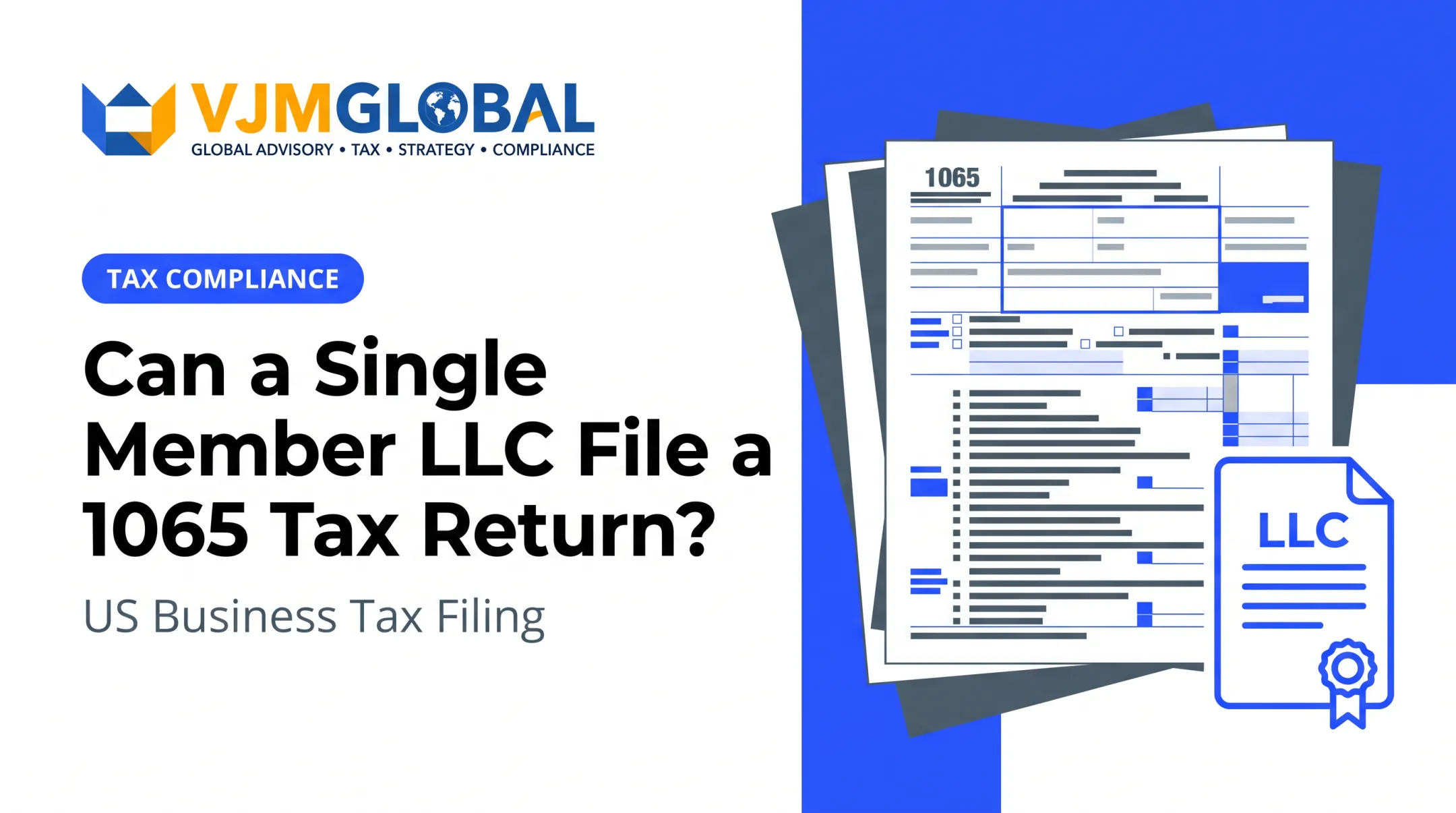
- Form 1065 belongs to multi-member LLCs taxed as partnerships.
- Australian residents may owe separate ATO reporting; verify against current ATO guidance.
What Is Single-Owner LLC Tax Filing?
An LLC is created under U.S. state law. Its U.S. federal tax treatment is a separate question, governed by U.S. federal classification rules. A U.S. LLC with one owner is generally a disregarded entity: the IRS looks through it and attributes income and expenses to the owner.
Owners can elect corporate treatment (C-corporation or S-corporation). That election changes the tax label only. The LLC remains an LLC under U.S. state law.
Two clarifications matter for Australians:
- An Australian company or sole trader is not a U.S. LLC. Foreign customers or contractors alone don't make U.S. forms relevant.
- Australia may classify the LLC differently. ATO ID 2010/77 says a single-member U.S. LLC can qualify as a foreign hybrid company under Division 830, but only if the statutory conditions are met.
Why the classification matters
Classification drives which return you file, whether income passes through to the owner, whether payroll or corporate formalities arise, and whether information returns apply.
Those outcomes depend on ownership, elections, U.S. activity, employees, tax residency, and income type. Having one owner alone does not settle the classification.
How Single-Owner LLC Tax Filing Works (Conceptual Flow)
The process runs in order: identify the owner and residence, confirm classification, organise records, prepare U.S. forms, review state and employment obligations, then assess Australian reporting.

Step 1: Confirm ownership, residency, and business activity
Work out whether the owner is a U.S. person, a nonresident alien (NRA), a company, or a trust. Then check whether the LLC conducts a U.S. trade or business, owns rental property, or earns other U.S.-source income.
U.S. citizens and resident aliens generally use Form 1040. An NRA engaged in a U.S. trade or business generally files Form 1040-NR. Australian tax residence alone doesn't make someone a U.S. NRA, and LLC ownership alone doesn't make all income effectively connected. Check current IRS instructions.
Step 2: Determine the LLC's tax classification
Default treatment is disregarded. Check whether a corporate election was ever made.
- Form 8832 elects corporate classification. Once made, changing it again is generally restricted for 60 months.
- Form 2553 elects S-corporation status. An NRA cannot be an S-corporation shareholder, so foreign owners must verify eligibility first.
Step 3: Prepare complete financial records
Gather the core records before you file:
- Sales invoices and payment-platform reports
- Bank statements, expenses, and asset purchases
- Depreciation schedules and contractor payments
- Payroll data, plus owner contributions and distributions
Keep business and personal transactions apart. Owner withdrawals are not automatically deductible expenses or taxable salary.
IRS guidance on record retention suggests keeping most records 3 years, 6 years if more than 25% of gross income was omitted, and employment records at least 4 years.
Step 4: Report income and expenses on the appropriate return
For an individual-owned disregarded LLC, Schedule C with Form 1040 is the usual route. Rental income may belong on Schedule E, and farming on Schedule F.
Other items may apply depending on facts:
- Schedule SE, generally when net self-employment earnings reach $400 (NRAs have special social-security rules)
- Form 1040-ES estimated payments, generally when expected tax due is $1,000 or more
- Form 1040-NR for qualifying nonresident owners
Step 5: Address foreign-owned LLC reporting and Australian obligations
A foreign-owned U.S. disregarded entity may need to file Form 5472 attached to a pro forma Form 1120 when it has reportable transactions with a related party. Owner contributions and distributions can count. Confirm current IRS instructions and exceptions.
On the Australian side, consider:
- Worldwide income inclusion, with amounts converted to Australian dollars
- A foreign income tax offset (FITO) where foreign tax was actually paid
- Controlled foreign company (CFC) rules, which depend on control tests and Australian-law classification
- Treaty provisions: on its facts, ATO ID 2010/188 treated the LLC as not a U.S. resident under the treaty; that result is not a blanket ruling

Step 6: Pay tax and maintain compliance throughout the year
Federal income tax is only one layer. State and local taxes, employment taxes, excise taxes, annual reports, and registered-agent requirements can all sit on top.
State examples include:
- Delaware: $400 annual LLC tax due 1 June
- Wyoming: license tax of $60 or $0.0002 of Wyoming assets, whichever is greater
- Florida: timely LLC annual report costing $138.75
Always confirm the relevant tax year's deadlines, extensions, and penalties against official IRS, state, FinCEN, and ATO sources.
Which Forms and Ongoing Filings Apply?
The forms you need depend on classification, owner status, income type, employees, U.S. state activity, and foreign-owner transactions.
Core forms for a default individual-owned LLC
- Form 1040 with Schedule C for ordinary business income
- Schedule E or F where the activity fits
- Schedule SE and Form 1040-ES for self-employment tax and estimates
- Depreciation forms where assets are held
Forming an LLC doesn't by itself create a separate U.S. federal income-tax return. Information returns, employment, excise, and U.S. state filings can still apply.
Forms for corporate elections
- Form 8832: elects corporate classification; the effective date can be up to 75 days before filing and up to 12 months after.
- Form 2553: S election, generally due within 2 months and 15 days of the tax year start.
- Form 1120 / 1120-S: C-corporation and S-corporation returns.
Before treating an S election as a tax saver, weigh payroll, reasonable compensation, shareholder eligibility, timing, and administration costs.
Foreign-owner and identification forms
Form SS-4 requests an EIN. An EIN is not an LLC, a tax classification, or a tax return. Classification elections go through Form 8832 or 2553.
For a foreign-owned disregarded entity, Form 5472 and the pro forma Form 1120 apply where there are reportable transactions. The failure-to-file penalty is $25,000, with another $25,000 if it continues more than 90 days after IRS notice, per the Form 5472 instructions.
Filing calendar and supporting documentation
For calendar-year 2026 filings:
| Item | Date |
|---|---|
| Form 1040 | 15 April 2027 |
| Form 1040-NR | 15 April 2027 with U.S. wages; 15 June 2027 otherwise |
| Form 1065 / 1120-S | 15 March 2027 |
| Form 1120 (incl. pro forma) | 15 April 2027 |
| Extended 1065 / 1120-S / 1120 | 15 September / 15 September / 15 October 2027 |
| Estimated tax | 15 April, 15 June, 15 September 2026; 15 January 2027 |
| Australian 2025-26 return (self-lodged) | 2 November 2026 |

Extensions of time to file don't extend time to pay. Form 7004 must be filed by the original due date on U.S. returns. Lodgment due dates for returns filed through a registered tax agent vary under the ATO program.
Before filing, reconcile bank, payment-platform, accounting, and tax-return figures so they match.
When professional review is appropriate
Get qualified cross-border advice if you have:
- An Australian owner with U.S. trade or business activity
- Multiple states or employees
- Related-party transactions or significant assets
- A corporate election
- Foreign exchange or treaty uncertainty
VJM Global supports international businesses with accounting, tax compliance, and financial advisory services. Australian or U.S.-connected owners can request a case-specific review rather than relying on a general checklist.
Common Issues, Misconceptions, and When Filing May Not Be Appropriate
Common mistakes and misconceptions
"Every LLC files Form 1065." It doesn't. A single-member LLC normally does not file it, unless its facts or an election create a different classification.
Mixing up the terms. Picture a Melbourne consultant who forms a Wyoming LLC and never elects anything. The LLC is the legal wrapper, the EIN is just an ID number, and the entity is disregarded for tax purposes, much like a sole proprietor. None of that creates an S corporation.
Reporting only withdrawals. Report the LLC's full income and deductible expenses, not just what you took out. Personal expenses aren't deductible business costs.
When the default approach may not be appropriate
- Employees, payroll, excise taxes, multiple states, or reportable foreign-owner transactions may require more than default treatment.
- Don't elect S or C status automatically. Compare tax, payroll, eligibility, and compliance consequences with current advice.
- A no-income year doesn't always erase filing duties. Contributions or formation costs can trigger Form 5472, and a non-resident alien (NRA) engaged in a U.S. trade or business may still need Form 1040-NR.
- FinCEN's August 2026 final rule continues to exempt U.S.-formed LLCs from BOI reporting, but check the current position for your year.
This guide does not cover treaty treatment, permanent-establishment exposure, CFC implications, transfer pricing, or foreign exchange treatment. Those issues need individual advice.
Conclusion
Single-owner LLC filing starts with classification and ownership. Then come accurate books, the correct U.S. forms, any foreign-owner information returns, and a separate Australian compliance review.
The LLC's facts and elections determine the filing, not its name or an EIN. Verify current IRS and ATO rules before you file.
Frequently Asked Questions
Can a single-member LLC be treated as a partnership?
By default, it is disregarded as a separate entity for federal income tax. It may be treated differently after a valid election or an ownership change. Tax classification is separate from state-law status.
Does a single-member LLC need a 1065?
Generally no. Form 1065 is for partnership taxation. Exceptions arise only where a different classification or ownership structure applies.
How do I know if my LLC is an S corp or sole proprietorship?
Review formation and election records, IRS acceptance notices, prior returns, and any Form 2553 or 1120-S. An LLC stays an LLC legally while taxed under a chosen classification.
Which LLC tax classification is best for my LLC?
It depends on profit, residency, payroll, reinvestment, state rules, eligibility, and compliance costs. Get a current U.S.-Australian tax review before electing.
What happens if my LLC makes no money?
Having no profit does not necessarily mean you have no filing obligation. Foreign-owned LLCs, or those with expenses, employees, or reportable transactions, may still have federal or state duties. Verify that year's requirements.
Are EINs and LLCs the same thing?
No. An LLC is a legal entity; an EIN is a federal tax identification number. Getting an EIN doesn't determine tax classification.