Introduction
Plenty of Australian founders assume a US LLC that owes no income tax has no US filing duties. That assumption is expensive. Form 5472 can still be required whenever the LLC has reportable transactions with its foreign owner or a related party, and the initial penalty is US$25,000 per related party, per year.
This guide focuses on a US LLC owned by a non-US individual or entity, which is the common setup for Australian owners. It covers who files, what must be reported, how to file, the deadlines, and what happens when a year is missed. It is general information, not individual tax advice.
Key Takeaways
- Form 5472 is an information return, not a calculation of US income tax.
- A foreign-owned single-member LLC may need Form 5472 plus a pro forma Form 1120.
- Contributions, distributions, loans, services, and property transfers can all be reportable.
- Check current IRS instructions for deadlines, submission method, and penalties before filing.
What Is Form 5472, and Why Can a "Disregarded" LLC Still Have to File?
What Form 5472 does
Form 5472 reports transactions between certain US entities and foreign owners or other related parties. The IRS describes it as an information return. It does not compute tax owed.
Why disregarded status does not remove every obligation
A single-member LLC is normally disregarded for ordinary federal income tax. Under Treasury Regulation 301.7701-2(c)(2)(vi), though, a domestic disregarded entity wholly owned by one foreign person is treated as a separate corporation for section 6038A reporting only. That treatment is what requires Form 5472.
Not every foreign-owned LLC must file, though. The obligation depends on:
- Tax classification of the entity
- Ownership structure
- Related-party relationships
- Whether reportable transactions occurred in the year
Foreign-owned US LLC versus foreign LLC
Formation law decides whether an entity is domestic or foreign, independent of its tax classification. An LLC formed in Delaware and owned by an Australian company is domestic. An LLC formed under non-US law that does business in the US is foreign, and its obligations should be analysed separately.
Other forms are easy to confuse with it:
- Form 5471: certain US persons with interests in foreign corporations
- Form 8858: US persons owning foreign disregarded entities or branches
- Form 1065: partnership income return
Who Is Required to File Form 5472?
Work through these questions in order:
- Where was the entity formed?
- How many owners does it have, and are they foreign persons?
- What is its federal tax classification?
- Are there related parties?
- Did reportable transactions occur during the tax year?
Foreign-owned single-member LLCs treated as disregarded entities
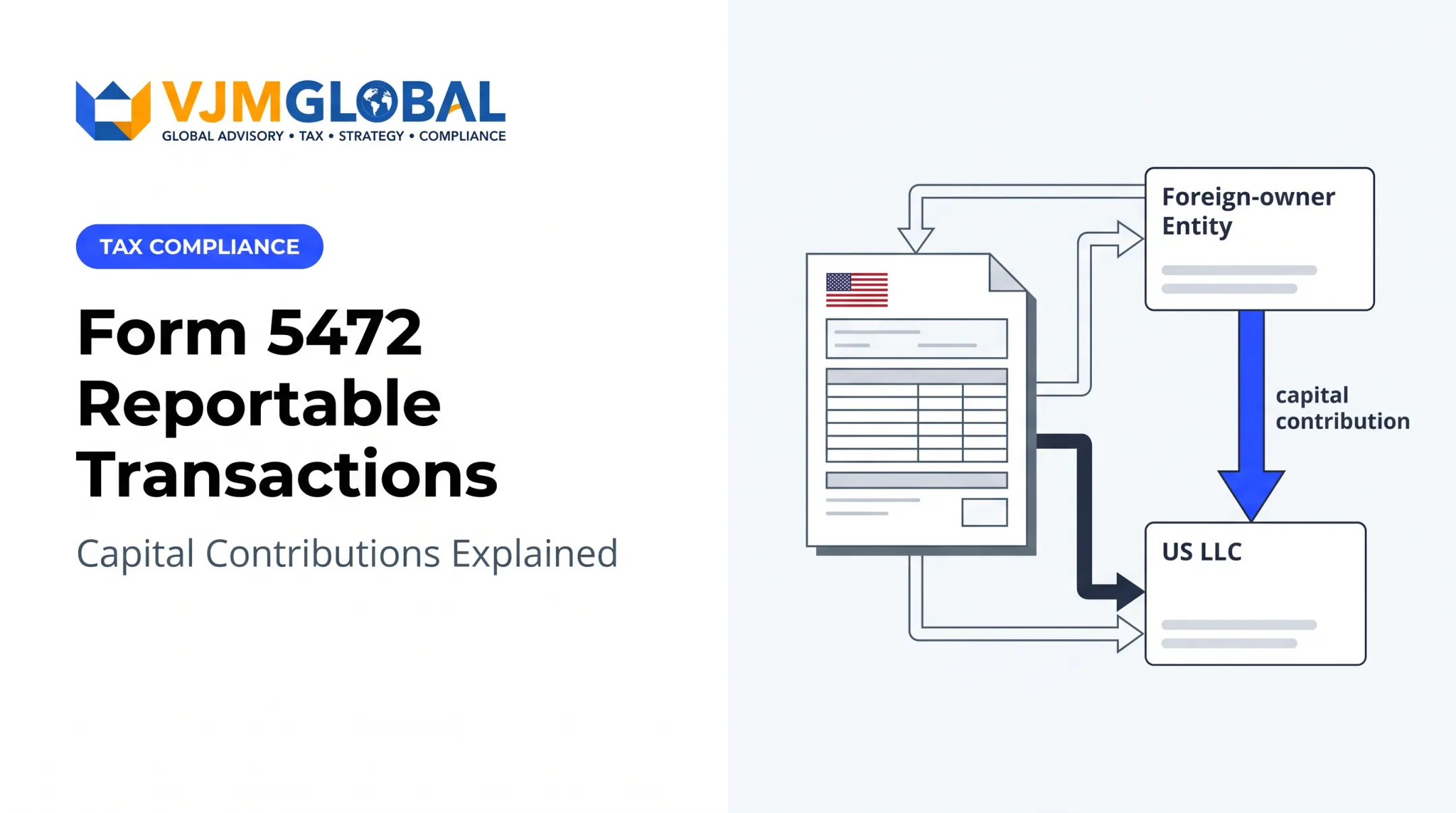
This is the typical case: one foreign individual, company, or trust owns the LLC, and the LLC transacts with its owner or another related party. For example, an Australian company funds its US single-member LLC with a capital contribution and later takes a distribution. Both are reportable. Your own structure may produce a different result.
US corporations and LLCs taxed as corporations
A US corporation, or an LLC electing corporate treatment, files if at least one foreign person owns 25% or more of voting power or total stock value, directly or indirectly, at any time in the year. Constructive ownership rules under section 318 apply, with modifications, so check the current instructions.
Foreign corporations engaged in a US trade or business
A foreign corporation conducting a US trade or business may also file. The analysis differs from the domestic disregarded LLC rules, and exceptions (treaty, section 883) have their own conditions.
Related parties and transaction conditions
Related parties include:
- A direct or indirect 25% foreign shareholder
- Persons related to the entity or that shareholder under sections 267(b) or 707(b)(1)
- Persons related to the entity under section 482
Ownership alone does not trigger filing. The entity generally files only when it has reportable transactions, and one form is needed for each related party.
What Transactions Must a Foreign-Owned LLC Report?
A reportable transaction is a covered transfer of money, property, rights, or services between the LLC and a foreign owner or related party. The current form instructions contain the definitive list.
Cash transactions and financing
- Capital contributions and distributions
- Loans, advances, and repayments
- Interest
- Expenses the owner pays on the LLC's behalf
Treat owner bank transfers as reportable even when they look informal, and review them against the form categories.
Sales, purchases, services, rent, and royalties
Part IV of the December 2023 form covers:
- Inventory and other property sales or purchases
- Rents and royalties
- Technical, managerial, or like services
- Commissions
- Interest and loans
- Intangible property licences
Amounts are reported in US dollars, with an exchange-rate schedule for foreign currency.
Non-cash and less-than-full-consideration transactions
Part VI requires a schedule for non-cash or below-value transactions with foreign related parties, such as property contributions, free services, or interest-free loans. Include estimated fair market value where possible.

There is no minimum-dollar filing threshold. The US$50,000 reporting shorthand is a convenience, not an exemption.
No-income and personal-use scenarios
An LLC with no revenue can still file. Part V captures disregarded entity transactions such as formation, contributions, and distributions. An owner who funds the LLC and pays its registered agent fee has already created reportable activity.
Documentation
Keep these on hand:
- Bank statements and invoices
- Loan and service agreements
- Capital and distribution records
- Property transfer documents
- Ownership charts
- Royalty or licence arrangements
Section 6038A requires permanent, accurate records. Identify each related party and confirm from the instructions whether separate forms are needed.
How to File Form 5472: EIN, Pro Forma Form 1120, and Deadlines
Confirm classification first: disregarded, taxed as a corporation, or another regime. That decides the return package.
Obtain and verify the EIN
The disregarded LLC uses its EIN for Form 5472. If it has none, apply using Form SS-4. Per the IRS instructions, line 9a is "Other" with "Foreign-owned U.S. disregarded entity-Form 5472."
VJM Global's US practice handles entity formation and EIN steps for clients of any origin.
Assemble the filing package
- Disregarded LLC: Form 5472 attached to a pro forma Form 1120, with "Foreign-owned U.S. DE" written across the top
- LLC taxed as a corporation: Form 5472 with its regular Form 1120
Reconcile entity details, owner and related-party data, transaction categories, and amounts against your records before preparing.
Deadline and extension
The due date follows the attached Form 1120. For calendar-year entities, that is 15 April. A timely Form 7004 generally extends to 15 October.
Disregarded entities use the Form 1120 extension code and mark "Foreign-owned U.S. DE." The entity's tax year follows its foreign owner's if that owner has a US return obligation.
Submission method
Current instructions (December 2024) prohibit e-filing for foreign-owned US disregarded entities. They must fax to 855-887-7737 at 300 DPI or higher, or mail to the IRS in Ogden, Utah. Check the current instructions before sending.

Pre-submission checklist:
- Correct EIN
- Complete owner details
- Matching name and address
- One form per related party
- Pro forma return attached
- Signature by an authorised officer
- Copies and proof of delivery
When professional support makes sense
Seek help if classification is unclear, you have multiple related parties or non-cash transfers, prior years were missed, or transactions flow between an Australian parent and the US LLC.
VJM Global supports foreign businesses with cross-border accounting, transaction documentation, and US tax compliance coordination.
Penalties, Common Mistakes, and Missed Filings
The IRS international penalties manual sets out the penalty framework:
- US$25,000 per related party per year for failing to file, filing a substantially incomplete form, or failing to keep records
- After IRS notice and 90 days, US$25,000 for each additional 30-day period, with no stated maximum
Common mistakes
- Assuming disregarded status means no filing
- Missing contributions or owner-paid expenses
- Leaving out non-cash transactions
- Using the wrong tax year
- Omitting related parties
- Filing without the pro forma Form 1120
- Following outdated submission instructions
Correcting a missed filing
- Identify every affected year so you know the full scope of exposure
- Reconstruct ownership and transaction records for each year involved
- Prepare the missing Form 5472 and the related pro forma Form 1120
- Add a reasonable-cause statement where the facts support one
- Get professional advice before answering any IRS notice
Relief is fact-specific and never guaranteed. Penalty abatement is separate from simply submitting a late return.
A reasonable-cause statement must set out facts in writing under penalties of perjury. The IRS may assess penalties before reviewing that statement.

Frequently Asked Questions
Who is required to file Form 5472?
25% foreign-owned US corporations, foreign corporations engaged in a US trade or business, and foreign-owned US disregarded entities with reportable transactions. Exact filing status depends on entity classification and the facts of each case.
How is a foreign LLC taxed in the US?
It depends on whether the LLC has one or several owners and whether it elected corporate treatment. Income tax is separate from the Form 5472 information-reporting duty.
Does a foreign-owned single-member LLC need to file Form 5472 if it has no income?
Possibly. Contributions, distributions, loans, or owner-paid expenses can trigger the form even without revenue.
Is Form 5472 filed with Form 1120?
Yes. Disregarded LLCs attach it to a pro forma Form 1120, and LLCs taxed as corporations file it with their regular return, subject to current IRS instructions.
What transactions must be reported on Form 5472?
Common categories include contributions, distributions, loans, interest, services, rent, royalties, and property transfers. Always follow the current IRS instructions for the complete list.