That said, first-time and international founders often hit the same walls: which legal structure to pick, how to register with the Secretary of State, and which taxes and licenses actually apply to them. This guide walks through the entire process, from validating your idea to registering, staying compliant, and growing once you're operational.
Key Takeaways
- Nebraska keeps startup costs low with simple registration and clear state rules
- Your legal structure (LLC, corporation, or sole proprietorship) sets liability, taxes, and funding options
- Register with the Secretary of State and appoint a registered agent for every entity
- Secure an EIN, sales tax permit, and any local or professional licenses before you operate
- Foreign founders avoid US compliance pitfalls by using cross-border formation specialists
Understanding Nebraska's Business Environment
Nebraska may not rank among the usual US startup capitals, yet the numbers tell a solid story. Small businesses make up 99.1% of all Nebraska businesses: 188,716 companies employing 414,068 people, or 48.6% of the state's workforce, according to the SBA's 2024 Small Business Profile.
Between March 2022 and March 2023, small businesses drove nearly 80% of the state's net employment growth.
The Nebraska Department of Economic Development actively supports new ventures through grants, loan programs, and export assistance. Formation is a series of manageable, well-documented steps rather than one overwhelming bureaucratic hurdle.
Popular Industries in Nebraska
Certain sectors consistently perform well in the state:
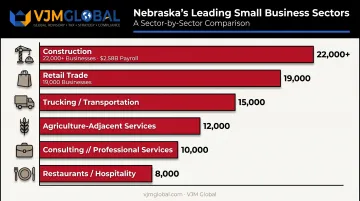
- Construction — over 22,000 small businesses, $2.58 billion in annual payroll
- Trucking and transportation — leveraging Nebraska's central US location
- Retail trade — nearly 19,000 small businesses statewide
- Agriculture-adjacent services — supply, consulting, and equipment support
- Consulting and professional services — business advisory, IT, and specialized expertise
- Restaurants and hospitality — food service and visitor-driven demand
Who Should Consider Starting a Business in Nebraska
This guide works for domestic entrepreneurs building their first company. It is equally relevant to foreign businesses, including Indian companies, evaluating Nebraska as a US entry point. Low formation costs and a simple filing process make it a practical testing ground for first-time expansion into the American market.
Step-by-Step Process to Register a Business in Nebraska
Step 1: Validate Your Business Idea
Before filing anything, confirm there's a real market. Identify your target customer, test your pricing assumptions, and map out how the business actually makes money. Skipping this step is the most common reason new businesses stall within the first year.
Step 2: Draft a Business Plan
A solid plan covers:
- Startup costs and ongoing overhead
- Competitor analysis
- Revenue projections for the first 12-24 months
- Your funding approach (self-funded, loan, or investor-backed)
Step 3: Choose a Legal Structure
This decision affects your liability, tax treatment, and ability to raise money:
| Structure | Liability Protection | Tax Treatment | Best For |
|---|---|---|---|
| Sole Proprietorship | None | Pass-through | Solo, low-risk ventures |
| Partnership | None (general) | Pass-through | Two+ owners, simple setup |
| LLC | Yes | Pass-through or corporate | Most small businesses |
| Corporation | Yes | Corporate (double taxation possible) | Businesses seeking outside investment |
Most first-time founders, and nearly all foreign entrants, choose an LLC for its liability shield and flexible tax treatment.
Step 4: Search and Reserve Your Business Name
Check name availability through the Nebraska Secretary of State's business search. Your name must be distinguishable from existing entities on record. You can reserve an approved name for 120 days.
If you plan to operate under a different name than your legal entity name, file a trade name (DBA) application separately.
Step 5: File Formation Documents
For an LLC, file a Certificate of Organization. For a corporation, file Articles of Incorporation. Both go through the Secretary of State, either online, by mail, or in person.
You must also appoint a registered agent with a physical Nebraska address. This person or entity accepts legal documents on the business's behalf and must be maintained continuously.
One quirk unique to Nebraska: LLCs must publish a formation notice for three successive weeks in a legal newspaper near their registered office, then file proof of that publication with the state.
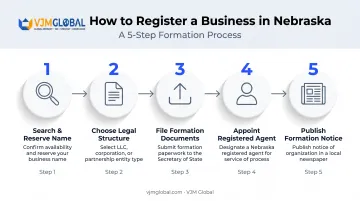
Registered agent rules, publication notices, and filing order trip up many first-time and international founders. Specialized formation services help close those gaps. VJM Global supports foreign clients with US entity choice, registered agent appointment, operating agreements or bylaws, and EIN registration with the IRS.
Nebraska Business Costs, Licenses, and Requirements
Typical Filing Costs
| Filing | Cost |
|---|---|
| LLC Certificate of Organization | $100 online / $110 in-office |
| Corporation Articles of Incorporation | $100 online / $110 in-office |
| Name reservation | $30 |
| Trade name (DBA) application | $100 online / $110 in-office |
| LLC publication proof filing | $25 online / $30 in-office |
These fees come from the Secretary of State's current fee schedule. Always double-check the live page before filing, since state fee tables update periodically.
How Much Money Do You Actually Need?
Beyond filing fees, budget for:
- Newspaper publication costs (varies by publisher, LLC-only requirement)
- Initial inventory or equipment
- Working capital for the first 3-6 months
- Licensing and permit fees specific to your industry
A simple consulting LLC might launch for under $1,000. A retail or restaurant concept needs considerably more for inventory, buildout, and staffing.
Licensing Requirements
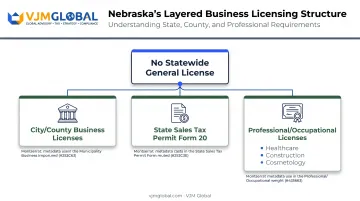
Nebraska has no single statewide general business license. Instead, requirements vary by location and industry:
- City or county business licenses (varies by municipality)
- Nebraska Department of Revenue sales tax permit (Form 20): required if you sell taxable goods, provide certain services, or hire employees
- Professional or occupational licenses for regulated fields like healthcare, construction trades, or cosmetology
Checking Name Availability
Use the Secretary of State's online business search tool before you file anything. A preliminary "available" result isn't a guarantee. Final approval happens at filing. Reserve the name if you're not ready to file immediately.
Understanding Nebraska Taxes and Compliance
Tax Structure
Nebraska's 2025 tax rates, per the Nebraska Department of Revenue, include:
- Corporate income tax: 5.20% of Nebraska taxable income
- Individual income tax (top bracket): 5.20%, applicable to pass-through LLC income
- State sales/use tax: 5.5%, plus local rates ranging from 0.5% to 2.0%
LLCs typically pass income through to owners' personal returns; corporations face the corporate rate directly, with a second layer of tax if profits are distributed as dividends.
Biennial Report Requirement
Nebraska requires periodic reports, not annual ones:
- LLCs file in odd-numbered years, due April 1
- Corporations file in even-numbered years, due March 1
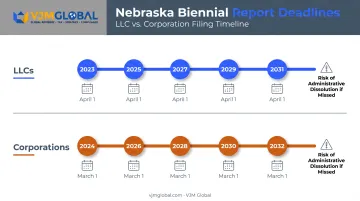
Missing these deadlines risks administrative dissolution. Mark your calendar early. This is one of the most commonly overlooked compliance items for new owners.
Cross-Border Complexity for Foreign-Owned Businesses
Foreign-owned businesses face layers most domestic owners never touch:
- Withholding on payments to foreign owners
- Tax treaty considerations
- Coordinating home-country filings with US obligations
VJM Global supports foreign-owned Nebraska businesses with ongoing accounting, payroll, and tax filing—including QuickBooks or Xero bookkeeping, payroll processing, and multi-state sales tax management.
Setting Up Banking, Funding, and Building Your Team
After formation, separate your finances, line up capital, and hire under Nebraska rules so liability protection and payroll stay intact from day one.
Business Banking
Open a separate business bank account immediately after formation. Mixing personal and business funds ("commingling") is one of the fastest ways to lose your liability protection. A court can disregard your LLC or corporate shield if finances aren't clearly separated.
Bring your formation documents, EIN confirmation, and government-issued ID when you open the account.
Funding Options
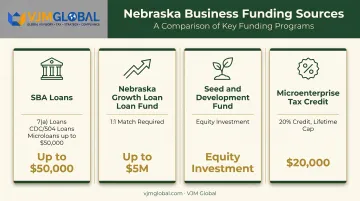
Common paths for Nebraska founders include:
- SBA loans — 7(a) and CDC/504 for larger needs; Microloans up to $50,000 for smaller starts (all active in Nebraska)
- State incentives — Nebraska Growth Loan Fund offers loan participation up to $5M with a 1:1 lender match; the Seed and Development Fund provides equity investment on similar terms
- Microenterprise Tax Credit — 20% credit on qualifying investment or employment increases, capped at $20,000 lifetime
- Bootstrapping or venture capital — choose based on how fast you need to grow and how much ownership you want to keep
Hiring Basics
Before bringing on your first employee:
- Obtain an EIN from the IRS (if you do not already have one)
- Register with the Nebraska Department of Labor
- Set up payroll withholding and follow state wage rules
- Report new hires and carry required workers' compensation coverage
Marketing and Growing Your Nebraska Business
Local visibility matters more in Nebraska than in oversaturated coastal markets. Community-rooted tactics often generate more traction than paid ads alone:
- Join your local Chamber of Commerce
- Sponsor community events
- Build partnerships with nearby businesses
For mentorship and growth support, start with these two:
- SCORE Nebraska — free mentoring, workshops, and pitch events in Omaha and Lincoln
- Nebraska Business Development Center (NBDC) — no-cost consulting from startup through succession, with nine locations statewide
Both are underused by new founders and worth a call before you spend money on outside consultants.
Frequently Asked Questions
How much does it cost to register a business in Nebraska?
LLC and corporation filings run $100 online or $110 in-office. Add $30 for name reservation and $100–$110 for a trade name (DBA) if you need one. LLCs also pay a newspaper publication fee that varies by publisher.
How much money do I need to start a small business in Nebraska?
It depends heavily on industry. Budget for filing fees, licensing, initial inventory or equipment, and at least 3-6 months of working capital beyond those startup costs.
How do I register my new small business in Nebraska?
File your Certificate of Organization (LLC) or Articles of Incorporation (corporation) through the Nebraska Secretary of State's online portal, appoint a registered agent, and complete any required publication notice.
What are the requirements to start an LLC in Nebraska?
You need a distinguishable business name, a Certificate of Organization filed with the Secretary of State, and a registered agent with a Nebraska address. LLCs must also publish a formation notice for three weeks.
Do I need a business license to operate in Nebraska?
Nebraska has no single statewide business license. Many businesses still need a local city/county license or an industry-specific permit, such as a sales tax permit or professional license.
How can I check if my business name is available in Nebraska?
Use the Nebraska Secretary of State's online business name search tool. A preliminary match doesn't guarantee final approval, so reserve the name if you're not ready to file right away.