But opportunity doesn't mean simplicity. Founders from India, the UK, and Australia quickly discover that US company formation isn't one system, it's fifty different state systems layered under federal tax rules that look nothing like what they know at home.
This guide breaks down the critical steps: structure selection, registration, tax compliance, and banking, so you can build your US entity without the costly missteps that trip up so many international founders.
Key Takeaways
- Entity type and state selection determine liability exposure, tax burden, and VC funding eligibility
- EIN, registered agent, and ITIN rules differ significantly for non-residents versus US citizens
- Ongoing compliance (BOI reporting, Form 5472, franchise taxes) carries steep penalties if missed
- Cross-border advisors who know US and home-country rules prevent costly double-taxation issues
Choosing the Right Business Structure for Your US Entity
Your structure decision shapes everything downstream, from how profits get taxed to whether investors take you seriously.
LLC vs. C-Corporation: What Foreign Owners Need to Know
Most international founders choose between two structures:
| Factor | LLC | C-Corporation |
|---|---|---|
| Taxation | Pass-through (owner reports profits) | Corporate-level tax, then dividend tax |
| Ownership limits | No restrictions on foreign owners | No restrictions on foreign owners |
| Venture capital fit | Rarely used by VCs | Preferred structure for institutional investors |
| Compliance burden | Lighter (fewer formalities) | Heavier (board meetings, minutes, bylaws) |
| Liability protection | Yes | Yes |
An LLC suits founders running an operating business or holding assets with fewer investors. A C-Corp fits startups planning to raise institutional capital, since most US venture funds simply won't invest in an LLC.
Why Foreign Founders Can't Elect S-Corp Status
Here's a restriction that catches people off guard: nonresident aliens cannot own shares in an S-Corporation, according to IRS rules on S-Corp eligibility. S-Corps require all shareholders to be US citizens or resident aliens.
This matters because S-Corps offer pass-through taxation without the double-tax hit of a C-Corp, an option that's simply off the table for non-residents. If you want pass-through treatment, an LLC is your only realistic path.
Picking Your State: Delaware, Wyoming, or Nevada
State choice affects cost, privacy, and investor perception:
- Delaware – The default for startups seeking outside investment, home to over 2.28 million registered entities and roughly 70% of Fortune 500 companies, according to the Delaware Division of Corporations. Annual LLC franchise tax runs around $300.
- Wyoming – The budget-friendly, privacy-focused option, with LLC filing fees as low as $60.
- Nevada – Offers no state income tax and strong privacy protections, though annual fees (around $350) run higher than Wyoming's.
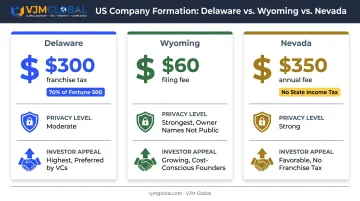
If you're not raising venture capital, Wyoming often makes more financial sense. If institutional investors are in your future, Delaware remains the safer bet.
Foreign Qualification: Extending an Existing Entity
Already have a company in India, the UK, or Australia? You don't always need a new US entity. Foreign qualification lets your existing company register to do business in a US state directly. It's faster to set up but exposes your home-country entity to US liability directly, unlike forming a separate US subsidiary that isolates that risk.
Example: An Australian SaaS company selling to US customers might form a Delaware C-Corp subsidiary to raise a seed round. An Indian export business simply shipping goods to US buyers, on the other hand, might only need foreign qualification in the state where it holds inventory.
Step-by-Step Registration Process
Once you've picked your structure and state, formation follows a predictable sequence.
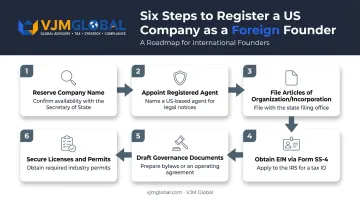
Reserve and register your company name – Search your target state's business database and the USPTO trademark database to avoid naming conflicts before you file.
Appoint a registered agent – Every state requires a registered agent with a physical address in the state of incorporation. This person or company receives legal notices and service of process on your behalf. Skip this step, and your filing gets rejected outright.
File Articles of Organization or Incorporation – Submit to the Secretary of State. Standard processing takes anywhere from a few days to a few weeks; expedited options (often same-day or 24-hour) cost extra but save time when deadlines matter.
Obtain an EIN from the IRS – Applicants without a US Social Security Number use Form SS-4, marking "foreign" on line 7b, and submit it by fax, mail, or phone (267-941-1099) rather than the online portal, which requires an SSN.
Draft governance documents – An operating agreement (LLC) or corporate bylaws (C-Corp), plus formal appointment of managers, directors, or officers, establishes who controls decisions and how.
Secure business licenses and permits – Requirements vary by industry and location, from general business licenses to sector-specific permits.
Tax Compliance and Ongoing Obligations for Foreign-Owned US Companies
Formation is just the entry point. What trips up foreign owners most often is what comes after.
Federal and State Filing Requirements
- C-Corporations file Form 1120 annually, reporting corporate income regardless of whether profits were distributed.
- Foreign-owned single-member LLCs treated as disregarded entities must file Form 5472 alongside a pro forma Form 1120, even with zero activity.
- Missing Form 5472 triggers a $25,000 penalty, according to the IRS Form 5472 instructions, with additional penalties accruing for continued non-filing.
- States layer on their own requirements, including annual reports, franchise taxes, and registered agent renewal fees.
- Delaware's franchise tax alone ranges from $175 to several thousand dollars, depending on your entity's structure and share count.
Economic Nexus, BOI Reporting, and Treaty Benefits
Economic nexus rules mean you can owe sales tax in a state even without a physical office there, once revenue or transaction volume crosses that state's threshold (often $100,000 in sales).
Ownership disclosure adds another layer of scrutiny. Under the Corporate Transparency Act, most domestic US companies are now exempt from Beneficial Ownership Information reporting, but foreign reporting companies still must file with FinCEN, disclosing owners holding 25% or more of the entity.
Finally, tax treaties between the US and countries like India, the UK, and Australia help prevent double taxation on the same income. To claim treaty benefits, you'll typically need a Certificate of Residency (Form 8802 for US applicants, or the equivalent from your home tax authority), proving where you're a tax resident.
Given how these obligations overlap, many foreign-owned entities partner with cross-border tax specialists—firms like VJM Global coordinate Form 5472 filings, FinCEN disclosures, and treaty documentation, helping clients avoid missed deadlines and penalties.
Banking, Documentation, and Common Roadblocks
Opening a US business bank account as a non-resident is often the most frustrating part of the entire process.
What you'll typically need:
- Your EIN confirmation letter
- Formation documents (Articles of Organization/Incorporation)
- A valid passport
- Proof of US business address (sometimes your registered agent's address works)
Beyond gathering these documents, many major banks still require an in-person visit to open an account, which creates real friction for founders who can't easily travel to the US. A handful of banks and fintech platforms now offer remote onboarding, but expect enhanced identity verification.
Other friction points to plan for:
- Apostille requirements – Foreign documents need apostille authentication before submission to US authorities. Hague Convention members like India, the UK, and Australia get faster processing.
- Time zone gaps – Coordinating with US banks, agents, and government offices across a 9-14 hour time difference slows everything down.
- AML/KYC checks – Enhanced due diligence for foreign beneficial owners holding 25%+ ownership can extend approval timelines.
Why Partnering with Cross-Border Experts Matters
Running a US entity while staying compliant back home means juggling two parallel sets of obligations that rarely sync up neatly.
An Indian founder filing Form 5472 in the US still owes FEMA reporting to the Reserve Bank of India. A UK-based founder claiming treaty relief needs someone who understands both HMRC and IRS paperwork. Missing either side usually costs more than the advisory fee would have.
This is where VJM Global fits in, working specifically with founders who need both sides covered:
- Backed by a New York office and 30+ years of tax, audit, and advisory experience
- Combines CPAs and Chartered Accountants on one team, covering both US and home-country filings
- Draws on direct experience with compliance in India, the UK, and Australia
VJM Global has supported 500+ American business owners with a 95% client retention rate, a track record built on catching the details that fall through the cracks when founders try to manage cross-border compliance alone.

Frequently Asked Questions
What are the main stages of formation of a company?
The core stages include reserving your company name and filing incorporation documents with the state. You'll then need an EIN from the IRS and any required state or industry-specific tax registrations.
What is the first step to be international for a company?
Before filing anything, define your market-entry objectives and choose your target jurisdiction and entity structure. Filing without this clarity often means restructuring later at extra cost.
Can a foreign national own 100% of a US company?
Yes. Non-residents can fully own LLCs and C-Corporations without needing US citizenship, residency, or a visa. The one exception is S-Corporations, which require US citizen or resident shareholders.
Do I need a US visa to form or own a company in the US?
You don't need a visa simply to own a US company. However, physically working in the US or actively managing day-to-day operations from within the country does require proper work authorization.
Which US state is best for foreign-owned company formation?
Delaware offers investor credibility and is the standard choice for startups raising capital. Wyoming appeals to founders prioritizing low fees and privacy. Many founders also incorporate directly in their state of actual operations.
How long does it take to register a company in the US as a foreigner?
State filing typically takes a few days to a few weeks depending on the state and whether you pay for expedited processing. EIN issuance without an SSN, done by fax or mail, generally adds another one to four weeks.