The pull factors are obvious once you look closely: EU single market access, Rotterdam and Amsterdam as logistics gateways, an English-friendly business culture, and a corporate tax structure that rewards smaller profit brackets. This isn't just startup territory either. German GmbH owners, freelancers, SMEs, and larger firms eyeing Dutch distribution are all asking the same question: how do we actually set this up?
This guide walks through entity types, registration steps, costs, and ongoing compliance for founders operating from Germany.
Key Takeaways
- German citizens and companies need no visa or work permit to start a Dutch business under EU freedom of establishment
- B.V. (private limited company) is the most common structure and needs no minimum share capital
- Registration runs through KVK and the Belastingdienst, and requires a Dutch business address
- KVK numbers can be issued immediately; VAT numbers typically follow within 10 working days
- Plan for ongoing cross-border VAT, NL-Germany tax treaty rules, and annual filings after setup
Can You Start a Business in the Netherlands from Germany?
Yes. As an EU citizen, you're protected by Article 49 TFEU, which guarantees freedom of establishment across member states. No visa, no work permit, no special authorisation required. Foreign entrepreneurs get the same registration rights as Dutch nationals. The main practical difference is a Dutch business address requirement — a PO box won't cut it. Business.gov.nl states that founders need structural physical activity in the Netherlands. Border-region entrepreneurs who can prove genuine Dutch activity may sometimes use a foreign private address. You have two broad paths:
- Form a new standalone Dutch entity (B.V., eenmanszaak, or N.V.)
- Register a branch (nevenvestiging) of your existing German GmbH or UG A few things ease the transition compared to setting up in Germany:
- KVK accepts documents in Dutch, English, German, or French
- Most incorporation steps can be completed remotely
Banks may still request video or in-person identity verification.
What to Know Before You Start: Structures and Requirements
Most delays here come from picking the wrong entity or missing a document, not from a lack of effort.
Common Legal Structures for German Founders
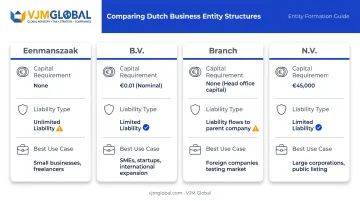
| Structure | Capital | Liability | Best For |
|---|---|---|---|
| Eenmanszaak | None | Unlimited personal liability | Freelancers with genuine Dutch activity |
| B.V. | From EUR 0.01 | Limited liability | Most founders, subsidiaries |
| Branch (nevenvestiging) | None | GmbH remains the legal entity | Extending an existing GmbH into NL |
| N.V. | EUR 45,000 minimum | Share-based, heavier governance | Capital-raising, larger firms |
A B.V. requires a notarial deed and UBO registration. A branch doesn't create a separate legal person — your GmbH stays the contracting entity, but the Dutch establishment still needs to be registered with KVK.
Requirements and Documents Needed
Before you file anything, gather:
- Valid German passport or ID, plus proof of German address
- A Dutch registered business address (physical or virtual office)
- A business plan showing Dutch market relevance (essential if you are relocating or seeking residence)
- Notarised Articles of Association, for B.V. or N.V. structures only
Why the Netherlands Makes Sense for German Businesses
Expanding into the Netherlands works best once you've validated demand in Germany and see cross-border signals worth acting on. A few concrete conditions make the case:
- Trade depth: €209.1 billion in bilateral goods trade in 2025 — Germany's third-largest partner by volume
- No customs friction: EU single market rules mean no border checks, and major German industrial hubs sit a short drive from Rotterdam
- Tax structure: Corporate tax at 19% on profit up to €200,000 and 25.8% above, per Belastingdienst's rate table (2024–2025 rates)
- English usability: KVK publishes English guidance and accepts English-language documentation from foreign companies, though not every bank or tax process runs fully in English
None of this replaces due diligence. It just means the groundwork is friendlier than in most non-EU markets.
Step-by-Step: How to Register a Business in the Netherlands from Germany
Avoid these common mistakes before you start:
- Rushing the KVK filing before documents are ready
- Ignoring VAT rules and the KOR exemption ceiling
- Underestimating how long bank onboarding takes
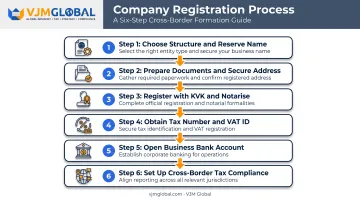
Step 1 – Choose Structure and Reserve Your Company Name
Decide between B.V., sole proprietorship, or branch based on your liability tolerance and capital plans. Check name availability directly with KVK before drafting any documents.
Step 2 – Prepare Documentation and Secure a Dutch Address
Gather your ID, proof of German address, and Articles of Association if forming a B.V. If you're not relocating, arrange a virtual office or co-working address. You will need to demonstrate genuine use of it, not just a mailbox.
Step 3 – Register with the KVK and Notarise (if applicable)
B.V. and N.V. founders sign before a Dutch civil-law notary, either in person or via a digital route available since 1 January 2024 for eligible cases. Sole traders register directly at KVK. If your file is complete, KVK can issue your number immediately.
Step 4 – Obtain Your Tax Number and Register for VAT
The Belastingdienst issues a tax ID automatically after KVK registration. VAT identifiers typically follow within 10 working days. Note: the €20,000 figure often cited is not a registration threshold. It is the ceiling for the optional KOR small-business VAT exemption scheme.
Step 5 – Open a Dutch Business Bank Account
Compare traditional banks like ING, ABN AMRO, and Rabobank against fintech alternatives for remote verification speed. Official guidance suggests bank approval can take 2-8 weeks, which is often longer than the registration itself.
Step 6 – Set Up Cross-Border Tax Compliance and Bookkeeping
Apply the NL-Germany double tax treaty to avoid being taxed twice on the same income. Under the treaty, business profits are generally taxable only where you're resident, unless you have a permanent establishment in the other country. Build a filing calendar that covers Dutch VAT, corporate tax, and annual accounts alongside your German obligations. Firms like VJM Global help founders coordinate that dual-jurisdiction calendar so nothing falls through the cracks.
Costs, Compliance and Getting Support
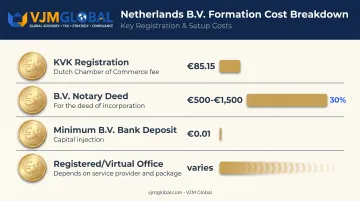
Here's what actual registration costs look like, based on current KVK figures:
| Item | Cost |
|---|---|
| KVK registration | €85.15 one-time |
| B.V. notary deed | €500–€1,500 |
| Minimum B.V. bank deposit | €0.01 |
| Registered/virtual office | Varies by provider and city |
Ongoing obligations don't stop after incorporation:
- Annual accounts filing, generally within 12 months of year-end
- Corporate tax returns, due before 1 June for calendar-year filers
- VAT returns, filed monthly, quarterly, or annually depending on your assignment
- KVK updates whenever a director or address changes
Miss enough filings, and KVK can deregister an inactive business after four weeks without response to their notice. Reinstating it afterward isn't guaranteed, especially for sole proprietorships.
Dual-market coordination is where most founders need help. VJM Global brings 30+ years of cross-border tax, audit, and entity-formation experience across 100+ countries, with dedicated support in both Germany and the Netherlands.
That support covers:
- B.V., N.V., branch, or partnership formation
- Notary-linked registration
- VAT and corporate tax registration
- Ongoing compliance alongside your German obligations
You can handle the Dutch side without relocating.
Frequently Asked Questions
Can I register a Dutch company from Germany without visiting the Netherlands?
Most steps can be done remotely, including digital B.V. incorporation for eligible cases. Banks, though, may still require video or in-person verification before opening an account.
Do German citizens need a visa to start a business in the Netherlands?
No. EU freedom of establishment under Article 49 TFEU removes visa and work permit requirements for German nationals starting a business anywhere in the EU.
What is the best business structure for a German entrepreneur expanding to the Netherlands?
A B.V. suits most founders since it offers liability protection with no minimum capital requirement. A branch works better if you're extending an existing GmbH rather than starting fresh.
How much does it cost to register a company in the Netherlands from Germany?
Expect roughly €85 for KVK registration and €500–€1,500 in notary fees for a B.V. Add ongoing accounting, and total costs vary by structure and provider.
How long does it take to set up a Dutch business from Germany?
You can receive a KVK number immediately if your file is complete, with VAT numbers following within about 10 working days. Bank account approval is often the longer bottleneck, sometimes taking 2–8 weeks.
Do I need a local director or partner in the Netherlands?
No. Full foreign ownership is allowed and there's no residency requirement for directors. A Dutch business address is mandatory, but a local partner or director is not.