On paper, forming a BV looks simple: pick a name, see a notary, register with the Chamber of Commerce. In practice, cost, timeline, and compliance outcomes vary widely depending on notary choice, capital structure, shareholder residency, and how well-prepared you are before you start.
This guide walks through the exact incorporation steps, what you need before you begin, the cost and tax factors that actually move the needle, common mistakes, and how a BV stacks up against other Dutch legal structures.
Key Takeaways
- A BV is a separate legal entity with limited shareholder liability, formed via a civil-law notary
- Minimum share capital is just €0.01, though under-capitalizing raises liability risk during the "i.o." phase
- Corporate income tax runs 19% up to €200,000 profit and 25.8% above that threshold
- Director-shareholders holding 5%+ of shares must draw a statutory minimum salary
- Foreign individuals and companies can own and direct a BV remotely with the right documentation
How to Set Up a Private Limited Company (BV) in the Netherlands
Incorporating a BV follows a fixed legal sequence. Skip a step or misjudge one, and you risk delays or unnecessary personal liability exposure.
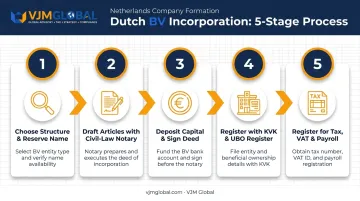
Step 1: Choose Your Business Structure and Reserve a Company Name
Before anything else, confirm a BV actually fits your shareholding, liability, and tax goals. (We compare it against other Dutch structures later in this guide.)
Once you're set on a BV:
- Check name availability using KVK's Name Check tool, which searches the Business Register and the BOIP trademark database. This is a similarity check, not a formal reservation.
- Follow naming rules: Dutch law requires your company name to include the term "Besloten Vennootschap met beperkte aansprakelijkheid" or its abbreviation, B.V.
- Decide on ownership structure: single shareholder or multiple, and who the initial director(s) will be.
Step 2: Draft Articles of Association with a Civil-Law Notary
A Dutch civil-law notary (notaris) must draft the deed of incorporation and Articles of Association. These cover the company's purpose, share classes, and any transfer restrictions on shares.
A common misconception is that the deed must always be in Dutch. Current notary-association guidance confirms that a digital BV incorporation deed can be executed in Dutch or English. If any party doesn't understand the language used, a translation, ideally through a sworn interpreter, is strongly recommended.
For foreign founders unfamiliar with Dutch notarial procedure, this stage is where things often stall. Coordinating notary appointments, preparing supporting documents, and verifying translations can eat weeks if you're doing it alone from overseas.
A formation partner like VJM Global typically steps in here, liaising with the notary, preparing documentation, and keeping the process moving so founders aren't navigating an unfamiliar system solo.
Step 3: Deposit Share Capital and Sign the Deed of Incorporation
Legally, you only need €0.01 in paid-in capital to incorporate. That said, under-capitalizing a BV can backfire.
- During the pre-incorporation phase, the company operates as a "BV in oprichting" (i.o.)
- Anyone signing agreements on behalf of a BV i.o. carries personal liability for those commitments
- That "i.o." status must be disclosed to anyone you're contracting with: failing to do so creates avoidable legal exposure
A business bank account needs to be arranged so the capital contribution can be deposited before or at signing. For a fully digital incorporation, only cash contributions are accepted; contributions in kind require the paper-deed route instead.
Step 4: Register with the KVK Trade Register and UBO Register
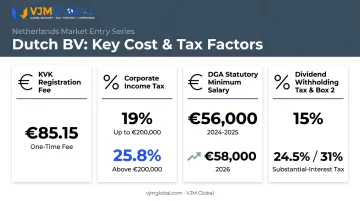
Once the deed is executed, the notary registers the BV and its directors with the KVK Business Register. This is currently a one-time fee of €85.15.
Separately, you must register every Ultimate Beneficial Owner (UBO) (meaning anyone holding more than 25% of shares or voting rights) in the UBO Register. According to business.gov.nl's UBO register guidance, this registration (and any subsequent changes) must be filed within 7 days. Missing that window, or filing incorrect details, can trigger enforcement action.
VJM Global's Netherlands formation service includes UBO filing as a standard part of the engagement, rather than leaving it as a separate task for clients to chase down after incorporation.
Step 5: Register for Tax, VAT and Payroll Obligations
Once KVK registration is complete, the Dutch Tax Administration (Belastingdienst) automatically receives the company's data and issues an RSIN (legal entity tax number) along with a VAT ID and turnover-tax number, typically within 10 working days.
If the BV will employ a director or staff, you'll also need to register as an employer to receive a payroll-tax number. VAT returns default to quarterly filing, though Belastingdienst can require monthly filing after late payments or returns.
VJM Global handles this entire registration sequence for clients. That includes RSIN and BTW-nummer setup, periodic VAT filings at the 21% standard rate, corporate income tax returns, and payroll registration covering wage tax, social insurance, and the 30% ruling for qualifying expat employees.
What You Need Before Setting Up a BV
Incomplete preparation is the single biggest cause of delayed incorporations and compliance headaches down the line. Get these three areas sorted before you approach a notary.
Documentation and Legal Readiness
Have the following ready:
- Valid passport or ID for every shareholder and director
- Proof of a registered Dutch business address
- UBO identification details for anyone owning more than 25%
- A draft version of your Articles of Association
Capital and Banking Readiness
Arrange a business bank account in advance, since depositing share capital is a precondition to signing the deed. Sort this early — banking setup can be one of the slower parts of the process for founders without an existing Dutch financial footprint.
Compliance and Residency Readiness
Here's some good news: neither shareholders nor directors need to be Dutch residents. But there are practical requirements worth planning for:
- A registered Dutch business address is mandatory, even if no one on the founding team lives locally
- Non-resident structures may need a tax representative depending on the activity involved
For foreign founders navigating these residency gaps, VJM Global's Netherlands entity formation service is priced per structure and includes support securing a registered address and, where needed, a local tax representative.
Key Factors That Affect Cost, Tax and Timeline When Setting Up a BV
Total cost and setup speed depend on several variables you actually control, not one fixed price tag.
Notary and Registration Costs
Notary fees vary by firm and by how complex your deed is. There's no official published benchmark range, so the smart move is getting quotes from two or three notaries before committing. On top of notary fees, budget for the €85.15 one-time KVK registration fee.
Corporate Income Tax Rate Applied
Your profit level determines which bracket applies. According to the Dutch Tax Administration's corporate tax rates, the rate structure for 2024 through 2026 is:
| Taxable profit | Corporate income tax rate |
|---|---|
| Up to €200,000 | 19.0% |
| Above €200,000 | 25.8% |
This directly affects how much post-tax profit is available for reinvestment or dividend distribution.
Director-Major Shareholder (DGA) Minimum Salary
If you hold 5% or more of shares and work for the BV, you're classified as a DGA and must draw a "customary" salary. Per the Belastingdienst's guidance on salary and substantial interest, that salary must be the highest of:
- A comparable employment salary for similar work
- The highest salary paid to any employee within the BV or connected entity
- A statutory floor: €56,000 for 2024 and 2025, rising to €58,000 in 2026
This is payroll tax exposure to plan for from day one, before it turns into a retroactive correction.
Dividend and Substantial-Interest Tax Treatment
Profit distributions to shareholders trigger a 15% dividend withholding tax, subject to specific exemptions. Substantial-interest holders (5%+ shareholders) also face Box 2 tax on dividend income: 24.5% up to roughly €67,800 and 31% above that threshold for 2025. Keep these two taxes distinct; withholding tax and Box 2 tax apply at different stages and aren't interchangeable.
BV vs Other Dutch Business Structures
A BV isn't automatically the right call for every founder. Here's how it compares:
| Structure | Capital required | Liability | Best suited for |
|---|---|---|---|
| BV | €0.01 minimum | Limited to the company (exceptions apply for mismanagement) | Most foreign founders and scaling businesses |
| NV | €45,000 minimum | Limited, with stricter governance | Large enterprises planning an IPO or capital markets access |
| VOF (general partnership) | None | Partners personally liable | Small, low-risk ventures with trusted partners |
| Eenmanszaak (sole proprietorship) | None | Owner personally liable | Solo operators with minimal risk exposure |
The NV carries a far higher capital bar and heavier governance obligations, so it rarely makes sense unless you're specifically targeting public markets. VOF and eenmanszaak structures are cheaper and faster to set up. However, they expose your personal assets directly to business debts — a trade-off that only makes sense for genuinely small-scale, low-risk activity.
Common Mistakes to Avoid When Setting Up a BV
Four mistakes come up repeatedly with foreign founders:
- Assuming €0.01 capital is adequate protection. The minimum satisfies the legal requirement, but it does nothing to shield you if creditors challenge under-capitalization.
- Missing the UBO filing deadline. The 7-day window for registration and updates gets overlooked more often than you'd expect, and incorrect filings can trigger enforcement.
- Ignoring the DGA minimum salary rule. Founders sometimes assume they can pay themselves nothing in year one, but this creates payroll tax exposure that surfaces later, with penalties attached.
- Trading extensively under "BV i.o." without disclosure. Every contract signed before formal incorporation without disclosing the i.o. status creates personal liability that formal incorporation won't retroactively erase.
Frequently Asked Questions
What is a public limited company?
A public limited company, known as an NV in the Netherlands, has freely transferable shares, often listed on a stock exchange. It's used mainly by large enterprises seeking public capital, with a €45,000 minimum capital requirement.
What is a limited company in the Netherlands?
In the Netherlands, "limited company" typically refers to a BV: a separate legal entity offering shareholders limited liability, formed through a notarial deed and KVK registration.
Can foreigners set up a BV in the Netherlands without living there?
Yes. Foreign individuals and companies can own and direct a Dutch BV remotely, as long as documentation, a registered Dutch address, and notarial requirements are satisfied.
How much does it cost to set up a BV in the Netherlands?
Costs mainly comprise notary fees (which vary by firm and case complexity), the €85.15 KVK registration fee, and any professional formation assistance you choose to use.
How long does it take to register a BV in the Netherlands?
Once documents and capital are ready, KVK registration usually takes just a few working days, with tax registration following within 10 working days. Most straightforward BV formations are complete within two to three weeks, and working with an experienced formation partner can help avoid delays caused by incomplete paperwork.
Is a BV required to pay its director a minimum salary?
Yes. A director-major shareholder (DGA) holding 5% or more of shares must be paid at least the statutory customary wage, set annually by the Dutch Tax Administration.