The interest isn't just local. Out-of-state founders, and increasingly Indian and other international businesses, are eyeing Tennessee as an entry point into the US market. This guide walks through naming, registering, licensing, and operating a business in Tennessee, step by step.
TL;DR
- Choose a structure (most pick an LLC), then register with the Secretary of State
- Get a free EIN from the IRS and register for state taxes via TNTAP
- Budget for local licenses once gross receipts hit $3,000 (city/county rules vary)
- Plan on $300–$370 to form; filings clear in days, full readiness in weeks
What You Need to Know Before Starting a Business in Tennessee
"Starting a business" in Tennessee actually covers five distinct steps: naming your entity, choosing its structure, filing with the Secretary of State, registering for tax accounts, and securing local licenses.
Not every entity needs to file with the state:
- No state registration required: sole proprietorships, general partnerships
- Formation documents required: LLCs, corporations, LPs, and LLPs
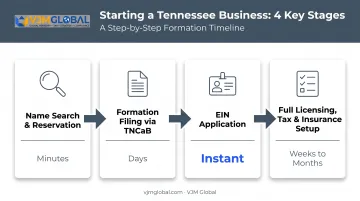
Timing varies by stage:
- Name search and reservation: minutes
- Formation filing through TNCaB: usually days
- EIN online: instant
- Fully licensed, tax-registered, and insured setup: weeks to months
Foreign entrepreneurs face an extra layer. Tennessee requires a registered agent with a physical in-state address. Companies already organized outside Tennessee may need a Certificate of Authority (foreign qualification) rather than domestic Articles of Organization.
Why Tennessee Is a Good Place to Start a Business
Tennessee's advantages are real, but they're conditions that favor certain businesses — not a blanket guarantee of success.
The tax picture:
- No individual income tax on wages or salaries
- Ranked 15th in the 2024 State Business Tax Climate Index and 8th in the 2025 State Tax Competitiveness Index
- Franchise & Excise tax still applies to LLCs and corporations — "no income tax" doesn't mean no state tax burden at all
Job creation incentives can cut Franchise & Excise liability for companies that invest and hire:
| Credit type | Requirement | Benefit |
|---|---|---|
| Standard | $500,000 investment + 25 new jobs (fewer in lower tiers) | $4,500 per job, offsets up to 50% of F&E liability |
| Enhanced (Tier 2-4) | Same investment threshold, lower job counts | Additional $4,500/job/year for 3-5 years |
Funding and advisory support is also available through:
- Tennessee Department of Economic and Community Development — state incentives and site support
- SBA Tennessee District Office — federal lending and counseling
- LaunchTN — startup-focused programs and networks
How to Start a Business in Tennessee – Step by Step
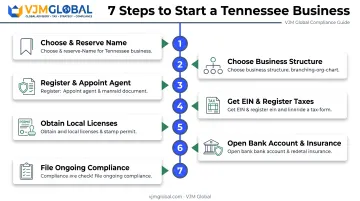
Most delays come from three avoidable mistakes: skipping the name search, misjudging local licensing thresholds, and putting off EIN and bank account setup until it becomes urgent. Here's the sequence that avoids all three.
Step 1 – Choose and Reserve a Business Name
Search the Tennessee Secretary of State's Name Availability database before doing anything else. Your name must be distinguishable from every other entity on file.
If you're not ready to file immediately:
- Reserve the name using Form SS-9425 for $20
- The reservation holds for 120 days
- Separately, check the USPTO trademark database . A name available at the state level is not automatically free of federal trademark conflicts
Step 2 – Choose a Business Structure
Your structure determines liability exposure, tax treatment, and state filing obligations.
| Structure | Personal liability | TN filing required |
|---|---|---|
| Sole proprietorship | Unlimited | No |
| General partnership | Unlimited | No |
| LLC | Protected | Yes |
| LP | GP unlimited, LP limited | Yes |
| LLP | All partners protected | Yes |
| C-corporation | Protected | Yes |
Most small business owners land on an LLC. It offers liability protection without the double taxation and rigid formalities of a corporation, plus flexibility in how profits get taxed.
Step 3 – Register Your Business and Appoint a Registered Agent
For an LLC, file Articles of Organization (Form SS-4270) through the TNCaB portal. For a corporation, it's a Charter instead.
Filing fee structure: $50 per member, $300 minimum, capped at $3,000. A 1-6 member LLC pays a flat $300.
Every entity except a general partnership must maintain a registered agent with a physical Tennessee street address — a P.O. box won't work. This trips up a lot of international founders.
Companies entering Tennessee from outside the US, including Indian businesses using it as a US market entry point, often use a professional registered agent or formation service for this requirement so they can focus on operations instead of paperwork.
VJM Global supports cross-border entity formation and has helped hundreds of American, UK, and Australian businesses complete this kind of state-level compliance.
Step 4 – Apply for an EIN and Register for State Taxes
An EIN from the IRS is free and usually issued instantly online. You need one if you have employees, operate as a corporation or multi-member LLC, or plan to open a business bank account.
International applicants without a US Social Security Number can apply by phone through the IRS's dedicated procedure.
Once you have your EIN, register on TNTAP (Tennessee Taxpayer Access Point) for:
- Sales and use tax: required if you sell taxable goods or services
- Franchise & Excise tax: applies to most LLCs and corporations doing business in Tennessee
Step 5 – Get Local Business Licenses and Permits
Tennessee ties local licensing to gross receipts, and this is where many new LLC owners get caught out.
- Under $3,000 in-state receipts: no license required
- $3,000-$99,999: minimal-activity license
- $100,000 or more: standard business license
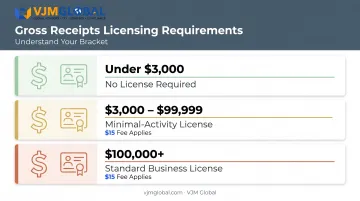
Both are issued through your county and/or municipal clerk, with a $15 fee per applicable jurisdiction.
Certain industries need separate licenses regardless of revenue:
- Contractors bidding jobs of $25,000+: Tennessee Board for Licensing Contractors
- Cosmetology: Tennessee Board of Cosmetology and Barber Examiners
- Food service: Tennessee Department of Health
Step 6 – Open a Business Bank Account and Set Up Insurance
Keeping business and personal finances separate protects your liability shield. Commingling funds is one of the fastest ways to lose LLC protection in a lawsuit.
Workers' compensation thresholds:
- Non-construction businesses: required at 5 or more full- or part-time employees
- Construction businesses: required from the first employee
General liability insurance isn't legally mandated in most cases, but most landlords, clients, and lenders will expect to see it before doing business with you.
Step 7 – File Ongoing Compliance and Build Operations
Tennessee LLCs and corporations file an annual report, due on the first day of the fourth month after your fiscal year ends (April 1 for a calendar-year filer). The fee mirrors the formation structure: $300 minimum, up to $3,000.
After the first filing is done, lock in payroll, bookkeeping, and a simple operating plan so ongoing Tennessee compliance stays routine rather than reactive.
Costs, Licenses, and Common Questions on Doing Business in Tennessee
Here's what a typical domestic LLC (1-6 members) spends to get operational:
| Scenario | Cost |
|---|---|
| Formation only | $300 |
| Formation + one local license | $315 |
| Formation + name reservation + one license | $335 |
| Formation + reservation + two license jurisdictions | $350 |
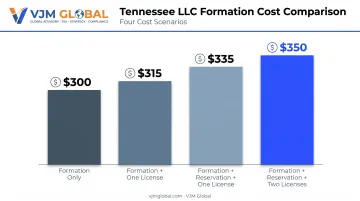
Important clarification: Forming an LLC does not exempt you from local business licensing. These are two separate requirements. Plenty of new owners assume state registration covers everything, then get flagged for an unlicensed business once gross receipts cross $3,000.
That licensing gap is one of the most common questions new owners get wrong. Companies new to US state-level compliance also face a steep learning curve on registered agents, franchise tax, and annual report deadlines.
A cross-border provider like VJM Global can handle entity formation and ongoing filings, so founders focus on the business instead of tracking every state deadline.
Conclusion
Starting a business in Tennessee comes down to a defined sequence: name it, structure it, register it, get your tax IDs, secure your licenses, and stay compliant. The steps themselves are straightforward. Sequencing and details—your registered agent address, gross receipts thresholds, and filing order—are what usually cause delays.
Getting the basics right early avoids costly delays and penalties down the line. For founders coming from outside Tennessee—or outside the US—local filing rules and tax setup are easy to misread. VJM Global helps with US entity formation, tax IDs, and ongoing compliance so you can launch without months of back-and-forth with state agencies. Start with name and structure, then file in order; bring in support as soon as cross-border or multi-state questions show up.
Frequently Asked Questions
What do I need to do to start a small business in Tennessee?
You'll need to choose a business name, pick a structure (most choose an LLC), register with the Tennessee Secretary of State, obtain an EIN, and secure any required local licenses based on your gross receipts.
How much does it cost to start a small business in Tennessee?
LLC formation starts at a $300 minimum filing fee. Add local license fees ($15 per jurisdiction) and an optional $20 name reservation, and most small LLCs get operational for $300-$370 total.
How do I register a business name (DBA) in Tennessee?
Tennessee calls this an "assumed name" rather than a DBA. You file an assumed name application with the Secretary of State for $20, and it stays valid for five years before renewal.
Does Tennessee require DBA registration?
Only if you're operating under a name different from your registered legal name. If your LLC operates exactly under its filed name, no assumed name registration is needed.
Do I need a business license if I have an LLC in Tennessee?
Yes, potentially. LLC formation and local business licensing are separate requirements. You'll need a license if your in-state gross receipts exceed $3,000 annually, regardless of your entity type.
How much does an LLC cost per year in Tennessee?
The annual report fee mirrors the formation cost structure: $300 minimum, up to $3,000 for larger LLCs, due on the first day of the fourth month after your fiscal year ends.