The process looks straightforward on paper. In practice, requirements shift based on your business structure, the state you form in, and whether you're a US resident or a foreign national setting up remotely. A Delaware LLC founder with an SSN faces a very different timeline than an NRI applying from Mumbai.
This guide walks through the exact registration steps, the documents banks and states require, the account-opening process itself, and the mistakes that trip up first-time founders most often.
Key Takeaways
- Choosing an LLC, C-Corp, S-Corp, or sole proprietorship shapes your liability protection, taxes, and bank account eligibility
- An EIN from the IRS is the mandatory bridge between company registration and opening a business bank account
- Banks require specific documents: a formation certificate, EIN letter, ID, and operating agreement. Missing even one delays approval
- Foreign founders and NRIs face extra verification steps that professional support can simplify
- Separating personal and business finances early protects your liability shield and keeps tax filing clean
Step-by-Step: How to Register Your Company in the US
Step 1: Choose Your Business Structure
This decision shapes everything downstream, from your tax bill to which banks will approve you. Here's how the main structures compare:
| Structure | Liability Protection | Tax Treatment | Best For |
|---|---|---|---|
| Sole proprietorship | None (unlimited personal liability) | Reported on personal return; self-employment tax applies | Solo freelancers testing an idea |
| LLC | Personal assets generally protected | Disregarded entity (single-member) or partnership (multi-member) by default; can elect corporate treatment | Most small businesses and foreign-owned entities |
| C-Corp | Strongest liability separation | Entity pays corporate tax; dividends taxed again at shareholder level | Startups raising venture capital |
| S-Corp | Comparable to a corporation | Pass-through taxation; capped at 100 shareholders | US-resident owners only |
Important for foreign founders: S-corps cannot have nonresident-alien shareholders, so this option is off the table if you're not a US resident. Don't assume S-corp eligibility just because it saves on self-employment tax.
Delaware and Wyoming remain the go-to states for international founders, largely thanks to favorable corporate law, privacy protections, and no state income tax on out-of-state income.
Stripe Atlas, one of the largest company-formation platforms, incorporated 23,000 companies in 2025 with founders from 169 countries, and now forms roughly one in five new Delaware C-corps. That scale reflects just how concentrated foreign-founder formation activity has become in these two states.
Step 2: Choose a Business Name & Registered Agent
Check name availability through your target state's Secretary of State business search tool before you file anything. If you're not ready to register immediately, most states let you reserve the name for a fee while you finish preparing documents.
Every US entity, including foreign-owned ones, must appoint a registered agent with a physical street address in the state of formation. This isn't optional:
- Delaware requires every entity to maintain a registered agent with a Delaware office address
- Wyoming explicitly bans P.O. boxes, mail drops, and virtual offices as registered agent addresses
- The registered address doesn't need to match where you actually operate
Step 3: File Formation Documents & Obtain Your EIN
File Articles of Organization (LLC) or Articles of Incorporation (Corp) with your chosen state. Fees vary meaningfully:
| State | LLC Filing Fee | Corporation Filing Fee |
|---|---|---|
| Delaware | $110 | From $109 |
| Wyoming | $100 | $100 |
| California | $70 | $100 |
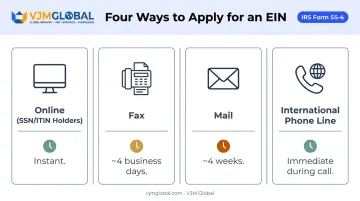
Once your entity exists on paper, apply for your EIN using IRS Form SS-4. If you have an SSN or ITIN, the online tool issues it instantly. If you don't, you'll need to enter "foreign" on line 7b and apply by fax or mail instead, since the online system requires a valid taxpayer ID to work.
Processing times differ sharply by method:
- Online (SSN/ITIN holders): immediate
- Fax: generally 4 business days with a return fax number
- Mail: approximately 4 weeks
- International phone line: some applicants can receive the EIN during the call itself
Step 4: Draft Governing Documents & Obtain Licenses
An LLC needs an Operating Agreement; a corporation needs Bylaws. Neither gets filed with the state (California and SBA guidance both confirm these stay in your own records), but banks will ask for them, and courts look for them if your liability shield is ever challenged.
Before you open your doors, research any state, county, or industry-specific licenses your business needs. Requirements vary by activity and location, so check federal, state, and local rules separately rather than assuming one filing covers everything.
Documents & Requirements for Registration and Banking
Incomplete documentation is the single biggest reason both registration filings and bank account applications get delayed. Knowing exactly what's needed at each stage saves weeks.
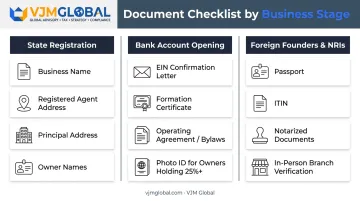
Documents needed to register your company: State filings typically require:
- Your chosen and confirmed-available business name
- Registered agent name and physical address
- Principal business address
- Full names and addresses of owners or members
Documents Banks Require to Open a Business Account
Banks ask for more than the state does. Standard requirements include:
- EIN confirmation letter (IRS CP 575)
- State-stamped Articles of Incorporation/Organization
- Operating Agreement or Bylaws
- Government-issued photo ID for every signatory and any beneficial owner holding 25% or more of the company
That 25% threshold isn't arbitrary. Under FinCEN's Customer Due Diligence rule, banks must identify and verify every natural person owning 25% or more of a legal-entity customer, plus one person with significant control over the business.
Beyond ownership checks, banks also set their own deposit rules. Minimum initial deposits vary widely by bank, ranging from $0 to a few hundred dollars, so check before you show up expecting a specific figure.
Additional Requirements for Foreign Founders, NRIs & International Entrepreneurs
Non-US residents typically substitute a passport and ITIN for the SSN most banks default to. Some institutions require in-person branch verification for foreign-owned entities, while online-first platforms have built more flexible remote onboarding.
This is where the process gets genuinely complicated. Coordinating EIN applications by fax, gathering notarized documents, and navigating bank-specific foreign-owner policies means many NRIs and OCIs find the paperwork alone eats weeks of back-and-forth.
Firms like VJM Global work specifically with NRIs, OCIs, and foreign investors on cross-border compliance. Having assisted 500+ American business owners, the firm helps founders compile documentation and coordinate between agencies instead of juggling each requirement alone.
Step-by-Step: How to Open a Business Bank Account
Step 1: Compare Banks & Account Types
Traditional banks and online-first platforms serve different needs:
| Provider Type | Monthly Fee | Domestic Wire Fee | Notes |
|---|---|---|---|
| Chase Business Complete | $15 (waivable) | $25 online / $35 branch | Branch access nationwide |
| Bank of America Business Advantage | $16 (waivable) | $30 | Many accounts open same-day |
| Mercury | No required fee | $0 | Online-first, foreign-founder friendly |
Traditional banks offer physical branches, which matter if you'll need in-person verification. Online-first platforms often waive fees entirely but come with country and business-activity restrictions.
Step 2: Prepare & Submit Your Application
You'll choose between an online application and an in-branch appointment. For founders without an SSN, in-branch is often recommended: Bank of America's online business application, for instance, is limited to US residents, so foreign applicants may need branch-assisted review regardless of which bank they choose.
Before applying, gather these documents:
- Formation documents, such as Articles of Incorporation or Organization
- EIN confirmation letter from the IRS
- Passport or government-issued ID for each beneficial owner
- Proof of US business address, if the bank requires it
Step 3: Complete Identity & Beneficial Ownership Verification
Banks must verify every beneficial owner under the FinCEN CDD rule mentioned earlier. There's no fixed regulatory timeline: federal rules say verification must happen before opening, or within a "reasonable time" afterward, but published examples give a sense of what to expect:
- Mercury: decisions usually within 1-2 business days
- Bank of America: many accounts open the same day, especially online
- Cases requiring enhanced due diligence take longer
Step 4: Fund & Activate Your Account
Make your initial deposit and connect the account to bookkeeping software immediately. Waiting even a few weeks to link accounting tools means reconstructing transaction history later, which is tedious and error-prone. Clean records from day one make tax season considerably less painful.
Choosing the Right Business Structure & Bank Account Type
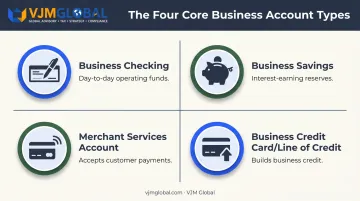
Most businesses eventually need some combination of four account types:
- Business checking: day-to-day operating funds and authorized transactions
- Business savings: reserves that earn interest
- Merchant services account: accepts customer credit and debit card payments
- Business credit card or line of credit: funds purchases and builds business credit history
Your structure shapes which of these you'll actually need. A corporation running payroll usually benefits from a dedicated payroll sub-account to keep those funds visibly separate. A sole proprietor with no employees might only need checking for the first year.
Once you know which accounts you need, the next step is finding a bank that offers them without excessive fees. Before committing to one, compare bundled starter packages across two or three providers.
Switching banks later means re-submitting formation documents, updating every vendor payment link, and often losing promotional fee waivers. These costs add up fast for something so easily avoided.
Common Mistakes to Avoid When Registering & Banking
Mixing personal and business funds before your account is even open is the most damaging mistake founders make. It can pierce the liability shield your LLC or corporation is supposed to provide, and it turns tax filing into a forensic exercise.
Other frequent missteps:
- Delaying the EIN application : This stalls both bank account opening and payroll setup, since nearly every downstream step depends on it
- Choosing a state based on popularity alone : Delaware works for many, but the right state depends on your actual tax exposure and compliance costs, not just where everyone else files
- Underestimating documentation for foreign-owned entities : Incomplete beneficial-ownership paperwork is a leading cause of rejected bank applications
Partnering with experienced firms like VJM Global helps founders avoid these pitfalls. Structured business setup support, combined with ongoing back-office and accounting services, keeps personal and business finances properly separated from the start.
Frequently Asked Questions
Is a bank statement needed for company registration?
No. Most states only require formation documents like Articles of Organization or Incorporation. A bank statement becomes relevant later for licenses, loans, or renewal filings, not the initial registration.
How do I register a company name with a bank?
You submit your legal or DBA business name during the bank's account application, along with your formation documents. The bank then links the account to that registered name.
What are the 4 types of business accounts?
Business checking, business savings, a merchant services account, and a business credit card or line of credit cover most day-to-day and growth financing needs.
Can a non-US resident open a US business bank account?
Yes, once the company is registered and an EIN is obtained. Some banks require in-person branch visits, while others, like Mercury, offer online-friendly pathways for eligible foreign-owned businesses.
Do I need an EIN before opening a business bank account?
Nearly all US banks require an EIN (or, for certain sole proprietors, an SSN) before approving an account. It's used for tax reporting and identity verification during onboarding.
How long does it take to open a business bank account after forming an LLC?
There's no universal timeline. It depends on the bank, your EIN processing method, and document readiness. Same-day approval is common, but foreign-owned entities often face longer waits due to added verification steps.