The payer prepares and sends the 1099-NEC. You, as recipient, use it as source information to report your income. This guide covers the reporting path, related schedules, expenses and withholding, special situations, and the checks to run each year. Line numbers below refer to tax year 2025 forms, so confirm them against the current IRS instructions before you file.
Key Takeaways
- Form 1099-NEC is an information return, not a tax bill or a substitute for your return.
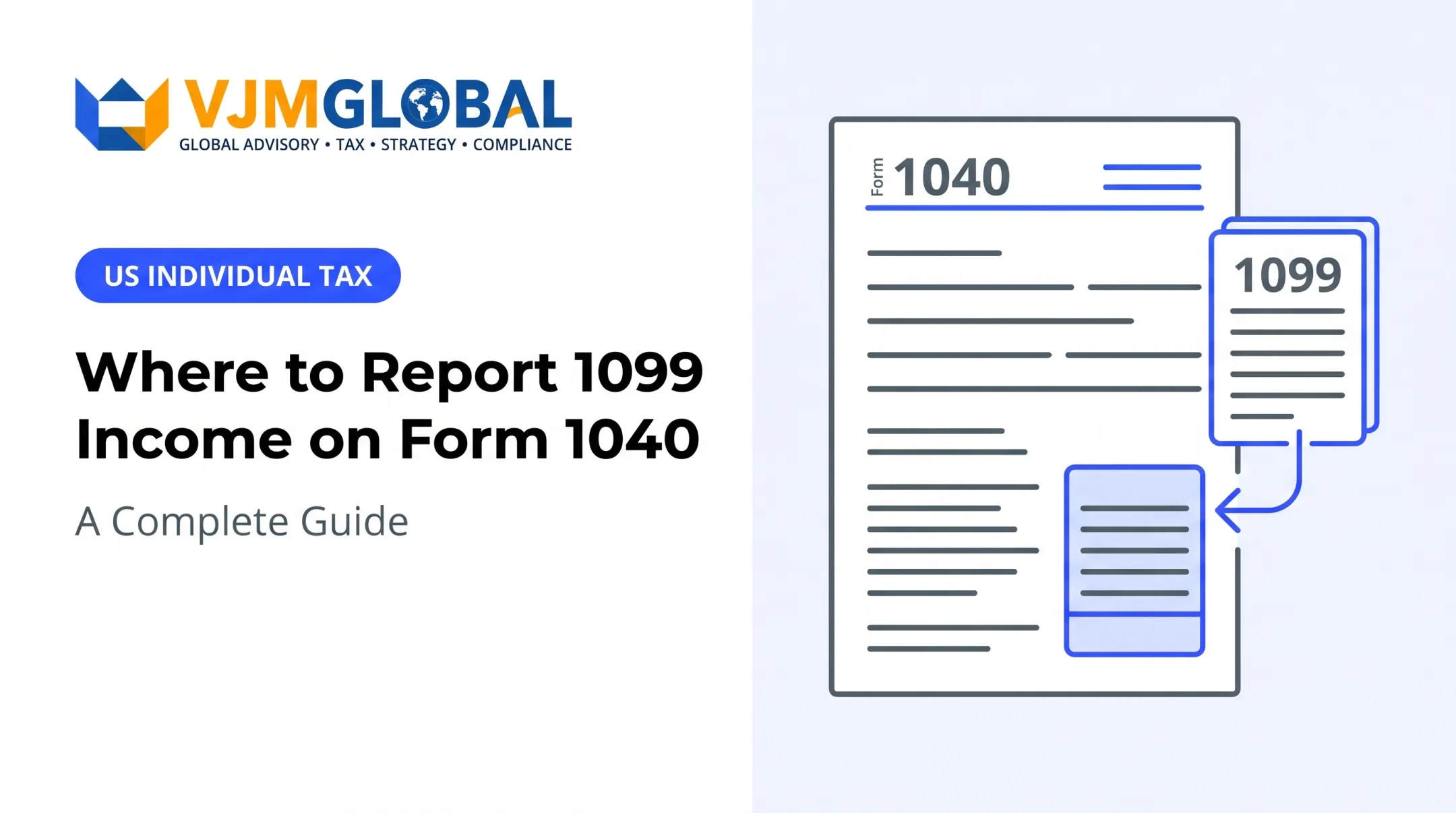
- The usual path is Box 1 to Schedule C, then net profit to Schedule 1 and Form 1040.
- You must report all taxable income even if no form arrives or the form is wrong.
- Check thresholds, deadlines and line numbers against current IRS guidance each year.
What Is Form 1099-NEC and How Does It Relate to Form 1040?
Form 1099-NEC reports nonemployee compensation. That means payments a business makes for services to someone who isn't its employee: freelance work, consulting, commissions, professional services and gig work. For the 2025 form, Box 1 holds that amount, according to the IRS instructions.
The form only reports what a payer paid. It doesn't decide whether you run a trade or business, which expenses are deductible, or how much profit you actually made.
How It Differs From W-2 and 1099-MISC
- Form W-2 reports employee wages. Contractor income and wages are reported through different mechanisms, and both can appear on one return.
- Form 1099-MISC covers items such as rents, prizes and other income. Service payments to nonemployees go on the 1099-NEC, which has existed since tax year 2020.
- The form type depends on the payment and the working relationship, not on preference.
The payer reporting threshold is a separate matter. It was $600 for 2025 payments and rises to $2,000 for payments made after December 31, 2025, per the IRS FAQ. It sets when a payer must file. It doesn't make smaller payments tax-free for you.
Where Does 1099-NEC Income Go on Form 1040?
The Usual Path: Box 1 to Schedule C
A sole proprietor, freelancer or independent contractor generally enters the Box 1 amount as gross receipts on Schedule C, line 1. It does not go on the wages line.
Schedule C produces a net profit or loss. For 2025, net profit carries to Schedule 1, line 3, and Schedule 1 additional income then flows to Form 1040, line 8.
Schedule F for Farming-Related Income
If the payment relates to a farming activity, it may belong on Schedule F instead. Classify by the underlying work, not by the form. Schedule F net profit or loss (line 34) flows to Schedule 1, line 6.
Schedule SE for Self-Employment Tax
Net earnings from self-employment of $400 or more generally require Schedule SE. The self-employment tax rate is 15.3%, covering Social Security and Medicare. Half of it is deductible on Schedule 1, line 15.
Note that this is calculated on your net earnings, not on gross Box 1 receipts.
Federal and State Withholding
Box 4 shows federal backup withholding. For 2025, you claim it on Form 1040, line 25b. State tax withheld belongs on your state return. It doesn't replace federal reporting.

How to Report 1099-NEC Income Step by Step
1. Gather Every Income Record
Collect all 1099-NECs, 1099-Ks, W-2s, invoices, bank statements and payment-platform reports. Reconcile them against what you were actually paid. Look for duplicates, omitted income and forms issued under the wrong taxpayer identification number (TIN).
2. Decide the Activity and Schedule
Work out whether this is a sole proprietorship, a farming business, a partnership, an S corporation or something else. Your tax classification and the nature of the work matter more than the form itself.
3. Enter Gross Receipts
Use Box 1 as the starting point on Schedule C or F. Add any other business income that wasn't on a 1099.
For example, a contractor receives a 1099-NEC showing US$12,000 and was also paid US$2,000 by a client who sent no form. Gross receipts are US$14,000. If business expenses total US$3,000, net profit is US$11,000. That net figure, not the gross, flows to Form 1040.

4. Record Ordinary and Necessary Expenses
Claim eligible expenses on the schedule itself. Don't subtract them from the 1099-NEC, and don't skip them because the payer reported gross payments.
An ordinary expense is common and accepted in your business. A necessary one is helpful and appropriate, per IRS Publication 535. Keep receipts, invoices, paid bills, canceled checks and mileage logs to back up each claim.
5. Carry the Result to Form 1040 and Review
Form 1040 picks up your schedule results, self-employment tax effects, withholding, estimated tax payments and any credits or deductions. Before filing, check that:
- Your name and TIN match the forms.
- All income is included.
- No 1099-NEC/1099-K payment is counted twice.
- Expenses are business-only.
- The 1099-NEC is kept with your records.
For 2026 estimated payments, the general safe harbor is the smaller of 90% of current-year tax or 100% of prior-year tax (110% if prior-year AGI exceeded US$150,000).

Special Situations That Can Change the Reporting Treatment
What If You Aren't Self-Employed?
A 1099-NEC doesn't settle your classification. Occasional or non-business income may need a different analysis.
The IRS looks at whether an activity has a profit motive, weighing time and effort, reliance on the income, and profit history. Hobby income goes on Schedule 1, line 8j.
In one IRS example, a community prize wrongly reported on a 1099-NEC was not subject to self-employment tax. That is a prize scenario, not a blanket rule. The income still generally must be reported.
Missing, Incorrect or Late Forms
Taxable income must be reported even without a form, as the IRS explains. Use reliable payment records and take these steps:
- Ask the payer for the form or a correction.
- If it is still missing after the end of February, contact the IRS.
- Keep documentation, and never simply delete income that looks wrong.
Form 4852 substitutes for W-2s and 1099-Rs, not for the 1099-NEC.
Both a 1099-NEC and a 1099-K
A client paying through a platform can trigger both forms for one payment. Report the income once.
The 1099-K gross amount isn't adjusted for fees, refunds or discounts, so use your records to find the correct figure, as the IRS 1099-K guidance describes.

W-2 Plus 1099-NEC, or Several 1099-NECs
Wages and contractor income can sit on the same return. Combine multiple 1099-NECs with your other receipts for the same activity without double-counting.
Cross-Border Situations
If you live outside the US, such as an Australian resident paid by a US client, your return may be Form 1040-NR rather than Form 1040. Foreign income, entity ownership and complex withholding call for individual advice from a qualified tax professional.
Common Mistakes and When to Get Professional Help
The mistakes that turn up most often:
- Entering Box 1 on the wages line.
- Reporting gross receipts as net profit.
- Leaving out income because no form arrived.
- Deducting personal expenses as business costs.
- Counting a payment twice across a 1099-NEC and a 1099-K.
The IRS matches third-party reports against returns, and mismatches can trigger a CP2000 notice proposing changes.

Attachment rules trip people up as well. The 2025 Form 1040 instructions name forms such as W-2, W-2G and 1099-R for paper attachment, not the 1099-NEC. Keep your copy with your records, and check the instructions for your filing method.
Seek professional help when you juggle multiple 1099s, complex Schedule C deductions, or cross-border withholding. VJM Global prepares Form 1040 and 1040-NR returns and supports reconciling 1099 forms, self-employment reporting and cross-border withholding questions.
Frequently Asked Questions
Where do I enter 1099 income on my 1040?
1099-NEC income generally starts on Schedule C (or Schedule F for farming). The net result carries to Schedule 1 and Form 1040. It is not entered as wages.
Do I need to include 1099-NEC with my tax return?
You must report the income, but the form serves as source information. It isn't routinely attached to an electronically filed return. Check the current filing instructions.
What if I have a 1099-NEC but am not self-employed?
The form doesn't determine worker status. The income generally still must be reported, and the right schedule depends on the underlying activity.
Who should I send a 1099-NEC to?
The payer, not the recipient, issues it. Payers send it to eligible nonemployees and file copies with the IRS under current rules.
What is a 1099-NEC?
It is the information return a payer uses to report qualifying nonemployee compensation paid for services.
What are the changes to the 1099 forms for 2026?
The confirmed change is the payer threshold, rising from $600 to $2,000 for payments after December 31, 2025. No 2026 box change is confirmed. Recipients must still report all taxable income either way.