Introduction: Where Is MAGI on Form 1040?
You won't find it. Form 1040 has no line labelled "modified adjusted gross income." You start with adjusted gross income (AGI), then calculate MAGI separately for the rule you're testing.
That's the confusion. The return shows total income, AGI, taxable income, tax and a refund or balance due, but no universal MAGI figure.
Australians with US filing obligations, such as US citizens living in Australia, run into this when checking Roth IRA or health insurance subsidy eligibility.
This guide covers:
- Where to find AGI on the return
- How to identify the rule being tested
- How to add back only the items that rule requires
Key Takeaways
- MAGI is AGI plus rule-specific modifications, and the formula changes by benefit.
- AGI is the figure printed on Form 1040. MAGI is usually calculated.
- Taxable income is not a substitute, because deductions come after AGI.
- Foreign income exclusions, tax-exempt interest or self-employment income often need extra worksheets.
Where Is MAGI on Form 1040?
The short answer
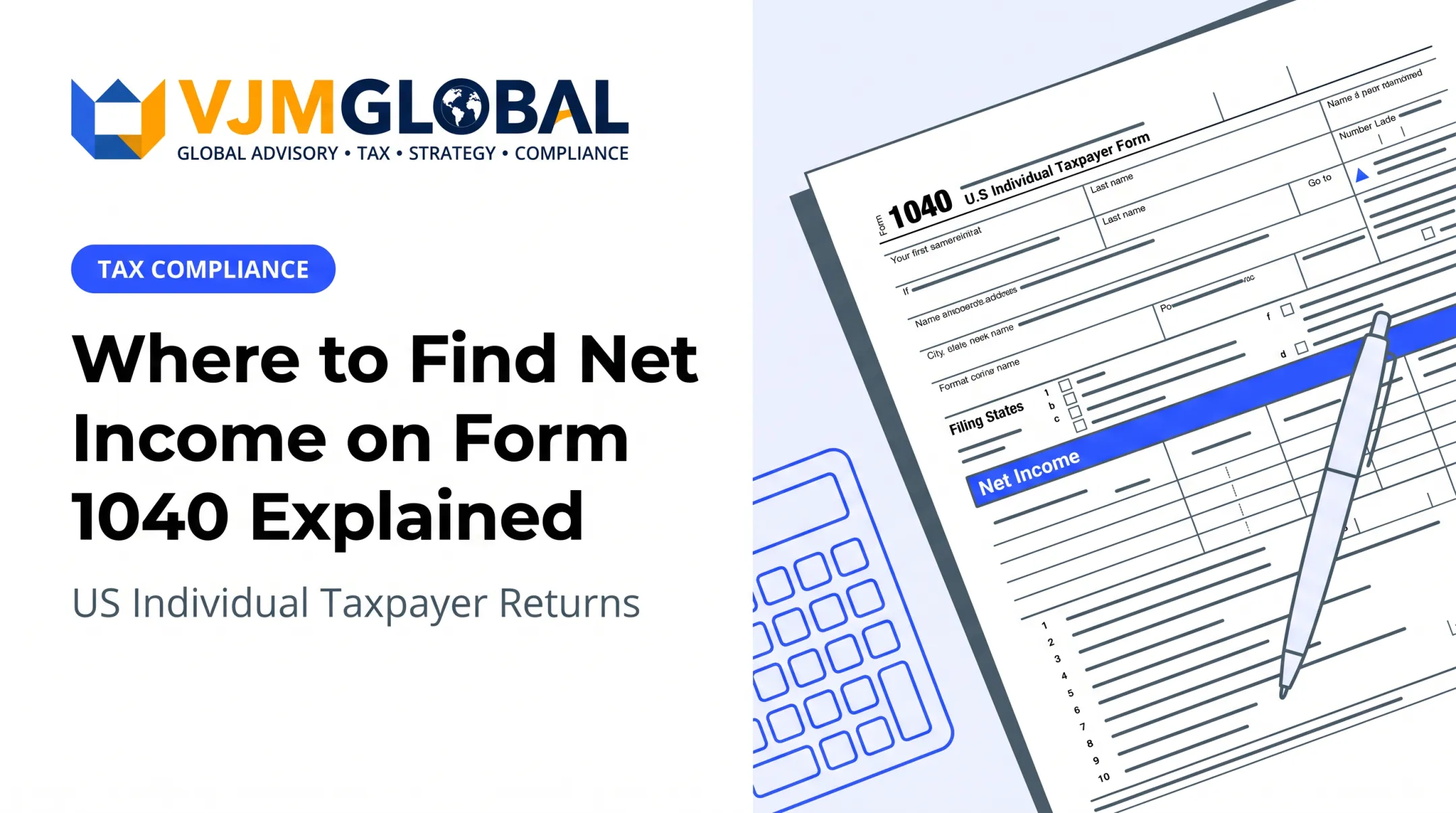
There is no MAGI line. HealthCare.gov confirms that MAGI is not a tax-return line. On the final 2025 Form 1040, AGI sits on line 11a (repeated on 11b). The 2026 draft keeps the same numbering, but check the current form and instructions before relying on any line number.
MAGI is a purpose-specific calculation built from return information. It is not a number printed on the face of the return.
Finding the starting figure
Three figures sit close together on the 2025 form:
| Figure | Line | What it is |
|---|---|---|
| Total income | 9 | Income before adjustments |
| AGI | 11a | Total income minus line 10 adjustments |
| Taxable income | 15 | AGI minus the standard or itemized deduction and other deductions |
Locate AGI, then look at what produced it. Schedule 1 matters here: Part I additional income flows to line 8, and Part II adjustments (such as student loan interest or an IRA deduction) flow to line 10. Keep it handy, because many MAGI add-backs come from those adjustments.
Checking the correct worksheet
The right worksheet depends on the question. Roth IRA eligibility, a traditional IRA deduction, the Premium Tax Credit and the student loan interest deduction each have their own. Use the current-year IRS instructions for the specific rule. Don't borrow an add-back list from another one.
How MAGI Differs From AGI and Taxable Income
AGI versus MAGI
AGI is income after eligible above-the-line adjustments. MAGI is AGI modified by the additions or exclusions a specific rule requires.
Sometimes the two are identical, when no relevant modification applies. Otherwise MAGI runs higher, because deductions or exclusions get added back.
MAGI versus taxable income
Taxable income is calculated after the standard or itemised deduction, so it is usually the lowest of the three figures. It is not MAGI.
Here is an illustrative example (made-up figures):
- Total income: US$165,000
- Traditional IRA deduction: US$7,000, giving AGI of US$158,000
- Roth IRA MAGI: AGI plus the US$7,000 IRA deduction added back, giving US$165,000
- Taxable income: lower again after the standard deduction is applied
Taxable income might look comfortably under a limit while Roth MAGI sits well inside the phase-out range. Single filers face a 2026 Roth phase-out of US$153,000 to US$168,000, per IRS Notice 2025-67.
Why the distinction matters
Using taxable income, or one program's formula for another, gives the wrong eligibility answer.
The flow is simple: total income leads to AGI, AGI is modified for the applicable purpose, and taxable income comes from a separate part of the return.

How to Calculate MAGI From Form 1040
Step 1: Identify the tax purpose
Name the exact question first: "What is my Roth IRA MAGI?" or "What income does the Premium Tax Credit use?" The purpose decides which modifications apply. Skip generic MAGI calculators that don't say which tax rule they follow.
Step 2: Find AGI on Form 1040
Go to line 11a. The figure draws on schedules and supporting forms, so you may need:
- Schedule 1
- Form 2555, if you claimed foreign income exclusions
- Student loan interest records
- Retirement contribution records
- Tax-exempt interest statements
Step 3: Add back only the required modifications
Possible add-backs include student loan interest, deductible IRA contributions, tax-exempt interest, nontaxable Social Security benefits, and foreign earned income or housing exclusions. Which ones apply depends on the program:
- Roth IRA: Start with AGI, subtract Roth conversion income, then add back traditional IRA deduction, student loan interest deduction and foreign exclusions (Publication 590-A, Worksheet 2-1).
- Premium Tax Credit: AGI plus tax-exempt interest, nontaxable Social Security and excluded foreign income.
- Medicare: AGI plus tax-exempt interest only, according to the SSA.

Three programs, three different answers from the same return.
Step 4: Apply the result to the threshold
Compare your MAGI with the current-year threshold for your filing status. It may qualify you, reduce the benefit or phase it out completely. Limits change annually, so never use a prior-year figure.
Common calculation mistakes to avoid
- Starting from taxable income
- Adding back every deduction automatically
- Assuming a W-2 or 1099 lists MAGI
- Reusing last year's worksheet
The 2025 Roth worksheet's upper limits were US$246,000 and US$165,000, while 2026 limits are US$252,000 and US$168,000.
Before relying on a result, confirm:
- the tax year
- your filing status
- the program you're testing
- the required forms
- the latest IRS instructions
Why MAGI Matters on a Tax Return
Retirement contributions and deductions
MAGI affects whether you can contribute directly to a Roth IRA and whether a traditional IRA contribution is deductible when a workplace plan applies. Phase-outs vary by filing status and year. For 2026, a single filer covered by a workplace plan sees the deduction phase out between US$81,000 and US$91,000.
Health coverage and tax benefits
Premium Tax Credit, Medicaid and CHIP all use MAGI-based household income. These definitions can include amounts not in taxable income. Use the program's own definition, not the Form 1040 number alone.
One 2026 change matters here: enhanced Premium Tax Credit eligibility above 400% of the federal poverty line ended after 2025. Repayment caps on excess advance payments no longer apply.
Medicare and other income-based rules
Medicare premium surcharges (IRMAA) use a lookback. 2026 premiums generally use 2024 MAGI. The Net Investment Income Tax has its own MAGI, with a US$200,000 threshold for single filers and US$250,000 for joint filers. That threshold is not inflation-indexed.

Cross-border and foreign-income considerations
Foreign earned income exclusions, housing exclusions or deductions and tax-exempt interest can lower taxable income while still counting toward MAGI. The 2026 foreign earned income exclusion maximum is US$132,900. The NIIT formula treats foreign income differently from the IRA and Premium Tax Credit formulas.
For people with Australian income, cross-border business interests or complicated US filings, VJM Global provides US individual return preparation (Form 1040 and 1040-NR) and international tax planning. That work includes withholding tax advice on cross-border transactions. Whether any of this applies depends on your own return.
Conclusion: MAGI Is Calculated, Not Located
You'll generally never see MAGI printed on Form 1040. Find AGI, decide which rule you're testing, then complete that rule's IRS worksheet.
Rules, thresholds, forms and worksheets change from year to year. If you have complex investments, foreign income, retirement contributions or income-based benefits, verify current IRS guidance or consult a qualified tax professional.
Frequently Asked Questions
Does MAGI appear on 1040?
Not as a separate line. Start with AGI, then calculate MAGI using the worksheet for the specific tax rule.
What is the difference between AGI and modified AGI?
AGI is income after eligible adjustments. Modified AGI starts with AGI and adds back items a particular credit, deduction, contribution or benefit requires.
Where can I find AGI on Form 1040?
On line 11a of the 2025 form. Forms change, so confirm the line number on the latest IRS version.
How do I calculate MAGI from Form 1040?
Find AGI, identify the tax purpose, apply that purpose's add-backs, then compare the result with the current-year rules.
Is MAGI the same for every tax benefit?
No. Roth IRA, Premium Tax Credit, Medicare and other rules each use different modifications.
Does MAGI affect Roth IRA or health insurance eligibility?
Yes, for both. Thresholds, filing status rules and add-backs differ by program, so check each separately.