.webp)
When you're running a small business, every minute counts and every dollar matters. But accounting? It consumes both. From reconciling transactions to sorting tax filings, bookkeeping can easily become a full-time job.
And for most small business owners, it's a job that gets squeezed between sales calls, product decisions, and customer issues, often late at night, and often with mistakes. And that's where outsourcing starts to make sense; not as a shortcut, but as a smarter strategy.
By the end of 2025, nearly 37% of U.S. small businesses plan to outsource their accounting functions, and many report cost savings of 20–60% compared to maintaining an internal team. Outsourcing accounting is no longer just a fallback but a strategic shift.
This blog breaks down the why, when, and how of outsourcing accounting services for US small businesses. You will get straight-up value for small business owners who want control over their finances without having to do everything themselves.
.webp)
Small business owners often wear multiple hats, including sales, operations, and customer support. At some point, accounting begins to consume time, energy, and clarity. Outsourcing becomes attractive once the cost of doing it internally exceeds the benefits.
The global accounting outsourcing market is projected to reach USD 81.25 billion by 2030, growing at ~8.2% CAGR. When you choose to outsource accounting, you're not just handing off bookkeeping. You're opening a suite of advantages that affect your bottom line, operations, and growth trajectory.
So what are the real reasons that many U.S. small businesses have already made that shift to India?
To have a better understanding of these reasons, let's go deeper into the key benefits:
By outsourcing, a business avoids expenses like:
When your accounting team is less than busy, those fixed costs still weigh on your books. Outsourcing turns many of these into variable costs.
U.S.-based small businesses must juggle GAAP, IRS regulations, payroll withholding rules, and, if they operate in multiple states, various local tax laws.
This is especially relevant if your business is expanding across borders or if you plan to expand internationally.
When accounting is internal, business owners often find themselves pulled into troubleshooting issues late in the day, reviewing journal entries, or chasing down missing invoices.
That's lost time from strategy, customer relationships, or product work.
Small businesses are not immune to fraud. In fact, improper internal controls or over-reliance on a single person can increase exposure.
As your business grows or slows down during a seasonal lull, your accounting needs change. You might need more forecasting or fewer transaction entries.
At VJM Global, we help small businesses explore these benefits by providing customized offshore accounting support that combines cost efficiency with reliable compliance. Our team offers accurate reporting, proactive insights, and scalable solutions that keep your finances under control while you focus on running the business.
Benefits sound good, but timing matters. Let's examine the signals that indicate it's time to outsource accounting.
Knowing why outsourcing works is one thing. Knowing when to do it can save you from wasted time, bad hires, or missed opportunities.
Below are some concrete red flags that small business owners often face before making the switch.
If you're tracking invoices, reconciling bank statements, or doing trial balance checks more than strategizing or building relationships, that's a warning sign. One of the first triggers for outsourcing is poor "timely financial information." If internal staff can't produce the numbers when you need them, you're losing control.
When you regularly catch yourself asking, "Why did I spend my evening reconciling receipts again?", it's time to delegate.
Errors in financial records or constant month-end delays often indicate your accounting capacity is under-skilled. Failing to meet deadlines is one of the earliest signs that you need outsourced support.
Other signs include:
These issues cost more than just money. They erode decision-making, investor confidence, and compliance.
When a new funding round, investor due diligence, or audit looms, your accounting processes must be solid. These are the prime reasons to outsource.
Likewise:
These are red‑flag moments where outsourcing with specialist oversight can protect you.
A common but often underestimated issue is that when one person handles too many accounting functions (approval, payment, reconciliation), the risk increases. Outsourcing firms incorporate enforced segregation of duties and built-in process checks.
Concerns about employee fraud often drive the decision to outsource accounting. If you find yourself doubting data supplied by your internal team or lacking cross-checks, it's a clear sign.
You may still be stuck on spreadsheets. Or your accounting software may not be able to scale. Outsourcing firms usually maintain the latest cloud-based tools (with automation, dashboards, and integrations).
If your tools are lagging, data flow is patchy, or integrations are missing, it's not a laziness problem; it's an infrastructure issue.
The next step is understanding what you can actually outsource. Let's see the services most firms provide and how they go beyond basic bookkeeping.
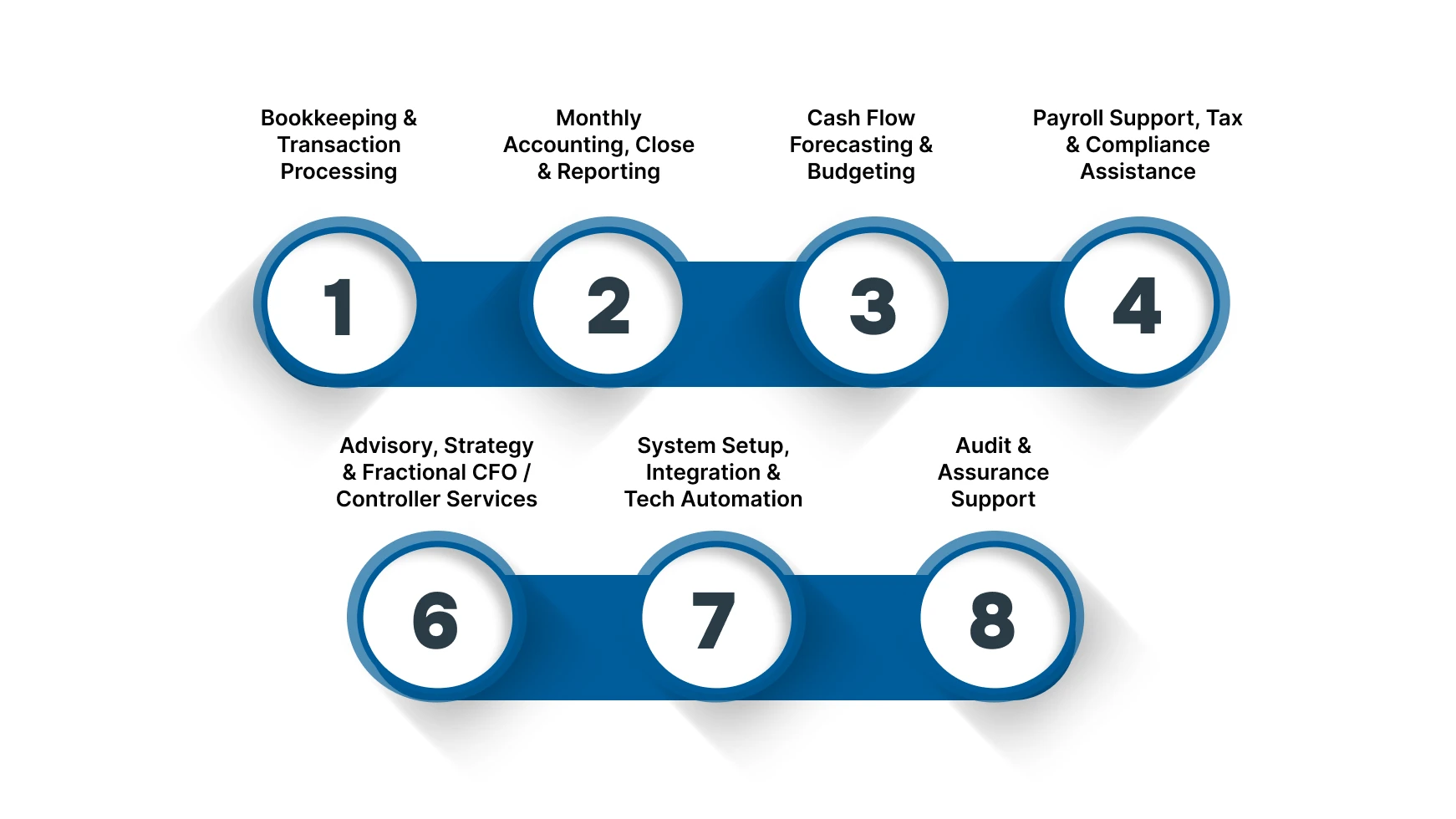
Outsourcing accounting isn't a solution that fits all. The best outsourcing firms customize a suite of services around what you need.
Below are the main service areas that small businesses typically receive, along with ways firms add value beyond the basics.
This is the foundation. Outsourced firms manage:
These tasks keep your records clean and ready for deeper analysis. Without solid bookkeeping, everything else falters.
VJM Global offers comprehensive, secure remote accounting and bookkeeping services customized for businesses operating in the U.S. market. The team ensures accurate financial tracking, tax compliance, and real-time reporting, so you can focus on growth while we handle the numbers.
Once bookkeeping is handled, firms will produce regular (often monthly) financial reporting:
These reports help you identify trends, spot problems early, and make informed decisions based on data.
A proactive firm doesn't wait for the past to catch up with it. They help you plan for the future.
When operating on tight margins, a 5–10% swing in cash flow can have a significant impact on your operations. Forecasting mitigates that.
Especially for U.S. small businesses (and ones operating across borders), compliance is a major burden:
These services help you avoid penalties, mitigate risk, and stay ahead of complexity.
VJM Global offers comprehensive GST outsourcing services, covering all aspects of GST. You focus on your core business, and we handle all statutory compliances, ensuring timely compliance.
This is where outsourcing shifts from "doing tasks" to "driving decisions."
Firms offering this layer effectively become strategic partners, not just back-office providers.
Many top outsourced firms also help build the infrastructure:
If your back office is manual or fragmented, this tech foundation is critical for scaling.
For companies working with external audit outsourcing and support, or needing compliance reviews:
By doing the heavy lifting early, you minimize audit risk, delays, and last‑minute scrambling.
VJM Global offers Internal Audit and Management Audits to identify risks, improve operational efficiency, and ensure compliance. With expert insights and a structured approach, VJM Global helps businesses stay on track and mitigate potential pitfalls.
However, not all providers are equal. Before handing over your books, find out what you should demand from an outsourced accounting partner.
You're not just buying "bookkeeping help." You're entrusting someone with your financial backbone. The right partner makes or breaks your business; not just in terms of cost, but also in terms of control, trust, security, and strategic alignment.
Here's a quick checklist of what you should test, demand, and verify.
A flashy website or smooth onboarding deck means nothing if the firm hasn't actually delivered for companies like yours. Focus on evidence of experience in your industry and outputs that align with your growth stage.
A breach or loss of data can wreck customer trust and compliance in minutes. Your partner must treat data security as a non-negotiable pillar, not an afterthought.
What matters is how they run their operations behind the scenes. Ask how they manage errors, who reviews work, and how they track quality.
In academic research, offshore accounting risk is often mitigated by combining output control (setting deliverables) with behavioral control (monitoring) and social control (relationship trust).
Good accounting can be ruined by bad communication. Look for firms that over-communicate early, explain things clearly, and operate on your rhythm, not theirs.
The cheapest provider often proves to be the most expensive in the long run. You want a partner whose pricing is transparent, scalable, and rooted in ROI.
Outsourcing doesn't mean disappearing. To maintain quality and alignment, incorporate mechanisms for oversight without micromanaging.
Choosing the right outsourced accounting partner is all about aligning with a team that understands your needs and can scale with your business.
At VJM Global, we understand that choosing the right outsourced accounting partner is crucial to your business's financial integrity and success. We specialize in providing secure, scalable solutions that align with your operational needs, industry standards, and growth stage.
Our team ensures transparent pricing, stringent data security measures, and clear communication throughout, giving you the confidence and control you need.
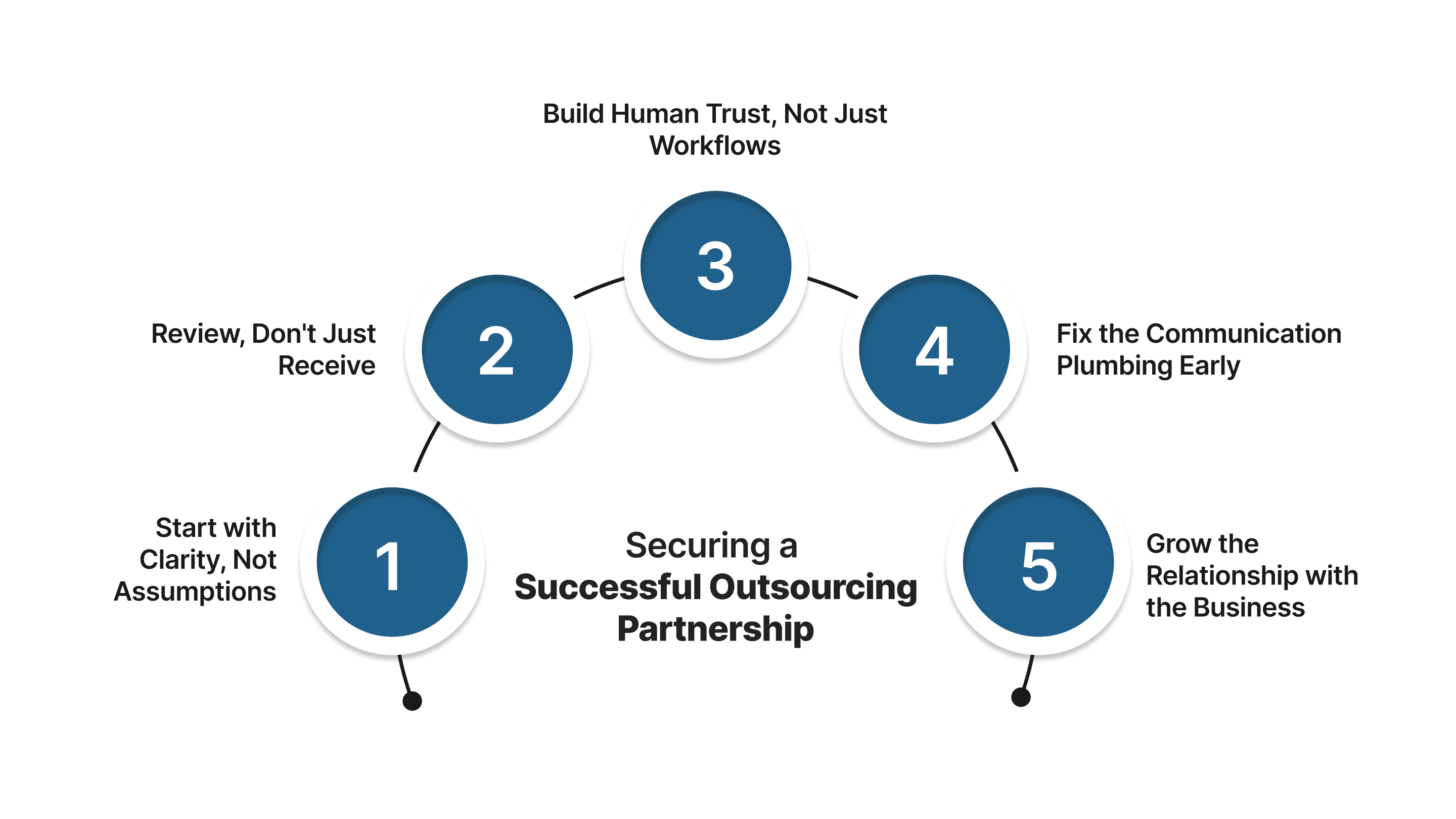
When you hand off your accounting, you're shifting how control, trust, and results are managed. Relationships, not just contracts, make or break the ROI.
Here's how to build a resilient, high‑performance relationship that grows with you.
Define the scope of work, key deliverables, and metrics that truly matter, like error rates, turnaround times, or reconciliation lags. Don't jump all-in on day one; start with a pilot phase to test communication and accuracy.
Establish a consistent review rhythm, with weekly check-ins and monthly reporting. Randomly audit sample entries and create space for two-way feedback to prevent errors from repeating and ensure the scope remains relevant.
Know who's on your account and talk to them, not just the lead. Share context and business updates so they understand what's changing on your side and can anticipate the changes.
Agree on tools (e.g., Slack, Teams, shared dashboards) and establish a communication window that overlaps with your work hours. Good outsourced teams explain what's behind the numbers.
Start with compliance and bookkeeping, then gradually introduce forecasting, advisory, and scenario planning. Strong partners evolve with you, but only if you give them visibility into what's next.
Strong relationships create lasting results. With the proper setup, outsourcing can shift accounting from a burden into a business advantage.
Outsourcing accounting services is no longer a workaround for small businesses; it's a smarter way to gain financial control, cut overhead, and stay focused on growth. Whether it's managing day-to-day bookkeeping, tightening compliance, or getting strategic insight without hiring a whole in-house team, outsourcing gives you access to expertise that scales with your business.
By recognizing the signs, understanding the benefits, and choosing the right partner, you can avoid common pitfalls and turn your accounting function into a strength, not a struggle.
At VJM Global, we specialize in providing U.S.-based small businesses with offshore accounting solutions that focus on clarity, compliance, and cost-effectiveness. Our team brings deep knowledge of U.S. standards, Indian regulations, and the tools modern businesses need to thrive.
Ready to simplify your accounting and refocus on what matters most? Book a free consultation with VJM Global and find out how we can help you run leaner, faster, and smarter.
Yes. Many providers offer modular engagements (e.g., bookkeeping only, payroll only, etc.). This lets you test the waters and scale up later without risking your entire financial process.
A credible outsourcing partner will migrate or integrate your existing systems (such as QuickBooks, Xero, and spreadsheets) and carefully transfer your historical data, ensuring validation and reconciliation checks are performed. So nothing breaks while they "take over."
Typically, in 4 to 6 weeks, the outsourced team can stabilize your books, reconcile accounts, and deliver consistent reports. After that, monthly performance, dashboards, and insights begin to materialize.
Not if set up right. A good partner provides you with dashboards, alerts, and review rights, allowing you to maintain strategic oversight while they handle execution, not decision-making.
Ask providers if they maintain audit-ready documentation, standardized controls, and the ability to support due diligence. Their workflow should align with third-party auditor expectations from the start, so you don't scramble later.