The reason is timing. The IRS expects tax to be paid as income is earned, not in one lump at filing. This guide covers why the penalty occurs, how it is calculated, what Forms 1040-ES and 2210 do, and how to prevent or challenge it.
Figures reflect tax year 2026 payment rules and the 2025 form editions. Last reviewed: November 17, 2026. Check the current IRS pages before you act.
Key Takeaways
- The penalty depends on when tax was paid, not just the final balance.
- Safe harbors: 90% of current-year tax or 100% of prior-year tax (110% above $150,000 AGI).
- Form 2210 calculates the penalty or claims exceptions; the IRS can calculate it for you.
- Paying promptly, adjusting withholding and annualising income can reduce the charge.
What Is the Form 1040 Estimated Tax Penalty?
What the penalty means
The IRS runs a pay-as-you-go system. Tax is due as income is received, through withholding or estimated payments. If too little arrives by each installment date, the IRS charges an underpayment penalty, according to IRS Topic 306.
Taxpayers who commonly face this penalty include:
- Self-employed people and freelancers
- Investors with gains, dividends or interest
- Business owners with pass-through income
- Employees whose withholding is too low
Why it shows up with Form 1040
On the 2025 Form 1040, the penalty is reported on line 38. Form 2210 computes it, and line 19 of that form feeds line 38. Line numbers matched the 2024 form, but confirm them on the current-year form before filing.
The penalty is not the tax balance. It is also separate from failure-to-file and failure-to-pay penalties, which relate to late returns and unpaid balances.
Events that trigger a shortfall
- Missed or late quarterly payments
- Lower withholding after a job or income change
- Stock or property sales
- Bonuses and self-employment income
- Retirement distributions and other income with no withholding
A refund or a full payment at filing does not erase an earlier timing shortfall. If you owed $4,000 by June and paid nothing until April, the underpaid period already counted.
How Is the Form 1040 Estimated Tax Penalty Calculated?
The quarterly shortfall calculation
The IRS looks at each required installment separately. For each due date, it compares what should have been paid with the withholding and estimated payments credited by then. Two things drive the result: the size of the shortfall and how long it stayed unpaid.
Under the regular method, each installment is generally 25% of the required annual payment. Form 2210 tracks payments by period and carries forward any overpayment from an earlier column.
Payment timing and withholding
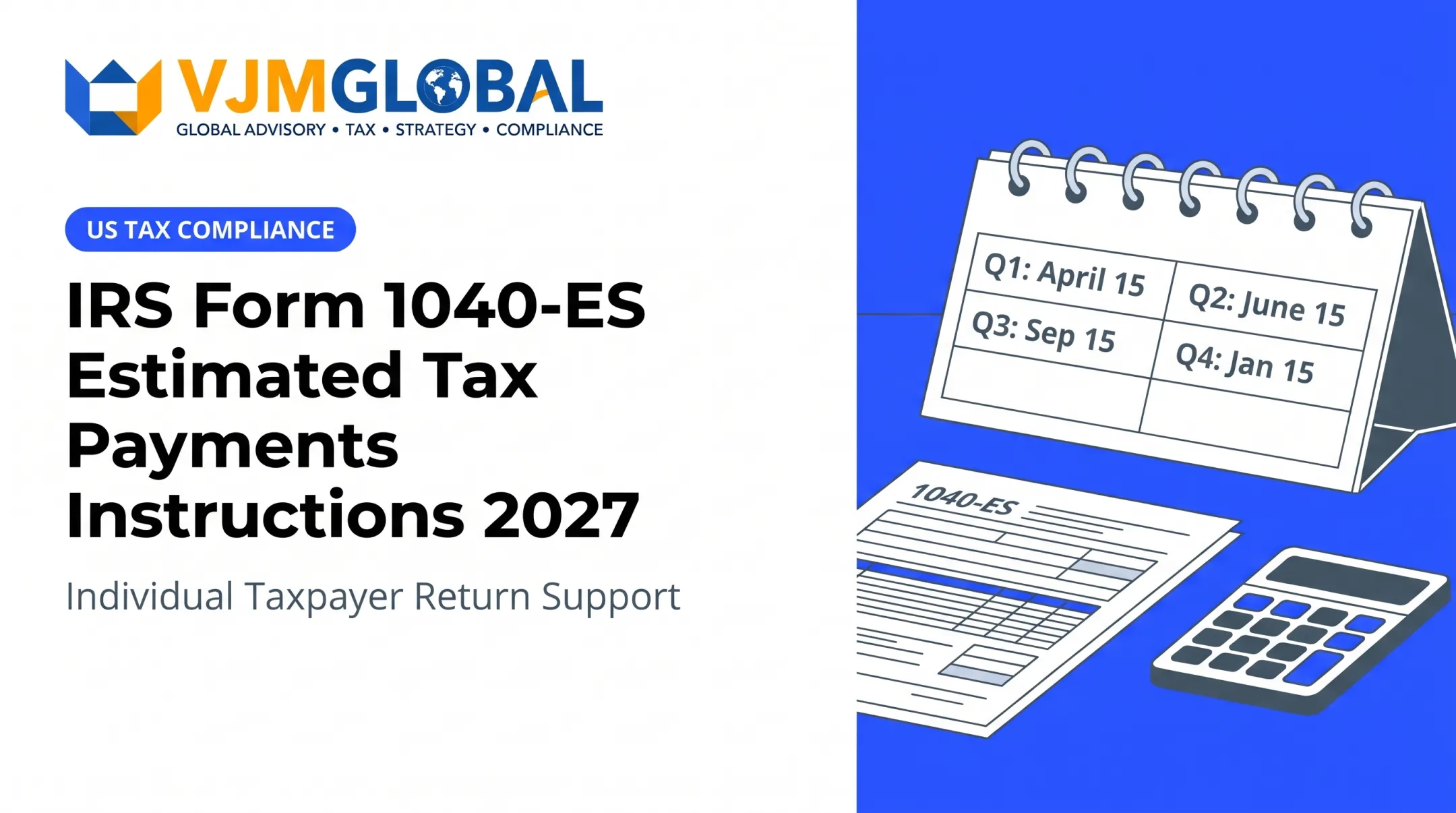
For calendar-year taxpayers, 2026 installments are due:
- April 15, 2026
- June 15, 2026
- September 15, 2026
- January 15, 2027
If a date falls on a weekend or legal holiday, it moves to the next business day. A late payment is credited on the day it is actually paid.
Withholding is treated differently. It is generally treated as paid in four equal amounts on the due dates, even if it was taken mostly late in the year.
You can instead use actual withholding dates by checking box D in Part II of Form 2210, per the Form 2210 instructions. A timely filed 2025 return's overpayment applied to 2026 counts as paid April 15, 2026.

Current IRS interest rates
The penalty uses the IRS individual underpayment rate, which can change each calendar quarter. Rates for 2026:
| Period | Individual underpayment rate |
|---|---|
| January 1 to March 31, 2026 | 7% |
| April 1 to June 30, 2026 | 6% |
| July 1 to September 30, 2026 | 7% |
| October 1 to December 31, 2026 | 7% |
Rates are compounded daily. Confirm them against the IRS quarterly interest rates page before relying on them.
A practical walkthrough (hypothetical)
This example uses invented numbers for illustration only. It is not an IRS rate or a real taxpayer result.
Suppose a freelancer has a required annual payment of $20,000, so each installment is $5,000. They pay nothing until January, when they send $20,000 in one go.
- The April, June and September installments each carried a $5,000 shortfall.
- Each shortfall accrued the penalty from its own due date until paid.
- The April shortfall ran longest, so it carries the largest charge.
- The January payment covers the final installment on time but does not reverse what accrued earlier.
Form 2210 does this arithmetic by period and applies the rate for each quarter involved.

What information you need
- Prior-year Form 1040 and current-year income and deduction estimates
- Withholding records, such as pay stubs and Forms W-2 and 1099
- Form 1040-ES payment confirmations and payment dates
- Filing status and relevant credits
Check your IRS online account and your payment confirmations before disputing any IRS calculation. A misapplied payment, such as one posted to the wrong tax year, is a common cause of errors.
Form 2210, Safe Harbors, and Penalty Relief
What Form 2210 does
Form 2210 is Underpayment of Estimated Tax by Individuals, Estates, and Trusts. It calculates the penalty and documents exceptions or special methods.
You generally do not need to file it just because a penalty may apply. The IRS can figure the penalty and bill you. Attach it when you want to claim a waiver, use the annualised method, or use actual withholding dates, since those require your own calculation.
Safe-harbor rules
Meeting a safe harbor avoids the penalty even if you owe more tax at filing. For 2026, estimated payments are generally required if you expect to owe at least $1,000 after withholding and refundable credits. The IRS Publication 505 sets out these tests.
You are generally safe if your payments equal the smaller of:
- 90% of your 2026 tax, or
- 100% of your 2025 tax (the 2025 return must cover 12 months)
If your 2025 AGI exceeded $150,000, the prior-year figure becomes 110%. The AGI threshold is $75,000 for married filing separately.
The penalty requirement also drops if you owe under $1,000 after withholding and credits. A zero-tax exception applies only if you had no 2025 tax, were a U.S. citizen or resident all year, and had a 12-month year.
Annualised income installment method
Schedule AI suits uneven income: seasonal businesses, late-year capital gains, commissions or irregular distributions. It can reduce or eliminate the penalty for earlier installments.
- It uses four periods: January 1 to March 31, May 31, August 31 and December 31.
- If used for any due date, it must be used for all.
- You need period-by-period income and deduction records using your accounting method.

It requires detailed calculations, not a rough annual estimate.
Waivers and special exceptions
The IRS may waive the penalty for:
- Casualty, disaster or other unusual circumstances that make it inequitable
- Underpayment caused by retirement after age 62, or by disability, with reasonable cause and no willful neglect
To request a waiver, check the relevant box in Part II:
- Full waiver: complete page 1 only
- Partial waiver: complete through line 18, put the requested amount in parentheses by line 19, and attach a statement explaining why and when you could not pay
Add documentation for retirement, disability, casualty or disaster claims.
First-time abatement does not apply to this penalty (IRC section 6654). Disaster postponements are event-specific, so check whether your area is covered.
When professional review helps
Consider a tax professional if you have:
- Uneven income or several income sources
- International activity
- Large withholding changes
- An IRS notice or an amended prior-year return
- Doubt about payment dates
VJM Global's U.S. tax team prepares Form 1040 and 1040-NR returns and tax plans built around U.S. revenue streams, and advises on IRS rules, treaties and FATCA/Form 8938. The team can review payment records and assess Form 2210 options, though no penalty outcome can be promised.
How to Avoid the Form 1040 Estimated Tax Penalty
Choose a payment strategy
You can raise employer withholding, make quarterly Form 1040-ES payments, or combine both. Then pick a target:
- Prior-year safe harbor: simple and predictable, good when income is rising
- Current-year 90%: lower payments when income has fallen, but needs accurate forecasts
- Conservative target: pay a bit above either test if income is volatile
Estimate income throughout the year
Review income, deductions, self-employment tax, credits, investment sales and withholding at regular intervals. Do not rely on last year's return alone. A new business, job change, bonus, asset sale, retirement distribution or change in filing status each calls for a fresh estimate.
Use withholding strategically
Employees can adjust Form W-4 when wages or outside income change. The IRS Tax Withholding Estimator can produce a prefilled W-4.
Because withholding is generally treated as paid evenly across the year, a late-year increase can cover earlier shortfalls in a way a late estimated payment cannot. Do not make changes you cannot support with real figures.
Pay on time and keep records
- Schedule all four payments at the start of the year.
- Choose "Estimated Tax" and the correct tax year when paying through Direct Pay, Online Account or EFTPS.
- Save confirmation numbers and bank records.
- Track any refund applied to next year's estimated tax, which counts as paid April 15.
Consider annualization
Form 2210 Schedule AI (the annualized income installment method) can lower the penalty versus equal installments when income is lumpy. It helps only when your actual facts support it. It is not a way to cancel a missed payment.
What to Do If You Missed a Payment or Received a Penalty
Immediate steps
- Make the missed payment as soon as possible.
- Keep paying later installments on schedule.
- Use an IRS-approved method and the right tax year and payment type.
- Keep proof of payment.
A catch-up payment stops further accrual but does not wipe out what has already built up.
Review before accepting the penalty
Compare the IRS figure with your:
- Payment confirmations
- Withholding records
- Prior-year tax
- Safe-harbor eligibility
- Income timing
Form 2210, Schedule AI, a waiver request or professional review may reduce or challenge the amount, depending on what you find.
Distinguish related charges
The estimated tax penalty is separate from:
- Failure to file: generally 5% of unpaid tax per month, up to 25%
- Failure to pay: generally 0.5% per month, up to 25%
If you cannot pay in full, the IRS offers short-term plans (up to 180 days) and monthly installment agreements. Penalties and interest generally keep accruing until the balance is paid. See the IRS payment plans page for current terms.
Frequently Asked Questions
What is the current IRS penalty and interest rate for underpayment of estimated taxes?
The rate depends on the tax year and quarter. For October to December 2026 it is 7% a year, compounded daily. Check the IRS quarterly interest-rate page for updates; this article was last reviewed November 17, 2026.
Why did I get a 1040 estimated tax underpayment penalty?
Your withholding and timely estimated payments probably did not cover the required installments. Paying the balance at filing, or receiving a refund, does not cancel an earlier timing shortfall.
How do I calculate my 1040 estimated tax underpayment penalty?
Compare each required installment with payments credited by its due date, then apply the quarterly rate for the time each shortfall remained unpaid. Form 2210 is the primary IRS form for this calculation.
How can I avoid the 1040 estimated tax penalty?
Meet a safe harbor, keep withholding adequate, and pay Form 1040-ES installments on time. Update your projections during the year, and use the annualised method if income is uneven.
What happens if I miss or make estimated tax payments late?
The shortfall accrues a time-based penalty. Pay as soon as possible, keep up with future installments, and check whether Form 2210 relief or a waiver applies.