Introduction
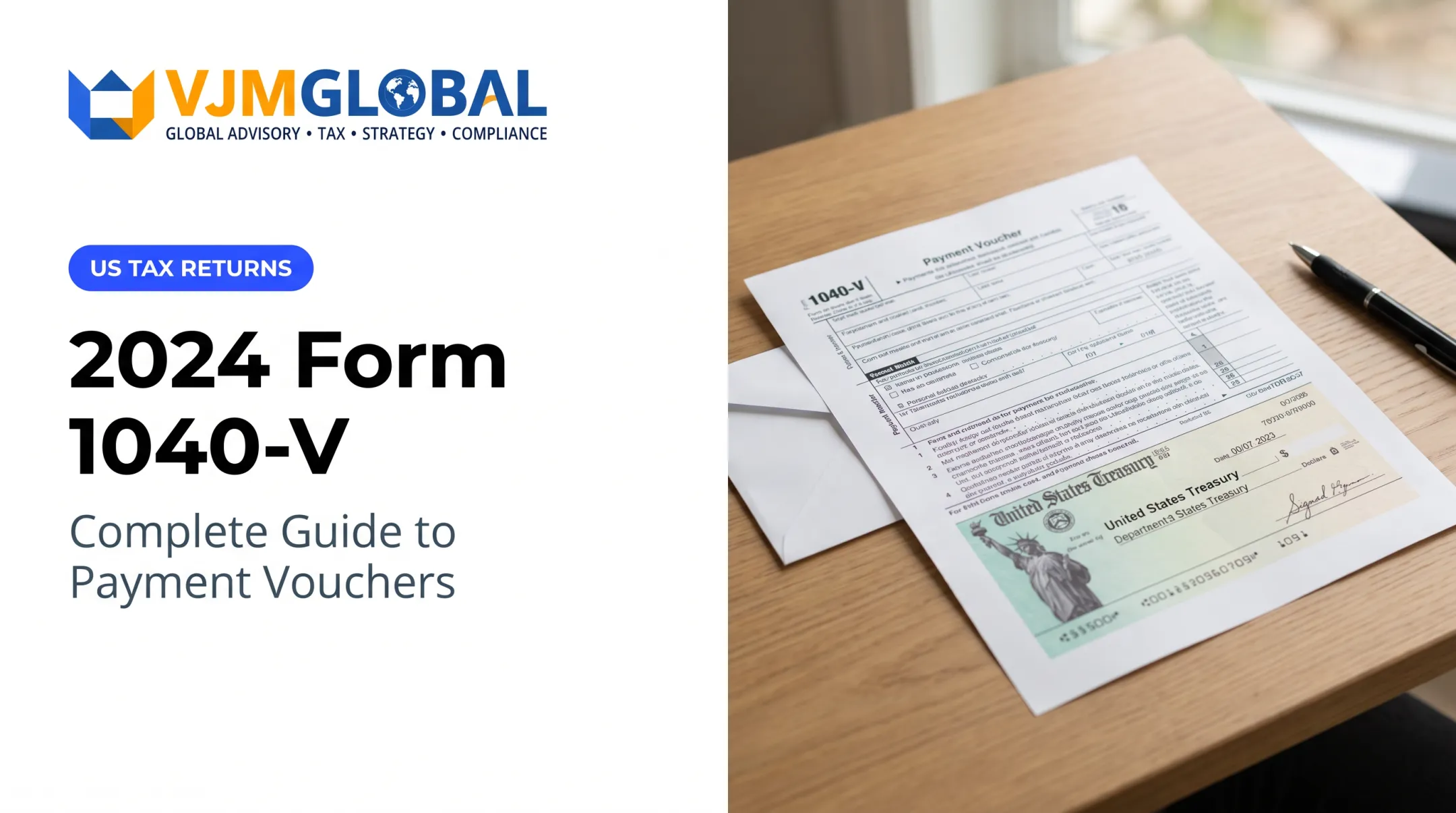
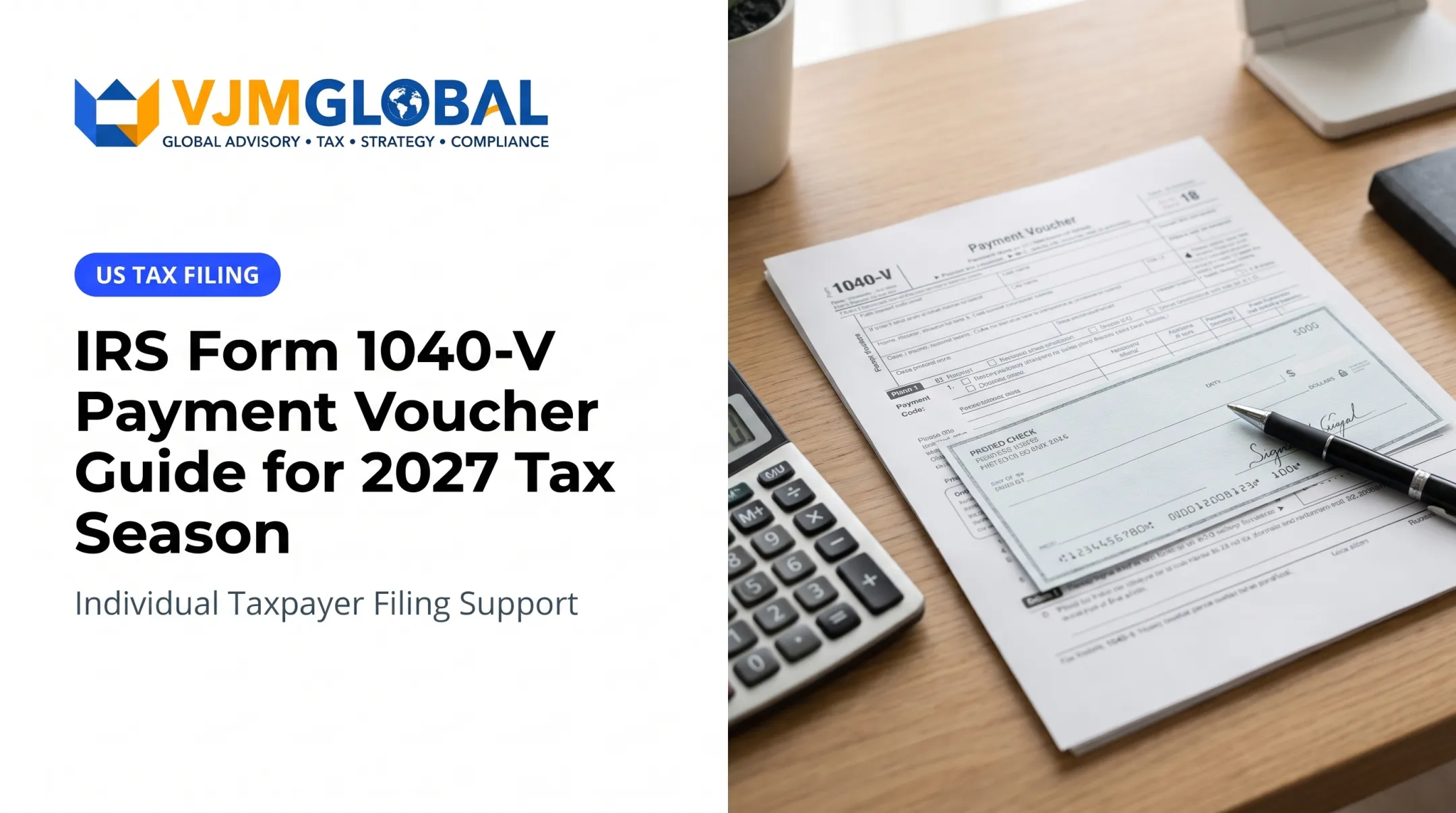
Form 1040-V is a short IRS payment voucher. It goes in the envelope with a check or money order when you owe a balance on a U.S. federal income tax return.
Here's where people trip up. You don't need it for every Form 1040 payment, and paying electronically generally removes the need for the paper voucher altogether.
If you're a U.S. citizen or green-card holder living in Australia, you still file U.S. returns on worldwide income. This guide covers who needs the voucher, how to fill it in, your payment options from Australia, deadlines, mailing, and recordkeeping.
Key Takeaways
- Form 1040-V helps the IRS match a mailed payment to the right taxpayer and tax year.
- Use it only with a check or money order for a balance due.
- Skip it for online payments, refunds, or a zero balance.
- Always follow the latest IRS instructions for amount, address, and method.
- From Australia, weigh international mail time against an eligible electronic option.
What Is Form 1040-V and When Do You Need It?
The voucher versus the return
Form 1040-V is the payment voucher for a balance due on the "Amount you owe" line of Form 1040, 1040-SR or 1040-NR. It is not a return, and it doesn't calculate tax.
Form 1040 reports income, deductions, credits and liability. The voucher simply travels with your payment.
A simple decision test
- Mailing a check or money order for a balance due: include the voucher.
- Paying through Direct Pay, an IRS Online Account, or by card: skip it; the IRS says not to complete the voucher when paying online.
- Refund or zero balance: there's no payment, so there's no voucher.
Use the voucher edition for the tax year you're paying. The IRS page and PDF editions don't always line up, so check the year printed on the form.
An Australian example
Say you're a U.S. citizen in Melbourne with a US$1,800 balance on your 2025 return. You hold only Australian bank accounts.
Mailing a U.S. dollar check means sourcing one, paying for international post, and waiting on transit. Other routes include:
- An international wire from your Australian bank (fees may apply)
- Card payment through an IRS-approved processor
U.S. tax and Australian tax are separate systems. Paying the IRS does not settle anything with the ATO, and the reverse is also true.
How to Complete Form 1040-V Correctly
Download the voucher from IRS.gov and confirm it matches the tax year you're paying. The form has four numbered lines:
| Line | What to enter |
|---|---|
| 1 | Your SSN (or ITIN). On a joint return, the SSN shown first |
| 2 | Spouse's SSN on a joint return (the second one shown) |
| 3 | The exact amount you're paying by check or money order |
| 4 | Name(s) and address as shown on your return, including foreign country, province/state and postal code if abroad |

Don't add fields or signatures. The form doesn't ask for them.
Preparing the payment
- Make the check or money order payable to "United States Treasury."
- Write your name, address, daytime phone number and SSN or ITIN on it.
- Note the tax year and form type (1040, 1040-SR or 1040-NR).
- Write the amount in dollars and cents, matching line 3 exactly.
Assembling the envelope
- Put the voucher and payment loose in the envelope
- Don't staple or attach them to each other or to your return
- Never mail cash
- Keep a copy or photo of the voucher and the check before sealing it
How to Submit Your Payment: Mail, Online, or Other Options
You never pay Form 1040-V itself online. You pay the underlying tax balance through an eligible channel, and then no paper voucher is needed.
| Method | What to know from Australia |
|---|---|
| Direct Pay | Free. Needs a U.S. checking or savings account and a U.S. ABA routing number; SWIFT isn't accepted |
| IRS Online Account | Bank payments carry no fees, but use a U.S. financial institution account |
| Debit/credit card | Processor fees apply: for example, 1.75% to 1.85% on personal credit cards (minimum $2.50) and about $2.10 to $2.15 on debit |
| EFTPS | No longer available for individual payments |
| Electronic Funds Withdrawal | Requested with an e-filed return; needs a U.S.-style routing number |
| International wire | Allowed in U.S. dollars from a foreign bank with a U.S. banking relationship; your bank may charge a fee |

Fees are paid to the processor, not the IRS, and card payments may involve currency conversion costs. Check IRS international payment guidance for current details.
Mailing from Australia
For filers mailing from Australia, the voucher address printed on the form is Internal Revenue Service, P.O. Box 1303, Charlotte, NC 28201-1303, USA. Confirm it against the current voucher before posting.
- Use regular mail. A private delivery service may delay processing, and only IRS-designated services qualify for timely-mailing treatment.
- Allow for international transit time.
- Keep your postmark or tracking record. An Australian postmark supports timely filing of a return, but it isn't proof that a payment was credited that day.
Form 1040-V versus Form 1040-ES
Form 1040-V accompanies a balance due on an annual return. Form 1040-ES covers estimated tax payments made during the year, with its own vouchers for each due date.
Deadlines, Common Errors, and What Happens If You Cannot Pay
Filing and paying are different deadlines
For the 2025 return, the regular deadline was 15 April 2026. A U.S. citizen or resident alien living abroad on that date gets an automatic extension to 15 June 2026 for filing and payment. Interest, however, runs on unpaid tax from 15 April.

Need longer to file? Form 4868 by 15 June generally extends filing to 15 October 2026. It does not extend time to pay. Form 1040-NR filers follow different dates, so don't assume the abroad extension applies.
Errors that delay or misapply payments
- Wrong SSN or ITIN
- Wrong tax year
- Voucher amount that doesn't match the check
- Outdated mailing address
- Missing identifiers on the check
- Voucher mailed without the payment
If you can't pay in full
File on time anyway and pay what you can. Failure to file costs generally 5% of unpaid tax per month (up to 25%), while failure to pay is generally 0.5% per month (capped at 25%).

The IRS underpayment rate for individuals was 7% in Q4 2026 and compounds daily.
Payment plans can help:
- Short-term plans: pay within 180 days, with no setup fee online
- Long-term online plans: for balances of $50,000 or less, setup fees from $29 (Direct Debit) or $69 otherwise
Penalties and interest continue until you pay in full.
Keep your records
Retain the voucher copy, check or wire evidence, confirmations and IRS letters. Keep records for 3 years from the return filing date, 6 years if you omitted more than 25% of gross income, and indefinitely if no valid return was filed.

Bottom Line: A Form 1040-V Checklist for U.S. Taxpayers in Australia
- Confirm you actually owe a balance.
- Choose your payment method.
- If mailing a check or money order, download the current voucher.
- Verify SSN/ITIN, tax year, name, address and amount.
- Use the address printed on the current form.
- Save proof of payment and mailing.
Electronic payment may suit some Australia-based filers better, but eligibility, fees, processing times and account requirements change, so check IRS.gov first.
If your situation involves international income, residency questions or broader compliance, VJM Global's tax compliance and advisory team can review your U.S. filing and payment obligations alongside cross-border considerations.
Frequently Asked Questions
Do I need to send Form 1040-V with my Form 1040?
Only when mailing a check or money order for a balance due. It's usually unnecessary for electronic payments, refunds, or a zero balance.
What is Form 1040-V used for?
It helps the IRS match a mailed payment with the right taxpayer and tax year. It isn't the tax return.
How do I get estimated tax payment vouchers?
They come with Form 1040-ES, not Form 1040-V. Download the 2026 Form 1040-ES and use a voucher only when mailing a check or money order.
What are the quarterly estimated tax payment dates for 2026?
15 April, 15 June and 15 September 2026, then 15 January 2027. A weekend or legal holiday moves the date to the next business day.
What is the deadline for filing Form 1040?
For tax year 2025, the deadline is 15 April 2026, with an automatic extension to 15 June for qualifying filers abroad. An extension to file doesn't extend the time to pay.
What is the difference between Form 1040 and Form 1040-V?
Form 1040 is the annual individual income tax return. Form 1040-V is a payment voucher used with a mailed payment for a balance due.