Many preparers treat it as a quick copy-paste from the books. That's where problems start. The IRS expects Schedule L to agree with the partnership's actual records, and it needs to connect logically with Schedule M-1, M-2, and the capital information on each partner's Schedule K-1.
This article walks through who actually needs to file Schedule L, how to read each line, a practical reconciliation workflow, how it relates to the other Form 1065 schedules, and the errors that trip up even experienced preparers. We'll also clear up a common point of confusion: Schedule L versus "Line L" on Schedule K-1 are not the same thing.
Key Takeaways
- Schedule L reports book-basis assets, liabilities, and partners' capital at year start and end
- Filing hinges on Schedule B's exception test, not revenue or asset size alone
- Assets must equal liabilities plus partners' capital on both reporting dates, with no exceptions
- Reconciliation gaps go to Schedules M-1, M-2, and M-3 when Schedule L is not enough
- Schedule K-1 Line L is each partner's tax-basis capital, separate from partnership-wide Schedule L
What Schedule L Is and When It Applies
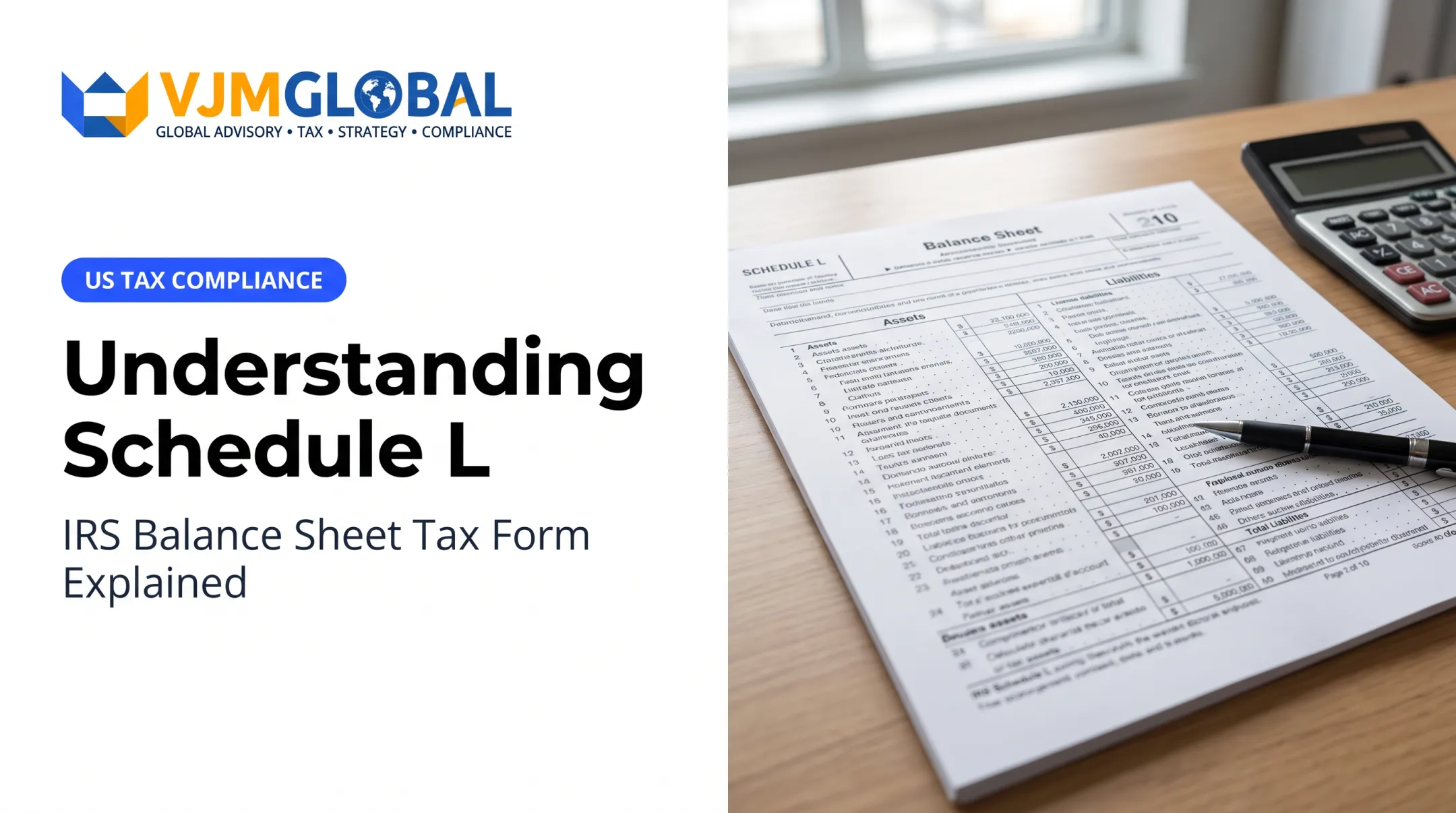
Schedule L, officially titled "Balance Sheets per Books," gives the IRS a snapshot of a partnership's financial position. It isn't used to calculate taxable income directly. Think of it as a check on consistency between what a partnership reports and what its books actually show.
Book Basis vs. Tax Basis
Schedule L amounts should generally come from the partnership's own books and records. That's different from the tax-basis figures used for partner capital reporting or basis tracking elsewhere on the return. According to the IRS Form 1065 instructions, the balance sheets "should agree with the partnership's books and records," and any differences need a written explanation attached to the return.
Domestic partnerships and multi-member LLCs taxed as partnerships both encounter Schedule L. But filing Form 1065 and being required to complete Schedule L aren't automatically the same obligation.
The Schedule B Exception
Schedule B, question 4, determines whether a partnership can skip Schedules L, M-1, and M-2 entirely. The exception requires all four of the following conditions to be true, not just one or two:
- Total receipts for the tax year under the current threshold
- Total assets at year-end under the current threshold
- Schedules K-1 furnished to partners and filed with the return by the due date, including extensions
- The partnership is not required to file Schedule M-3
Dollar thresholds change from year to year, so verify the current figures in the IRS instructions before relying on them. Don't assume last year's numbers still apply.
Why Keep a Balance Sheet Anyway
Even partnerships that qualify for the filing exception often maintain an internal balance sheet. Lenders ask for one. Partners want visibility into their capital position. Auditors expect continuity between years. Skipping Schedule L on the return doesn't mean skipping good bookkeeping.
A quick note: this article covers general mechanics, not personalised tax advice. Partnerships with foreign partners, unusual ownership structures, inactive status, or nonstandard accounting methods should consult the current IRS instructions or a qualified adviser before filing.
How to Read Schedule L: Assets, Liabilities, and Capital
Schedule L uses a two-column format: beginning-of-year and end-of-year. The beginning balance should match the prior year's ending balance unless there's a documented correction or restatement attached.
The Asset Section
Assets are broken into specific categories rather than lumped together. The current form separates:
| Category | What it captures |
|---|---|
| Cash | Cash and deposit accounts |
| Trade receivables | Notes and accounts receivable, net of bad debt allowance |
| Inventories | Goods held for sale or production |
| Government and tax-exempt securities | Specific investment categories |
| Other current assets | Attach a statement for detail |
| Loans to partners | Separate from loans received from partners |
| Fixed assets | Buildings and depreciable property, net of accumulated depreciation |
| Depletable assets and land | Reported separately from other fixed assets |
| Intangibles | Amortizable assets, net of accumulated amortization |
Fixed assets and accumulated depreciation deserve particular attention. These figures should reconcile with the partnership's fixed-asset register and general ledger, not just a rough estimate carried from last year.
Liabilities and Partners' Capital
The liabilities section separates current liabilities, long-term debt, nonrecourse loans, and partner or related-party loans. Keep loans to partners and loans from partners classified separately. Mixing these up is a common source of confusion during review.
Partners' capital is the residual figure: what's left after subtracting total liabilities from total assets. It moves throughout the year based on:
- Contributions from partners
- Allocated book income or loss
- Distributions made to partners
The Completeness Test
Every balance sheet must satisfy the same equation: assets equal liabilities plus capital. If the two sides don't match, something in the preparation process needs investigation. Unusual items, like negative capital balances, partner loans, or intercompany amounts, should be reviewed on their own merits rather than forced into whatever line seems closest.

How to Prepare and Reconcile Schedule L
Building an accurate Schedule L follows a fairly predictable workflow, even though the underlying numbers can get messy.
A Practical Preparation Workflow
- Close the books for the tax year and generate a final trial balance
- Map each ledger account to the corresponding Schedule L line
- Pull beginning balances from the prior year's filed return
- Enter ending balances based on the current trial balance
- Reconcile the trial balance against what's been entered on the form
Support documentation matters here. Bank statements, receivables ageing, inventory counts, fixed-asset schedules, loan confirmations, and records of partner contributions and distributions all back up the numbers on the form.
Catching Reconciliation Problems Early
During reconciliation, watch for:
- Omitted accounts that never made it onto the mapping sheet
- Duplicate balances from account consolidations
- Reversed sign conventions (a liability entered as a positive asset, for example)
- Stale balances carried forward without review
- Journal entries lacking supporting documentation
Compare the current year's beginning column against last year's filed ending column. If they don't match, document why, whether it's an amended return, an accounting correction, a reclassification, or a change in how the books are maintained.

Schedule L should also connect logically to the income statement, Schedule M-1, Schedule M-2, and the capital figures on partner schedules. Some amounts should tie exactly; others won't, because they're built on different bases for different purposes.
Year-End Checklist
Before finalising Schedule L, confirm:
- Bank accounts are reconciled
- Receivables and payables ageing reports are current
- Inventory records match physical counts
- Fixed-asset and depreciation schedules are updated
- Outstanding debt balances are confirmed with lenders
- Partner contribution and distribution activity is documented
- Foreign or related-party transactions have been reviewed
This is where a lot of partnerships, particularly ones juggling cross-border operations, start to feel the strain of doing it all in-house.
VJM Global works with partnerships on exactly this kind of reconciliation: closing the books, tying the trial balance to supporting schedules, and preparing the return itself.
For partnerships with international partners or operations spanning multiple countries, that kind of structured review before filing tends to catch issues long before they become IRS correspondence.
Schedule L Compared With M-1, M-2, M-3, and K-1
Schedule L doesn't operate alone. It's one piece of a set of interconnected schedules, each answering a different question.
| Schedule | What it answers |
|---|---|
| Schedule L | What does the balance sheet look like per the books? |
| Schedule M-1 | How does book income reconcile with return income? |
| Schedule M-2 | What changed in partners' tax-basis capital accounts? |
| Schedule M-3 | A more detailed book-to-tax reconciliation for qualifying partnerships |
| Schedule K-1 | What's each partner's allocated share of income, capital, and other items? |
Why Differences Aren't Automatically Errors
A partnership can show differences between Schedule L and tax-return figures without having made a mistake, provided those differences are documented and reconciled. Book basis and tax basis often diverge legitimately.
M-3 Filing Thresholds
Certain partnerships must file Schedule M-3 instead of relying on M-1 alone. According to the IRS Schedule M-3 instructions, the mandatory tests include:
- Total assets of $10 million or more
- Adjusted total assets of $10 million or more
- Total receipts of $35 million or more
- A reportable entity partner owning 50% or more of capital, profit, or loss at any point during the year
Meeting any single test, not all of them, triggers the requirement. Always confirm current thresholds in the 2025 Form 1065 instructions rather than relying on prior-year figures.

Line L on Schedule K-1: A Different Animal
Here's where confusion often creeps in. "Line L" on Schedule K-1 reports an individual partner's tax-basis capital account, their contributions, share of income or loss, and distributions. It has nothing to do with the partnership-wide Schedule L balance sheet beyond sharing a letter. Treating them as interchangeable is a mistake that shows up more often than it should.
Common Schedule L Errors and a Filing Checklist
Some mistakes show up repeatedly across partnership returns. Knowing what to watch for saves time during review.
Frequent Errors
- Failing to carry forward prior-year ending balances as the current beginning balances
- Reporting tax-basis figures where the books require book-basis amounts
- Omitting accumulated depreciation or netting it incorrectly against fixed assets
- Misclassifying partner loans, mixing loans to partners with loans from partners
- Leaving "other" line items unsupported without an attached statement
When the Balance Sheet Won't Balance
If assets don't equal liabilities plus capital, work backward through:
- Check the trial balance for data entry errors
- Recalculate retained or undistributed earnings
- Review partner contributions and distributions for the year
- Confirm closing entries were posted
- Verify sign conventions on liability and contra-asset accounts
Mismatches between Schedule L capital, Schedule M-2, and partner capital reporting usually trace back to a basis difference. The correct fix depends on whether the discrepancy stems from book-to-tax differences or an actual data entry problem.
Why This Matters Beyond the Filing Itself
Inconsistent schedules invite IRS correspondence, amended returns, delayed partner K-1s, and headaches during an audit or a financing review where lenders expect clean, supportable financials.
Final Filing Checklist
- Confirm whether Schedule L filing applies based on current Schedule B criteria
- Use the current year's form and instructions, not an outdated version
- Reconcile both the beginning and ending columns against supporting records
- Verify assets equal liabilities plus capital on both dates
- Tie figures to Schedule M-1, M-2, or M-3 as applicable
- Review partner contribution, distribution, and loan activity
- Retain workpapers supporting every line item
Partnerships with foreign partners, related-party transactions, multiple currencies, or significant book-tax differences are good candidates for professional review before filing.
Frequently Asked Questions
What is Schedule L on Form 1065?
Schedule L is the "Balance Sheets per Books" section of Form 1065. It reports a partnership's assets, liabilities, and partners' capital at both the beginning and end of the tax year.
What are the instructions for filing Schedule L on Form 1065?
Use the current IRS Form 1065 and its instructions, complete both the beginning and ending columns using the partnership's books, and confirm the accounting equation balances before tying figures to related schedules.
Who is required to file Schedule L on Form 1065?
It depends on how the partnership answers Schedule B's question 4. Partnerships meeting all four small-partnership exception conditions can skip Schedule L; everyone else must complete it.
What are the balance sheet requirements and format for partnerships on Form 1065?
Schedule L uses a two-column format for beginning and end-of-year figures. Assets, liabilities, and capital are reported on the basis specified in the current form instructions, typically book basis.
What are Schedules M-1, M-2, and M-3 on Form 1065 and who must file them?
M-1 reconciles book income with return income, M-2 tracks changes in tax-basis capital, and M-3 provides a more detailed reconciliation for larger partnerships. Eligibility rules change, so check current IRS thresholds.
What is Section L on Schedule K-1?
Line L on Schedule K-1 reports an individual partner's tax-basis capital account, including contributions, allocated income or loss, and distributions. It's distinct from the partnership-wide Schedule L balance sheet.