The IRS received 6,154,614 Form 1120-S returns in fiscal 2025, according to the IRS Data Book. Many came from owners running U.S. S corporations from abroad, including Australia, where time zones and unfamiliar terminology add friction.
This guide covers when Schedule L is required, what each section means, how to reconcile it, and where mistakes creep in.
Key Takeaways
- Schedule L is skipped only if receipts and year-end assets are each under $250,000.
- Assets must equal liabilities plus equity, using book values.
- Schedule L feeds into Schedules M-1 and M-2, so the figures must agree.
- Book equity is not shareholder basis. Track basis separately.
- Reconcile shareholder loans and distributions before filing.
What Is Schedule L on Form 1120-S?
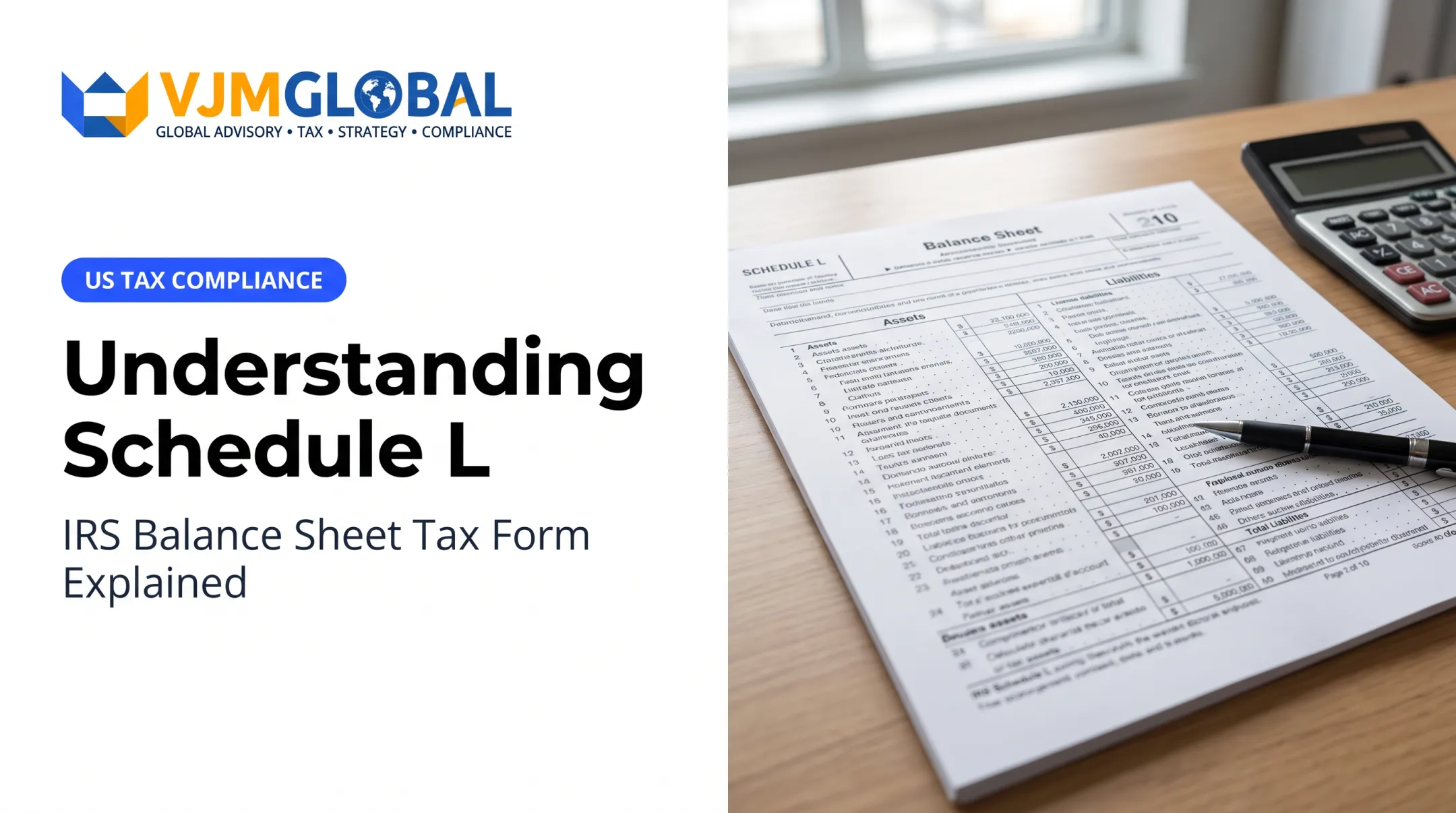
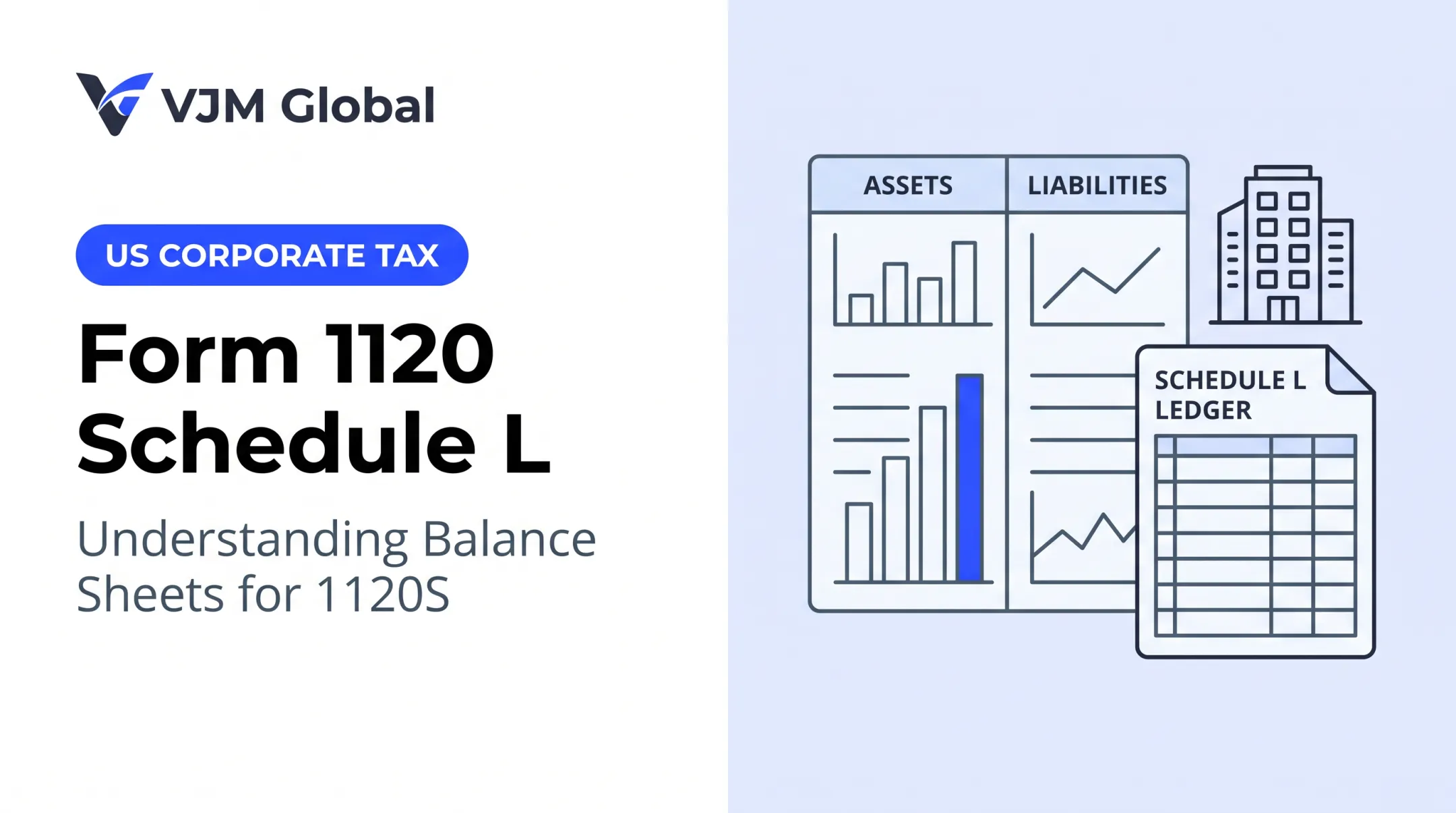
Schedule L is titled Balance Sheets per Books. It shows assets, liabilities and shareholders' equity at the start and end of the tax year. Your accounting software holds the full balance sheet. Schedule L is the summarised version that goes to the IRS.
The IRS instructions say the balance sheets should agree with the corporation's books and records. That rules out tax-only figures, guesses, or an estimated market value of the business.
A balance sheet and a profit and loss statement answer different questions:
- The balance sheet shows financial position on specific dates.
- The profit and loss statement shows activity over a period.
The IRS reads Schedule L alongside the rest of the return. Income, deductions, distributions and equity movements should tell one consistent story.
When Is Schedule L Required?
The small-corporation exception
Schedule B, question 11 sets two tests for tax year 2025. Total receipts and year-end total assets must each be less than $250,000. Exactly $250,000 fails the test.

If you answer Yes, Schedules L and M-1 need not be completed. Two things still apply:
- Schedule M-2 is still required.
- Item F (total assets) must still be completed using your book method. Enter zero only if there were no year-end assets.
"Total receipts" is broader than sales. It includes page 1 income lines, certain Schedule K income items and specified Form 8825 amounts.
Even when exempt, keep a full balance sheet. Lenders, shareholders and next year's preparer will want one.
Deadlines and extensions
The return is due on the 15th day of the third month after year-end. For calendar-year 2025, that is March 16, 2026, because March 15 falls on a Sunday. Weekend and holiday dates roll to the next business day.
Form 7004 generally gives six months to file, but no extra time to pay. Corporations that keep their books and records outside the U.S. may qualify for a special file-and-pay extension to the 15th day of the sixth month. See the Form 7004 instructions and attach the qualification statement.
State rules differ. California's Form 100S, for example, has its own timing and information-on-request rules, so check each state separately.
What Goes on Schedule L?
Assets
Each line has a beginning-of-year and end-of-year column. The IRS instructions don't state in so many words that opening balances must equal the prior year's closing balances. Treat that as sound practice anyway, since a gap signals an error.
Principal asset lines include:
- Cash
- Trade notes and accounts receivable, less allowance for bad debts
- Inventories
- U.S. government obligations and tax-exempt securities
- Loans to shareholders
- Buildings and other depreciable assets, less accumulated depreciation
- Land
- Amortizable intangible assets, less accumulated amortization
- Other assets (with an attached statement)
Book assets are not the same as what the business is worth. Under FASB guidance, costs of developing internally generated goodwill should not be capitalized. Line 13 covers amortizable intangibles only. Don't park a brand valuation in "other assets."
Liabilities
- Accounts payable
- Mortgages, notes and bonds payable in less than one year
- Other current liabilities
- Loans from shareholders
- Mortgages, notes and bonds payable in one year or more
- Other liabilities
Classify debt by when it falls due. Direction matters for shareholder loans. Money the corporation lends to a shareholder is an asset (line 7). Money a shareholder lends to the corporation is a liability (line 19). Keep a signed note and a repayment record for the second kind.
Shareholders' equity
Equity lines cover capital stock, additional paid-in capital, retained earnings, adjustments to shareholders' equity, and treasury stock. Contributions, income, losses, distributions and prior-year corrections all move these balances.
These are corporate book accounts. They are not each shareholder's stock or debt basis.
The balancing equation
Total assets must equal total liabilities plus shareholders' equity. If they don't, look for an omitted transaction, a misclassified item, a wrong opening balance, or an unposted year-end adjustment.
How to Prepare and Reconcile the 1120-S Balance Sheet
Gather the records
Before you start, collect:
- General ledger and the prior-year return
- Bank and credit-card statements
- Receivables and payables reports
- Inventory records
- Loan agreements
- Fixed-asset and depreciation schedules
- Shareholder contribution and distribution records
- Equity roll-forward
Your accounting method shapes the numbers. Cash-basis books generally recognise income when received and expenses when paid, while accrual books recognise them when earned or incurred. Schedule L still follows your books, so receivables, payables and inventory won't look the same for every company.
Build it in sequence
- Carry forward verified prior-year ending balances.
- Reconcile cash, debt, shareholder accounts, fixed assets and depreciation.
- Reconcile retained earnings and distributions.
- Close the books and post adjusting entries.
- Review classifications and prepare the balance sheet.
- Confirm the accounting equation and file supporting documents.

Connect Schedule L to other schedules
Schedule M-1 reconciles book income to the income on the return, ending at Schedule K, line 18. Schedule M-2 analyses the Accumulated Adjustments Account, previously taxed income, accumulated earnings and profits, and the other adjustments account. Retained earnings on line 24 is a book figure, so M-2 won't simply mirror it.
Schedule K-1 and Form 7203 carry the shareholder-level detail. Form 7203 applies when a shareholder claims a loss, receives a non-dividend distribution, disposes of stock, or receives a loan repayment.
Pre-filing checklist
- Opening balances match prior-year closing balances
- Assets and debts are classified correctly
- Shareholder activity is traced and documented
- Depreciation is complete
- Equity roll-forward ties out
- M-1 and M-2 agree with Schedule L
- Assets equal liabilities plus equity
Incomplete books, prior-year errors, overseas ownership or complex shareholder loans are good reasons to get a second pair of eyes. VJM Global offers accounting outsourcing and U.S. tax compliance support, including Form 1120-S preparation, for owners who want help. It's one option among several.
Common Mistakes and Why Schedule L Accuracy Matters
Misclassifying shareholder transactions
Recording a loan as equity, or a contribution as an undocumented loan, distorts liabilities, equity and repayment records. Debt basis requires bona fide debt running directly to the shareholder under Treas. Reg. 1.1366-2. An account label isn't enough, and a guarantee alone doesn't create basis.
Keep the categories separate:
- Contributions increase equity.
- Distributions reduce equity.
- Salary runs through payroll. The IRS expects reasonable compensation before non-wage distributions.
- Reimbursements repay documented business expenses.
- Loans need a written note, terms and repayments.
Failing to reconcile opening and closing balances
Common causes include:
- An uncorrected prior-year balance
- A missing bank or credit-card account
- Transactions posted to the wrong period
- Unsupported opening equity
If Schedule L won't balance, work through this order:
- Compare against the prior-year return.
- Inspect the general ledger.
- Review retained earnings and distributions.
- Check fixed-asset schedules.
- Trace shareholder activity.

Omitting depreciation, inventory or debt splits
- Missing accumulated depreciation overstates assets.
- Inconsistent inventory treatment shifts both assets and income.
- Lumping all debt together hides what is due within a year.
Check the current IRS instructions and Publication 538 for your method and industry.
Confusing book, tax and market values
Schedule L uses book values. Tax basis, shareholder basis and fair market value serve other purposes. Never add a speculative value for the business or its goodwill just to force a balance.
Why Schedule L accuracy matters beyond filing
An accurate balance sheet shows liquidity, debt, retained earnings and capital needs. Lenders rely on it too. The SBA's July 2026 7(a) checklist for non-delegated loans asks for an interim balance sheet within 120 days of submission, plus three years of year-end statements or business tax returns.
Getting the return wrong has a real cost. For tax year 2025, a late or incomplete return carries $255 per shareholder per month, up to 12 months, even with no tax due.
Final Thoughts
Schedule L is more than numbers copied into a form. The figures should come from reconciled books and agree with Schedules M-1 and M-2 and your supporting records.
Check the current IRS instructions each year. Where shareholder basis, loans, distributions, overseas ownership or prior-year corrections are involved, get qualified tax or accounting advice.
Frequently Asked Questions
Is a balance sheet required on 1120S?
Balance-sheet reporting appears on Schedule L. It is skipped only if receipts and year-end assets are each under $250,000. Keeping accurate books is still wise.
What is Schedule L on Form 1120-S?
It is the balance sheet per books. It reports beginning- and end-of-year assets, liabilities and shareholders' equity.
What does an S corporation include on its balance sheet?
Cash, receivables, inventory, fixed and intangible assets, and liabilities including shareholder loans. Equity covers capital stock, paid-in capital, retained earnings and other adjustments.
What happens if Schedule L does not balance?
Assets must equal liabilities plus equity. Review opening balances, missing transactions, depreciation, debt classification, distributions and retained earnings.
How do shareholder loans appear on an S corporation balance sheet?
Loans to shareholders are assets (line 7). Documented loans from shareholders are liabilities (line 19).
How does Schedule L relate to Schedules M-1 and M-2?
Schedule L reports book balances. M-1 reconciles book income to return income. M-2 tracks AAA and related accounts, per the current instructions.