They're not, and mixing them up can stall your bank account, your business license, or your first tax filing.
A Company Registration Number (CRN) proves your business legally exists. An EIN is a US federal tax ID issued by the IRS. Different job, different issuer, different rulebook.
This article breaks down both terms, compares them side by side, and helps you figure out exactly which one (or both) your business actually needs.
Key Takeaways
- A CRN confirms legal entity status; an EIN identifies you to the IRS for tax purposes
- Most operating US businesses need bothExpanding into India adds a CIN, PAN, and TAN, on top of your existing home-country identifiers
CRN vs EIN: Quick Comparison
These two identifiers get confused constantly, mostly because both show up on the same paperwork: bank forms, vendor applications, licensing renewals. Here's how they actually differ.
| Factor | Company Registration Number | EIN |
|---|---|---|
| Issuing authority | State Secretary of State, Companies House (UK), ASIC (Australia), or Ministry of Corporate Affairs (India) | IRS only (US federal government) |
| Purpose | Establishes legal entity status for contracts, banking, licensing | Tracks federal tax obligations, payroll, and reporting |
| Format | Varies by jurisdiction (state-specific in the US, alphanumeric in the UK) | Fixed nine digits: XX-XXXXXXX |
| Who needs it | Any legally registered entity: LLC, corporation, LLP | Employers, corporations, partnerships, and others who opt in |
| When you get it | At the moment of incorporation | Applied for separately, usually after entity formation |
Notice the geographic split. In Australia, this gets even more layered. ASIC issues a nine-digit Australian Company Number (ACN) when a company registers. The ATO's Australian Business Number (ABN) is a separate, broader 11-digit identifier used for tax and business dealings. They're related but not interchangeable — much like the CRN/EIN pairing in the US.
What is a Company Registration Number?
A CRN is the unique ID your government registration authority assigns the moment your business becomes a legal entity. Think of it as your company's birth certificate: proof it officially exists.
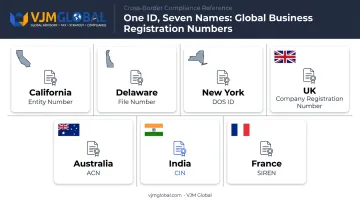
The tricky part is naming. The US doesn't even use "CRN" as a national term:
- California calls it an Entity Number
- Delaware uses a File Number
- New York issues a DOS ID
- UK companies get a Company Registration Number from Companies House
- Australia issues an ACN through ASIC
- India assigns a CIN via the Ministry of Corporate Affairs
- France uses a SIREN number
This matters for VJM Global's client base specifically. We work with businesses across the US, UK, and Australia, and each one arrives using a different word for the same basic concept.
A CRN lets your business:
- Open a bank account under the company's legal name
- Sign binding contracts
- Apply for state or local licenses
- Appear as a verified entity in official registries
One detail that trips people up: a CRN has nothing to do with tax status. Non-profits get one. Businesses with zero employees get one. Registration and taxation are entirely separate tracks, which is exactly why the EIN exists as a distinct system.
Where to Find Your Company Registration Number
In the US, your entity number appears directly on your Certificate of Incorporation or Certificate of Formation, the document your state sent you at registration. Lost it? Search your state's Secretary of State business entity database by company name.
Internationally, the process looks similar:
- UK: Search Companies House's public register
- Australia: Check ASIC's company registers or ABN Lookup
- India: Use the MCA portal's CIN search tool
What is an EIN?
An EIN is a nine-digit federal tax ID issued exclusively by the IRS to identify your business for tax purposes. Functionally, it's the business equivalent of a Social Security Number for individuals.
You'll need one if you plan to:
- File federal business tax returns
- Hire employees and run payroll
- Open a US business bank account (most banks require it)
- Operate as a corporation or partnership
Here's something worth knowing: even solo entrepreneurs without employees often get an EIN voluntarily. Why? It keeps personal and business finances cleanly separated, which matters at tax time and if you ever face an audit.
One more clarification, especially for our international readers — an EIN is strictly a US instrument. Other countries run their own tax ID systems entirely. India, for instance, uses PAN for general taxpayer identification and TAN specifically for entities responsible for deducting tax at source. None of these substitute for each other across borders.
Applying for an EIN
The application route depends on where your business operates, not your citizenship.
- US-based applicants apply free through the IRS online portal and typically receive their EIN immediately upon approval
- International applicants (principal business outside the US) must apply by phone at 267-941-1099, by fax, or by mail using Form SS-4
- Processing times vary sharply: instant online, about 4 business days by fax, and up to 4 weeks by mail
Timing matters as much as method: form your legal entity first (LLC, corporation, whatever structure fits) before applying for the EIN. The IRS explicitly flags this sequence to avoid processing delays caused by mismatched or incomplete entity details on Form SS-4.
Do You Need Both a CRN and an EIN?
Short answer: yes, for most operating businesses. These two identifiers cover completely different legal territory, so one doesn't cancel out the need for the other.
Use this situational guide:
- Forming any legal entity (LLC, corporation, LLP)? You need a state registration number, full stop.
- Hiring staff, opening a US bank account, or filing federal taxes? Add an EIN to the mix.
- Running a sole proprietorship with no employees? You might get away with just an SSN and skip the EIN entirely.
What you can't do is swap one for the other. Try using an EIN where a bank or licensing authority expects your state entity number, and you'll hit rejected applications and processing delays.
The IRS itself confirms that EIN and name-control mismatches cause corporate and partnership e-filed returns to bounce back, a direct, documented consequence of getting these details wrong on official filings.
Foreign Companies Expanding Into India or the US
Cross-border expansion multiplies the identifier count fast. A US company entering India, for example, doesn't trade its EIN for Indian equivalents. It keeps the EIN for domestic US tax obligations and adds a new set of Indian identifiers on top:
- CIN (Corporate Identification Number) from incorporating with the Ministry of Corporate Affairs
- DIN (Director Identification Number) for each company director
- PAN for general tax identification
- TAN if the entity will deduct or collect tax at source
- GST registration once turnover crosses the applicable threshold
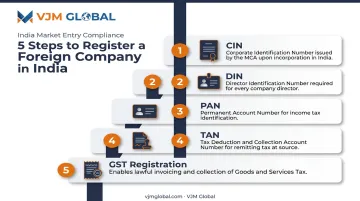
That's five potential registrations layered on top of whatever identifiers the business already holds back home. These requirements stack on top of what you already hold rather than replacing it.
This is precisely where VJM Global spends most of its time. We've guided over 500 American businesses, 250+ UK companies, and 250+ Australian businesses through Indian market entry, handling everything from digital signatures and DIN allotment through to post-incorporation GST and TAN registration.
If you're unsure which registration numbers or tax IDs apply to your specific structure, talk to VJM Global's team before you file anything. A quick consultation upfront beats untangling a rejected application later.
Conclusion
A Company Registration Number and an EIN serve two distinct purposes: one proves your business legally exists, while the other keeps you compliant with tax authorities.
Before assuming either number works interchangeably, confirm exactly which jurisdiction's rules apply to your situation. Getting both numbers right the first time helps you avoid banking delays, tax penalties, and licensing headaches, especially once your business starts operating across borders.
If you're expanding into India from the US, UK, or Australia, VJM Global's cross-border compliance specialists can confirm exactly which registration and tax numbers your business needs.
Frequently Asked Questions
What is the difference between an EIN and business registration number?
An EIN is a US federal tax ID issued by the IRS specifically for tax reporting. A business registration number is issued by a state or national authority to confirm your company's legal entity status.
How do I find my business registration number?
It's printed on your Certificate of Incorporation or Formation. You can also look it up through your state's Secretary of State database or the relevant national business registry.
Can I use my EIN as my company registration number?
No. They come from different issuing authorities and serve different legal functions, so one can't substitute for the other on official filings or applications.
Do all businesses need both a CRN and an EIN?
Most operating US entities need both. Sole proprietors without employees are an exception: they can often use an SSN instead of applying for an EIN.
Is a company registration number the same as a tax ID number?
Not exactly. A CRN establishes legal entity status, while a tax ID like an EIN exists for federal tax reporting and compliance purposes.
What is the equivalent of an EIN when registering a company in India, the UK, or Australia?
India uses PAN and TAN for tax purposes alongside a CIN for entity registration. The UK relies on a company registration number from Companies House. Australia uses an ABN and ACN through the ATO and ASIC.