Introduction
Singapore businesses expanding to the United States face an immediate structural challenge: unlike Singapore's streamlined Unique Entity Number (UEN) system managed by ACRA, the US has no single, unified company registration number.
Instead, multiple identifiers are issued by different federal and state authorities—and confusing them can delay bank account openings, tax compliance deadlines, and critical legal filings.
More than 50% of Fortune 500 companies incorporate in Delaware, yet each still carries separate federal tax identifiers and state-specific registration numbers. This affects every Singapore entrepreneur, SME, or multinational entering the US market.
This guide covers which registration numbers you actually need—EIN, state tax IDs, and more—when each applies, and how the decentralized US system differs from Singapore's unified approach.
Key Takeaways
- The USA has no single company registration number—businesses receive a federal EIN from the IRS and separate state registration numbers from each state where they operate
- The EIN is a 9-digit federal tax identifier (XX-XXXXXXX) used for tax filings, payroll, banking, and opening U.S. business bank accounts
- State entity numbers vary in name and format—common labels include File Number, Entity ID, Document Number, and UBI
- Form SS-4 is required for Singapore businesses (no online IRS access): fax takes ~4 business days, mail takes ~4 weeks
- All 50 states require a registered agent with a local physical address before incorporation
What Is a Company Registration Number in the USA?
In the United States, "company registration number" is not a standardized identifier — it's a collective term for several numbers a business receives from federal and state authorities upon registration.
Each serves a distinct legal or administrative purpose, with no mechanism linking them into a unified record.
The Contrast with Singapore's UEN System
Singapore businesses operate with a single UEN that functions across all government interactions—from IRAS tax filings to CPF submissions to corporate bank applications. The UEN follows three standardized formats depending on entity type, and UEN.gov.sg consolidates all entity types into one searchable database.
The US operates on a federalist model, meaning business registration authority sits with individual states rather than the federal government. As OpenCorporates observed in May 2025, "There is no single federal registry for all companies. Data is spread across 50 states, the District of Columbia, and various territories." Each state maintains its own business entity registry with distinct naming conventions, numbering formats, and disclosure requirements.
When people ask about a "US company registration number," they typically mean either:
- The EIN (Employer Identification Number) for federal tax purposes
- The state entity/file number for state-level compliance
These identifiers serve entirely different functions and are issued by separate authorities with no cross-referencing system between them.
The Two Core Identifiers: EIN and State Registration Number
The Federal EIN: Your Tax Identity
The Employer Identification Number is a 9-digit federal tax ID issued by the Internal Revenue Service, formatted as XX-XXXXXXX. According to IRS Publication 1635, it functions like a Social Security Number for businesses and is required for:
- Federal tax filings and returns
- Opening US business bank accounts
- Hiring employees and processing payroll
- Applying for business loans and credit
- Entering contracts with government agencies
The EIN is federal and remains constant regardless of how many states you operate in.
State Registration Numbers: Jurisdiction-Specific Identifiers
When filing Articles of Incorporation (corporations) or Articles of Organization (LLCs) with a US state, that state automatically assigns a unique entity identifier. The naming convention differs across states:
| State | Identifier Name | Format Example |
|---|---|---|
| California | Entity Number | C1234567 (corporations), 123456789012 (LLCs) |
| Delaware | File Number | 1234567 (numeric) |
| Texas | File Number | Numeric |
| Florida | Document Number | Alphanumeric |
| Washington | UBI (Unified Business Identifier) | 123456789 (9-digit) |
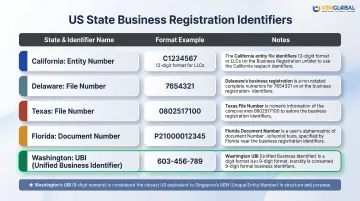
Washington's UBI stands out: it simultaneously registers businesses with the Department of Revenue, Department of Labor & Industries, and Employment Security Department, making it the closest US equivalent to Singapore's UEN.
Key Differences and When Each Is Used
Understanding which identifier applies to which situation prevents costly filing errors. Here's how they divide:
EIN applies to:
- Federal tax returns (Form 1120, 1065, etc.)
- IRS correspondence and federal payroll tax deposits
- Banking relationships and federal agency interactions
State registration number applies to:
- State annual reports, tax obligations (income, franchise, sales tax)
- Business licenses, permits, and state court filings
- Legal contracts within that jurisdiction
Operating across multiple states means holding a different state number in each jurisdiction—there is no master state identifier.
Additional Specialized Identifiers
Depending on business type and activities, Singapore businesses may also encounter:
- State Taxpayer ID: For sales tax collection and remittance in states with sales tax
- D-U-N-S Number: A private 9-digit identifier from Dun & Bradstreet used for vendor onboarding, business credit, and some government contracts
- FTC Registered Identification Number (RN): Optional identifier for businesses selling textiles, wool, or fur products in the US
How Singapore Businesses Can Obtain a US Company Registration Number
Step 1: Choose Your State and Incorporate
Before applying for any federal number, Singapore businesses must first incorporate in a US state. The incorporation process automatically generates your state entity number.
Popular choices for international founders:
- Delaware: Home to more than 50% of Fortune 500 companies, featuring the specialized Court of Chancery (established 1792) and business-friendly Delaware General Corporation Law
- Wyoming: Zero state personal or corporate income tax, strong privacy protections (member names not public), lowest annual fees
- Florida: No state personal income tax, straightforward online filing, large consumer market access
Critical requirement: All 50 US states require business entities to designate a registered agent with a physical in-state address to receive legal notices and government documents. Singapore businesses must engage a professional registered agent service before incorporating.
Step 2: Apply for an EIN as a Non-US Resident
CRITICAL RESTRICTION: The IRS online EIN application requires a valid US Social Security Number (SSN) or Individual Taxpayer Identification Number (ITIN), blocking most Singapore applicants from using the instant online tool.
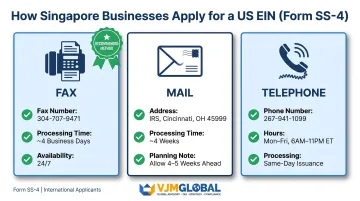
Singapore businesses must use IRS Form SS-4 submitted via:
Fax (Recommended for Speed)
- Fax to: 304-707-9471
- Processing time: Approximately 4 business days
- Available 24/7
Mail (Slower but Reliable)
- Mail to: Internal Revenue Service, Attn: EIN International Operation, Cincinnati, OH 45999
- Processing time: Approximately 4 weeks
- Mail 4-5 weeks before you need the EIN
Telephone (International Only)
- Call: 267-941-1099 (not toll-free)
- Hours: Monday-Friday, 6:00 AM - 11:00 PM Eastern Time
- Same-day issuance during call
Important clarification: According to IRS Form SS-4 instructions, a US address is not required for foreign applicants. On Lines 4-5, enter your Singapore address including city, postal code, and country name. On Line 7b (SSN/ITIN), enter "foreign" or "N/A" if you're ineligible for US tax identification numbers.
Step 3: Complete Form SS-4 Accurately
Common errors that delay EIN issuance for Singapore applicants:
- The responsible party must be a natural person (individual), not an entity — unless applying as a government body
- Select the correct entity type: LLC, corporation, partnership, or other applicable structure
- State a clear reason for applying: "started new business," "banking purposes," or another IRS-recognized category
- Write out your full international address without abbreviations on the foreign address lines
The IRS limits EIN issuance to one per responsible party per day, so plan accordingly if registering multiple entities.
Step 4: Obtain State-Level Tax or Business IDs
Once your EIN is secured, state-level obligations kick in. Depending on your state and business activities, additional registrations may include:
- State employer withholding ID for payroll taxes
- Sales tax permit for product-based businesses
- Professional licenses for regulated industries
- Workers' compensation insurance registration
Check your specific state's Department of Revenue or Secretary of State website for complete requirements.
The Value of Working with Business Setup Advisors
The US dual federal-state system operates very differently from ACRA's centralized model. Getting the sequence right — state incorporation first, then EIN, then state-level IDs — matters. A misstep early can delay banking, payroll, or contract execution by weeks.
Working with an advisory firm experienced in cross-border business compliance helps Singapore businesses:
- Prepare accurate registration documents from the start
- Select the right entity structure for their business model
- Obtain all identifiers in the correct sequence
- Coordinate registered agent requirements and ongoing state compliance
- Avoid delays caused by incomplete or incorrectly filed forms
VJM Global supports international businesses with cross-border accounting, tax compliance coordination, and multi-jurisdiction advisory — helping clients navigate the administrative complexity of operating across borders with confidence.
How to Find a US Company Registration Number
Finding Your Own EIN
The EIN appears on your IRS confirmation letter (historically referenced as Form CP 575) sent upon approval. According to the IRS website, you can confirm an existing EIN by:
- Requesting an Entity transcript via "Get a business tax transcript"
- Calling 800-829-4933 to request Letter 147C (EIN Previously Assigned)
- Checking any previously filed federal tax return
Store this document securely, as banks, partners, and agencies will request it repeatedly.
Finding Your Own State Registration Number
Your state identifier appears on:
- Filed copy of Articles of Incorporation or Organization
- Annual report confirmations from the state
- State business entity search portals (free lookup)
Most Secretary of State websites provide free business entity search tools where you can look up your own records by company name.
Looking Up Another Company's Registration
When conducting due diligence on US partners or vendors, these resources cover the main registration databases:
State Secretary of State Portals (for state registration numbers):
- Delaware: icis.corp.delaware.gov
- California: bizfileonline.sos.ca.gov
- Texas: sos.state.tx.us/corp/sosda
- Florida: dos.fl.gov/sunbiz/search
- Washington: ccfs.sos.wa.gov
SEC EDGAR Database (for publicly traded companies): The Securities and Exchange Commission's EDGAR system uses the Central Index Key (CIK) to identify corporations filing public disclosures. Search at sec.gov/edgar/search.
IRS Tax-Exempt Organization Search (for non-profits): Verify tax-exempt status and access Form 990s at irs.gov/charities-non-profits/tax-exempt-organization-search.
OpenCorporates (third-party aggregator): Aggregates data from all 50 state registries into one searchable platform, though EIN/tax data is not included and update frequency varies by state.
Common Misconceptions Singapore Businesses Have About US Registration Numbers
Misconception 1: The EIN Is the Only Registration Number Needed
Many Singapore founders assume obtaining an EIN completes US business registration. In reality, the EIN handles only federal tax obligations. State registration, state tax IDs, and required licenses are separate requirements obtained independently through state authorities.
Misconception 2: A US Company Registration Number Works Like Singapore's UEN
Singapore's UEN is a single, permanent identifier that covers all government and commercial dealings — one number, one system. The US works differently. The US system is fundamentally decentralized, with federal and state identifiers serving separate purposes:
- The EIN covers federal tax obligations only
- Each state issues its own registration numbers for state-level compliance
- Expanding to additional states means acquiring new identifiers in each jurisdiction
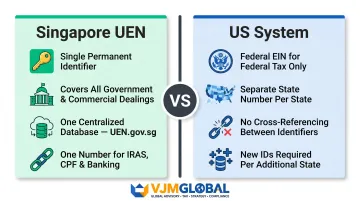
Understanding this structural difference upfront prevents missed filings and avoids compliance gaps as your US footprint grows.
Misconception 3: Singapore Businesses Cannot Get an EIN Without a US Address or SSN
While the IRS online application requires a US SSN or ITIN, non-resident foreign entities can obtain an EIN through Form SS-4 via fax or mail without a US address or Social Security Number. The Form SS-4 instructions explicitly accommodate foreign addresses and allow "foreign" or "N/A" entries for applicants ineligible for US tax identification numbers.
Processing via fax or mail typically takes 4–6 weeks, so Singapore businesses should factor this into their US setup timeline rather than waiting until the last moment.
Frequently Asked Questions
Do US companies have a company registration number?
Yes, but unlike countries with centralized identifiers, US companies receive multiple registration numbers. Each business holds a federal EIN from the IRS for tax purposes and a separate state-issued entity number from the Secretary of State where it incorporates.. Both serve distinct compliance functions.
Is a company registration number the same as an EIN?
An EIN is one type of company registration number, specifically the federal tax identifier issued by the IRS. However, it's not the only identifier. US companies also hold separate state registration numbers issued by each state where they operate, and these two identifiers are not interchangeable.
How do I find my company registration number in the USA?
Check your IRS confirmation letter (Form CP 575) for your EIN, or request an Entity transcript from the IRS. For your state registration number, review your filed Articles of Incorporation/Organization or use your state's Secretary of State business entity search portal.
What is my US LLC company registration number?
A US LLC receives two core identifiers: a state-assigned entity/file number issued upon filing Articles of Organization (format varies by state), and a federal EIN from the IRS.
How many digits is a business registration number in the USA?
The federal EIN is always 9 digits formatted as XX-XXXXXXX. State registration numbers vary widely: some states use 7-digit alphanumeric codes (California corporations), others use 12-digit numeric identifiers (California LLCs), and Washington uses a 9-digit UBI. There is no uniform standard across all 50 states.
Can a Singapore business get a US company registration number without a US address?
Yes. Singapore businesses can obtain a US EIN by submitting Form SS-4 via fax or mail to the IRS — no US address or Social Security Number is required for foreign entities. For state registration, a registered agent address in your state of incorporation is required.