Introduction
Picture this: A Singapore business owner has finalized their India expansion strategy, secured seed capital, and identified their first Indian client — only to discover that signing the contract requires a 21-character identifier they've never encountered. Unlike Singapore's 9-character UEN, India's Corporate Identification Number (CIN) encodes the company's listing status, state of incorporation, industry, and registration year into a single string. Every official transaction, tax filing, and legal document your Indian subsidiary produces will reference this number.
This guide walks Singapore businesses through what the CIN is, how to decode its format, how it compares to the UEN, and what your business must do to obtain one when entering India.
The stakes are concrete: failing to display a valid CIN on required documents triggers penalties of ₹1,000 per day under Section 12(8) of the Companies Act, 2013, capped at ₹1,00,000 — and both the company and every officer in default are personally liable.
Key Takeaways
- CIN is India's mandatory 21-digit corporate identifier, issued by the Registrar of Companies (ROC) at incorporation
- Every Indian company — including subsidiaries of Singapore businesses — receives a unique CIN automatically upon registration
- CIN encodes six data points: listing status, industry (NIC code), state, incorporation year, entity type, and sequential number
- CIN is distinct from GST number, PAN, and DIN — each covers a different compliance requirement
- Singapore businesses must quote their Indian subsidiary's CIN on all official documents and MCA filings
What Is a Company Registration Number (CIN) in India?
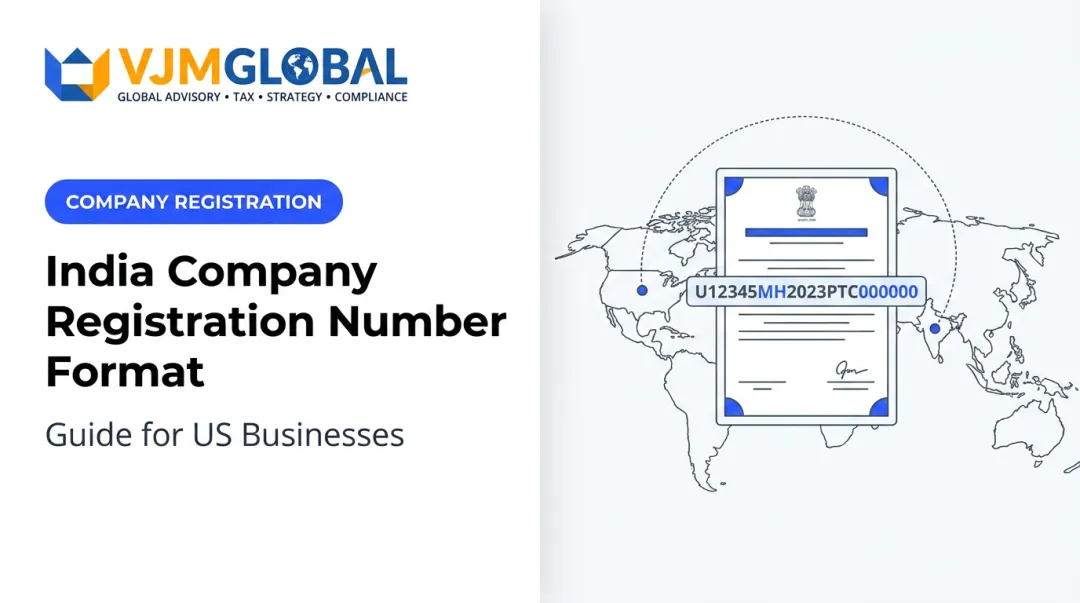
The Corporate Identification Number (CIN) is a unique 21-character alphanumeric identifier assigned to every company incorporated in India under the Companies Act, 2013. Issued by the Registrar of Companies (ROC) under the Ministry of Corporate Affairs (MCA), the CIN functions as the company's permanent identity throughout its existence.
Who receives a CIN?
- Private Limited Companies (PTC)
- Public Limited Companies (PLC)
- One Person Companies (OPC)
- Section 8 / Not-for-Profit Companies (NPL)
- Nidhi Companies
- Subsidiaries of Foreign Companies (FTC) — including Singapore-owned Indian subsidiaries
- Government-owned companies (GOI, SGC)
Important exclusion: Limited Liability Partnerships (LLPs) do not receive a CIN. Instead, they are assigned a 7-character LLPIN (LLP Identification Number) under the LLP Act, 2008. Singapore businesses considering the LLP structure should note this difference, as it affects which identifiers appear across compliance filings and cross-border documentation.
Why the CIN matters:
The ROC uses the CIN to track every company activity from inception: annual filings, director changes, registered office shifts, and compliance history. The CIN must be quoted in all ROC transactions and MCA e-forms.
Section 12(3)(c) of the Companies Act, 2013 also mandates display of the CIN on business letters, billheads, notices, and other official publications.
Failing to display the CIN carries real financial exposure. Under Section 12(8), companies that omit the CIN from required documents face a penalty of Rs 1,000 per day of continuing default, capped at Rs 1,00,000 — with both the company and every officer in default held liable. Small companies may receive up to 50% relief under Section 446B, but the display obligation remains absolute.
How to Read India's CIN Format: A Breakdown for Singapore Businesses
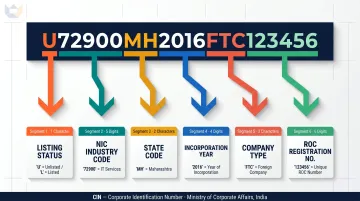
India's CIN is a 21-character alphanumeric code that encodes six distinct pieces of information. Each segment tells a specific story — useful when verifying a local partner, registering your Indian subsidiary, or reviewing compliance records. Here's what each component means, illustrated with a concrete example:
Example CIN: U72900MH2016FTC123456
| Position | Characters | Type | Represents | Example Value |
|---|---|---|---|---|
| 1 | 1 | Alpha | Listing status | U (Unlisted) |
| 2-6 | 5 | Numeric | Industry (NIC code) | 72900 (IT services) |
| 7-8 | 2 | Alpha | State code | MH (Maharashtra) |
| 9-12 | 4 | Numeric | Incorporation year | 2016 |
| 13-15 | 3 | Alpha | Company type | FTC (Foreign subsidiary) |
| 16-21 | 6 | Numeric | ROC registration number | 123456 |
Character 1: Listing Status (L or U)
- L = Listed on an Indian stock exchange (BSE, NSE)
- U = Unlisted
Most Singapore-owned Indian subsidiaries will start with U, since they typically operate as private entities rather than publicly traded companies.
Digits 2–6: Industry Code (NIC)
This 5-digit code represents the company's primary economic activity, classified using NIC (National Industrial Classification) codes maintained by the Ministry of Statistics. Common codes for Singapore businesses include:
- 72900 – IT services and software development
- 45200 – Import/export and trading
- 64110 – Banking and financial services
- 70100 – Management consulting
Singapore businesses should ensure the NIC code accurately reflects their actual operations in India. Incorrect classification can require a CIN amendment later, requiring additional filings and delays.
Characters 7–8: State Code
The 2-letter code identifies the state where the company's registered office is located:
- MH = Maharashtra (Mumbai, Pune)
- DL = Delhi (NCR)
- KA = Karnataka (Bengaluru)
- TN = Tamil Nadu (Chennai)
- GJ = Gujarat (Ahmedabad)
For Singapore businesses, the choice of state affects ROC jurisdiction, state-level compliances (such as professional tax), and stamp duty rates on incorporation documents.
Digits 9–12: Incorporation Year
This 4-digit field records the calendar year of incorporation. When reviewing a potential Indian partner or vendor, this segment quickly confirms how long the entity has been in operation — relevant for due diligence and creditworthiness assessments.
Characters 13–15: Company Type Code
This 3-letter code identifies the legal entity type. Key codes for Singapore investors:
- PTC = Private Limited Company (most common structure)
- FTC = Subsidiary of a Foreign Company (Indian subsidiary of a Singapore parent)
- PLC = Public Limited Company
- OPC = One Person Company
- NPL = Section 8 / Not-for-Profit Company
The FTC code specifically denotes a subsidiary of a foreign company, signaling clearly to Indian counterparties that the entity operates under a foreign parent.
Digits 16–21: ROC Registration Number
This 6-digit sequential number is assigned by the specific ROC office handling the incorporation. It's the core "company registration number" sometimes referenced independently in older systems.
Singapore UEN vs. India CIN: Key Differences
Singapore business owners are familiar with the Unique Entity Number (UEN) — a 9–10 character identifier issued by ACRA (Accounting and Corporate Regulatory Authority). The UEN serves as Singapore's equivalent of a business registration number, but it's structurally and functionally different from India's CIN.
Singapore UEN Format:
- Length: 9 or 10 characters (alphanumeric)
- Format examples:
nnnnnnnnX(9 chars) – Businesses registered before 2009yyyynnnnnX(10 chars) – Companies registered after 2009 (yyyy = year)TyyPQnnnnX(10 chars) – Other entities (T = prefix, yy = year, PQ = entity type)
- Information encoded: Registration year (partial), entity type (T-format only)
- Does NOT encode: Industry, geography, listing status
India CIN Format:
- Length: 21 characters (alphanumeric)
- Information encoded: Listing status, industry (NIC), state, year, entity type, registration number
- Encodes 6 distinct data points — compared to UEN's 1–2
Comparison Table:
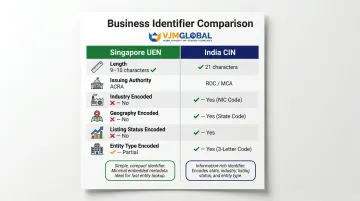
| Feature | Singapore UEN | India CIN |
|---|---|---|
| Length | 9-10 characters | 21 characters |
| Issuing authority | ACRA | ROC / MCA |
| Encodes industry | No | Yes (5-digit NIC code) |
| Encodes geography | No (city-state) | Yes (2-letter state code) |
| Encodes listing status | No | Yes (L/U) |
| Encodes entity type | Partial (T-format) | Yes (3-letter code) |
| Governing law | ACRA Act | Companies Act, 2013 |
Practical Implication for Singapore Businesses
These structural differences have a direct impact on how you verify Indian counterparties. When entering contracts with Indian partners, conducting due diligence, or onboarding Indian vendors, Singapore companies should request and verify the Indian counterparty's CIN — not just the company name.
The MCA portal's "Find CIN" tool lets you search by CIN or company name. It returns the registered address, directors, filing history, and compliance status — enough to confirm whether you're dealing with a legitimately registered entity before signing anything.
How Singapore Businesses Register in India and Obtain Their CIN
Singapore businesses entering India can choose from several structures, each resulting in a CIN:
Common Entry Structures:
- Wholly-Owned Subsidiary (Private Limited Company) — Most common for Singapore investors. Provides separate legal entity status, limited liability, and long-term scalability. Company type code: PTC or FTC.
- Branch Office — Extension of the Singapore parent. Suitable for import/export, professional services, or research. Requires RBI approval. Company type code: FTC.
- Liaison Office — For market research and communication only. Cannot engage in revenue-generating activities. Also receives a CIN under FTC classification.
For Singapore businesses seeking a permanent presence in India, VJM Global typically recommends the wholly-owned subsidiary (Private Limited Company) structure — it offers the broadest legal protection, operational flexibility, and the clearest path to long-term scalability.
Pre-Registration Steps
1. Obtain Digital Signature Certificates (DSC)
All proposed directors must obtain a Class 3 DSC from a licensed Certifying Authority in India. For Singapore nationals, this requires a color scan of the passport. The DSC is valid for 1-2 years and is mandatory for all MCA e-form submissions — without it, no incorporation filing can proceed.
2. Apply for Director Identification Numbers (DIN)
Each director must obtain an 8-digit DIN. For foreign directors — including Singapore nationals — documents must be notarized and apostilled under Rule 13(5) of the Companies (Incorporation) Rules, 2014. Since Singapore is a Hague Convention country, apostille is completed through the Singapore Academy of Law (SAL).
Required documents for Singapore directors:
- Passport (color scan, notarized and apostilled)
- Overseas address proof (not older than 1 year, notarized and apostilled)
- Board Resolution from the Singapore parent company authorizing India incorporation
- Certificate of Incorporation and MOA/AOA of the Singapore parent (apostilled copies)
SPICe+ Form Process
India's company incorporation is handled through the SPICe+ (Simplified Proforma for Incorporating Company Electronically Plus) integrated web form on the MCA portal. The process runs in two parts, filed simultaneously with the AGILE-PRO form:
| Form Component | What It Covers |
|---|---|
| SPICe+ Part A | Name reservation — submit 1-2 proposed names; approval in 2-3 working days |
| SPICe+ Part B | Company details, eMOA/eAOA upload, DIN for up to 3 directors, PAN and TAN |
| AGILE-PRO | GSTIN, EPFO, ESIC, Professional Tax (state-specific), and bank account opening |
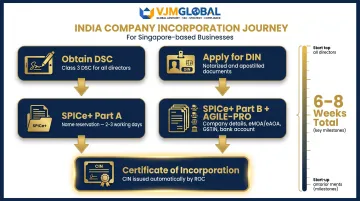
Upon ROC approval, the Certificate of Incorporation (Form INC-11) is issued electronically and contains the CIN. The CIN is automatically generated by the ROC — Singapore businesses do not apply for it separately.
Typical Timeline:
- Name approval: 2-3 working days
- SPICe+ processing: 5-7 working days (may extend to 10 during peak filing periods in March-April)
- Document apostille (Singapore): 1-3 weeks
- Total realistic timeline for Singapore businesses: 6-8 weeks
Expert support: VJM Global helps Singapore companies navigate the MCA portal, prepare apostilled documentation, and meet FDI and FEMA compliance requirements. With 30+ years of experience and a 95% client retention rate across international engagements, the team covers everything from DSC procurement to post-incorporation compliance setup. Typical turnaround for Singapore-owned subsidiaries is around 13 days once all apostilled documents are ready.
Where Must CIN Be Displayed? Compliance Rules Singapore Businesses Must Follow
Under Section 12(3)(c) and Rule 26 of the Companies (Incorporation) Rules, 2014, every Indian company must display its CIN on all official documents and communications:
Mandatory CIN display locations:
- Company letterheads
- Invoices and bills
- Receipts and payment vouchers
- Notices and official emails to external parties
- Annual reports and financial statements
- MCA e-form submissions
- All official publications and communications
Additional requirements under Rule 26:
- Display company name, registered office address, and CIN along with telephone, email, and website (if any)
- If the company changed its name in the last 2 years, mention the former name(s) alongside
- For One Person Companies (OPC), add "(One Person Company)" in brackets below the company name
Critical clarification: This obligation applies to the Indian subsidiary's CIN — not the Singapore parent company's UEN — for all business conducted through the Indian entity.
The CIN itself is tied to the company's structural identity, which means certain business changes will trigger an amendment to the number — not just its display.
When the CIN Changes
A company's CIN is amended when there is a structural change:
Triggers for CIN amendment:
- Moving from Unlisted (U) to Listed (L) status, or the reverse
- Shifting the registered office to a different state, which updates the 2-letter state code
- Change in primary business activity: Altering the main NIC code (digits 2–6 of the CIN)
- Change in company type: Conversion (e.g., Private Limited to Public Limited changes PTC to PLC)
Each of these changes requires specific MCA filings — and the amended CIN must be updated across all official documents immediately. For Singapore businesses restructuring Indian operations, factoring in this compliance step before finalizing any structural decision avoids retroactive corrections.
CIN vs. Other Indian Business Identifiers: A Quick Reference
When setting up in India, Singapore businesses will encounter several registration numbers — each issued by a different authority for a different purpose. Confusing them can delay compliance filings or create errors in official documents.
| Identifier | Full Form | Format | Issuing Authority | Purpose |
|---|---|---|---|---|
| CIN | Corporate Identification Number | 21-char alphanumeric | ROC / MCA | Unique company identity; encodes listing, industry, state, year, type |
| GSTIN | GST Identification Number | 15-digit (2 state + 10 PAN + 1 entity + 1 default + 1 check) | CBIC / GST authorities | Tax registration for GST compliance |
| PAN | Permanent Account Number | 10-char (5 alpha + 4 numeric + 1 check) | Income Tax Department | Tax identity for income tax; 4th char indicates entity type (C=Company) |
| DIN | Director Identification Number | 8-digit numeric | MCA | Unique identity for company directors |
| LLPIN | LLP Identification Number | 7-char alphanumeric | ROC / MCA | Unique identity for LLPs (not companies) |
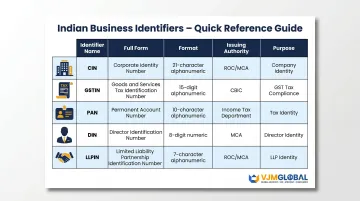
Here's when each identifier becomes relevant for a Singapore business entering India:
- CIN — Issued automatically at incorporation; required on all official company documents and filings from day one
- PAN — Applied for alongside incorporation; mandatory for all companies regardless of turnover or business activity
- GSTIN — Triggered once turnover crosses ₹40 lakh (₹20 lakh for service businesses); apply for GST registration before crossing the threshold
- DIN — Each Singapore national appointed as a director of the Indian subsidiary must obtain their own DIN before the company can be incorporated
Your Indian subsidiary will carry all four identifiers, each used in a distinct regulatory context — tax filings, government portals, banking, and director records do not accept substitutes.
Frequently Asked Questions
Do Indian companies have a company registration number?
Yes. Every company incorporated in India under the Companies Act, 2013 is assigned a Corporate Identification Number (CIN) — a unique 21-digit alphanumeric code — by the Registrar of Companies at the time of registration.
What is the format of company registration number in India?
The CIN follows a 21-character structure: 1 letter (listing status: L or U) + 5 digits (NIC industry code) + 2 letters (state code) + 4 digits (incorporation year) + 3 letters (company type: PTC, FTC, PLC, etc.) + 6 digits (ROC registration number).
How can I find my company registration number online?
Visit the MCA portal's "Find CIN" tool under MCA Services. Search by company name or existing CIN to retrieve full company details including CIN, registered address, directors, and filing history — free of charge.
Is a CIN number public information?
Yes. CIN is publicly accessible through the MCA portal. Singapore businesses can use it to verify the legal standing, compliance status, and director details of any Indian company before engaging with them.
Is CIN the same as GST?
No. CIN and GSTIN are separate identifiers serving different purposes. CIN is a corporate identity number issued by the MCA for company compliance under the Companies Act, 2013. GSTIN is a 15-digit tax registration number issued by GST authorities for goods and services tax reporting. A company will have both, but they are not interchangeable.
What is the difference between EIN and registration number?
EIN (Employer Identification Number) is a 9-digit tax identifier issued by the U.S. IRS — not equivalent to India's CIN, which encodes structural company information rather than tax identity. For Singapore businesses, the closer analogy is your UEN: like CIN, it's a corporate identity number, not a tax registration.
Ready to set up your Indian subsidiary and obtain your CIN? VJM Global works with Singapore companies at every stage of India entry: DSC and DIN procurement, SPICe+ filing, apostilled document preparation, and post-incorporation compliance. With 30+ years of experience supporting foreign businesses across 15+ industries, we help Singapore companies register in India correctly the first time. Contact us at [email protected] or call +91 9891576441 to get started.