Introduction
Moving from F-1 to H-1B can change your payroll withholding, your Social Security and Medicare treatment, your tax-residency count, and the forms you file. It does not automatically make you a full-year U.S. tax resident.
This guide is for international students and recent graduates, including OPT and CPT workers, moving into H-1B employment. Many also keep Australian bank accounts, investments, or tax ties, which adds a second layer of reporting.
We cover how to:
- Pin down your transition date
- Choose between Form 1040-NR, Form 1040, or a dual-status return
- Review FICA treatment
- Gather the right documents
- Check state and foreign-account obligations
Key Takeaways
- Start with the H-1B effective date and residency count, not the petition or approval date.
- Review F-1 day exclusions, H-1B day counting, and the substantial presence test separately.
- Income tax and FICA are different systems with different end dates.
- Australian accounts raise separate FBAR, Form 8938, ATO, and foreign-tax-credit questions.
How the F-1-to-H-1B Transition Changes Your U.S. Tax Status
Immigration status and tax residency are different
An F-1 or H-1B label does not decide whether you are a resident or nonresident for U.S. tax purposes. The IRS substantial presence test does.
You meet it with at least 31 days in the current year and 183 weighted days, per IRS Publication 519:
- All current-year days
- One-third of the prior year's days
- One-sixth of the year before that
Qualifying F-1 student days are generally excluded during the first five years, provided you substantially comply with visa requirements. "Exempt individual" refers to day counting only. It is not an exemption from U.S. tax.
H-1B days, by contrast, generally count once that status is effective. Check any earlier F, J, M, or Q history, because it affects the count.
Effective date versus petition or approval date
Your controlling date is the date H-1B status actually begins. Look at:
- The H-1B approval notice (Form I-797)
- The Form I-94 attached to a Form I-797A
- Your newest I-94 if you travelled internationally
A change of status inside the U.S. and a consular-processing case can produce different start dates. Payroll should not switch treatment automatically on 1 October or on the approval-notice date.
Confirm the actual date with your immigration counsel or the employer's HR team, since approval alone is not admission or a visa.
Transition-year and dual-status analysis
Picture a simple year. You work on OPT from January to August, then on H-1B from September. The F-1 months may be excluded from the day count, while the H-1B months count.
Whether you reach 183 weighted days decides your filing position.
Possible outcomes:
- Nonresident for the whole year
- Resident for the whole year
- Dual-status: nonresident for one part, resident for another
- A treaty or closer-connection position, if your facts support it
Residence under substantial presence generally starts on your first qualifying day of presence in the year, not the day the total hits 183. Check current IRS guidance before relying on any special position.

Forms, Documents, and Deadlines for the Transition-Year Return
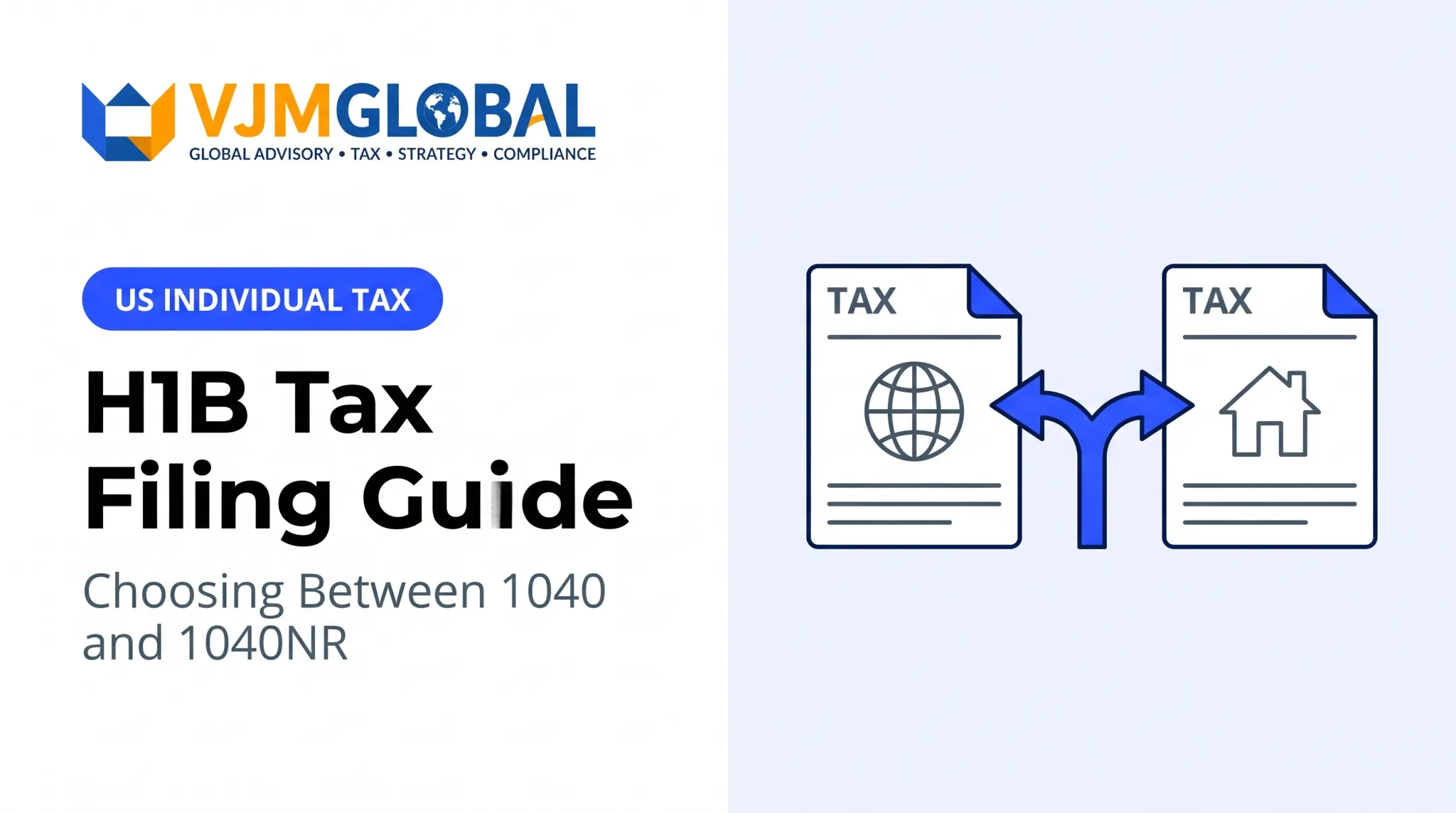
Choosing the correct federal return
Work through these questions in order: your residency result, your U.S.-source income, your withholding, any treaty claim, and the date residency begins.
| Situation | Return |
|---|---|
| Nonresident all year | Form 1040-NR |
| Dual-status, resident at year-end | Form 1040 or 1040-SR, with a statement for the nonresident period |
| Dual-status, nonresident at year-end | Form 1040-NR, with a statement for the resident period |
| Resident all year | Form 1040 |
Those return rules come from the 2025 1040-NR instructions. Form 8843 may also be needed for the F-1 period.
It is not an income-tax return, and each qualifying individual files their own. Attach it to Form 1040-NR if you file one. Otherwise send it separately by the 1040-NR deadline.
Documents to collect before filing
Income records:
- Form W-2 for OPT, CPT, and H-1B wages
- Form 1042-S for scholarships, stipends, or treaty-related income
- Any Form 1099, such as 1099-NEC or 1099-INT
- US federal and state withholding summaries
Immigration and travel records:
- Passport pages and visa history
- Form I-20 and employment authorization documents
- Form I-797A and Form I-94
- Entry and exit dates
- Prior returns and prior Forms 8843
- SSN or ITIN records
Filing dates, extensions, and payment timing
For tax year 2025, a nonresident with wages subject to U.S. withholding files by 15 April 2026. Without such wages, the deadline is 15 June 2026. Form 4868 gives six more months to file, generally to 15 October 2026, but not more time to pay.
Paid preparers generally must e-file Form 1040-NR, though dual-status returns are an exception. Confirm the current filing method for your situation. Check US state, FBAR, Form 8938, and Australian deadlines separately, since they run on their own calendars.
A practical filing workflow
- Determine the H-1B effective date.
- Calculate tax residency.
- Classify each income item.
- Reconcile withholding.
- Identify required forms.
- Review foreign reporting.
- Keep proof of filing.

Before submitting, compare dates and amounts on payroll records against your immigration documents. Mismatches are where errors hide.
Income, FICA, Treaty Benefits, and 1099 Work After H-1B
Federal income tax on F-1 and H-1B earnings
A nonresident is taxed on applicable U.S.-source income. Once resident treatment begins, worldwide income is taxable. H-1B status does not set a separate rate; your liability still turns on residency, filing status, taxable income, deductions, credits, withholding, and any valid treaty position.
Social Security and Medicare taxes during the transition
Nonresident F-1 students are generally exempt from Social Security and Medicare tax on authorised work for the purposes of the visa, including practical training, per IRS guidance on student FICA. That exemption ends on a change to non-exempt status, such as H-1B, or when you become a resident alien. It can end before income-tax residency begins.
Review your payslips for Social Security and Medicare lines. If tax was withheld in error, ask your employer for a refund first. If you cannot get a full refund, claim a refund from the IRS using Form 843 and Form 8316, with supporting documents.

Deductions, credits, and treaty claims
Nonresidents generally cannot claim the standard deduction, though eligible Indian students and business apprentices have a treaty exception. Dual-status filers generally cannot claim it even for the resident period. Do not use Form 1040 software or claim resident-only deductions without confirming eligibility.
Treaty benefits depend on your country of treaty residence, income type, the article, time limits, and saving-clause rules. Relevant forms include:
- Form 8233 for personal-services compensation
- Form W-8BEN for eligible non-service income
- Form 8833 for disclosing treaty-based return positions
Independent-contractor or 1099 income
Accepting Form 1099 income as an H-1B worker raises employment-authorisation questions, employer-sponsorship limits, self-employment tax, and income-reporting duties. Get separate immigration and tax advice before accepting contractor work, freelance income, or any payment outside your sponsoring-employer arrangement.
Foreign Accounts, Australian Obligations, and State Taxes
Australian bank accounts and foreign-asset reporting
FBAR and Form 8938 are separate filings. FBAR applies when aggregate foreign-account value exceeds US$10,000 at any time in the year, and is filed separately through FinCEN.
Form 8938 goes with your income-tax return and uses higher thresholds: for someone living in the U.S. and filing as single, US$50,000 at year-end or US$75,000 at any time, per the Form 8938 instructions.

Reporting an account does not make its balance taxable. Interest, dividends, investment income, and pensions may still need separate reporting. Many F-1 and H-1B holders overlook this because the account sits outside the U.S.
Coordinating U.S. and Australian tax obligations
A U.S. return does not satisfy Australian obligations. The ATO applies four residence tests (resides, domicile, 183-day, and Commonwealth superannuation) and generally taxes Australian residents on worldwide income. Assess these items against current ATO guidance:
- ATO residency status
- Australian-source income
- Treaty provisions
- Any foreign income tax offset
Do not assume that your Australian filing position or a treaty claim decides U.S. residency. The two systems run on separate tests.
State and local returns
State rules differ from federal ones. Residency, work location, employer location, withholding, and remote work can each create a state or local return, whatever your federal result.
California taxes part-year residents on worldwide income while resident and California-source income while nonresident. New York can treat you as a resident through domicile, or a permanent place of abode plus 184 days or more in the state.
Check your state revenue authority for part-year returns, multi-state situations, refunds, extensions, and local taxes. Neither F-1 nor H-1B status controls state residency.
Common Mistakes and When to Seek Professional Support
Common transition-year errors
- Filing Form 1040 when Form 1040-NR was required
- Treating H-1B approval as the effective date
- Missing a dual-status year
- Applying the F-1 FICA exemption after it ends
- Leaving out OPT or CPT income
- Claiming the standard deduction on a dual-status return
- Treating an extension as extra time to pay
- Skipping FBAR, Form 8938, 1099, 1042-S, state, or Australian reporting
The consequences vary. FBAR omissions can carry civil or criminal penalties depending on the facts. Form 8938 carries an initial US$10,000 failure-to-file penalty, with up to US$50,000 more after IRS notice, subject to reasonable-cause rules.

When professional review is worthwhile
Consider a specialist if you:
- Changed status mid-year or travelled during the transition
- Have prior F, J, M, or Q history
- Claim treaty benefits
- Received 1099 income
- Hold foreign investments
- Must coordinate U.S. and Australian filings
VJM Global offers cross-border tax and accounting support, including Form 1040-NR preparation for nonresident individuals and FBAR filings. It is not an immigration firm, so visa and work-authorisation questions belong with an immigration attorney.
Closing compliance reminder
- Confirm the H-1B effective date.
- Calculate residency.
- Collect every income form.
- Reconcile payroll.
- Review foreign reporting.
- Check state and Australian obligations.
- Keep copies of the filed return.
This article is general information. Tax and immigration rules change, so confirm your position with qualified U.S. tax, immigration, and Australian tax professionals.
Frequently Asked Questions
How do I transition from F-1 to H-1B?
Your employer files the petition, but your tax position follows the effective status date, not the petition or approval date. Check Form I-94 and seek immigration advice if travel or consular processing is involved.
How do international students (F-1) file U.S. tax returns?
First determine residency, then choose Form 1040-NR or Form 1040. Add Form 8843 where applicable, gather W-2 and 1042-S forms, file any state return, and review treaty eligibility.
Am I considered a resident for U.S. tax purposes?
It depends on the substantial presence test. F-1 days are generally excluded for up to five years, while H-1B days count. The result can be nonresident, resident, or dual-status.
Can international students be exempt from U.S. taxes?
Not entirely. Treaty relief, qualified scholarship treatment, and the limited FICA exemption may reduce specific taxes. No blanket exemption covers all U.S. taxes.
Do H-1B visa holders have to pay U.S. taxes, including Social Security and Medicare (FICA)?
Yes, generally. Federal income tax, any state or local tax, and FICA apply, though residency and the effective date must be reviewed separately.
Do F-1 students need to file an FBAR?
It depends on foreign-account ownership and the US$10,000 aggregate threshold. The F-1 label alone does not decide it, so check whether you are a U.S. person for FBAR purposes.