Form 5472 is an IRS information return. It can apply to foreign-owned U.S. corporations, foreign corporations doing business in the United States, and foreign-owned U.S. disregarded entities.
This guide covers eligibility, reportable transactions, deadlines, penalties, records, and how to evaluate a filing service. It is general information, not tax advice. Confirm your facts with a qualified cross-border professional.
Key Takeaways
- Form 5472 reports related-party transactions; it isn't a tax-calculation form.
- A foreign-owned U.S. LLC can owe a filing even with little or no income.
- Living in Australia doesn't make you a foreign owner; citizenship, ownership and entity type do.
- Check current IRS rules on deadlines, penalties and filing methods before you file.
What Is Form 5472 and Does It Apply to Expats in Australia?
Form 5472 helps the IRS monitor transactions between a U.S. reporting entity and its foreign related parties. The legal basis is IRC sections 6038A and 6038C. The form covers both monetary and non-monetary transactions.
It is an information return. The entity generally files it with its Form 1120, or with a pro forma Form 1120 if it is a foreign-owned disregarded entity.
For expats in Australia, whether Form 5472 applies depends on ownership and entity classification, not on living abroad.
Residence versus ownership
Two examples show the difference:
- A U.S. citizen living in Australia who personally owns a U.S. LLC remains a U.S. person. Living abroad does not make them a foreign owner.
- An Australian resident (who is not a U.S. person) or an Australian company that owns a U.S. LLC may create a foreign-owned entity situation that needs analysis.
Why entity classification matters
The IRS treats three cases differently:
- A U.S. corporation that is at least 25% foreign-owned, by vote or value, directly or indirectly.
- A foreign corporation engaged in a U.S. trade or business.
- A domestic disregarded entity, such as a single-member LLC, wholly owned by a foreign person

Under 26 CFR 301.7701-2, that entity is treated as a corporation for these limited reporting rules for tax years beginning on or after January 1, 2017.
Who Must File Form 5472?
A filing obligation arises for the three categories above when reportable transactions occur with a related party.
Who counts as a related party
- A direct or indirect 25% foreign shareholder
- Persons related under sections 267(b) or 707(b)(1)
- Other persons related under section 482
A foreign customer or supplier is not automatically related. File a separate Form 5472 for each related party with reportable transactions.
Expat eligibility checklist
- Who legally owns the U.S. entity?
- Is the owner an individual, company, partnership or trust?
- How is the entity classified for U.S. federal tax?
- Were there transfers, loans, services or property exchanges with the owner or another related party?
- Does the entity have an EIN and a return filing structure?
Small or inactive is not exempt
"No income" is not the same as "no reportable transactions." A newly formed LLC that received owner funding has a reportable event even if it made no sales.
Who may not need to file
An entity that fails the ownership test, or has no reportable transactions, may be outside the requirement. The instructions' exceptions are narrow, and several do not apply to foreign-owned disregarded entities.
Treaty positions, including under the U.S.-Australia treaty, are not a general exemption for a domestic LLC. Check current IRS instructions before relying on any exception.
Which Transactions and Information Must Be Reported?
A reportable transaction is a transfer of money, property, services, rights or other value between the entity and a foreign related party.
Monetary transactions owners often overlook
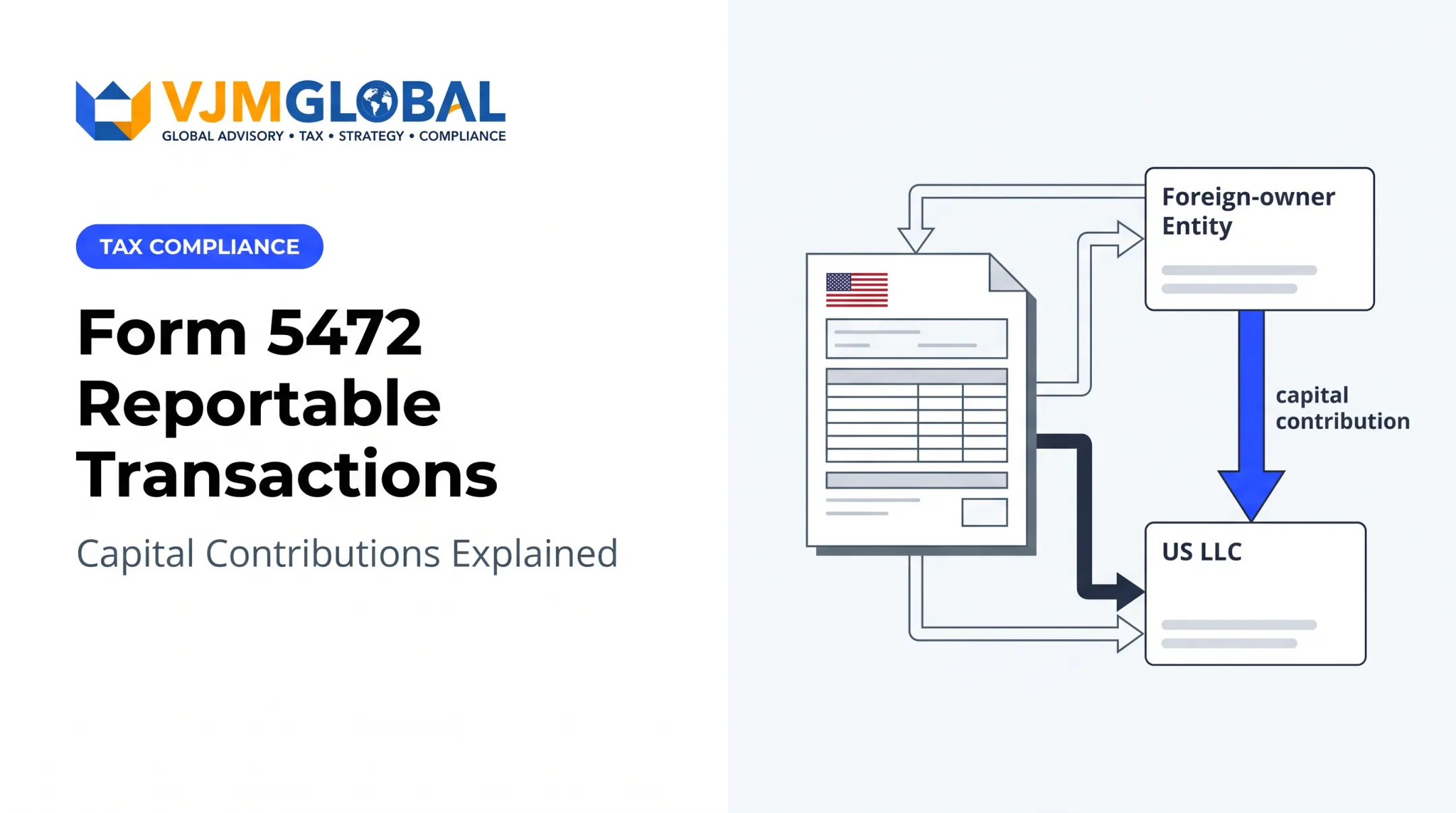
- Capital contributions and owner funding
- Distributions and withdrawals
- Loans, advances, repayments and interest
- Management, consulting, marketing or accounting fees
- Sales or purchases of goods, equipment, software, royalties or licences
Part IV of the form lists specific categories, such as rents, royalties, services, commissions, amounts borrowed or lent, and interest. For a foreign-owned disregarded entity, Part V covers other transactions, including formation-related contributions and distributions.
Non-cash transactions
Part VI covers non-monetary transactions or those with less than full consideration. Examples include contributing equipment, transferring intellectual property, providing services without payment, or forgiving debt. Arm's-length pricing under section 482 may apply, so keep valuation support.
Build a transaction inventory
Pull together:
- Bank statements for the U.S. and Australian accounts
- Bookkeeping ledgers and invoices
- Loan and intercompany agreements
- Owner expense reimbursements
- Asset registers
The filing should reconcile to these records. Don't assume small, personal or one-off payments are immaterial. There is no general $10,000 filing threshold, so verify any de minimis claim for your specific category and year.
Deadlines, Filing Package, and Recordkeeping
You file Form 5472 with the entity's return, not your personal Form 1040. A foreign-owned disregarded entity attaches it to a pro forma Form 1120.
Filing workflow
- Confirm entity classification.
- Obtain or verify the EIN.
- Identify related parties.
- Gather transaction totals.
- Complete the form sections for each related party.
- Attach the Form 1120 or pro forma Form 1120.
- Run a technical review.
- Submit by an IRS-permitted method.

Deadlines and extensions
Calendar-year entities generally file by April 15. Form 7004 gives an automatic extension, generally six months, but it does not extend payment deadlines. Your personal expat extension does not change the entity's deadline.
Current instructions say a foreign-owned disregarded entity cannot e-file this package and must use paper mail or fax. An AICPA proposal to allow e-filing is not a rule change.
Document checklist
- Ownership records and formation documents
- EIN confirmation
- Bank statements and general ledger
- Invoices and contracts
- Loan documents
- Contribution and distribution records
- Details of non-cash transfers
Recordkeeping
Section 6038A requires records adequate to determine correct tax treatment. Those records generally must be kept in the United States, with exceptions. Records held outside the United States may need to be produced within 60 days, and translations within 30.
IRS retention guidance says three years is common but varies, so don't treat that period as universal.
Penalties for Late or Missing Filings
The base penalty under IRC 6038A(d) is $25,000 per failure. Continuing failures after IRS notice stack quickly:
- Additional $25,000 for each 30-day period once the failure runs more than 90 days after notice
- Separate related-party filings can push exposure past one penalty per entity

Reasonable-cause relief is available through a written explanation signed under penalties of perjury. First-time abatement is generally not available for these penalties. Past relief, such as Notice 2022-36, covered a closed window and isn't a current amnesty.
Form 5472 Filing Services: When Professional Help Makes Sense
Professional support is most useful for:
- First-year filings
- Foreign-owned disregarded entities
- Multiple related parties
- Non-cash transactions or intercompany services
- Prior-year omissions
- Unclear entity classification
- Records split across Australia and the United States
Service-selection checklist
- Experience with U.S. international tax and foreign-owned LLCs
- Transaction reconciliation against your records
- Clear scope and pricing
- Secure document exchange
- Review of the full filing package
- Deadline tracking
- Support if the IRS sends a notice
Check credentials too. CPAs, enrolled agents and attorneys have unlimited IRS representation rights, and paid preparers need a valid PTIN. A Form 8821 only allows access to tax information; Form 2848 authorises representation.
Where VJM Global fits
VJM Global provides U.S. and Australian entity formation, tax, payroll, accounting and compliance services. The team includes CPAs and Chartered Accountants, with encrypted portals, ISO 27001-certified information security, and pricing quoted by entity structure and scope.
Confirm whether Form 5472 support covers your entity type and circumstances before you engage.
Frequently Asked Questions
What is the purpose of Form 5472?
It discloses certain transactions between qualifying U.S. reporting entities and foreign related parties. It is an information-reporting obligation, not a direct tax calculation.
What are the penalties for not filing Form 5472?
The statutory penalty is $25,000 per failure, with further penalties after IRS notice. Verify current rules and relief options with the IRS.
Do foreign-owned U.S. LLCs have to file Form 5472 if they had no income?
Possibly. No income doesn't remove the duty if there were reportable transactions, such as owner funding, distributions, loans, or payments made on the LLC's behalf.
Is Form 5472 filed with a personal tax return or Form 1120?
It goes with the entity's Form 1120 or pro forma Form 1120, not simply with an individual expat's return.
What information and records are needed to file Form 5472?
You need ownership and related-party details, EIN information, transaction totals, bank and accounting records, agreements and invoices, plus support for non-cash valuations.