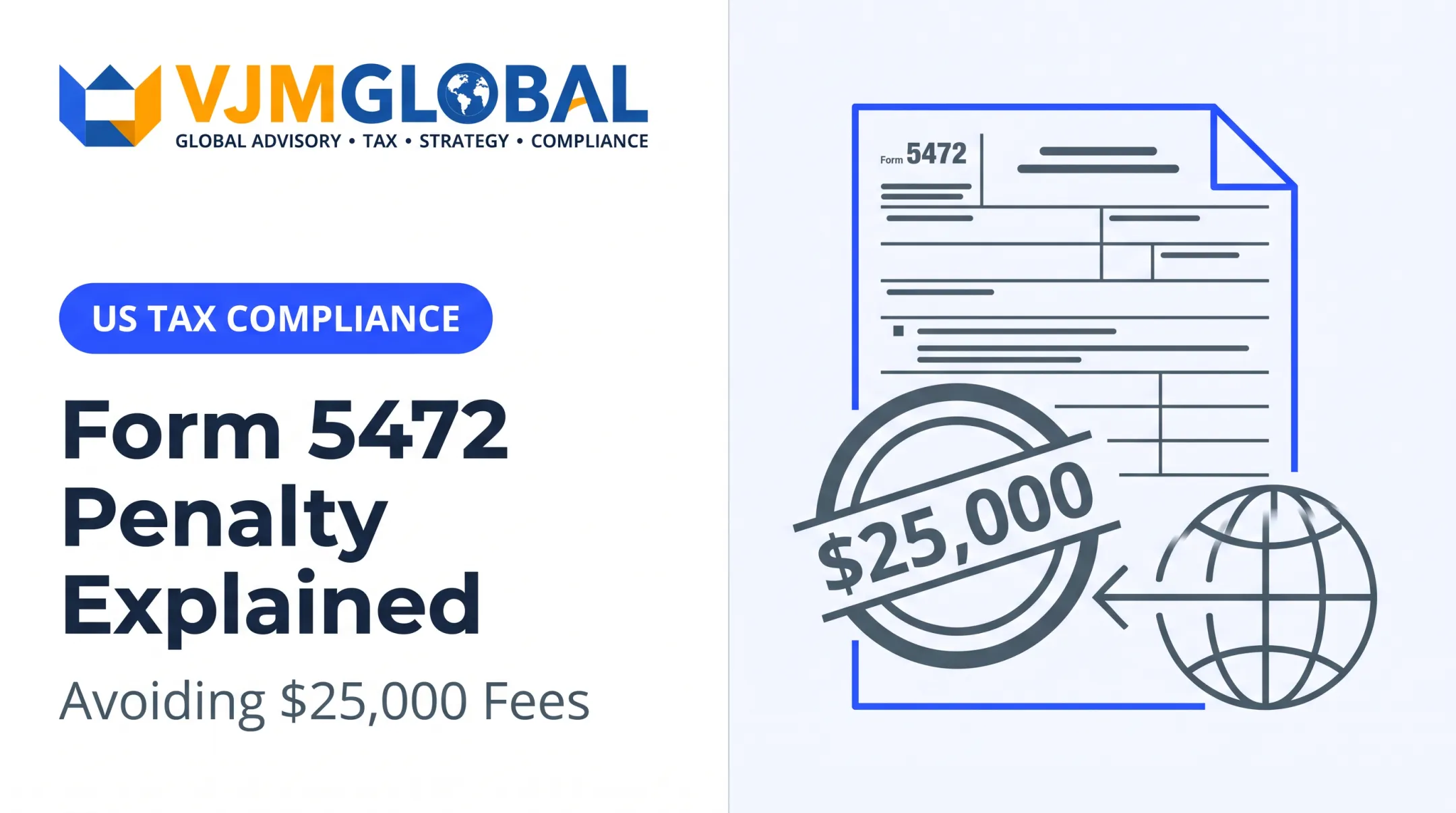
Many owners miss this. The penalty for getting it wrong starts at $25,000 per tax year, so it pays to check early.
This guide covers who must report, how to spot a capital contribution, how it differs from a loan or reimbursement, what records to gather, and how to verify the correct treatment for your entity and tax year.
Key Takeaways
- Cash, property, and other value a foreign owner provides to a US entity can be reportable.
- Formation funding and expenses you pay personally for the company need review, not dismissal.
- Form 5472 is an information return. It does not set your income tax, basis, or Australian tax outcome.
- Always confirm parts, deadlines, and penalties against the current IRS form and instructions.
Who Must Report a Capital Contribution on Form 5472?
Which entities must report
Two groups matter most:
- A US corporation that is 25% foreign-owned. A foreign person must own at least 25% of voting power or total stock value, directly or indirectly.
- A foreign-owned US disregarded entity (DRE). A US LLC wholly owned by one foreign person and otherwise disregarded is treated as a domestic corporation for section 6038A reporting only.
Living in Australia does not by itself trigger anything. Legal ownership does. An Australian individual or an Australian company that owns the US LLC can bring the rules into play.
Owner, shareholder, and related party
The IRS instructions distinguish several roles:
- A related party includes a 25% foreign shareholder and anyone related to the corporation or that shareholder under the tax code's related-person rules
- A foreign related party is a related party that is also a foreign person
This is why a contribution from your Australian operating company needs a separate look from one you make personally. They may involve different related parties, and the form is filed per related party.
Ordinary payments to unrelated US customers, contractors, and vendors fall outside the related-party trigger. But a payment an owner makes on the entity's behalf is a separate transaction and can be treated differently.
A simple decision path
- Identify the entity classification (corporation or DRE).
- Confirm foreign ownership and any related parties.
- Identify each transfer of money or property.
- Check the current Form 5472 instructions to decide whether and where to report it.

What Counts as a Capital Contribution, and What Does Not?
Defining a capital contribution
A capital contribution is value provided to the entity to fund formation, operations, or growth, without being structured as revenue, pay, or a conventional loan. The bookkeeping label alone doesn't settle it. Facts, documents, the legal arrangement, and entity classification drive the analysis.
Formation funding and startup costs
Money wired in when the LLC is formed deserves particular attention. For a foreign-owned DRE, amounts connected with formation, including contributions, fall under Part V.
Say you personally pay state fees, registered-agent costs, or software subscriptions. The company may later book that as contributed capital, a reimbursement, or a payable. The instructions don't automatically treat every owner-paid expense as equity, so the paperwork must show which it is.
Additional cash and non-cash contributions
Later transfers might cover cash flow, equipment, contractors, or a product launch. For each, record the date, source, purpose, and amount.
For an AUD-to-USD transfer, keep:
- the original AUD amount
- the USD amount received
- the exchange-rate source
- the bank wire confirmation
Contributed equipment, intellectual property, or inventory needs valuation support beyond a wire slip. Services and the use of property may fall under another category, such as Part VI nonmonetary transactions, rather than capital. Don't assume every non-cash transfer is capital.
Contribution versus other owner transactions
| Transaction | Typical feature | Example |
|---|---|---|
| Capital contribution | No repayment expected | Owner funds LLC startup |
| Loan or advance | Repayment terms, often interest | Signed agreement to repay in 24 months |
| Reimbursement | Company repays an owner-paid expense | Owner pays a vendor, LLC pays owner back |
| Distribution | Value flows out to owner | Owner withdraws surplus cash |
| Payment for services | Fees for work done | Owner invoices for consulting |
Match the label to the agreement and economic substance.
What Form 5472 does not establish
Reporting a contribution doesn't make it taxable income to the entity or deductible to you. Keep it separate from basis, debt-equity treatment, transfer pricing, withholding, and Australian tax consequences. Those need their own advice.

How to Report Capital Contributions on Form 5472
Build a transaction inventory
Pull a full inventory from:
- Business and foreign bank statements
- Payment platforms and the general ledger
- Owner reimbursements and formation documents
- Transfers by related parties
Include items that never touched the company account, such as an owner paying a bill directly. Reconcile the list to the books.
Pick the right section
For a foreign-owned DRE, contributions not already in Part IV go in Part V: check the box and attach a statement describing them. Part V is a checkbox plus statement, not a dollar line.
A corporation uses Parts IV and VI for its listed transactions. Don't copy a DRE approach without checking the current form.
Loans sit elsewhere: Part IV reports amounts borrowed (line 17) and loaned (line 31), with interest on separate lines.
Report the right related party
Part III applies to all filers, even when the party also appears in Part II. File one Form 5472 for each related party with a reportable transaction. For example, if you and your Australian company both fund the LLC, expect separate forms.
Convert and reconcile
Report in US dollars with an exchange-rate schedule. The instructions don't prescribe one mandatory conversion method, so keep the original AUD figure and document your method. Tie totals to bank confirmations, accounting entries, agreements, and valuations.
Prepare and submit the package
A DRE attaches Form 5472 to a pro forma Form 1120, writing "Foreign-owned U.S. DE" across the top. It is due by the Form 1120 deadline, generally the 15th day of the fourth month after year end. Form 7004 generally extends it by six months.

Foreign-owned DREs can't e-file Form 5472 under current instructions. The package goes by fax to 855-887-7737 or by mail to the IRS in Ogden, Utah.
Penalties are serious:
- $25,000 for each tax year of failure, including untimely or improper filing
- An extra $25,000 per 30-day period after 90 days from IRS notice
- A substantially incomplete form counts as a failure to file
Use this compliance workflow:
- Identify and classify transactions
- Document, convert, and reconcile
- Complete the form and attach the return
- Submit and keep proof of filing
Records, Common Mistakes, and When to Get Help
Records to keep
- Bank and wire statements
- Formation documents and the operating agreement
- Contribution resolutions and owner ledgers
- Receipts for personally paid expenses
- Loan agreements and property valuations
- Exchange-rate support and ownership details
- Filed returns
Retention must run at least as long as the relevant assessment and collection periods. There is no single fixed timeframe. Records are normally kept in the United States.
Common errors
- Assuming no revenue means no filing (the trigger is reportable transactions, not revenue)
- Leaving out formation contributions
- Treating every owner transfer as capital
- Missing personally paid expenses
- Misclassifying loans or distributions
- Omitting related parties
- Using unsupported exchange rates
- Reporting total company revenue instead of related-party transactions
When to get professional review
Get help if any of these apply:
- Several foreign related parties
- Non-cash contributions
- Intercompany funding
- Mixed personal and business accounts
- Prior missed filings
- Doubts about entity classification
VJM Global supports Australian businesses with US entities through US tax compliance and accounting services, including reviewing transaction records and preparing the relevant filings.
Frequently Asked Questions
What is a reportable transaction for Form 5472?
It is a covered transfer of money, property, or value between the US reporting entity and a related party. Check the current IRS instructions for entity-specific categories and exceptions.
What should I report as a capital contribution on Form 5472?
Initial and later owner funding, certain expenses paid on the entity's behalf, and possibly non-cash contributions. Treatment depends on the facts, entity classification, and current instructions.
Does an initial capital contribution need to be reported if the US LLC had no income?
Yes, it may. A lack of income does not remove the obligation when formation funding or other reportable transactions occurred. Confirm the entity's filing status.
Is a loan to my US LLC the same as a capital contribution?
No. Debt has repayment terms, documentation, and intent to repay. Principal, interest, and repayments may need separate reporting.
What records should I keep for a capital contribution reported on Form 5472?
Keep transfer confirmations, accounting entries, contribution agreements, expense receipts, currency-conversion support, ownership details, and copies of filed forms.