Putting the number on the wrong line is an easy mistake. Self-employed people, freelancers, investors and anyone whose withholding fell short often make several payments across the year. Some of them mix up estimated payments, withholding, extension payments and last year's refund credit. This guide separates the four and shows how to total and verify what you paid.
All forms, lines and amounts below refer to US federal returns, so figures are in US dollars.
Key Takeaways
- Quarterly federal estimated payments and an applied prior-year overpayment go on Form 1040, line 26.
- Form 1040-ES calculates and sends payments. It is not a line on the return.
- Withholding from W-2s and 1099s belongs on line 25, not line 26.
- Keep payment confirmations and check the current IRS instructions before filing.
Where Estimated Tax Payments Appear on Form 1040
Line 26 of the 2025 Form 1040 is labelled for 2025 estimated tax payments and the amount applied from your 2024 return. Per the Form 1040 instructions, this is the single place to combine both.
The line numbers were the same on the 2024 form, but the year in the label rolls forward, so always use the form for the year you are filing.
Form 1040-ES versus Form 1040
The two forms do different jobs:
- Form 1040-ES helps you figure estimated tax and supplies payment vouchers during the year.
- Form 1040 is the annual return. Line 26 reports what you actually paid.
How line 26 affects your refund or balance due
Line 26 feeds line 33, total payments, which also includes withholding (line 25d) and refundable credits (line 32). The return then compares line 33 with line 24, total tax:
- If line 33 is higher, the difference is an overpayment on line 34. You can take it as a refund (line 35a) or apply it to next year's estimated tax (line 36).
- If line 24 is higher, you owe the difference on line 37.
An overpayment counts on line 26 only if you elected on line 36 of the prior-year return to apply it forward. The 2025 instructions say that election cannot be changed after filing. To confirm it, open your 2024 return and check line 36.
Example: combining payments into one line 26 total
Say you made four quarterly payments for 2025 and also applied an overpayment from your 2024 return. The calculation looks like this:
- Payment 1 (April)
- Payment 2 (June)
- Payment 3 (September)
- Payment 4 (January, designated for 2025)
- Amount from the 2024 return, line 36
Add all five. The sum is your line 26 entry. Do not add anything else to it.

What Belongs on Line 26, and What Does Not
Belongs on line 26:
- Federal estimated payments for that tax year, made through IRS electronic channels
- Cheques or money orders sent with Form 1040-ES vouchers
- An eligible prior-year overpayment applied forward
Goes elsewhere:
- Withholding: lines 25a to 25c cover tax withheld on W-2s, 1099s (including 1099-R) and other forms, totalled on line 25d. Match each figure to its source document.
- Extension payments: a payment made with Form 4868 goes on Schedule 3, line 10, and flows to Form 1040 line 31.
- Balance due paid with the return: this is line 37. Form 1040-V is the voucher for paying by cheque or money order.
- Refundable credits: these sit on line 32.
- State estimated tax: line 26 is for federal payments only.
Which tax year does a January payment belong to?
The fourth instalment for a given year is due in January of the next year. For tax year 2026, it is due January 15, 2027. Direct Pay asks you to choose a tax year, so choose the year the instalment is for, not the calendar year you pay in. A mistake here sends the money to the wrong return.
Joint returns, spouses and misapplied payments
Some situations need extra care:
- Separate returns after joint payments: spouses may agree how to split joint estimated payments. If they cannot agree, the instructions give an allocation based on each spouse's tax.
- Overpayment applied to a spouse's account: the instructions call for the spouse's SSN and a statement.
- Duplicate or wrong-year payments: compare your records with your IRS account transcript. There is no dedicated IRS form for moving a payment between years or SSNs, so resolve it through the notice or by calling the IRS.
How to Total, Report and Verify Estimated Payments
Step-by-step checklist
- Gather records: your prior-year return, 1040-ES records, electronic confirmations, cancelled cheques or bank statements, and your IRS account transcript.
- List each payment by tax year, date, amount and method. Do not rely on memory or bank-clearing dates.
- Add the verified payments and any applied prior-year overpayment.
- Enter the total on line 26.
- Cross-check line 33 to confirm nothing is counted twice as withholding or a credit.

When your records and the IRS differ
You can view or download an account transcript through the IRS Online Account, which shows up to five years of payment history. Compare each payment against your confirmations.
A Direct Pay confirmation number proves submission, not that the payment posted to the intended year. The IRS says to check your account two business days after the withdrawal date.
If a CP23 notice flags a discrepancy, gather your payment records and contact the IRS using the number and response date on the notice. Form 843 is for refund claims and penalty abatement, so do not treat it as a payment-transfer form.
Reporting correctly does not remove a penalty
An accurate line 26 does not cancel an underpayment penalty if instalments were late or too small.
For tax year 2026, the Form 1040-ES instructions say estimated payments are generally required if you expect to owe at least $1,000 after withholding and refundable credits. You avoid the requirement if your payments and credits meet the smaller of:
- 90% of the current year's tax, or
- 100% of the prior year's tax (110% if prior-year AGI exceeded $150,000, or $75,000 if married filing separately)
If your income arrives unevenly, the annualised income method on Schedule AI of Form 2210 may lower the penalty. The IRS underpayment interest rate for individuals in Q4 2026 is 7% a year, compounded daily.

Payment Timing, Methods and Records
Who usually needs to pay
Typical candidates include self-employed people, freelancers, gig workers, investors, landlords and anyone whose withholding is too low. Test your situation against the thresholds above rather than one income figure.
The 2026 calendar-year schedule
| Period covered | Due date |
|---|---|
| January 1 to March 31 | April 15, 2026 |
| April 1 to May 31 | June 15, 2026 |
| June 1 to August 31 | September 15, 2026 |
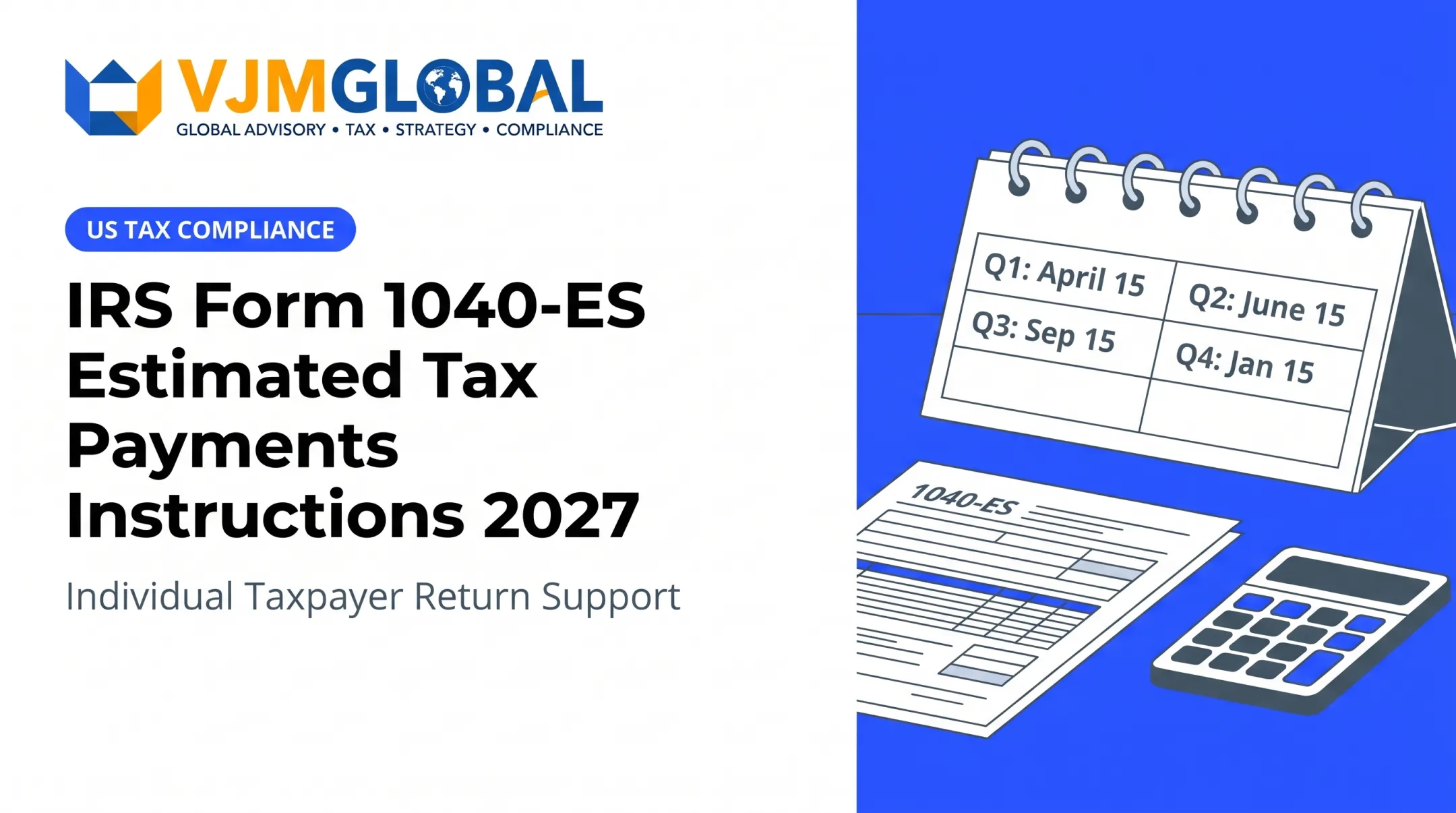
| September 1 to December 31 | January 15, 2027 |
A due date on a weekend or legal holiday moves to the next business day. Fiscal-year filers use the 15th day of the 4th, 6th and 9th months, plus the first month after year-end. Farmers and fishermen with at least two-thirds of gross income from those activities can make one payment by January 15, 2027, or none if they file and pay in full by March 1, 2027.
Ways to pay
- Direct Pay: no fee, no login, schedulable up to 365 days ahead, with a confirmation number. See the IRS Direct Pay help page.
- Online Account: bank payment options plus payment history and pending payments.
- Debit or credit card: processors charge fees. Debit fees run around $2.10 to $2.15 and credit fees 1.75% to 1.85% (minimum $2.50). Confirm current rates on the IRS card-payment page before you pay.
- Cheque or money order: use the 2026 Form 1040-ES voucher.
- EFTPS: check the current IRS page, because availability for individuals has changed.

Keep every confirmation number, cancelled cheque and bank statement. The IRS guidance does not set one general retention period, so keep them at least until the return is closed out.
Getting help with reconciliation
If your return has several income sources, an unclear prior-year credit or a mismatch with IRS records, VJM Global prepares US individual returns (Form 1040 and 1040-NR) and can reconcile estimated payments against your IRS account.
Frequently Asked Questions
Where do I show estimated tax payments on 1040?
Use line 26 for qualifying estimated payments and any prior-year overpayment applied forward. Confirm the line against the current tax-year IRS instructions.
Do I need to do a tax return if I earn under $18,000?
Not necessarily, but $18,000 is not a universal cut-off. For 2025, the gross-income threshold is $15,750 for a single filer under 65 and $17,750 at 65 or older. Other thresholds apply to other statuses, and net self-employment earnings of $400 or more trigger filing.
What is the easiest way to pay taxes?
IRS Direct Pay is free, needs no login and gives a confirmation number. It works for estimated payments and for a final balance due, but choose the correct payment reason and tax year.
Is Form 1040-ES the same as Form 1040?
No. Form 1040 is the annual individual return. Form 1040-ES is used to calculate and pay estimated tax during the year.
Do estimated tax payments go on line 25 or line 26?
Line 26. Line 25 is federal income tax withheld, taken from W-2s, 1099s and similar documents.
What happens if the IRS does not show my estimated payment?
Compare your IRS account transcript with your confirmations and bank records. If a payment is missing or sits in the wrong year, follow the process in the IRS notice, such as CP23, and send your supporting records.