Form 1040-ES helps individuals estimate and pay federal income tax and self-employment tax during the year. This guide covers eligibility, calculation, deadlines, payment methods, and penalties, using the 2026 form. Rules, thresholds, and dates change, so check the latest IRS Form 1040-ES and official IRS guidance before you pay. For readers in Australia with US tax obligations, the same US rules apply, and dollar figures below are in US dollars (US$).
Key Takeaways
- Form 1040-ES is for individuals whose income isn't fully covered by withholding.
- Compare expected 2026 tax, prior-year tax, withholding, and credits to see if payments are due.
- Installments fall on set dates; confirm exceptions for your tax year.
- Online payments don't require mailing the form; mailed checks need a voucher.
What Is IRS Form 1040-ES?
Form 1040-ES, Estimated Tax for Individuals, is a package containing the Estimated Tax Worksheet and payment vouchers for mailing installments.
The worksheet covers income tax, alternative minimum tax, self-employment tax, and other taxes in its calculation. It is not the annual return.
Form 1040 reports your final income and tax for the year, while 1040-ES prepays an estimate during the year. IRS instructions say not to send the annual return with an estimated payment.
Key points on what you send and keep:
- The worksheet is for your records. Don't mail it.
- Mail only the voucher with a check or money order.
- Make the check payable to United States Treasury, with your SSN and "2026 Form 1040-ES" on it.
- Keep the worksheet and payment confirmations.
Form 1040-ES is built for individuals. Corporations file on Form 1120 and partnerships on Form 1065, and they follow different estimated tax procedures.
Who Needs to Pay Estimated Tax Using Form 1040-ES?
The general rule: you need to pay if income isn't taxed through withholding. IRS examples include self-employment and gig income, interest, dividends, rents, alimony, unemployment compensation, and taxable Social Security benefits.
Capital gains, prizes, and taxable retirement income can also create a gap.
The 2026 tests
For 2026, you generally must make payments if both are true:
- You expect to owe at least $1,000 after withholding and refundable credits.
- Your withholding and refundable credits will be less than the smaller of 90% of 2026 tax or 100% of 2025 tax.
Use 110% of prior-year tax instead of 100% if prior-year AGI exceeded $150,000 ($75,000 if married filing separately).
Who typically lands here
- Sole proprietors and independent contractors
- Investors with large gains or dividends
- Landlords
- Employees with side income or too little withholding
Common exceptions
You may not need to pay if withholding is sufficient, credits cover the gap, or expected liability is under the threshold.
There is also a no-prior-year-liability exception. It applies if you had no 2025 tax, were a US citizen or resident alien all of 2025, and your 2025 return covered 12 months.
US taxpayers living abroad
Publication 54 says estimated tax requirements are generally the same abroad as in the US. Don't include income that is or will be exempt from US tax.
Form 2555 covers the foreign earned income exclusion and Form 1116 covers the foreign tax credit. Both can shrink your estimate, so check current IRS rules before calculating.
How to Calculate Estimated Tax Payments
Start with your prior-year return, then project the current year. The 2026 worksheet runs in this order:
- Estimate AGI and deductions.
- Calculate taxable income and income tax.
- Add alternative minimum tax and subtract nonrefundable credits.
- Add self-employment and other taxes.
- Subtract refundable credits.
- Compare with the safe-harbor amount, subtract withholding, and divide into installments.

Self-employment tax
The worksheet uses net earnings of 92.35% of net profit. Social Security tax is 12.4% up to the $184,500 wage base, and Medicare is 2.9%. You deduct one-half of self-employment tax.
Withholding and credits
Expected wage withholding reduces what you owe through installments. Withholding is entered separately from credits.
Refundable credits that lower your estimate include:
- Earned income credit
- Additional child tax credit
- Net premium tax credit
Any 2025 overpayment applied to 2026 estimates also counts.
When income changes
Income rarely arrives evenly. A seasonal repair shop or a large late-year capital gain can throw off a flat quarterly plan. Publication 505 says to recalculate when income, deductions, or credits change. Pay the revised amount by the next due date, or spread it across remaining installments.
For uneven income, the annualized income installment method (Form 2210, Schedule AI) can lower early payments. Keep updated records as you go.
VJM Global's US-compliant tax professionals can review your estimates and set up a year-round payment plan.
When and How to Make 1040-ES Payments
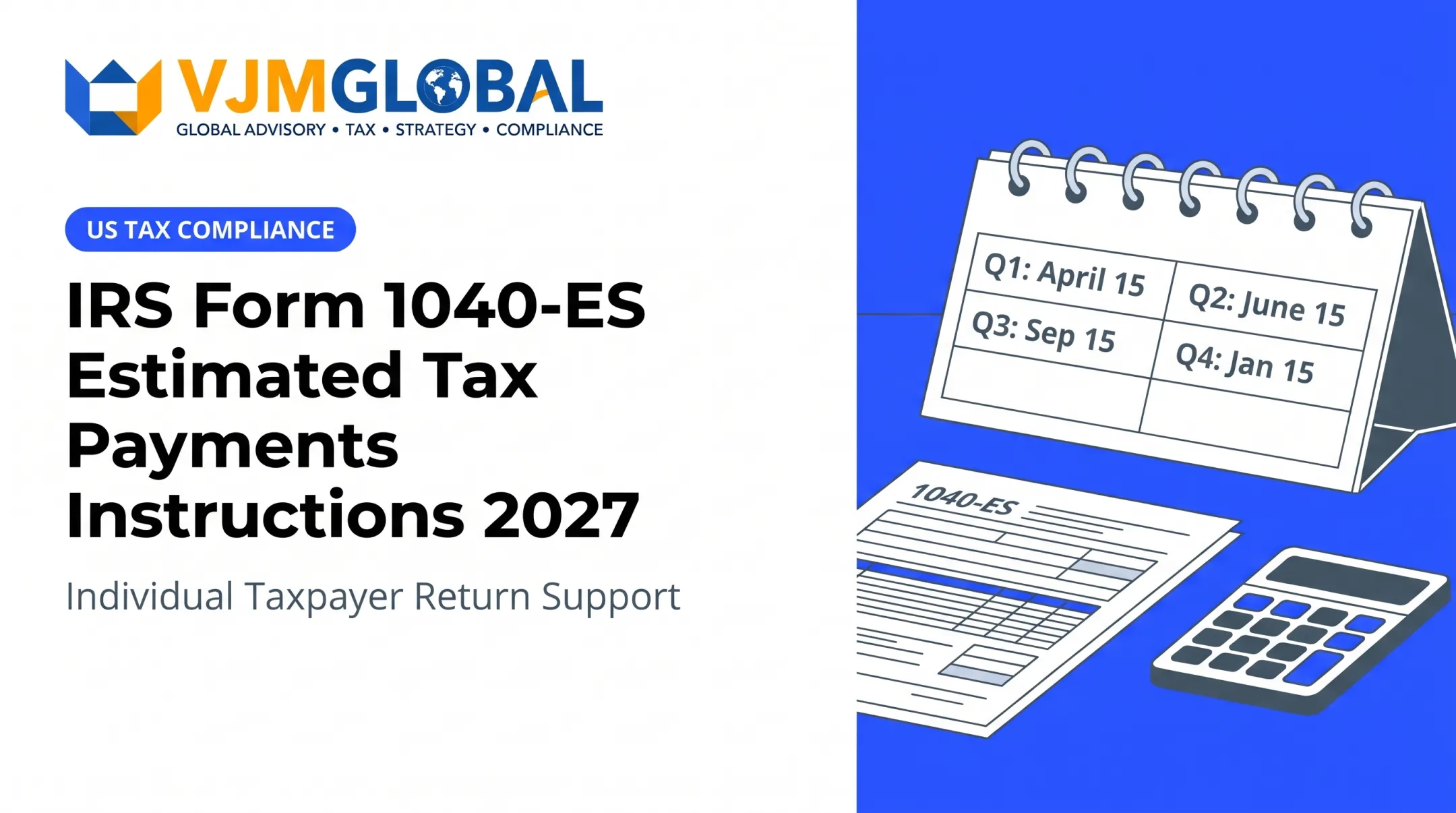
2026 calendar-year schedule
- April 15, 2026
- June 15, 2026
- September 15, 2026
- January 15, 2027

You may instead pay the full estimate by April 15, 2026. The January installment generally isn't required if you file your return and pay the balance by February 1, 2027.
Weekend or holiday due dates move to the next business day.
Other timing rules:
- Fiscal-year filers use the 15th day of the 4th, 6th, and 9th months, plus the first month after year-end
- Farmers and fishers with at least two-thirds of gross income from those activities have a special one-payment option
- Disaster-area deadlines vary, so check the IRS disaster-relief page
Electronic options
- IRS Online Account: supports most individual tax payments and shows payment history.
- Direct Pay: free payments from a bank account, including estimated tax.
- Electronic Funds Withdrawal: available when e-filing, including up to four quarterly payments.
- Debit or credit card: processor fees apply (for example $2.15 debit or 1.75%, minimum $2.50, credit via Pay1040); see the IRS fee page, as amounts vary by processor.
- EFTPS: the IRS says individuals can no longer create new EFTPS accounts or use it for payments, though existing users may continue for now.

Paying by mail
Send the voucher and check or money order to the address for your state. The IRS corrected the 2026 addresses, so download the current PDF.
Copies downloaded before February 13, 2026 may carry an incorrect address. Charlotte, NC and Louisville, KY are the two processing locations, split by state.
Paying from outside the United States
The IRS accepts foreign-bank wires in US dollars. The foreign bank needs a US banking relationship and may charge a fee.
Estimated tax uses tax-type code 10406, and the IRS directs you to its same-day wire worksheet. Exchange rates and bank processing time can affect timing, so pay early.
Records to keep
Save confirmations, bank records, vouchers, dates, amounts, and the tax year designated for each payment. You'll need them to reconcile against your Form 1040.
Penalties, Adjustments, and Common Mistakes
The underpayment penalty is figured separately for each installment, based on the amount underpaid and how long it stayed unpaid. Form 2210 instructions explain the calculation. The IRS set a 7% annual underpayment interest rate for the fourth quarter of 2026, and that rate changes quarterly.
Common errors
- Missing an installment
- Paying after the deadline
- Designating the wrong tax year
- Assuming a large annual payment fixes a late quarterly one (it may not erase an earlier-period penalty)
- Not updating estimates after a major income change
A refund on your return does not protect you from a penalty. The IRS may still assess one if you did not pay enough by each due date, even when a refund is due.
Waivers exist for situations such as casualty, disaster, or certain retirement and disability circumstances. Confirm the current rules in the final 2026 Form 2210 instructions, since waiver details above reflect the 2025 version.
If you overpay
On Form 1040 you can take a refund or apply the overpayment to 2026 estimated tax. The election to apply it forward can't be changed later. Reconcile every payment before filing.
Frequently Asked Questions
Who needs to pay 1040-ES?
Individuals who expect taxable income without enough withholding may need to pay. You generally must pay if you expect to owe $1,000 or more after withholding, subject to the IRS safe-harbor tests.
Do I need to file 1040-ES?
No. The worksheet is for figuring payments and stays in your records. You only send a voucher with a mailed payment, and online payments generally don't require mailing anything.
What is the IRS Form 1040-ES for?
It helps individuals calculate and pay estimated federal income tax in quarterly installments during the tax year.
What is the penalty for not paying estimated taxes?
An underpayment penalty may apply when payments are too small or late. The amount depends on the size and timing of the shortfall and the quarterly IRS interest rate.
What is the difference between 1040 and 1040-ES?
Form 1040 is the annual individual income tax return. Form 1040-ES is used to calculate and make estimated tax payments during the year.
What are IRS payment vouchers?
Vouchers accompany mailed estimated tax payments. They identify the taxpayer, tax year, and payment period for IRS processing.