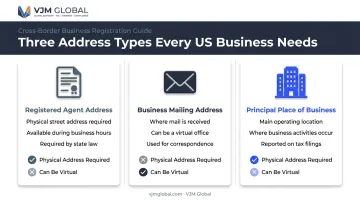
The short answer is yes, with conditions. Many first-time founders confuse three separate concepts: the registered agent address, the business mailing address, and the principal place of business. Each one plays by different rules, and mixing them up can delay your LLC formation or trigger compliance headaches down the line.
This guide breaks down what US states, the IRS, and banks actually require. We'll also cover what happens if your US business decides to expand into a market like India, where the address question resurfaces all over again.
Key Takeaways
- Virtual offices work as mailing addresses, but most states also require a registered agent with a physical street address
- The IRS accepts virtual offices as mailing addresses on EIN applications, given a valid responsible party
- Privacy, cost savings, and professional credibility drive founders toward virtual offices over home addresses
- US businesses expanding into India can use virtual offices for their registered office, with proper documentation
What Is a Virtual Office and How Does It Work?
A virtual office gives you a real, physical business address plus a bundle of support services, minus the lease and the desk. According to Investopedia, these setups typically include a business address, mail handling, phone answering, and access to meeting rooms or coworking space on demand.
For business registration purposes, three services matter most:
- A usable business address: one you can list on formation documents and correspondence
- Mail handling and forwarding: scanned or physically forwarded mail so you never miss an official notice
- Bundled registered agent service: many providers pair the address with agent services, though this is a separate legal function
Here's where founders trip up: a virtual office is not the same as a PO Box. USPS classifies private mailbox operators as Commercial Mail Receiving Agencies, and mail sent to those addresses must show a "PMB" or "#" designation. Most state filing forms and the IRS explicitly reject PO Boxes for physical address fields. A virtual office's street address typically clears that bar because it's a genuine commercial location, not a mailbox rental.
Compare that to using your home address, which is the default for most solo founders. It works, but it puts your personal address on permanent public record with your Secretary of State and, in many cases, on Google search results tied to your business name.
Can You Legally Register a US Business Using a Virtual Office Address?
Most states allow a commercial or virtual address on your Articles of Organization or Incorporation, listed as your mailing or principal business address. That part is fairly settled. The complication comes from a second, separate requirement most founders don't see coming.
The Registered Agent Is a Different Animal
Every US state requires an LLC or corporation to name a registered agent: a person or company with a physical street address in the state of formation, available during normal business hours to accept legal notices and service of process.
| State | Registered Agent Requirement |
|---|---|
| Delaware | In-state street address, office open during normal business hours |
| Wyoming | Physical Wyoming address, agent present during business hours |
| Nevada | Physical Nevada address required for noncommercial agents |
Some virtual office providers bundle registered agent service into their plans. Others don't. A virtual address subscription alone doesn't automatically satisfy this requirement — confirm your provider is a compliant agent, not just a mail-forwarding address.
What the IRS Actually Requires
Form SS-4, the EIN application, asks for a mailing address on lines 4a-4b and a separate physical street address on lines 5a-5b only if it differs. Line 5a explicitly prohibits a PO Box.
Nowhere does the IRS's SS-4 instructions mention "virtual" or "commercial" addresses by name. A virtual office address generally satisfies the mailing address field, provided your application lists a responsible party with a valid SSN or ITIN.
Why Delaware, Wyoming, and Nevada Come Up So Often
Delaware saw 289,810 new entities formed in 2024, with more than 2.1 million active legal entities on record and roughly 66.7% of Fortune 500 companies incorporated there, according to Delaware's Division of Corporations. Wyoming and Nevada get similar attention for favorable tax treatment, though Nevada's tax rankings are mixed depending on the tax category.
None of this means these states are automatically right for your business. Popularity reflects legal-system familiarity, not a guarantee of fit.
Banking Adds Another Layer
Opening a business bank account is often the sticking point. Wells Fargo's official documentation states that registered-agent, virtual, and PO/commercial-mailbox addresses are not acceptable as proof of physical business address: banks generally want a lease, utility bill, or filed state document showing your actual operating location.
Successful formation doesn't guarantee account approval, so call ahead and ask what your bank needs before you finalize your virtual office plan.
Before you file: confirm the specific rules with your state's Secretary of State, since requirements vary by state and entity type.
Virtual Office Rules Across Different Business Structures
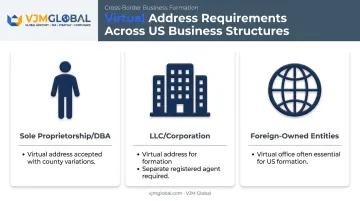
The virtual office question plays out a little differently depending on how you've structured your business.
Sole Proprietorship / DBA filings
Virtual office addresses are generally accepted for DBA registrations, but requirements vary by county and state. New York and Los Angeles County, for instance, require the actual street address of your principal place of business (not a PO Box) for assumed name filings. A genuine commercial address from a virtual office provider typically satisfies this, as long as it reflects where business communications are truly received.
LLC and Corporation
The rule stays consistent here: your virtual office can serve as the business address on formation paperwork, but the registered agent requirement is separate and mandatory. Don't assume one service covers both.
Non-US residents and foreign-owned entities
Founders outside the US face a different calculus. International founders, including NRIs, OCIs, and foreign investors without a US presence, rely on virtual offices almost by necessity. Without a physical US address, forming an LLC or opening a bank account becomes far harder. A compliant virtual office paired with a proper registered agent often becomes the entry point that makes US formation possible at all.
Top Benefits of Using a Virtual Office for Business Registration
Cost is usually the first draw. CoworkingCafe's 2025 report found a national median virtual office price of $120 per month, with metro-level medians ranging from $50 in smaller cities to $240 in premium markets like Naples.
Traditional office space, by contrast, runs on a per-square-foot lease model that adds up fast once you factor in utilities, furniture, and a long-term commitment.
Beyond savings, founders consistently point to:
- Privacy protection: your home address never appears on public state or IRS records
- Professional credibility: a recognizable business district address builds trust with clients and investors faster than a residential one
- Flexibility: you can register and run your business from anywhere in the world, not just where you live
- Reduced administrative load: bundled mail handling and call answering free up time for solo founders juggling everything themselves
None of these benefits eliminate the compliance steps covered earlier. They just make the whole process cheaper and less exposed.
Expanding Beyond the US? Using a Virtual Office to Register a Business in India
Plenty of US businesses run into this same address question once they start eyeing international growth. India is one of the most common destinations for outsourcing, manufacturing, and tech partnerships.
India's Ministry of Corporate Affairs requires every LLP and Private Limited Company to maintain a registered office capable of receiving and acknowledging official communications. A virtual office or coworking arrangement can satisfy this, but it needs proper documentation:
- No Objection Certificate (NOC) from the space provider, confirming you can use the address as your registered office
- Rent agreement with the virtual office or coworking provider
- Utility bills (electricity, telephone, or gas) showing the registered address, dated no older than 2-3 months
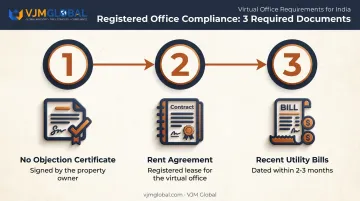
Miss any of these, and your ROC filing stalls.
This is where firms with on-the-ground experience matter. VJM Global has spent over 30 years navigating India's regulatory system and has supported more than 500 American business owners setting up entities there. Beyond the address paperwork, US companies entering India also have to handle:
- FEMA compliance: managing capital inflows, share allotments, and profit repatriation under Reserve Bank of India rules
- Tax registrations: GST, PAN, TAN, plus Shops & Establishment and EPF/ESI registrations where applicable
- Ongoing accounting: bookkeeping, payroll, and financial reporting that satisfies both Indian regulators and US parent-company standards
VJM Global's team includes CPAs, Chartered Accountants, and US-compliant professionals who work across both GAAP and IFRS standards. That dual expertise matters when your Indian entity's books need to make sense to a US-based finance team back home.
If you're a US business weighing an India entry, reach out to VJM Global for a consultation tailored to your entity type and industry. Our team can help you sort out the registered office, FEMA filings, or tax setup.
Frequently Asked Questions
Can I have a virtual office for my business?
Yes. Most US states and international jurisdictions like India permit virtual offices, as long as the address meets specific legal and documentation requirements for your entity type.
Do small online businesses need to be registered?
Most do, depending on structure and revenue. A sole proprietor using their own legal name may not need formal registration, but LLCs, corporations, and DBAs generally require it.
Can I use a virtual office address as my LLC's registered agent address?
Not automatically. A registered agent needs a physical address available during business hours. Some virtual office providers bundle this service, but the two aren't always the same thing.
Is a virtual office address accepted by the IRS for EIN applications?
Yes, as a mailing address on Form SS-4, provided you list a responsible party with a valid SSN or ITIN. A PO Box isn't accepted on the physical address line.
Can a US business use a virtual office to register a company in India?
Yes. India's MCA permits registered office addresses via virtual office or coworking arrangements, provided you supply the NOC, rent agreement, and utility bills. VJM Global manages this process for clients entering India.
How much does a virtual office typically cost for business registration purposes?
Pricing varies by provider and location. Typical monthly rates range from $50 to $240, depending on the city and included services like mail handling or a live receptionist.