
This is the exact situation facing foreign-owned companies, freelancers, remote sellers, and NRIs trying to enter the Indian market. Setting up a physical office before you even know if the market works for you rarely makes sense.
A virtual office looks like the obvious fix. It often is, but success depends heavily on provider credibility, documentation quality, and state-specific compliance nuances. Not every address will survive GST scrutiny.
This guide walks through the registration process, required documents, decision factors, common mistakes, and alternatives, with specific insights for foreign entrepreneurs, NRIs, and OCIs entering India.
Key Takeaways
- Virtual offices qualify for GST registration when providers supply valid rent agreements and ownership proof
- Approval typically takes 7 working days, extending to 30 days if physical verification is triggered
- GST officers can conduct physical verification at any time, making provider legitimacy critical
- Foreign owners and NRIs benefit most by pairing a virtual office with a remote compliance partner
- Businesses needing on-site staff, inventory, or storage should weigh other address options
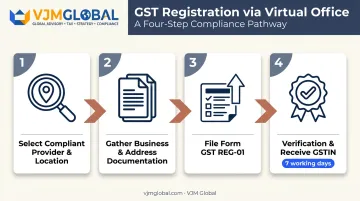
How to Register for GST Using a Virtual Office
Step 1: Select a Compliant Virtual Office Provider & Location
Not all virtual office addresses hold up under GST scrutiny. Before signing anything, confirm the provider's space is:
- Commercially zoned and verifiable through property records
- Free of past GST address disputes or verification rejections
- Backed by a track record of successful GST verifications with reasonable document turnaround
Location strategy matters just as much as vetting the provider itself. If you're planning multi-state operations, or entering India through one specific market, pick a state that aligns with where you'll actually do business, not just wherever the cheapest plan is.
Step 2: Gather Business & Address Documentation
Two document buckets need to come together here.
Core business documents:
- PAN card of the business or applicant
- Certificate of incorporation or partnership deed
- ID and address proof of the authorized signatory
Virtual-office-specific proof, based on CBIC's April 2025 instruction, which standardized documentary requirements for rented and shared premises:
- Signed rent or lease agreement
- One ownership document from the lessor (property tax receipt, electricity bill, or similar)
- A consent letter, where applicable, along with the consenter's identity proof
Step 3: File Form GST REG-01 With the Virtual Address as PPOB
On the GST portal, list the virtual office as your Principal Place of Business under Part B of REG-01. Upload the address proof and authorization documents, then select the correct possession type. For coworking or virtual setups without a registered sub-lease, choose "Shared."
Signatory verification follows next, either through a Digital Signature Certificate (mandatory for companies and LLPs) or Aadhaar-based e-sign/EVC for other eligible entity types.
Step 4: Complete Verification and Receive GSTIN
If your documents are in order, Rule 9 of the CGST Rules requires approval within 7 working days. That window extends to 30 days if Aadhaar authentication wasn't completed, risk parameters flag your application, or the officer schedules a physical site visit.
Make sure your provider can acknowledge your business presence if an officer shows up unannounced. Once approved, you'll get a 15-digit GSTIN, and you'll need to renew the virtual office agreement periodically to keep it active.
When Should You Use a Virtual Office for GST Registration?
A virtual office works best when your business doesn't need daily physical operations at the registered address. Treating it as a default choice for every business model causes problems later.
Good fit for:
- Freelancers and remote service providers without a fixed workspace
- E-commerce sellers needing GST registration across multiple states
- Foreign companies and NRIs entering India without an immediate physical footprint
- Early-stage startups trying to minimize overhead before scaling
Risky or inefficient for:
- Businesses with large on-site teams that need a real office anyway
- Operations requiring inventory storage or warehouse space
- Industries with inspection-heavy licenses, where address scrutiny compounds with other regulatory checks
VJM Global helps foreign companies and NRIs assess this fit before filing for GST registration. If your business model requires people physically showing up somewhere every day, a virtual office simply won't hold up as your registered address.
Documents & Provider Requirements Checklist
Careful preparation and provider selection determine whether your application sails through or gets stuck in a scrutiny loop. Here's what to have ready.
Business & Identity Documents
- PAN card of the business or applicant
- Incorporation or registration certificate
- ID and address proof of the authorized signatory
- Digital Signature Certificate (for companies and LLPs)
- Valid Indian bank account (required within 30 days of registration under Rule 10A, not at filing)
Virtual Office Specific Documents
- Signed rent agreement or lease deed
- No Objection Certificate or consent letter, depending on the arrangement
- A recent utility bill or property tax receipt confirming the address is genuine
Provider Credibility Checks
Before committing, verify the provider:
- Operates from a genuine, verifiable commercial establishment
- Has handled GST verifications successfully before
- Offers mail handling and can respond if a GST officer visits unannounced
For foreign entrepreneurs and NRIs registering remotely, this last point carries real risk: you can't be there to answer the door. Providers who coordinate directly with a compliance partner remove that risk entirely.
VJM Global brings exactly this kind of support, guiding foreign businesses through Indian company setup and GST compliance. The team manages documentation and provider coordination, so applications don't stall on a technicality.
Key Considerations & Common Mistakes to Avoid
A handful of variables decide whether your GST application clears smoothly or gets stuck in a loop of officer notices. Most rejections trace back to one of these:
| Mistake | Why It Matters | Impact |
|---|---|---|
| Choosing an overused or unreliable provider address | Addresses tied to many unrelated businesses or flagged activity draw automatic scrutiny | Higher risk of rejection or delayed processing |
| Submitting incomplete or mismatched documentation | Any mismatch between PAN, incorporation details, and address proof breaks the application | Department notices, resubmissions, lost time |
| Ignoring state-specific verification norms | Some jurisdictions apply stricter physical checks on shared or virtual addresses | Multi-state businesses face uneven scrutiny levels |
| Letting the virtual office agreement lapse | GST registration must reflect an active, valid PPOB at all times | Compliance notices or GSTIN suspension |
Enforcement Drives Make This Real, Not Theoretical
CBIC's second nationwide drive against fake GST registrations ran for two months starting August 2024, targeting suspicious GSTINs for verification and action.
During an earlier version of this drive, Economic Times reported that genuine e-commerce operators using virtual offices got caught in scrutiny. Field officers found no employees or accessible records at the inspected addresses.
The lesson: a virtual office that looks fine on paper still needs to function like a real business address when someone comes knocking. Providers like VJM Global that specialize in GST compliance help clients keep documentation and PPOB status audit-ready before inspections happen.
Alternatives to Using a Virtual Office for GST Registration
A virtual office isn't the only path to a valid PPOB. Depending on your stage and operational needs, one of these might fit better.
| Option | When It's Better | Key Trade-Offs |
|---|---|---|
| Leased/Owned Physical Office | Businesses needing daily operations, staff, or on-site inventory | Higher cost, longer lease commitments |
| Coworking Space With Dedicated Desk | Teams wanting occasional in-person access alongside a registered address | Costs more than a virtual office, less than full leased space |
| Registered Compliance Partner Address | Foreign companies and NRIs who want registration, address, and filings managed together | Requires an experienced partner you can trust with correspondence |
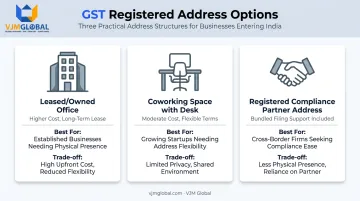
For foreign companies and NRIs specifically, routing registration through a compliance partner often makes more sense than managing a virtual office independently. This combines the address solution with ongoing GST filing support in a single partnership.
Firms like VJM Global work this way, pairing virtual office coordination with end-to-end business setup and compliance. Clients aren't juggling separate vendors for the address and the paperwork.
Frequently Asked Questions
Can I use a virtual office for GST registration?
Yes, virtual offices are legal for GST registration as long as the provider supplies a valid rent agreement, NOC or consent letter, and a recent utility bill or ownership document.
Can I register my business for GST online?
Yes. The entire process runs through the GST portal using Form REG-01, with documents uploaded digitally and signatory verification completed via DSC or Aadhaar-based authentication.
Is a virtual office address accepted in every Indian state for GST registration?
Most states accept virtual offices, but verification strictness varies by jurisdiction. Confirm with your provider and check current state-level practices before applying.
What documents are required for GST registration using a virtual office?
You'll need your PAN, incorporation certificate, and signatory ID proof, along with the provider's rent agreement, NOC or consent letter, and a recent utility bill or ownership document.
Can foreign companies or NRIs use a virtual office for GST registration in India?
Yes, foreign companies and NRIs can register using a virtual office. Pairing it with a compliance partner simplifies documentation, signatory verification, and ongoing filings without needing physical presence in India.
What happens if GST authorities reject a virtual office address?
Officers typically issue a REG-03 notice first, giving you 7 working days to respond before any rejection. Most cases resolve by reapplying with a verified provider and complete documentation.