This guide shows where dividends paid appear on the 2025 Form 1120, how they affect the corporation's books, and what shareholders receive. It separates Schedule M-2, Schedule L, Schedule C, Form 1099-DIV and the general ledger, and flags what Australian-based owners of U.S. corporations should watch. Always check the current-year IRS instructions before filing.
Key Takeaways
- Dividends paid by a C corporation are reported as distributions on Schedule M-2, not deducted.
- Schedule C covers dividends received and special deductions, not dividends paid.
- Reconcile payments to bank records, shareholder ledger, retained earnings, Form 1120 schedules, and Form 1099-DIV.
- Form 1120 reporting does not decide Australian tax treatment.
Where Dividends Paid Appear on Form 1120
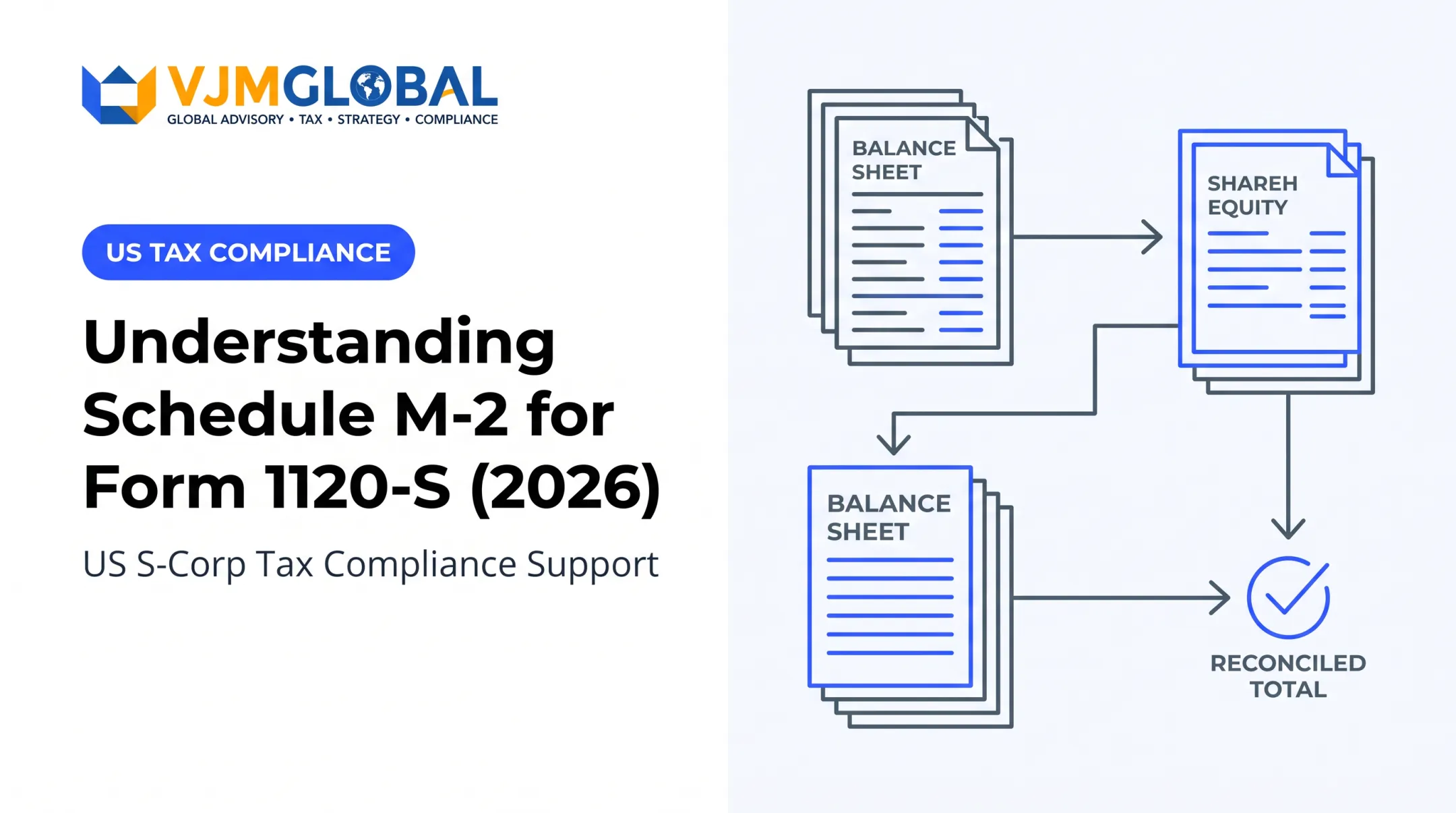
The short answer: Schedule M-2, line 5. On the 2025 form, M-2 is the "Analysis of Unappropriated Retained Earnings per Books," and line 5 reports distributions as cash, stock and property. Line 8 gives the ending balance. Confirm line labels against the form for your filing year.
Why it is not a deduction
Dividends are distributions of corporate earnings, not operating expenses. IRS Publication 542 states that a corporation does not deduct dividends on its income tax return.
The Schedule L effect
Schedule L is the balance sheet per books. It has no "dividends paid" line, but the entries show up in other lines:
- Cash (line 1) decreases for cash dividends; for property dividends, the distributed asset leaves the books
- Any dividends payable balance clears when the distribution is made
- Retained earnings, unappropriated (line 25) decreases
The IRS expects these balance sheets to agree with the corporation's books and records.
Why not Schedule C
The word "dividends" appears on Schedule C, but it addresses dividends and inclusions the corporation received, plus special deductions. Schedule C line 23 flows to page 1 line 4, and line 24 to line 29b. Dividends you paid have no place there.

What M-2 does not do
M-2 reconciles book retained earnings. It is not a tax earnings and profits (E&P) calculation, and it does not decide how a shareholder is taxed on the payment.
How to Report and Reconcile Dividends Paid
Start with source records
Gather these before touching the return:
- Board authorization and minutes
- Declaration, record and payment dates
- Shareholder register
- Cancelled checks or bank transfers
- Valuation support for stock or property distributions
Book the entry
The typical entry debits retained earnings (or a dividends account) and credits cash or dividends payable. Separate dividends declared from dividends actually paid in the year. Your accountant should confirm the recognition date under your reporting framework.
Workflow for the return
- Total the year's distributions by type: cash, stock, property.
- Enter those totals on Schedule M-2, line 5 (Dividends).
- Update Schedule L so equity and related balances reflect amounts paid.
- Tie Schedule M-2 and L figures to the trial balance and financial statements.
Small corporations with total receipts and year-end assets each under $250,000 may skip Schedules L, M-1 and M-2 under Schedule K question 13, but must still report the cash and book value of non-cash distributions there.

Corporations with $10 million or more in assets use Schedule M-3 instead of M-1.
Match shareholder reporting
A corporation files Form 1099-DIV for each shareholder receiving $10 or more in dividends or reportable distributions, and for liquidating distributions of $600 or more. Nondividend distributions go in box 3.
The form feeds the shareholder's return. It does not create a deduction on Form 1120.
Non-cash and unusual payments
- Stock dividends are generally excluded from income under IRC §305, with exceptions.
- Under §311, a corporation distributing appreciated property recognizes gain.
- If non-stock distributions exceed current and accumulated E&P, Schedule K question 6 points to Form 5452.
- Below-market shareholder loans, cancelled shareholder debt and excessive shareholder-employee pay can be recast as distributions.
Tax Treatment of Dividends Paid
C corporation dividends are not deductible. They are paid from after-tax earnings. As the Tax Policy Center explains, income is taxed at the corporate level and again to shareholders when distributed.
Under IRC §316, a distribution is a dividend to the extent of current or accumulated E&P. Under §301, the rest first reduces the shareholder's basis, then becomes gain. Retained earnings per books on Schedule M-2 is a different measure, so track E&P separately.
Labels do not control. Payments called salary, loans, reimbursements or personal benefits can be treated as constructive dividends if the facts do not support them. Document loan terms, interest and repayment, and keep compensation reasonable.
Australian-based owners
Form 1120 does not determine Australian tax treatment. Points to review for a non-U.S. shareholder:
- U.S. withholding generally runs at 30% on U.S.-source dividends, unless a treaty reduces it
- Form 1042-S reports the payment, and Form 1042 is the annual withholding return
- Foreign individuals typically provide Form W-8BEN; entities use W-8BEN-E
Under the U.S.-Australia treaty, as amended, maximum source-country rates are:
- 15% in general cases
- 5% for qualifying corporate holders of at least 10% of voting power
- 0% for qualifying companies holding at least 80% for the required period

Limitation-on-benefits conditions apply.
On the Australian side, residents must declare foreign income. The ATO allows a foreign income tax offset where foreign tax was paid on income included in assessable income. Get specific advice on your facts.
Dividends Paid vs. Dividends Received
| Dividends paid | Dividends received | |
|---|---|---|
| Who | Corporation to its shareholders | Corporation from other companies |
| Where | Schedule M-2 line 5, Schedule L | Schedule C, page 1 line 4 |
| Tax effect | No deduction | Income, possibly with a special deduction |
| Cash flow (GAAP) | Financing | Operating |
Under IFRS, dividends paid may be operating or financing, and dividends received may be operating or investing.
What confusion costs
- An improper deduction for dividends paid
- Omitted dividend income
- A dividends received deduction (DRD) claimed on the wrong item
- M-1, M-2 and financial statements that disagree
DRD basics
The 2025 instructions list these rates for eligible dividends received:
- 50% for domestic corporations under 20% owned
- 65% for 20% or more ownership
- 23.3% or 26.7% for public-utility preferred stock
- 50% or 65% for eligible foreign dividends
- 100% for qualifying §245A dividends
Eligibility conditions apply, so follow the instructions. None of this applies to dividends you pay.
Common Mistakes and Filing Checklist
Mistakes to avoid
- Reporting dividends paid on Schedule C
- Deducting shareholder dividends as an operating expense
- Confusing retained earnings with E&P
- Leaving out stock or property distributions
- Filing without reconciling to the general ledger
Pre-filing checklist
- Shareholder approvals on file
- Payment records matched to bank statements
- Distributions classified: cash, stock, property, nondividend
- Schedule M-2 line 5 completed
- Schedule L tied to the books, if required
- Form 1099-DIV issued, with backup withholding checked via Form W-9
- Forms 1042, 1042-S and W-8BEN collected for foreign shareholders
- Current IRS instructions reviewed
When Professional Tax and Accounting Support May Help
Get help when the corporation has any of these situations:
- Multiple share classes
- Foreign shareholders
- Related-party transactions
- Non-cash distributions
- Accumulated earnings concerns
- Unclear book-to-tax reconciliations
VJM Global supports international businesses with accounting outsourcing and U.S. tax compliance, including Form 1120 preparation, organised records, and review of trial balances and general ledgers. It works alongside your tax adviser rather than replacing that adviser, and Australian tax advice depends on your specific facts.
Frequently Asked Questions
Where do you report dividends paid on Form 1120?
Dividends paid are reported as distributions on Schedule M-2, line 5, with matching effects on Schedule L when required. Verify line numbers on the current-year form.
Do corporations get a deduction for dividends paid?
No. C corporations generally cannot deduct dividends paid as ordinary business expenses, because they are distributions of corporate earnings.
How do you account for dividends paid?
Debit retained earnings or a dividends account and credit cash or dividends payable. Then reconcile to the shareholder ledger, financial statements and Form 1120 schedules.
Is Schedule C used to report dividends paid on Form 1120?
No. Schedule C generally covers dividends received and special deductions, not dividends the corporation pays to its own shareholders.
Where do shareholders report dividends from a C corporation?
Shareholders generally use Form 1099-DIV to report ordinary dividends on Form 1040, line 3b, with qualified dividends also on line 3a. Schedule B applies when ordinary dividends exceed $1,500.