"2026" can mean two things. A 2025 tax-year return filed in 2026 uses the 2025 form. A 2026 tax-year return filed in 2027 uses a form that, at the time of writing, exists only as an IRS draft marked "do not file." Check the IRS About Form 1120-S page for the current revision before you start.
For Australian-based businesses, there's another layer. U.S. filings run separately from your Australian tax return, foreign income reporting and any shareholder-level obligations. This guide covers both sides.
Key Takeaways
- Confirm the S election, effective date, tax year and form revision first.
- Collect books, payroll, ownership records and prior returns before entering numbers.
- Schedules vary by facts; don't assume a standard package.
- Form 1120-S, K-1s, payroll, distributions and basis are linked but separate items.
- Australian reporting doesn't replace U.S. filing.
What Is Form 1120-S and Who Must File It?
Form 1120-S is the U.S. income tax return for S corporations. It reports the entity's income, deductions and credits, then passes each shareholder's share through Schedule K-1.
Who files Form 1120-S?
A corporation or eligible entity with an accepted S election must file Form 1120-S each year. The IRS 2025 form says not to file unless Form 2553 has been filed or is attached. An eligible LLC that meets the S tests is treated as a corporation from the election's effective date and generally does not need Form 8832 just for that purpose.
Keep the documents separate:
- The corporation files Form 1120-S.
- Each shareholder receives a Schedule K-1.
- Shareholder-employees receive W-2 wages.
- Shareholders report results on their own individual returns.
What information does the form require?
Gather these before you open the form:
- Legal name, EIN, address and business activity code
- Accounting method and incorporation details
- S election date and shareholder register
- Total assets, income statement and trial balance
- Fixed asset records and payroll reports
- Distributions, loans and the prior-year return
The federal return follows tax classification, not the entity's legal name.
| Form | Used for |
|---|---|
| 1120-S | S corporations; K-1s report each shareholder's share |
| 1120 | C corporations, to figure corporate income tax |
| 1065 | Partnerships, which pass income to partners |
Ownership rules still apply once the right return is chosen. An S corporation can have no more than 100 shareholders, one class of stock and only permitted shareholder types. A nonresident alien generally cannot be a direct shareholder, which is a major issue for Australian owners.
How to Complete the Main Form 1120-S
Part I: Identification and tax-year information
Check these details against official records and last year's return:
- Name and EIN
- Tax year and accounting method
- Election date and shareholder count
- Activity code and total assets
Item F asks for total assets; when Schedule L is required, use line 15, column (d). Confirm line numbers on the current revision, since they can shift.
Page 1 income: lines 1a through 6
Report gross receipts, returns and allowances, cost of goods sold (supported by Form 1125-A if applicable), and gains or losses from business property. Other income goes on line 5 or 6 as the instructions direct.
Some items don't belong on page 1:
- Rental real estate goes on Form 8825 and Schedule K line 2.
- Interest, dividends and capital gains are separately stated on Schedule K.
Page 1 deductions: lines 7 through 21
Deductions cover officer compensation, wages, repairs, rent, taxes, interest, depreciation, advertising, benefits and pensions. Every figure should match payroll and bookkeeping.
Officer pay needs particular care:
- Form 1125-E is required at total receipts of $500,000 or more, and its line 4 flows to line 7.
- Shareholder-employees must receive "reasonable compensation" before non-wage distributions, per IRS guidance.
- Health premiums for a more-than-2% shareholder-employee are deductible by the corporation and reported as W-2 wages.
Common misclassifications:
- Section 179 is passed through on Schedule K line 11, not deducted on page 1.
- Charitable contributions are separately stated.
- Capital purchases are depreciated, not expensed as repairs.
Ordinary business income and tax lines
Income less deductions gives ordinary business income or loss on line 22, which flows to Schedule K. Lines 23 to 28 cover entity-level taxes, payments and balances.
Most S corporations owe no entity-level tax, but some do:
- Built-in gains tax can apply under Section 1374.
- Excess net passive income tax can apply when accumulated earnings and profits exist and passive income exceeds 25% of gross receipts.
- LIFO recapture applies in certain former C corporation cases.
Pre-filing reconciliation
Tie the return to the trial balance, general ledger, bank activity, Forms 941, W-2s, fixed-asset schedules, shareholder transactions and prior return. Every figure needs a source document. If it can't be traced, it isn't ready to file.

Form 1120-S Schedules and Shareholder Reporting
Schedule B: which schedules apply
Schedule B asks about accounting method, shareholders, ownership arrangements and other filing triggers. Question 11 tests whether both total receipts and year-end assets are below $250,000 for 2025. A "yes" removes Schedules L and M-1. Verify the threshold for the year you're filing.
Schedule K: corporate totals
Schedule K summarises ordinary income, rental income, interest, dividends, gains, separately stated deductions, credits, distributions and tax-exempt items. Page 1 results and supporting forms such as 8825, 4562 and 4797 feed into it.
Schedule K-1: each shareholder's share
The corporation prepares one K-1 per shareholder. Allocations follow shares held and days owned, so mid-year changes need care.
A K-1 isn't a tax bill. It gives shareholders the data for their own returns and affects:
- Stock basis and loss limits
- Qualified business income (2025 K-1 box 17, code V)
- Estimated tax payments
K-1 income increases basis; distributions and losses reduce it. Shareholders may need Form 7203 when claiming a loss, receiving a non-dividend distribution or disposing of stock.
Schedules L, M-1 and M-2
- L: balance sheet per books
- M-1: book-to-tax reconciliation
- M-2: accumulated adjustments account and related equity
At year-end assets of $10 million or more, Schedule M-3 replaces M-1.
Payroll, distributions and supporting forms
Keep officer wages, payroll taxes, distributions, shareholder loans and retained earnings in separate categories, and reconcile them to payroll filings. Supporting forms may include 1125-A, 4562, 4797, 8825, 7203 and K-2/K-3.
For 2025, a domestic filing exception for K-2/K-3 exists, and a small-S-corporation exception applies when receipts and assets are both under $250,000. A shareholder's K-3 request can override the exception. Confirm K-2/K-3 exception details in the IRS Form 1120-S instructions for the tax year you file.

2026 Deadlines, Extensions, Filing, and Penalties
Which deadline applies?
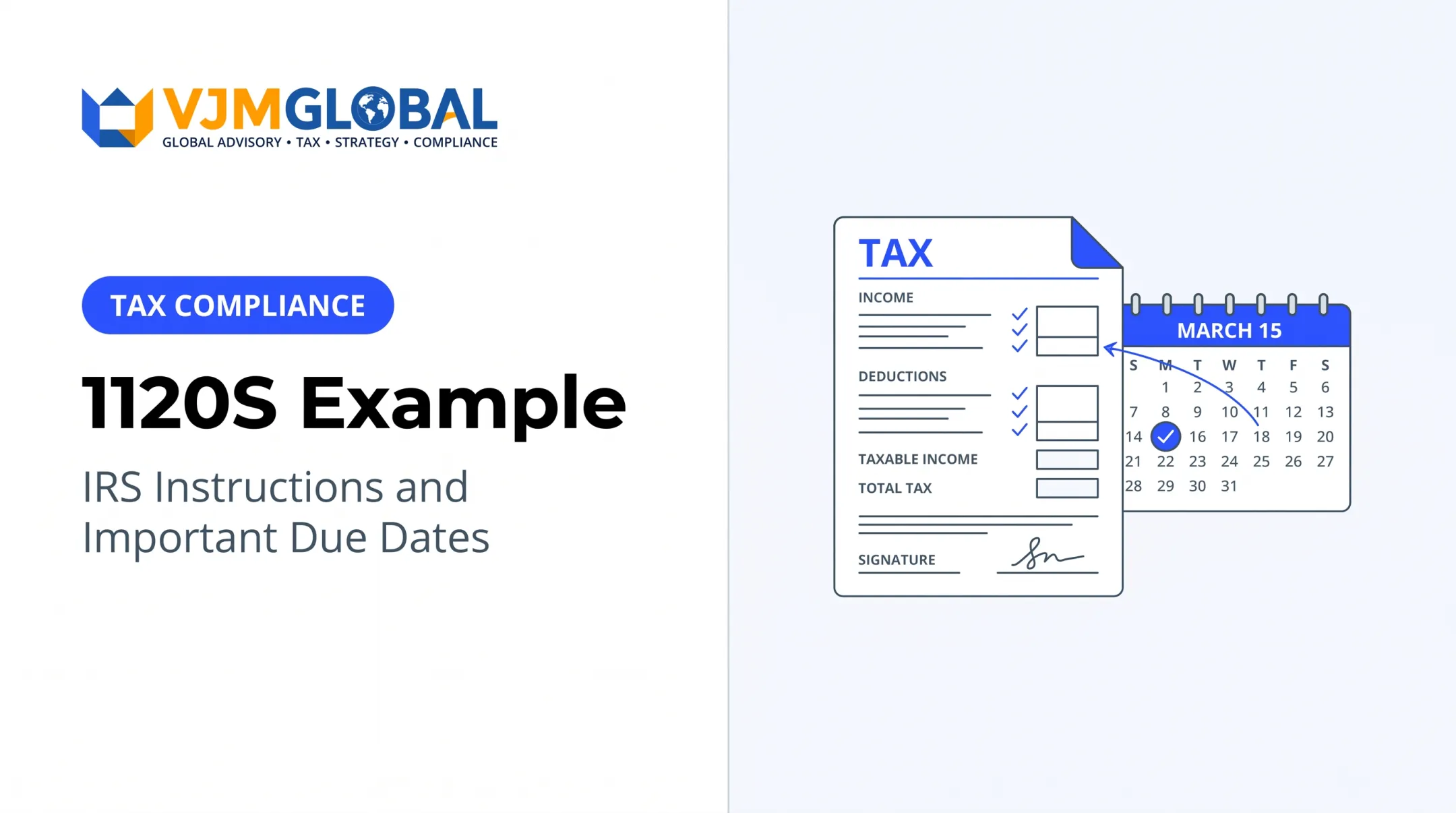
The general due date is the 15th day of the third month after year-end. If that date falls on a weekend or holiday, it moves to the next business day.
- Calendar-year 2025 return: due March 16, 2026
- Calendar-year 2026 return: due March 15, 2027, pending final instructions
Form 7004 extensions
Form 7004 generally gives an automatic six-month filing extension, per the Form 7004 instructions. It must be filed by the original due date. It doesn't extend payment, so any entity-level tax is still due on the original date. Payroll deposits, shareholder estimates and state filings run on their own schedules.
Electronic and paper filing
The 2025 instructions say e-filing is generally available through IRS-authorised Modernized e-File providers. The regulation behind the 10-return e-file rule refers to corporations filing Form 1120 and doesn't expressly name Form 1120-S. Confirm your obligation in the current instructions.
For paper filing, the address depends on state, total assets and whether Schedule M-3 is attached. A corporation in a foreign country files with IRS, P.O. Box 409101, Ogden, UT 84409 (2025 instructions). Check current instructions before mailing.
Penalties and relief
Amounts below come from the 2025 instructions for returns due in 2026:
| Failure | Penalty |
|---|---|
| Late return | $255 per shareholder per month, up to 12 months |
| Late payment | 0.5% of unpaid tax per month, capped at 25% |
| Missing or late K-1/K-3 | $340 per statement |
Interest is set quarterly. First-Time Abate generally requires a clean three-year history and must be requested. Reasonable cause is judged case by case. Penalty relief doesn't fix an inaccurate return; for that, file an amended Form 1120-S and issue corrected K-1s.

Cross-border workflow for Australian-based businesses
The U.S. return, K-1s, state filings and individual U.S. returns don't replace Australian reporting. They need to be coordinated.
Review these points:
- Foreign shareholders: a nonresident alien is ineligible as a direct S shareholder.
- ATO treatment: the ATO may tax attributed foreign income under CFC rules, and a foreign income tax offset isn't automatic for every U.S. payment.
- ECI and withholding: don't import partnership withholding rules into S-corporation reporting.
- Currency: the IRS requires U.S. dollars; the ATO requires AUD conversion under its own rules.
VJM Global's cross-border accounting and tax team can help Australian-based businesses coordinate U.S. accounting records, Form 1120-S preparation, shareholder reporting and related compliance.
Final Filing Checklist and Conclusion
Before you submit
- Confirm S election acceptance, effective date, tax year, form revision, deadline, accounting method and authorised signature.
- Reconcile income, deductions, officer pay, payroll taxes, distributions, loans and total assets to source records.
- Verify Schedule B answers, Schedule K totals, each K-1, allocations and attachments, including K-2/K-3 where applicable.
Final review and records
After you file:
- Retain e-file acceptance or mailing proof
- Send K-1s to shareholders
- Keep the return and workpapers
Publication 583 generally points to a three-year retention period, with longer periods in some cases.
Get professional review when your facts include:
- Foreign ownership or multiple shareholders
- Mid-year ownership changes or amended returns
- Former C corporation history or built-in gains
- Passive income, large distributions or major basis adjustments
Conclusion
An accurate return depends on the right tax-year instructions, reconciliation to the books, schedules chosen by your facts, and consistent K-1s. This guide is educational only. Confirm current IRS guidance, and get US and Australian professional advice where obligations overlap.
Frequently Asked Questions
Does 1120-S require a balance sheet?
Schedule L is required unless Schedule B question 11 is "yes" (receipts and assets both under $250,000 for 2025). Even then, keep balance-sheet records.
What is Form 1120-S used for in 2026?
It reports an S corporation's income, deductions, credits and shareholder allocations for the tax year being filed.
Who must file Form 1120-S?
Corporations and eligible entities with an effective S election generally file annually, including LLCs taxed as S corporations.
When is Form 1120-S due for 2026?
A 2025 calendar-year return was due March 16, 2026. A 2026 return points to March 15, 2027. Form 7004 extends filing, not payment.
What schedules are required with Form 1120-S?
Schedules B, K and K-1 are central. L, M-1 and M-2 depend on your facts, and M-3 may replace M-1 at $10 million in assets.
Can I file Form 1120-S electronically?
E-filing is generally available through approved providers. Check the current instructions to see whether it's mandatory for you.