This guide is written for Australian business owners, investors, and multinational groups connected to a U.S. S corporation or its shareholders. Australian tax residency and reporting are separate matters, and nothing here replaces advice from a registered Australian tax agent or a U.S. tax professional. We'll walk through who typically needs to pay, how the estimate is built, the 2026 federal deadlines, accepted payment channels, and the mistakes that trip up first-time shareholders.
Key Takeaways
- Ordinary S corp income passes through to shareholders, who typically owe personal estimated tax rather than the corporation
- Whether a payment is required depends on withholding, credits, prior payments, and 2026 IRS safe-harbour rules
- Salary withholding, Form 1120-S, Schedule K-1, state taxes, and shareholder payments remain separate compliance tracks
- Confirm 2026 federal and state deadlines against current IRS and state guidance before you pay
What Are S Corp Quarterly Estimated Taxes and Why Are They Used?
Quarterly estimated tax payments are advance instalments toward tax that isn't covered by withholding, most commonly, a shareholder's share of S corp income. They exist because the U.S. runs a pay-as-you-go system: tax is expected to be paid as income is earned, not bundled into one payment the following April.
One clarification matters before anything else. Nonresident aliens generally cannot be direct shareholders of a U.S. S corporation, and corporations or partnerships can't hold shares either, according to the IRS's S corporations page. If you're an Australian considering this structure, your U.S. tax-residency classification, not your nationality, determines whether the structure is even available to you.
How the pass-through mechanism works
- The corporation files Form 1120-S as an annual information return, reporting income, deductions, and credits
- Each shareholder receives a Schedule K-1 showing their allocated share
- Shareholders report that K-1 income on their personal U.S. return, taxed at individual rates
- Income is taxable to the shareholder whether or not cash is actually distributed
That last point catches people out constantly. A shareholder can owe tax on profit the corporation retained for working capital, even if they never saw a cent of it personally.
What shareholder estimated tax is not
Separate items worth distinguishing from shareholder estimated payments:
- The S corp's own Form 1120-S filing and K-1 distribution process
- Federal and state payroll-tax deposits tied to employee and owner-employee wages
- Entity-level taxes an S corp can still owe, including built-in gains tax, excess net passive income tax, or state franchise and composite taxes
An Australian shareholder also carries a parallel obligation at home: assessing Australian tax residency, foreign income reporting, controlled-entity rules, and any treaty position, ideally with a qualified Australian adviser working alongside your U.S. preparer.
How to Calculate and Pay S Corp Estimated Quarterly Taxes
Resist the temptation to just divide last year's tax bill by four. Income from an S corp rarely arrives evenly, and the calculation works better as a repeatable process than a one-off guess.
- Gather your data: current bookkeeping, projected S corp revenue and deductible expenses, your ownership percentage, prior-year returns, W-2 salary and withholding records, prior estimated payments, and any other income or credits
- Project taxable income: estimate your expected K-1 allocation alongside wages, deductions, and other income; your actual K-1 may not exist yet when an instalment is due, so treat early estimates as provisional
- Estimate the tax, then subtract what's already covered: work out expected federal tax and any additional taxes, then deduct withholding, credits, and payments already made
- Check against the safe harbour: compare your projected liability to the current IRS thresholds before assuming a payment is even required
- Allocate the remaining balance across the relevant payment periods, adjusting later instalments as profit, salary, distributions, or withholding shift
- Submit and record: pay through an approved IRS method, keep the confirmation, log it in your tax file, and check state instructions separately

Safe harbour thresholds to verify
Generally, a payment is required when expected 2026 tax after withholding is at least $1,000 and withholding falls short of the smaller of 90% of the current year's tax or 100% of the prior year's tax (110% if prior-year adjusted gross income exceeded $150,000), per 2026 Form 1040-ES. These figures are reviewed annually, so confirm them against the current form rather than this article before you file.
A simplified illustration
Say a shareholder projects $140,000 of K-1 income on top of $60,000 in W-2 wages from the same S corp, with $8,000 of federal withholding already taken from those wages. If the projected total tax comes to $35,000, the remaining $27,000 gap (after subtracting withholding and any prior estimated payments) is what gets spread across the remaining instalment periods.
That allocation is not necessarily in four equal slices, especially if income arrived unevenly through the year. This is illustrative only; your actual numbers will differ.
Accurate books make this entire exercise far less painful. VJM Global's U.S. accounting and payroll coordination work helps shareholders keep bookkeeping, W-2 records, and K-1 projections aligned so updated estimates can be prepared each quarter — though the U.S. tax position itself should always be reviewed by a qualified tax professional before you pay.
When Are S Corp Estimated Payments Due in 2026 and How Are They Paid?
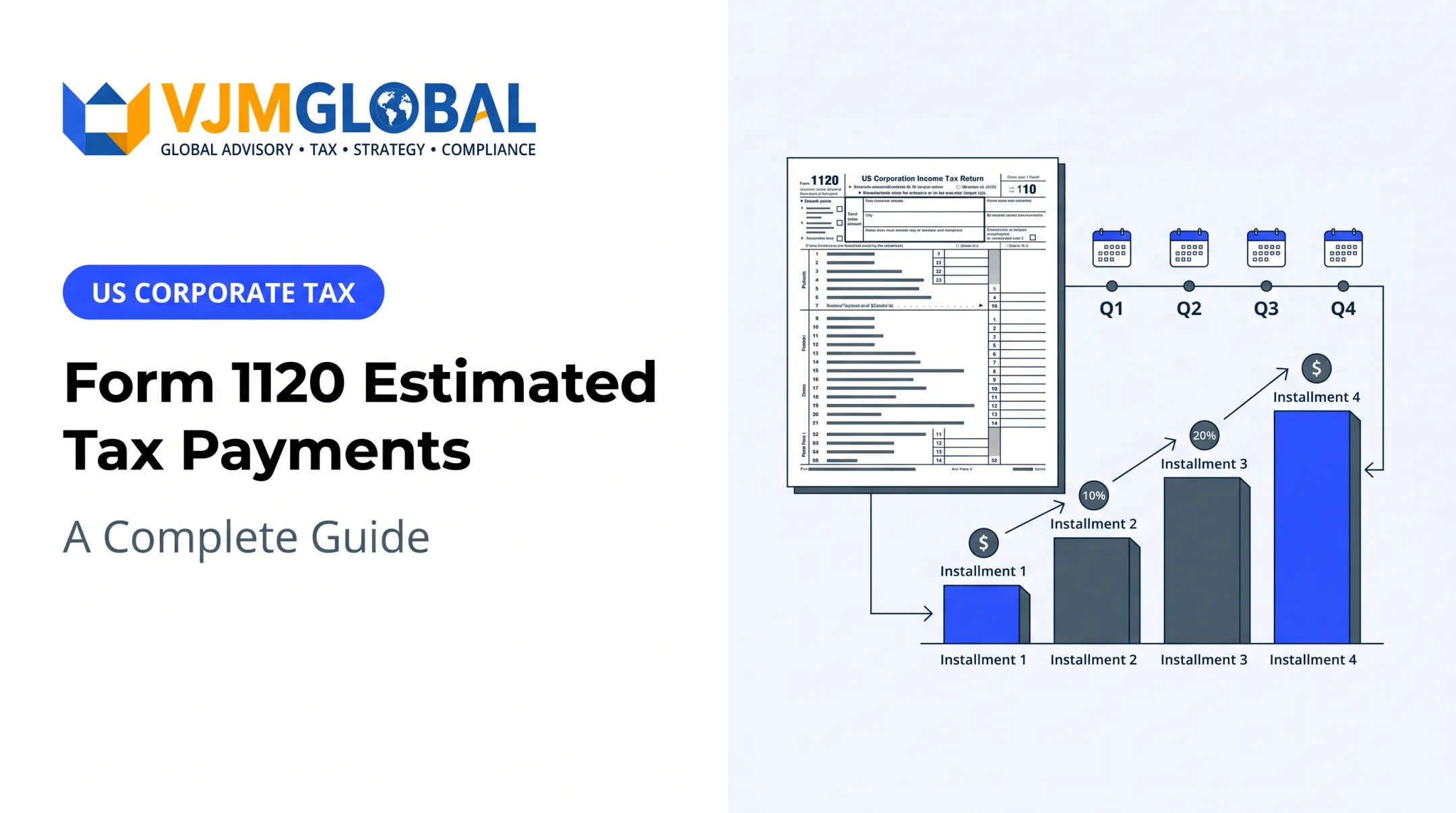
The four 2026 federal instalment periods aren't even calendar quarters, and the final one spills into the following January.
| Instalment | Income period | Due date |
|---|---|---|
| Q1 | Jan 1 – Mar 31, 2026 | April 15, 2026 |
| Q2 | Apr 1 – May 31, 2026 | June 15, 2026 |
| Q3 | Jun 1 – Aug 31, 2026 | September 15, 2026 |
| Q4 | Sep 1 – Dec 31, 2026 | January 15, 2027 |

These dates come from IRS tax calendar guidance; a weekend or federal holiday pushes any deadline to the next business day. Don't confuse the January 2027 payment date with the 2027 tax year. It still relates to 2026 income.
Don't confuse this with the corporation's own deadline
The S corp's own Form 1120-S return (for a calendar-year 2025 return) is generally due in mid-March 2026, with Schedule K-1 furnished to shareholders around the same time. That's a completely separate clock from your personal estimated-payment schedule, as are:
- Payroll-tax deposit deadlines for employee and owner wages
- State return and state estimated-payment dates, which vary by jurisdiction
- Form 7004, which can extend the corporation's filing time but has no bearing on shareholder payment timing
Accepted payment channels
- IRS Direct Pay: free, no sign-in required, draws from a U.S. bank account
- IRS Online Account: tracks estimated payments and tax history
- EFTPS: existing users can continue, though new individual enrolments are currently restricted
- Debit/credit card or digital wallet: through IRS-authorised providers, with processing fees
- Check or money order: payable to "United States Treasury," mailed with the correct Form 1040-ES voucher
- International wire: available for shareholders without a U.S. bank account, remitted in U.S. dollars through the Same-Day Taxpayer Payment Worksheet
State rules vary widely, particularly where an Australian-owned structure has employees, shareholders, or nexus across more than one state. Check each relevant state tax authority directly rather than assuming federal rules transfer across.
A filing extension on Form 1120-S does not extend a shareholder's estimated-payment deadline, and it does not stop interest or underpayment exposure from accruing.
Key Factors, Common Issues, and When Estimated Payments May Not Be Appropriate
A handful of variables can swing your estimate significantly between quarters.
What moves the number
- Seasonal or volatile revenue, one-time transactions, or a change in ownership percentage mid-year
- Reasonable compensation levels, payroll withholding, benefits, and retirement contributions
- State income tax, franchise tax, composite tax, or multi-state filing requirements
- Australian tax residency status, foreign exchange conversion, and treaty positions that interact with your U.S. filing
Misconceptions worth correcting
- "The S corp pays all the quarterly taxes": ignores the split between corporate obligations and shareholder-level income tax
- "Distributions are always tax-free": ignores basis rules and the fact that undistributed profit is often still taxable
- "Four equal payments are always right": ignores uneven income, annualised-income methods, and safe-harbour planning
- "An 1120-S extension buys more time to pay": confuses filing relief with a payment obligation that doesn't move
A separate payment may be reduced or unnecessary when:
- W-2 withholding already covers the gap
- Prior payments satisfy a safe harbour
- Projected tax sits under the relevant threshold
- Income genuinely dropped mid-year
Each of these needs a current calculation, not an assumption carried over from last year.
If you miss a payment or get the number wrong: pay as soon as practical, recalculate the remaining instalments, keep every confirmation, and get advice on penalty exposure. The IRS's penalty guidance notes the underpayment penalty is calculated separately for each required payment date. A later catch-up doesn't automatically erase an earlier shortfall.

A simple recurring routine helps:
- Reconcile books monthly
- Revisit the estimate each quarter
- Coordinate payroll data with K-1 projections
- Keep a deadline calendar with every confirmation filed away
This section is educational, not personalised advice. IRS rules, state rules, and cross-border obligations change, and your specific position should be reviewed by a qualified professional.
Conclusion
S corp quarterly tax planning is a shareholder-level estimated-payment process tied to pass-through income, withholding, payroll, and whatever state obligations apply on top. Relying on a flat percentage or four equal payments tends to break down the moment income becomes uneven.
Accurate books, current payroll records, updated K-1 projections, and verified IRS and state deadlines serve you better than a rule of thumb. If you're an Australian owner or part of a multinational group with U.S. S corp exposure, coordinate your U.S. and Australian tax advice before each instalment, not after.
Frequently Asked Questions
How do you calculate and pay estimated quarterly taxes for an S Corp?
Project the shareholder's taxable income (K-1 allocation plus wages and other income), estimate the tax, subtract withholding and prior payments, then check the result against current IRS safe-harbour rules. Pay the remaining balance through Direct Pay, EFTPS, or another approved IRS method.
Does an S Corp have to make quarterly estimated tax payments?
Usually not at the corporate level: the corporation typically doesn't pay federal income tax on ordinary pass-through income. Shareholders may need estimated payments personally, and the corporation can still face separate payroll, state, or entity-level tax obligations.
What are the rules and estimated tax payment due dates for S Corps?
Shareholder estimated-payment dates are separate from the Form 1120-S filing deadline, payroll-tax deposits, and state deadlines. Always verify current IRS dates, since weekends and holidays can shift them.
When does an S Corp or its shareholders need to start paying quarterly estimated taxes?
Generally once projected tax not covered by withholding or credits reaches the IRS threshold for the year. Pay close attention if you're a new S Corp, a new shareholder, or mid-year income changed sharply.
What are the estimated tax payment due dates in 2026 for S Corps?
For calendar-year 2026 income, shareholder instalments fall on April 15, June 15, and September 15, 2026, with the final instalment due January 15, 2027. State deadlines and the corporation's own filing date may differ from these.