Introduction
Treating estimated tax as a year-end task is expensive. A C corporation can owe an underpayment penalty even when it eventually pays every dollar of its tax bill, because the penalty is measured instalment by instalment.
The safe harbor is a U.S. federal rule. It can protect an eligible C corporation from the estimated-tax underpayment penalty, but it does not reduce the tax the corporation actually owes.
This guide is written for Australian-based founders, investors, and foreign-owned U.S. corporations. It covers eligibility, the calculation, 2026 deadlines, payment methods, and the mistakes that trigger penalties.
Key Takeaways
- Instalments are required when expected federal tax is $500 or more.
- The safe harbor is generally the lesser of 100% of current-year tax or 100% of prior-year tax.
- Corporate due dates fall in the 4th, 6th, 9th, and 12th months, not on the individual schedule.
- Large corporations, new companies, fiscal-year filers, and seasonal earners need extra analysis.
What Are C Corporation Estimated Tax Payments?
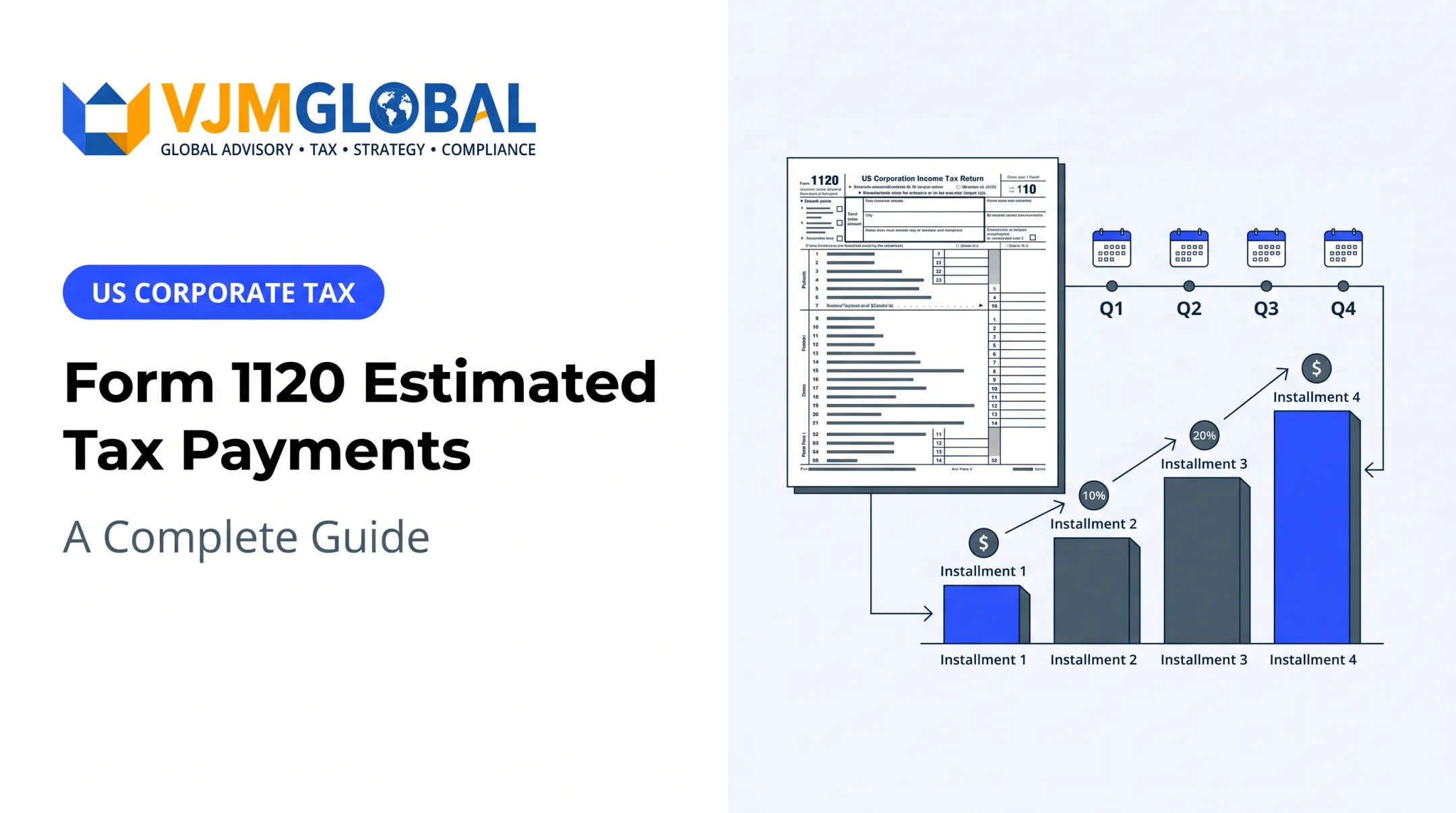
Estimated tax payments are advance payments of a corporation's expected U.S. federal income tax, made under a pay-as-you-go system. They are separate from the final Form 1120 filing and any balance due at year-end.
Who Must Pay?
A corporation generally must make instalments when its expected federal income tax liability is $500 or more. Under IRS penalty guidance, refundable credits reduce the tax shown, so run the test after credits.
The rule covers corporations formed as C corporations and LLCs that elect corporate tax treatment. An electing LLC files Form 1120, and the corporate estimated-tax rules then apply to its federal corporate tax.
Foreign ownership gives no exemption. Neither the statute nor the Form 1120 instructions provide a foreign-owner exception. An Australian-owned U.S. C corporation with taxable U.S. income follows the same rules as any other.
Australian obligations are a different matter. The ATO describes PAYG instalments as prepayments of Australian tax. They run under a separate regime and do not count toward U.S. estimated tax.
What Estimated Tax Does Not Cover
Federal corporate estimated tax covers federal income tax only. Other taxes follow their own rules and deadlines:
- State income tax and franchise tax
- Payroll tax and withholding
- Sales tax
- Australian company tax and PAYG instalments
Form 5472 is also unrelated. It is an information return for 25%-foreign-owned corporations, not an estimated-tax form, and it carries its own $25,000 non-filing penalty.
How C Corporation Estimated Tax Safe Harbor Rules Work
A safe harbor generally protects the corporation from the penalty when the required amount is paid on time, even if the final tax turns out higher than forecast.
The Basic Safe-Harbor Calculation
Under IRC 6655(d), the required annual payment is generally the lesser of:
- 100% of the current-year tax, or
- 100% of the prior-year tax shown on a return
The required amount is paid in four instalments, generally 25% each. Paying the correct total by year-end does not cure an earlier missed instalment, because the penalty is computed on each underpaid instalment for its own underpayment period. Payments are credited against instalments in chronological order.
Prior-Year Return Requirements
The prior-year option is available only if:
- The prior tax year was a full 12 months, and
- A return was filed showing a positive tax liability
A zero-tax prior return, or no prior return, does not support the prior-year option. A new corporation should not assume a zero figure creates a usable safe harbor. It must use the current-year basis instead.
Large-Corporation Restrictions
A corporation is "large" if it or a predecessor had taxable income of $1 million or more in any of the three preceding tax years. Predecessors include specified corporations in Section 381 transactions. In a controlled group, the $1 million test is shared among members, not granted to each one.

A large corporation generally cannot use prior-year tax after the first instalment. Any first-instalment reduction based on prior-year tax is recaptured in the next instalment. Current-year forecasting therefore matters far more.
Avoid the Individual 110% Rule Misconception
The 110% prior-year safe harbor belongs to individuals under IRC 6654. Section 6655 uses the 100% framework for corporations, subject to the large-corporation restriction, and does not set a separate higher percentage for 2026.
How to Calculate the Safe-Harbor Payment
Follow this workflow:
- Review the prior-year Form 1120 and confirm it qualifies.
- Estimate current-year taxable income.
- Identify deductions and credits.
- Choose the route: prior-year, current-year, or an alternative method.
- Calculate the annual required amount and divide it into instalments.
Inputs Needed
Gather these before you start:
- Prior-year return and current profit-and-loss statements
- Balance sheet and projected revenue and expenses
- Depreciation, net operating losses, and tax credits
- Foreign-related items and estimated state-tax information
Book income is not federal taxable income. Depreciation, timing differences, and non-deductible items can all move the figure, so flag book-to-tax adjustments in your projection.
Applying the Method
Compare 100% of this year's expected tax with 100% of last year's tax (if eligible), take the lower figure, and split it into four equal parts.
Hypothetical example (illustrative figures only): A corporation filed a prior-year return showing $40,000 of tax and is not a large corporation. It expects $60,000 this year. The prior-year route gives $40,000, so each instalment is $10,000. If it has paid $10,000 by the first deadline, it owes the next $10,000 by the second.

Payments already made reduce the remaining obligation, but they are credited chronologically against the earliest unpaid instalment.
Alternatives for Uneven or Seasonal Income
Two alternatives exist for uneven income:
- Annualized income method: instalments track income actually earned to date.
- Adjusted seasonal method: available only if the base-period percentage for any six consecutive months is at least 70%, using the three preceding tax years.
Both can ease cash flow, but they demand more recordkeeping than the regular method. Schedule A of Form 2220 handles the calculations.
Forms and Supporting Records
Form 1120-W and its instructions are now historical. The 2022 revision was the last, so don't treat it as a current form. Use Publication 542 alongside the 2025 Form 1120 instructions.
Generally, you need not attach Form 2220, because the IRS calculates and bills the penalty. Attach it when the tax is $500 or more and you use one of these approaches:
- Annualized income method
- Adjusted seasonal method
- Large-corporation first-instalment prior-year calculation
Keep payment confirmations, working papers, forecasts, and credit support.
When Payments Are Due and How to Pay
For a calendar-year C corporation, the 2026 dates are:
| Instalment | Due date |
|---|---|
| 1 | April 15, 2026 |
| 2 | June 15, 2026 |
| 3 | September 15, 2026 |
| 4 | December 15, 2026 |
The general rule is the 15th day of the 4th, 6th, 9th, and 12th months of the tax year, per Publication 509.
Fiscal-Year Corporations
Count from the start of your own tax year, not calendar quarters. For example, a year beginning July 1 has instalments due on October 15, December 15, March 15, and June 15. A partial month counts as a month. A June 30 year-end has a special September 15 return deadline, but the instalment pattern stays the same.
Weekend and Holiday Adjustments
Under IRC 7503, a due date falling on a weekend or legal holiday moves to the next business day. Confirm each date against the current IRS tax calendar.
Payment Method and Proof
Corporations must pay electronically. Options include:
- EFTPS (new enrolments can take up to five business days)
- IRS Business Tax Account, for eligible Form 1120 filers
- Authorised financial institutions or other third parties
Before submitting, confirm the tax period, payment type, amount, and date. Keep the confirmation.
How to Avoid Underpayment Penalties
The penalty is assessed by instalment period. A corporation can be charged for an early shortfall even if it catches up later or receives a refund on its annual return. The rate is the federal short-term rate plus 3 points, which is 7%, 6%, 7%, and 7% across the four quarters of 2026.

How Form 2220 Fits In
Form 2220 is the corporate underpayment calculation form. The annualized, seasonal, large-corporation, and prior-year methods all affect it. Attach it in the cases listed above. Otherwise, the IRS may calculate the penalty and send a notice.
When Estimates Should Be Updated
Review forecasts after each quarter or major change, including:
- Revenue, margins, and deductions
- Credits, distributions, and acquisitions
- Losses and one-time transactions
Current books and rolling forecasts prevent both penalties and needless overpayment that strains cash.
Overpayments and Potential Refunds
Form 4466 requests a quick refund of an overpayment. The overpayment must be at least 10% of expected tax and at least $500. File after year-end and before filing the return.
IRS instructions say no later than the return's original due date, and the IRS acts within 45 days. Note that one regulation still cites a 3rd-month deadline, so file early.
Practical Compliance Checklist
- Confirm the prior-year return qualifies for the prior-year route
- Confirm the tax-year classification
- Test large-corporation status
- Calendar each instalment date
- Save payment confirmations
- Update forecasts quarterly
- Keep federal and state obligations separate
Professional Support for Foreign-Owned U.S. Corporations
VJM Global provides tax, accounting, and compliance services within the United States, including a New York branch office, and works with clients of any nationality. For Australian and other international businesses, that can mean current books, estimated-tax forecasting, and coordinated corporate filings.
This article is general information, not tax advice. Confirm your facts with a qualified tax professional, especially if the corporation is foreign-owned, part of a controlled group, newly formed, seasonal, or subject to multiple jurisdictions.
Frequently Asked Questions
Do estimated tax payments count toward safe harbor?
Yes. Timely, correctly designated payments count toward the required annual amount. Timing and instalment allocation still affect the penalty calculation.
What are the IRS safe harbor rules for 2026?
Pay the lesser of 100% of current-year tax or 100% of qualifying prior-year tax. Large corporations face prior-year limits after the first instalment. Verify the latest IRS guidance for your tax year.
How do I calculate a safe harbor payment?
Gather your prior-year return and current forecasts, apply the 100% formula, and split the result into four instalments. Adjust for credits, large-corporation status, and seasonal methods.
Who must make estimated tax payments as a C corporation?
C corporations and LLCs taxed as C corporations expecting federal tax of $500 or more. State and Australian obligations are separate.
When are C corporation estimated tax payments due?
On the 15th day of the 4th, 6th, 9th, and 12th months of the tax year. For calendar-year corporations in 2026: April 15, June 15, September 15, and December 15.
Can a C corporation use the prior-year safe harbor if it had no tax liability?
No. A zero-tax prior return, or no prior return, does not support the prior-year option. The corporation must use the current-year basis.