Missing that date doesn't just create a paperwork headache. It delays the Schedule K-1 forms shareholders need for their own returns, and it can trigger penalties even when the S corp owes zero federal income tax. That's the part that surprises people most: a $0 tax bill doesn't mean a $0 filing obligation.
This guide walks through calendar-year and fiscal-year deadlines, Form 1120-S, extensions via Form 7004, payroll obligations, and what to do if you're already behind. Let's start with what actually matters first.
Key Takeaways
- The federal Form 1120-S deadline is generally the 15th day of the third month after the tax year closes
- Every S corp must file Form 1120-S and issue a Schedule K-1 to each shareholder, regardless of income level
- Form 7004 buys more time to file, not more time to pay any tax owed
- Fiscal-year entities, employers, and multi-state businesses often face additional, separate deadlines
- Check current IRS guidance each year, since weekends and holidays shift exact dates
Why S Corp Tax Timing Matters
An S corporation's federal return isn't like a typical business tax filing. Form 1120-S is primarily informational — it reports the company's income, deductions, and credits, then passes those items through to shareholders via Schedule K-1. The corporation itself usually doesn't write a check to the IRS for income tax. Shareholders do, on their personal returns.
That pass-through structure is exactly why timing matters so much. Shareholders can't finish their individual tax returns until they have an accurate K-1 in hand. If the entity return is late, the K-1s are late too, and that sets off a chain reaction:
- Shareholders can't finalise their personal returns on schedule
- Estimated tax payments get calculated on guesswork instead of real numbers
- Amended returns become necessary once correct figures arrive
- Shareholders end up filing their own extensions just to wait on the business
Filing Obligations Aren't the Same as Payment Obligations
Pass-through treatment covers income tax, but it doesn't erase every possible entity-level liability. Some S corps still owe built-in gains tax, excess net passive income tax, or state-level franchise taxes regardless of how income flows to owners. Shareholders also need to plan ahead for tax owed on allocated income, even if the corporation never issues a distribution to cover it.
State deadlines rarely mirror the federal calendar. Income tax, franchise tax, employment tax, and annual report deadlines vary by state, and a business registered in multiple states needs to track each one separately. We'll cover the federal late-filing and late-payment consequences in detail further down, directly from current IRS guidance rather than estimated figures.
Best Time to File or Pay Based on Different Scenarios
There's no single S corp deadline that applies to every business. The right date depends on the entity's tax year, whether it runs payroll, whether it needs an extension, and which states it operates in. Here's how that breaks down by scenario.
Calendar-Year S Corporations
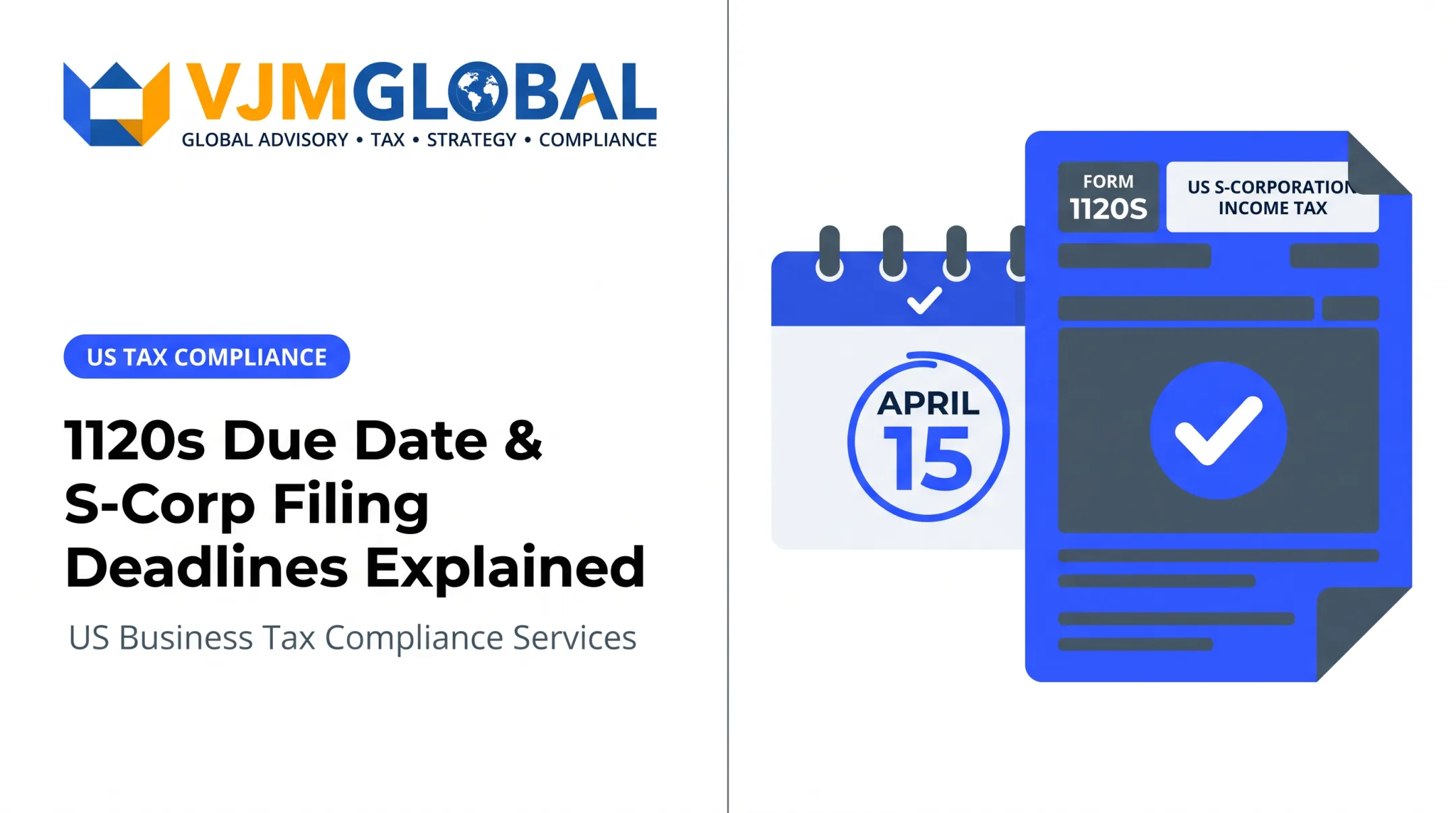
Most S corps use a calendar tax year, running January 1 through December 31. For these businesses, the standard rule is the 15th day of the third month after year-end, typically March 15.
For the 2025 tax year, that date shifts. Since March 15, 2026 falls on a Sunday, the deadline moves to March 16, 2026, according to the 2025 Form 1120-S instructions. The IRS applies this next-business-day rule whenever a due date lands on a weekend or federal holiday.
The filing package for calendar-year S corps typically includes:
- Form 1120-S, the entity's main tax return
- A Schedule K-1 for every shareholder who held stock during the year
- Any supporting schedules tied to credits, foreign activity, or built-in gains
Fiscal-Year S Corporations
Not every S corp runs on a calendar year, though fewer do, and for good reason: adopting a fiscal year usually requires IRS approval or a qualifying business purpose. The underlying rule stays the same regardless of which year-end applies: returns are due the 15th day of the third month after the fiscal year closes.
Say an S corp runs its fiscal year from July 1 to June 30. Its Form 1120-S would ordinarily be due September 15, following that same third-month calculation. Before assuming your business can simply pick a convenient year-end, confirm it was properly established. Not every S corp qualifies to use a fiscal year without specific IRS authorisation.
S Corporations Requesting an Extension
Need more time? Form 7004 provides an automatic six-month extension, and it's generally due by the original return deadline. For a calendar-year S corp, that means filing Form 7004 by March 16, 2026, which pushes the new filing deadline to September 15, 2026, per the Form 7004 instructions.

Here's the part owners frequently misunderstand:
Form 7004 extends the time to file. It does not extend the time to pay any tax that's owed.
If your S corp has an entity-level tax liability (built-in gains tax, for example) that payment is still due by the original deadline. Interest accrues on unpaid amounts even with an approved extension in place.
S Corporations With Employees
Running payroll adds an entirely separate set of deadlines that don't move just because your income tax return is extended. According to IRS Publication 509, employers need to track:
| Form | Frequency | Typical Due Date |
|---|---|---|
| Form 941 (quarterly federal tax return) | Quarterly | Last day of the month after each quarter closes |
| Form 940 (FUTA) | Annual | January 31 (or February 10 if deposits were made on time) |
| Form W-2 / W-3 | Annual | Late January or early February, filed with the SSA |
Payroll tax deposit schedules depend on your assigned deposit frequency, either monthly or semi-weekly, based on prior lookback period liability. Mixing up the income tax calendar with the payroll calendar is one of the most common timing mistakes S corp owners make.
Signs It's the Right Time to Act
A few practical readiness signals tell you the entity return is on track:
- Books are reconciled through year-end, with no outstanding bank or credit card discrepancies
- Payroll records have been reviewed against W-2 totals
- Shareholder ownership percentages and stock basis are current
- All 1099s, bank statements, and prior-year returns are gathered
If your business operates in multiple states or has a complex ownership structure, set your internal review date several weeks before the IRS deadline rather than right up against it. Receiving complete K-1 draft information from your preparer is usually the clearest sign the process is moving correctly.
When to Avoid Delaying S Corp Tax Work
Waiting until the deadline is risky under several common circumstances:
- Bookkeeping isn't fully reconciled
- Shareholder ownership or basis information has changed mid-year
- The business operates across multiple states
- The return requires specialized schedules, such as foreign activity or built-in gains calculations
Having little or no income doesn't remove the filing requirement. Every S corp must file Form 1120-S annually under section 6037, according to Internal Revenue Bulletin 2025-38, regardless of profitability.
What Late Filing Actually Costs
The IRS applies a per-shareholder penalty structure, not a flat fee. For returns with no tax due, the 2025 Form 1120-S instructions specify a penalty of $255 per shareholder, per month or partial month the return is late, capped at 12 months.
A corporation with five shareholders that files three months late could face a penalty well into the thousands, before any tax owed even enters the calculation.
Separate from that, failing to furnish a correct, timely Schedule K-1 can trigger an additional $340 penalty per affected K-1. Intentional disregard of correct reporting doubles that figure or applies 10% of the relevant items, whichever is greater.

Beyond the dollar amounts, missed deadlines create downstream problems:
- Delayed K-1s leave shareholders unable to finish personal returns
- Shareholders may need to file their own extensions
- Estimated tax payments get calculated on incomplete information
- Additional professional fees accumulate from rushed, corrective work
If You've Already Missed a Deadline
- File the return or extension immediately — don't wait for a notice to arrive first
- Pay a reasonable estimate of any tax owed to limit interest accrual
- Keep proof of filing and payment dates and confirmation numbers
- Explore penalty relief where circumstances support it
The IRS does offer reasonable-cause relief, and businesses with a first-time compliance slip sometimes qualify for First-Time Penalty Abatement. That relief depends on demonstrating ordinary care despite an inability to comply, not simply forgetting or relying on a preparer.
Discuss options with a tax professional rather than assuming automatic approval or automatic denial.
Best Practices for Managing S Corp Tax Deadlines
A reliable compliance calendar beats scrambling every March. Build one that separates:
- The entity return deadline (and extended deadline, if applicable)
- Schedule K-1 delivery to shareholders
- Shareholder estimated tax payment dates
- Payroll deposits and quarterly/annual forms
- State income, franchise, and annual report deadlines
A Practical Preparation Workflow
- Reconcile accounting records through year-end
- Review shareholder and officer details for accuracy
- Confirm payroll and 1099 contractor reporting is complete
- Gather prior-year returns and any outstanding IRS notices
- Estimate tax exposure before the deadline approaches
- Conduct a final review before submission
Set internal deadlines two to three weeks ahead of the IRS date. That buffer gives you room to fix missing documents or a rejected e-file without tipping into late-filing territory.
Monitor ownership changes, distributions, shareholder basis, and officer compensation throughout the year rather than reconstructing them all in March.

VJM Global's tax compliance and accounting support fits this workflow. Our team helps businesses organise records, coordinate Form 1120-S and K-1 preparation, track extension filings, and keep payroll and state obligations on schedule.
We don't guarantee specific tax outcomes, but we do help remove the guesswork from the timeline itself. Businesses with multiple shareholders, international owners, fiscal years, or multi-state activity tend to benefit most from getting advice early, rather than treating an extension as a planning substitute.
Conclusion
There's no universal S corp deadline that fits every business. Your filing date depends on:
- Tax year (calendar versus fiscal-year status)
- Whether an extension was filed
- Payroll obligations
- States where the company operates
Form 7004 generally buys more time to file, not more time to pay. If your S corp owes entity-level tax, that payment is still due on the original date regardless of any extension.
Confirm your specific deadline and start gathering records and K-1 information early. Bring in a qualified tax professional once your situation involves multiple states, international ownership, or payroll complexity.
Frequently Asked Questions
What is the filing due date for an S corporation?
Generally, the 15th day of the third month after the tax year ends — March 15 for calendar-year filers. Always verify the exact current-year date, since weekends and holidays can shift it forward.
What is the due date for corporate tax payment?
Any entity-level tax an S corp owes is typically due by the original filing deadline, even if an extension is filed. Shareholders separately owe tax on their allocated pass-through income through their own returns.
What is the deadline to file an extension for an S corporation?
Form 7004 is generally due by the original return deadline, providing an automatic six-month extension. Confirm the current extension period directly with IRS instructions each year.
How long do you have to submit a corporation tax return?
Calendar-year S corps generally have until March 15, or the next business day if that date falls on a weekend. An approved extension moves the filing deadline to September 15, without changing when any tax payment is due.
What happens if you miss the S Corp tax deadline?
You may face per-shareholder, per-month penalties, interest on unpaid tax, and delayed Schedule K-1s that complicate shareholders' personal filings. File as soon as possible and consult a tax professional about reasonable-cause relief.
What is the due date for corporate tax filing?
The exact date depends on entity type and tax year-end. For S corps, it's the 15th day of the third month after year close; always confirm both federal and state deadlines separately, since they rarely align.