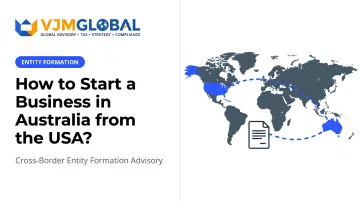
The interest isn't coming from one type of founder. US startups want an APAC foothold. E-commerce and SME sellers see a market of engaged, high-spending consumers. Consultants and service firms want the credibility that comes with a local entity rather than invoicing from abroad.
Here's the misconception that trips up almost everyone: you do not need to relocate or hold Australian residency to own a business there. This guide walks through the structures, requirements, costs, and registration steps US-based founders actually need.
TL;DR
- US citizens and companies can own an Australian business without citizenship or residency (local roles still apply)
- Choose a Pty Ltd subsidiary or a branch office—liability and tax outcomes differ
- Core steps: Director ID, ASIC registration, ABN/GST, and a compliant registered office
- A visa is required only if you live and work in Australia, not merely to own the business
- Ongoing tax and ASIC compliance matter as much as the initial setup
Can a US Business Start Operations in Australia?
Yes. A US business can start operations in Australia by registering a compliant local presence—typically a Pty Ltd subsidiary or a branch—so it can legally trade and invoice under Australian law.
This is about legal and tax presence, not personal relocation. Ownership and day-to-day management can stay firmly based in the US while the entity operates in Australia.
The Three Main Structures
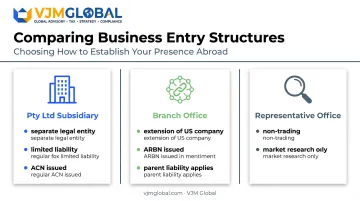
- Pty Ltd subsidiary — a separate legal entity with limited liability, registered with ASIC and issued an Australian Company Number (ACN)
- Branch office — an extension of your existing US company, registered as a foreign company and assigned an Australian Registered Body Number (ARBN)
- Representative office — a non-trading presence for market research only; any actual trading needs a Pty Ltd or ARBN registration
Can a US Citizen Start a Business in Australia?
Yes. Citizenship or permanent residency is not required to own an Australian company. You must still fill mandatory local roles—a resident director for a Pty Ltd, or a local agent for a branch—or ASIC will reject the application.
Why Expand Your Business to Australia From the USA
Expansion makes sense when a few conditions line up: an established trade relationship, compatible legal systems, and real demand for US products or services across the region.
Australia checks those boxes. Its economy runs on roughly US$1.76 trillion in GDP, placing it among the world's 15 largest sovereign economies, with a population just over 27 million and GDP per capita near US$64,600. That's a wealthy, concentrated consumer base, not a market you have to fight for scraps in.
The Australia-United States Free Trade Agreement has been in force since January 2005, reducing friction for American companies moving goods, services, and capital into the country. That's two decades of legal groundwork already laid.
Other practical advantages include:
- Ranked 19th globally in the IMD World Talent Ranking 2025, with Appeal at 13th for attracting skilled workers
- Pty Ltd registration online through ASIC's Business Registration Service, with no long queue between you and an ACN
- Local incorporation that opens banking relationships, builds client trust, and qualifies you for government tenders
Selling remotely from a US entity rarely unlocks those same doors.
Key Decisions & Requirements Before You Start
Most US founders don't struggle with paperwork. They struggle with the local-appointment and compliance obligations that come before the paperwork.
Subsidiary vs. Branch
This decision shapes everything downstream:
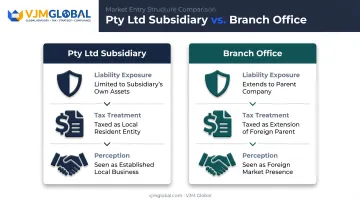
- Liability exposure - a Pty Ltd is a separate legal entity, ring-fencing risk; a branch carries the parent company's liability
- Tax treatment - each structure handles loss offsetting and dividend withholding differently
- Perception - Australian banks and clients generally view a Pty Ltd as more established than a branch
Mandatory Local Appointments
Every Pty Ltd needs at least one Australia-resident director. Every branch needs a local agent authorized to accept legal service on the company's behalf. There's no way around this, and it's the single most common reason applications stall.
VJM Global's Australia market team arranges this appointment as part of entity formation support, removing a major bottleneck for US founders working remotely.
FIRB Screening
Most standard company setups fall well below the Foreign Investment Review Board's thresholds. For 2025, private US investors face a general screening threshold of A$1.464 billion, dropping to A$339 million for sensitive sectors like transport, telecommunications, media, and defense-related activities. Unless you're moving serious capital into a sensitive industry, FIRB approval likely won't apply to you.
Visa vs. Ownership
No visa is required to register or own an Australian business remotely. A visa only comes into play if you personally intend to live and work inside Australia.
First-Year Costs
Government fees are fixed and modest:
- ASIC company registration: A$636
- Optional name reservation: A$65
Private service costs for resident director appointment, registered office, and compliance support vary by provider and scope. A tailored quote is more useful than any generic estimate.
How to Start a Business in Australia From the USA – Step by Step
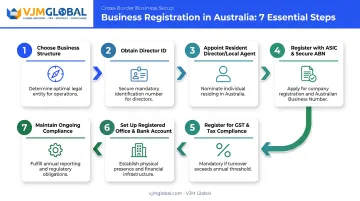
The process runs through seven steps covering structure choice, mandatory local appointments, formal registration, and post-registration compliance. Skipping the local agent or resident director appointment before lodging is the single most common cause of rejected applications.
Step 1 – Choose Your Business Structure and Entry Model
Decide between a Pty Ltd subsidiary, branch office, or representative office based on your liability appetite, tax strategy, and long-term commitment to the Australian market.
Common miss: defaulting to whichever structure "sounds simpler" instead of getting professional advice on the tax and liability trade-offs first.
Step 2 – Obtain a Director Identification Number
Any US-based individual acting as a director must get a Director ID through the Australian Business Registry Services before registration can be lodged. Overseas applicants without Australian identity documents typically file a paper application, submitting either one primary and one secondary ID document, or two primary documents.
This can take up to 56 business days for foreign-based applicants, so start it early. It's the step most likely to derail your timeline if left until the last minute.
Step 3 – Appoint a Resident Director or Local Agent
This mandatory local appointment must be finalized before lodging paperwork with ASIC, not after. A firm like VJM Global, with an established Australia market team, can help arrange this appointment as part of a broader entity formation package built for US clients.
Step 4 – Register With ASIC and Secure Your ABN
Lodge the correct ASIC form: a Pty Ltd registration produces an ACN, while a foreign company registration (Form 402, plus certified incorporation documents and local-agent appointment) produces an ARBN. Both carry a government fee of A$636.
| Registration | Fee | Result |
|---|---|---|
| Pty Ltd | A$636 | ACN issued |
| Foreign branch | A$636 | ARBN issued |
| ABN | No fee | Issued after ACN (often within 20 business days) |
Once you have your ACN, apply for an Australian Business Number for invoicing and tax purposes.
Step 5 – Register for GST and Set Up Tax Compliance
GST registration becomes mandatory once annual turnover hits A$75,000 or more, and you have 21 days to register once you cross that line. Alongside GST, plan for these tax items:
- Tax File Number for the company
- PAYG withholding if you hire staff
- Superannuation contributions for employees
Common miss: assuming GST registration is optional below the threshold. Voluntary registration below A$75,000 can still unlock input tax credits, meaning you claw back GST paid on business expenses.
Step 6 – Set Up a Registered Office and Business Bank Account
Every Pty Ltd needs a physical street address in Australia. PO boxes don't qualify, and ASIC sends official notices there. Branches face a similar requirement, with the added expectation of a representative present during standard business hours.
Opening a bank account remotely is where most US founders hit friction. Major Australian banks generally expect the applicant to be an Australian resident and tax resident, which is a problem if you still live in the US. Professional providers can help arrange banking introductions and a compliant registered office address.
Step 7 – Maintain Ongoing Compliance and Scale
Registration is the beginning, not the finish line. Ongoing obligations include:
- ASIC annual review fee - A$342 for an ordinary proprietary company
- Tax return lodgements - annual company income tax filings
- BAS filings - quarterly for most businesses, monthly above A$20 million in turnover, annual only for voluntary GST registrants under A$75,000
VJM Global's cross-border accounting, tax, and compliance services, built on experience serving 250+ Australian businesses, give US companies a single provider to lean on across both setup and the compliance work that follows.
Conclusion
Starting a business in Australia from the USA is entirely achievable without packing a single bag, provided the right structure and local appointments are locked in from day one. Speed matters less than clarity here. A rushed registration with the wrong structure or a missing local appointment costs more time to fix than it would have taken to plan properly upfront.
Long-term success comes down to treating Australian compliance as an ongoing function, not a box you check once. A cross-border partner like VJM Global can handle entity setup, local appointments, and ongoing Australian tax and compliance so the workload stays manageable instead of turning into a backlog.
Frequently Asked Questions
Can a US citizen start a business in Australia?
Yes, with no citizenship or residency requirement. You will need to appoint a local resident director (for a Pty Ltd) or a local agent (for a branch), depending on the structure you choose.
Is A$20,000 enough to move to Australia?
That figure usually covers personal relocation and living costs, not business registration. Keep those budgets separate and check current cost-of-living guidance on top of your setup costs.
What is the 200-day rule in Australia?
There's no official "200-day rule" for business owners. This is likely confused with the ATO's 183-day tax residency test, which determines individual tax residency based on physical presence in Australia during an income year.
Do I need to visit Australia in person to register my company?
No. Most of the registration process can be completed remotely, as long as a resident director (Pty Ltd) or local agent (branch) is already appointed before you lodge.
How long does it take to register a business in Australia from the USA?
ASIC doesn't publish a standard turnaround for either structure, but the Director ID step for overseas applicants can take up to 56 business days, so that's usually your longest lead time. Plan around that, not the registration form itself.
Do I need an Australian bank account to run my business from the US?
Generally yes—for day-to-day transactions and GST. Major banks often require Australian residency for online account opening, so many US founders use a local partner or specialist to open the account remotely.